

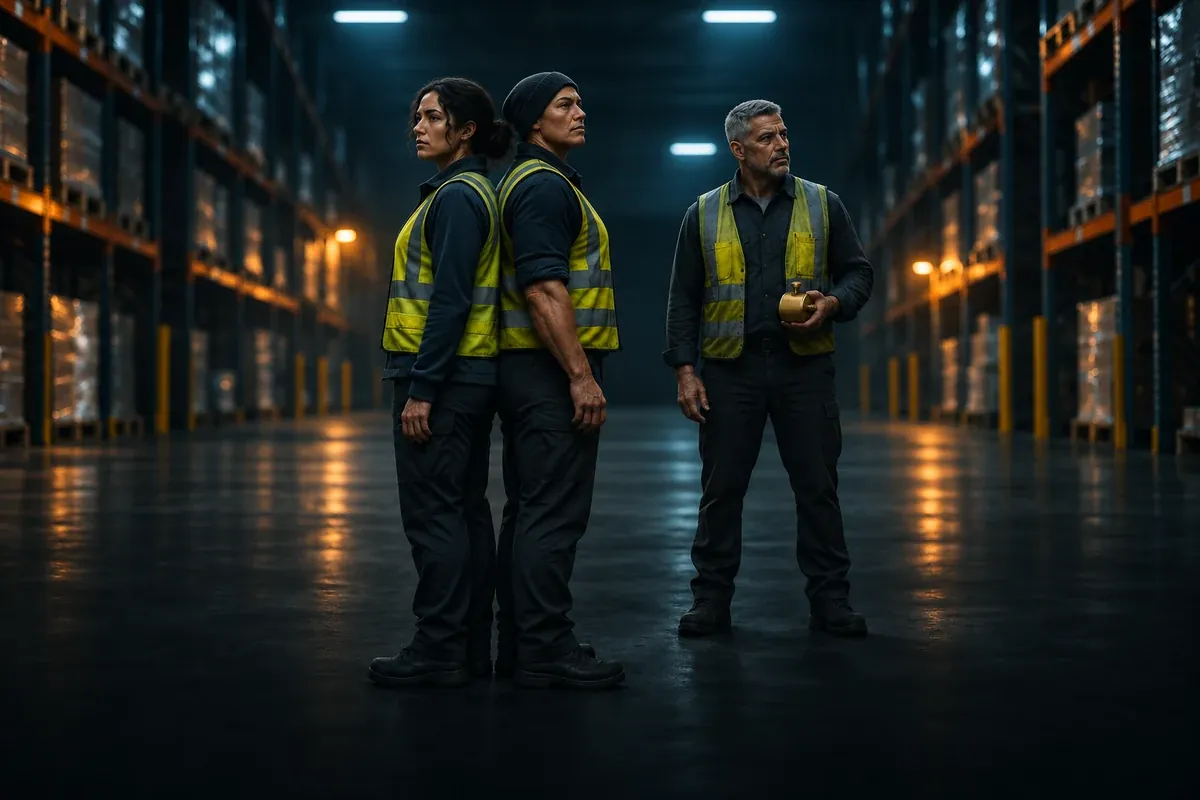
June slept until two in the afternoon and woke with the lullaby still in the room.
She lay on the mattress and made herself do what she always did with unacceptable data: she built a table. Column one, what she had observed. A voice, female, humming, overhead, in a part of a warehouse where the architecture had stopped making sense. Column two, explanations. Exhaustion. Suggestion — Rook had primed her all night with rules about ceilings, and a primed brain is a haunted house that builds itself. Coincidence — lullabies are a small genre; thousands of women hummed that same tune to thousands of kids.
Column three she left unlabeled, because the label would have been and yet, and spreadsheets didn’t have a column for the way her whole body had known the voice before her mind was allowed a vote.
She got up. She ate rice and an egg. She did the thing she did every few weeks, which she had never once described out loud to anyone, because said out loud it sounded like a symptom.
Her phone had one saved voicemail. DAMI, it said. 0:47. Two years old, received four days before the accident, preserved through two phone upgrades with the cold care of an archivist. June pressed play, and held the phone to her ear, and listened to her sister take a breath and say, “Junebug, hey, it’s me—“
She pressed stop at 0:03. Same as always. Her thumb did it without being asked, the way a hand jerks off a stove.
The rest of the message could be anything. As long as she never heard it, it was still incoming. That was the deal June had made with no one, and she kept it the way you keep a rule you don’t examine.
She spent the hour before the bus doing diligence instead, because diligence was a room she could breathe in. QuickNest’s corporate site listed its fulfillment network with the pride of a company that had gone public on logistics: FC-1 through FC-8, Reno to Albuquerque, each with a photo, a square footage, a sustainability brag. There was no FC-9. Not a missing page — a missing number. The sequence just skipped, 8 to 10, FC-10 in Boise, like a hotel with no thirteenth floor.
Her offer letter said QN Fulfillment Services LLC — Est. 1962. QuickNest, the parent, had been founded in 2006. She searched the LLC in the state business registry and found it, active, in good standing, incorporated 1962 — which meant the subsidiary was forty-four years older than the company that owned it. Corporate structures did strange things, she knew that from the county job. Usually, though, the shell was younger than the animal.
She wrote it all in the notebook she’d carried since the county fired her — the habit of a junior auditor who had learned that the numbers nobody wants checked are the only numbers worth checking — and caught the 8:40 bus wearing both her sweaters, because FC-9 had been cold in a way that lived in the joints.
Petra was waiting at the badge-in line with two coffees from the machine, one of which she put in June’s hand like it was a tool issue.
“Rule of the deep shift,” Petra said. “Nobody badges in on an empty stomach or a dry mouth. Not official. Mine.”
“Thanks.” June badged. The reader blinked green. OKAFOR, J. — CLOCKED IN 21:58. First procedure survived; her badge had not already been clocked in; she hated that she’d checked.
“You did good last night,” Petra said as they walked the long cold hallway to the floor. “Clean drop, Rook says. First-nighters usually cry or quit. One guy tried to take a selfie in the gap. Rook had him boxing returns in Cage R by midnight and out the door by two.”
“What happens if you look up?”
“Don’t know. Nobody who looks up has ever described it to me.” Petra said it light, and then, less light: “That’s not a joke, by the way. It’s not that they’re dead or anything dramatic. They just won’t describe it. My old buddy Marchetti looked up, year and a half ago. Finished his shift fine. Came in the next night, worked fine. But he’d stopped talking about anything overhead. Weather. Planes. His daughter’s bunk bed. Anything that was up. His sentences would just... route around it, like a road closure. He transferred to days in the spring. Days!” She said it the way a sailor says dry land. “Forty-one an hour down to nineteen, to stand in the sun.”
The floor at night had a sound June hadn’t noticed during the panic of orientation: under the scanner beeps and the conveyor hum there was a low, patient white noise, like a seashell the size of a building. You stopped hearing it after an hour. You felt it instead.
They worked. Zone C, smalls — phone chargers, insoles, a hundred units of a kitchen gadget that existed to do one thing to an avocado. Petra talked, June picked, and the talking turned out to be load-bearing.
“Procedure six,” Petra said, apropos of a vending machine anecdote. “You read it and thought, cute, right? Exact change, never out of order, if it’s out of order you’re not in Break Room 2.” She scanned a tote. “There was a guy, before my time — swing shift back when nights had a swing shift — who went for his lemon chews at like four a.m. and the machine had an OUT OF ORDER sign. Handwritten. And instead of walking out, he thought, huh, weird, and he put his money in anyway.”
“And?”
“And his quarters never hit the bin. No sound. Like posting coins into a lake. And the room, he said, was two degrees off. The tables were where tables would be, the fridge hummed like a fridge, but the hum had no motor under it, you know? A hum doing an impression of a fridge.” Petra shrugged. “He backed out the door he came in, and he was in the hallway outside Break Room 1, which is on the other side of the floor.
“Nobody ever found a Break Room 2 with a sign in it. So now it’s procedure six, and now we check the machine works before we need it to, and we keep exact change in our vests. Here.” She dug in a pocket and gave June a plastic sandwich bag with six quarters and a yellow candy. “Starter kit.”
It should have been funny. It was funny, and June laughed, and the laugh didn’t cover the thought underneath: every item on that laminate is a story like this one. Thirteen procedures. Thirteen incidents, minimum, serious enough to legislate. Somebody wrote each of those lines after the fact.
An auditor’s thought followed it, unbidden, in her own professional voice: so where are the incident reports filed?
Around midnight they rotated through Break Room 1, and June got her first four a.m. coffee preview: half the crew drifting in and out, nodding to each other by name. She counted — she couldn’t help it — eleven faces, and matched them to the voices she’d been hearing across the aisles. A man named Okonkwo who sang two bars of something every time he sealed a carton.
A pair of sisters, the Reyes twins, who worked zone F bulk like a single organism with four arms. An older woman everyone called Professor, who did crosswords in the eleven-minute window in ink. They welcomed June with the particular warmth of people who are genuinely glad you exist and are also checking you against a list. Everyone here counts everyone, she wrote in the notebook later. Not suspicion. Housekeeping.
At 1:55 a.m., June broke her first rule.
It wasn’t dramatic. That was the thing about her flaw; it never felt like a flaw from the inside, it felt like rigor. Petra closed out a batch — fourteen totes, her count — and June, waiting on the system, eyes idle, counted the stack. Just visually. Just because counting was what her eyes did with stacks.
Thirteen.
She counted again, finger-pointing this time, tote by tote, the way procedure two specifically, explicitly told her not to do, because your buddy’s count is your count. Thirteen. The manifest said fourteen. The scanner said fourteen, batch complete, all items reconciled. The stack said thirteen, and June Okafor had been fired from a county job for refusing to let a reconciled number alone, and some wiring in her was never going to unlearn that, not for any laminate.
“Petra. There’s thirteen totes.”
Petra turned around slow. Not annoyed-slow. Careful-slow, bomb-squad-slow, and that was June’s first signal that she had done something categorically different from being right.
“You counted my count,” Petra said.
“The batch says fourteen—“
“Hey. Look at me.” Petra’s voice stayed friendly and went about forty pounds heavier. “Answer exact. Did you touch any of them?”
“No.”
“Did you say the number out loud? Before just now?”
“...No.”
“Okay.” Petra keyed her radio. “Rook. Station nine, zone C. We have a discrepancy.” A pause, and then she said a phrase June had not heard in orientation, in a voice stripped of all its trucker music: “Count-against-count.”
Rook did not arrive in under a minute this time. He arrived at a flat sprint, which in a man of his stillness was more alarming than a scream, and he was clicking the brass counter as he came — click click click click — not at them. At the aisles. At the dark between the aisles.
“Positions,” he said, and Petra took June by the sleeve and stood her back-to-back with her in the open floor, away from the shelving. Around them, June heard the same word go out over other radios, other stations, the marsh-bird beeps of scanners falling silent zone by zone until the seashell hum of the building was the only thing left with a voice. The whole night crew of FC-9, maybe forty people, was standing still.
“Eleven minutes,” Rook said quietly, beside them, eyes moving along the shelf lines. “That’s the procedure for this. We hold eleven minutes. Nobody counts anything. If a number comes into your head, let it leave. Do your times tables wrong on purpose if you have to.”
“The fourteenth tote—“ June began.
“There was no fourteenth tote,” Rook said, with a gentleness that frightened her more than anger would have. “There never is. That’s what the discrepancy is, Okafor. It isn’t that something’s missing. It’s that something was counted that was never there — and when you count it back, out loud or in your head with your finger out, you agree with it about existing.”
The eleven minutes were the longest architecture of her life. Nothing happened, in the way that nothing happens in a house where you’ve heard a floorboard: aggressively, loudly, nothing. At one point, three aisles over, a tote shifted with a soft plastic shrug, settling, the way stock settles. No one turned their head. June stood with her shoulder blades against Petra’s broad warm back, listened to the building hum its seashell note, and let every number that rose in her mind go by like traffic.
At 2:09 Rook checked his watch, clicked once, and said, “Clear. Back to work,” and the floor came alive again as if a tape had resumed.
Petra exhaled for about a year. Then she turned around and looked at June, and June braced for the fury she’d earned, and didn’t get it. Got something worse. Petra looked tired, suddenly, and every one of her years, and she pulled off her beanie, and that was when June saw clearly what the cap had kept half-hidden: a patch of gray above her left ear, sharp-edged as a bleach stain, in hair otherwise young and black.
“I’m not mad,” Petra said. “I need you to hear that, because what I’m about to tell you is going to sound like mad. My last buddy, Marchetti — the one who looked up — that’s not why he transferred to days. He held the ceiling thing fine, mostly. What happened was, near the end, he got scared enough to stop trusting my counts. Started re-counting me. Quiet, polite, finger out, behind my back. Three times I caught him.” She put the beanie back on. “Week after the third time, day shift did their cycle count, and his badge count came up short.”
“His... badge count.”
“Forty people on nights, June. Everyone can name them. His chair’s in the break room, his jacket’s in his locker, his daughter’s drawing is still taped inside it. And every list this company runs — payroll, badge logs, the pick-rate board — says FC-9 nights has thirty-nine associates, and has only ever had thirty-nine.” Petra picked up her scanner, and her voice came out level, procedural, the voice of a woman reading her own laminate, the one printed somewhere softer than plastic.
“Day shift thinks he transferred. I think I’m the only person on this earth who remembers riding to work with him. So, new rule, my rule, the real procedure two: I don’t need you to believe my counts. I need you to need them. Because the building listens for people who’ve started doing the math alone.”
She beeped the next bin like nothing had happened, because the belt was running and the night was long, and that, June understood, was also a procedure.
“Fourteen in a batch, by the way,” Petra added, friendly again, not looking up. “There’s always fourteen. Say it with me sometime. It’s easier in chorus.”