

The hospital is paying me nine thousand dollars to exorcise a surgeon who has not lost a patient in eleven years, and I would like it noted that this sounds to me like a very good surgeon.
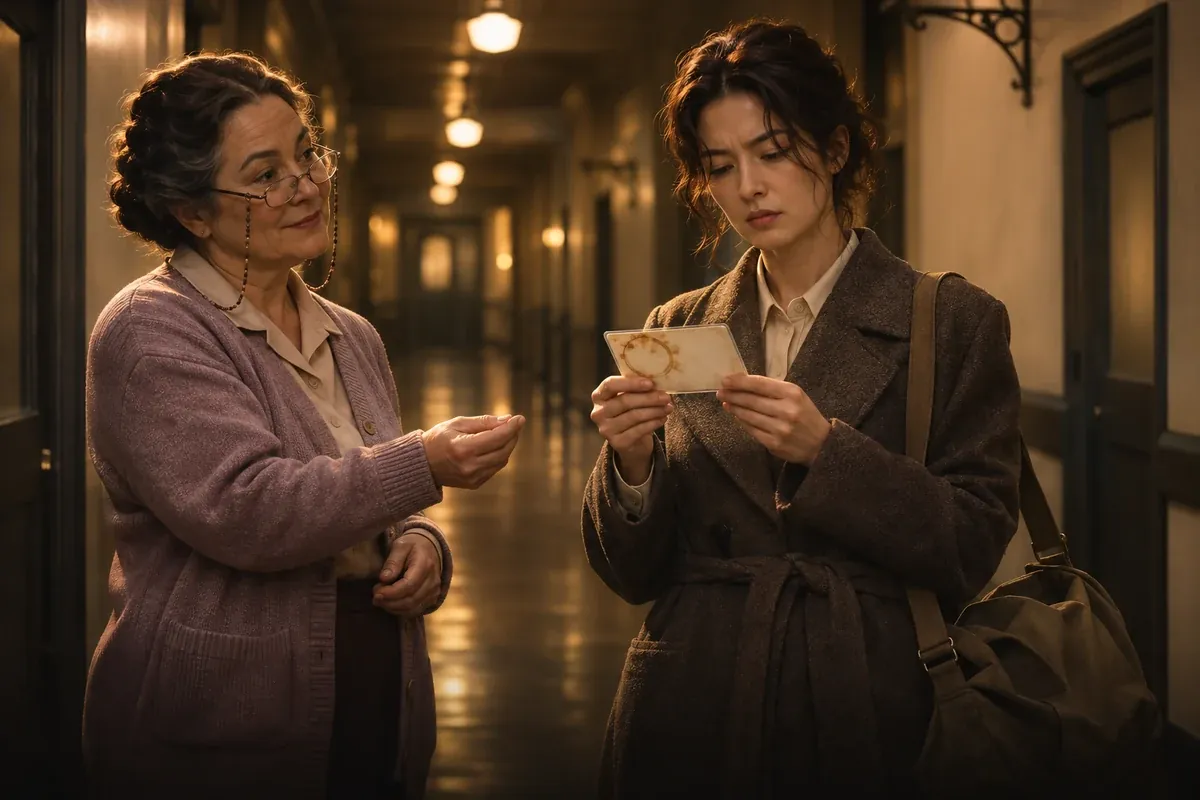
I say so to the night administrator at 11:40 on a Tuesday, in a corridor with no clocks. She does not laugh. She hands me a laminated card.
“Three rules,” says Dolores Kuhl. She wears a lilac cardigan, reading glasses on a beaded chain, and a smile that has been ironed flat. “Every newcomer gets one. Per policy.”
The card has a coffee ring on it. I read it standing up, the way I read anything I may later have to dispute.
One: Nobody on Seven dies alone after midnight. Two: Nobody says a time of death out loud. Three: Nobody answers the call light in 7-13.
“Which one do people break?”
“Whichever one they’re tired enough to.” She turns the card over in my hand, as if the back might hold a fourth. “The ward is yours until Monday, Ms. Falk. Clause nine. Seven nights on the premises, and you don’t leave before your shift ends.”
“Noted,” I say, which is what I say when I am deciding whether to be frightened.
Here is my situation, itemized, because that is how I keep my head. Item one: I am a freelance exorcist with a blog called Haunted, Probably Pipes. Item two: seventy percent of my jobs are mold, grief or bad wiring. Item three: three have been real, and I do not discuss them. Item four: my mother lives at Heron Pointe, where a settlement from a lawsuit I don’t remember covers the base rate and I cover everything else, and nine thousand dollars is a year of everything else.
I came in through the ambulance bay because I always scout the back door first. My hatchback is parked nose-out, the way I leave it for a fast exit. My kit is a canvas duffel: kosher salt, a 1952 Roman Ritual with a cracked spine, a voltmeter, an infrared thermometer gun and a travel kettle, because nothing has ever gone wrong in a place where somebody was making tea.
“Okay, okay, okay,” says the woman who meets me at the elevator, and then she laughs at herself. “Sorry. I do that. I’m Priya. Charge nurse. Come on, I’ll walk you the length.”
Priya Doshi is maybe thirty, with a pen tucked into her braid, and she is the first person in this building who looks at my face instead of my duffel.
Ward Seven is the old trauma wing. One corridor, long as a bowling lane, twenty-two doors down both sides, 7-01 at the elevator end and 7-22 at the far wall. Alcohol gel in the air. The squeak of crepe soles.
Every ten feet, high on the wall, an iron bracket. Every bracket empty.
“Where did the clocks go?”
“There aren’t any,” Priya says. “There never were. The brackets are from 1911, when this was the nuns’ infirmary. We kept them.” She hums three bars of something tinny, the music you hear when you are on hold, and does not look at me. “People get weird about time up here. It’s easier without.”
I check my watch. 11:49. It is, I realize, the only clock on the floor.
We pass 7-12, 7-13, 7-14. The door of 7-13 is shut like the others. It has a brass number plate like the others. Nothing at all is wrong with it, and every hair on my arms sits up.
“Don’t,” Priya says quietly, though I haven’t done anything.
“I wasn’t going to.”
At the far end, beside the dock door where I came in, there is a scrub sink under a hard white light. A man stands at it with his sleeves pushed up and his forearms red to the elbow.
He is tall and thin in the way of people who forget lunch, with dark hair gone a little long and a face that could be thirty-seven or sixty, depending on where the light hits it. He washes slowly, each finger, as if the blood belongs to somebody he plans to see again.
“Dr. Hale,” Priya says. “This is the exorcist.”
“Ms. Falk.” He doesn’t offer a hand, since he’s wet. His voice is low and unhurried, the voice of a man who has never needed to raise it. “You came in by the bay. And you parked facing out.”
“Do you check the lot for everyone, or just the ones with salt?”
“Only the ones I am expecting.” He turns off the tap with his elbow. “Please do not salt the surgical suite. Housekeeping will not forgive either of us.”
It is a joke, and it is not a joke, and I cannot find the seam. What I know about him fits on an index card: no malpractice suits, no family, a locker in the basement. The staff say he is possessed. In my experience, staff say that about anyone better at the job than they are.
“Eleven years,” I say. “You’d think someone would audit that.”
“Someone has.” He dries each hand and looks at me longer than manners allow, and there is something almost like hunger in it, except hunger is the wrong word. It is the look of a man reading a document he has read many times and still cannot believe is real. “Eat something before you begin, Ms. Falk. You will want your strength.”
“Why?”
His mouth moves, a flinch rather than a smile. Before he can answer, the speaker over our heads says, “Code, Seven-nineteen,” in a flat voice, and the corridor erupts.
Priya is already running. She stops, spins back and grabs my sleeve.
“Seven-oh-four. Ansel Rudd. Seventy-one, stroke. If he goes while I’m on the code, you sit with him.”
“I’m not staff.”
“Tonight you are. You hold his hand. You do not leave him. And you do not, I mean it, Juno, say the time.” Her braid swings as she goes. “Okay, okay, okay.”
Dr. Hale has already disappeared through the dock doors with his wet arms and his unhurried walk. The corridor is suddenly empty, and I am alone with twenty-one closed doors and one that is not mine to open.
7-04 is a single room, lamp low. The monitor draws its green line on the wall. Ansel Rudd lies under a blue blanket with one side of his face gone slack and the other side stubborn. He has a ferryman’s hands, broad, sun-cured, a faded anchor on the left wrist. Somebody has left a mug of cold tea on the sill.
I pull the chair to the bed. It is 12:02 by my watch. I talk because silence is how rooms get ideas.
“I’m Juno. I’m here about the haunting. Don’t worry, it’s probably pipes.”
His eyes track me, one of them anyway. I take his hand. It’s warm and dry and surprisingly strong. It squeezes once.
At 12:07 the squeeze stops.
The green line on the wall flattens into a single, level stroke. I wait for the alarm. There is none. I look at the machine. It is lit, confident, working perfectly, and it makes no sound at all, as if someone has told it to be polite.
“Mr. Rudd?”
Nothing. His chest is still. The hand in mine is already losing its heat.
I have sat with the dying before. I know that this is it. I know I should shout for a nurse, and I do, once, loudly, and the corridor answers with the distant clatter of the code and nothing else. Nobody comes.
Item one: I am alone with a dead man. Item two: my watch is right there on my wrist, and I want badly to look at it and say the number aloud, because that is what you do. You give the death a time so it can be a death and not a thing happening in the room.
I do not look. I hold the hand. I say, “I’m here. You’re not alone.” My voice sounds like someone else’s.
Forty seconds. A minute. The lamp hums.
Then the dead man turns his head on the pillow, slowly, all of it, the slack side and the stubborn side. He opens his eyes. They are not his eyes. They are very clear and very calm and fixed on me with an old, terrible tenderness.
“Look how tall you got,” he says.
It is my father’s voice. My father, who has been dead for twenty-two years, who said exactly those words every Tuesday night with a carpenter’s pencil in his hand and my head against the pantry door.