

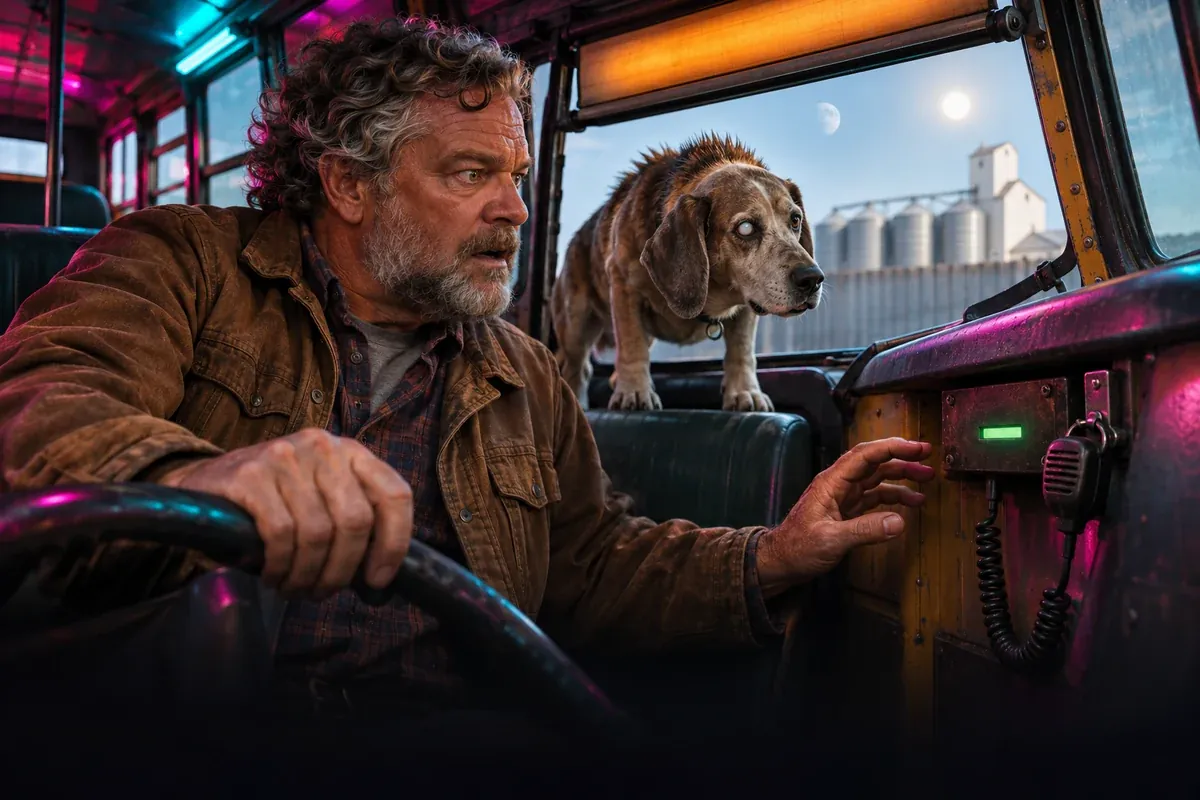
"Technically," Toby said, "it's not gone."
I had pulled Nine onto the shoulder two hundred yards short of the ramp and was staring at the end of the blue line like a man who had just been told his house was a rumor. The sign above my head read 2:41:10.
"Say again, son?"
Toby was standing in the aisle, which he knew better than to do, and he did not seem to notice. His eyes had gone unfocused, the way they do when he reads the board in math.
"The road isn't gone. It's like when you fold a map and the lines keep going on the other side." He pointed north and west across the corn, at nothing. "It's over there. About half a mile. A gravel lane, then a dry creek, then the overpass road comes back out the other side. I can see all of it. It's kind of glowing."
[Class assigned: Navigator. Navigators perceive where displaced routes have gone.]
I looked at the System's note, and then at the boy.
"Sit down, Toby."
"Yes sir. Rule one."
I held my own blue line, which showed where every road used to be, up against his finger, which showed where every road went. Between the two of them I had a map. The first one anyone had had all morning.
We took it.
First a farm lane, then a drainage ditch that Nine crossed in a long groaning slide, with Dee shouting "Lord have mercy" and the twins shouting "Again!" Then a creek bed, dry and wide enough for two lanes, with the walls of the Rows rising on both sides like green cliffs.
I was a mile in, gravel singing under the tires, when Hector Nuñez said, "Is that hay?"
He had a clipboard open on his knee. "That's, in fairness, that's hay."
They came off the top of the bank in a line. Round bales, the big ones, six feet across, rolling on their own and gaining. There were seven. The lead one had a knot of twine for a face, and it was doing thirty.
[Entity detected: Roller. Rank 1.]
"Rollers," said Hector, as if someone had asked. His voice went up half an octave. "My eyes just told me. It says they don't turn."
"They don't turn?"
"They don't turn!"
I could not use the Stop Arm, because I was moving. I had thirteen Miles and a button I had never touched, so I touched it.
[Crossing Gate. Cost: 6 Miles.]
A red-and-white barrier arm swung out of the front bumper with a bell and a flashing light, twelve feet across, like the one at the railroad crossing on Elm. The first Roller hit it at thirty miles an hour. There was a sound like a sack of flour meeting a wall, and the bale burst into a cloud of straw that smelled like autumn. Something small and flat fell out and spun on the gravel.
A ticket. Cardboard, punched at one corner, stamped with a tiny yellow octagon.
The Gate held through the second and the third. The fourth came in at an angle and nicked the left front tire, and Nine swung hard, and I fought her straight.
"Hold on to something! Rule one!"
"Rule one!" eight voices shouted back.
The last three bales went wide and rolled up the bank. I thought we were through. Then the sky above the creek went black.
Chaff-crows, Hector's eyes told him, and I thought it was an unfair name, because crows are nice. These were thin as cut paper. They came down the creek in a wave, hundreds of black wings and no sound but a dry flutter, and they landed on the windshield like a hand.
I could not see the road. I could not see anything.
"Mr. Tuttle?" Toby said, very small.
"Nobody panic."
I had never found out what the Air Horn on Nine did, because it had never worked. This time my hand went to the dash anyway, and the System took the fee.
[Air Horn. Cost: 4 Miles.]
You have never heard a horn like it. It was a cow, a freight train and a tornado siren, all at once. Every crow lifted off the glass in one piece and went up and away, and the corn on both banks shivered as if it had been slapped.
"Oh, you've got to be kidding me," said Dee, at the back. She had been standing by the emergency door with the ladle over her shoulder like a bat.
A Husker had climbed onto the rear step. Both long arms were around the door handle, and the paper where its face should be was pressed to the little window. Delores Pickett looked at it with the expression she once used on a fifth grader with a stolen pudding.
"Not on my watch, sugar," she said. She cracked the window two inches and whacked it across the knuckles.
It burst into a puff of husk. A ticket fluttered in through the gap and into her apron pocket. She patted it.
"Seconds," she said, with deep satisfaction.
Then the bank fell away, and I saw my blue line and the glow of Toby's second road meet at the far end of the rise and join into a single ribbon of asphalt running north.
I took it at forty. I will tell you about the rest of the drive some other time. A bridge Gravy would not cross, and he put his paw on my knee and I took him seriously and we found a ford. An hour in which nobody said anything, and Mr. Bao quietly started singing in Vietnamese, an old song, and the twins slowly joined him. The Miles ticked up one at a time, because you earn them by carrying somebody. I watched them climb from three to sixteen to twenty-nine.
I came down the last hill into Harmon at 9:56 in the morning with the sun straight overhead and the second moon sitting pale beside it like a bad idea. Four minutes to spare.
Harmon is a grain co-op. Four silos, a long white elevator, a scale house and a gravel yard, inside a ring of corrugated fence someone had put together in about three hours. At the gate stood an eight-foot post with a glowing octagon on top, white and yellow, like a stop sign designed by a saint. The Rows ended at the fence, as if somebody had drawn the line.
A woman in a county rain jacket, with a clipboard and a face like a locked filing cabinet, was waiting.
"Captain Anneliese Prout," she said, before I had the door open. "How many?"
"Eight passengers, me, and a dog, ma'am."
"I count nine and a dog." She wrote it down. "Welcome to Harmon Stop. No killing on the premises. Three nights free, then five tickets a night. Single file. You, sir, hold the door."
I held it. They went by one at a time. Dee patted my arm. Hector shook my hand with a hand that would not stop shaking. Mr. Bao bowed. Wade said "Thanks, mister," and Cole said nothing to the ground, then, at the last second, "Thanks." A woman burst out of the crowd shouting two names, and the twins hit her like bowling balls.
The last one down was Toby, with his trombone case.
[RUN 1: COMPLETE. Delivered: 8 of 8. Late: No. Loss: None. Reward: 2 Marks, 12 tickets, 15 Miles.]
He stopped on the bottom step. "Technically, you're supposed to say goodbye."
"Goodbye, Toby."
He did not move.
Then Nine's radio spoke.
Every bus in our fleet had a two-way under the dash, a gray box with a coiled mic on a hook. The district pulled them all in 2019 for tablets. Nine's had been gutted. I had seen the empty case myself the day I bought her. All that was left was a faceplate and the microphone.
The faceplate lit up green.
"Dispatch to Nine," said a voice I had known for twenty-eight years.
Warm, dry as toast, hoarse from decades of cigarettes she had quit in 2006. Peg Ostrander, district transportation dispatcher. She had said my name on Friday at 5:50 a.m., telling me to have a good weekend.
Gravy stood up on his seat, and his hackles rose from his neck to his tail.
"Peg?" I said.
"Nice work on Run 1, honey. Don't be late. Run 2 is on the board."
The sign above me rolled, rattling, and settled.
[RUN 2: PASSENGER: Joanna Tuttle. PICKUP: Gull Harbor Stop. DISTANCE: 340 miles. WINDOW: 11 days. DECLINE: 1 Demerit.]
My daughter's name was printed in amber light over the windshield.
"Is she alive?" I said. "Peg. Is Joanna alive?"
"She's on my board, honey," said the voice from the radio that did not have a single wire in it. "Eleven days. I'd get moving."