

File note: November 10. Observing loss conditions in person, for the file. Equipment: two flashlights, one thermos, a vet.
Dot Okonjo resigned on the first Friday of November, at seven o’clock, in front of a hundred and ten folding chairs.
I had not exposed her. I had walked into the Ptarmigan Diner at six, set the option agreement on the counter between the pie case and the rolling pin, and asked her one question. Did the Mutual know?
“No,” said Dot. She had not looked at the paper. She did not need to. “It’s a hundred and ninety thousand dollars short, Jo. The fund. Four winters of patching with money we did not have. I thought if I held the option until the note came due, I could pay it off with the insurance money, quietly, and give the paper back, and nobody would ever have to vote on a thing that frightened them.”
“You hid it.”
“I called it procedure.” She smiled, thinly. “That’s the oldest trick I know.”
She told them herself, in the Grange hall. She read the option aloud, line by line, and laid the rolling pin on the card table, and said she was out of order and would remain out of order until someone moved to recognize it. Mick did, in a voice that cracked. The room was so quiet I could hear the leaking urn.
They did not throw her out. They voted, forty-nine to forty-one, to accept her resignation as chair, and to let her stay. Teo, who had been standing at the back with the Book, was nominated by three different people before he could say no.
“Acting chair,” said Teo, and swallowed. “Until we all know what we’re doing.”
“That’s never going to happen,” said Dot, from the third row, and for the first time in two weeks she sounded like herself.
On Monday afternoon, with the November Three already rising behind the ridge, I told Brice Quillan.
I had not planned it. I found him in the lodge lot with his tailgate down and a laptop open, watching eleven trail cameras tick through their stills. He had not left Pell Pass in three weeks. I think he had decided it was a puzzle.
“Mr. Quillan,” I said. “If I told you something that sounded insane, and I asked you to watch for yourself before you wrote anything down, would you?”
He looked up. His gray eyes did not move.
“I have spent twenty years,” he said, “listening to people lie to me about animals.”
“This isn’t that.”
“Then say it.”
I said it. It took four minutes. He did not interrupt, and he did not nod. When I finished, he closed the laptop, and looked up the valley for so long that I thought he was going to walk to his truck and drive away.
“Tonight,” he said, at last.
“Tonight is the middle night. It’s the one that matters.”
“Then I’ll be here,” said Brice Quillan. “I don’t believe you. But I would very much like to be wrong in front of a witness.”
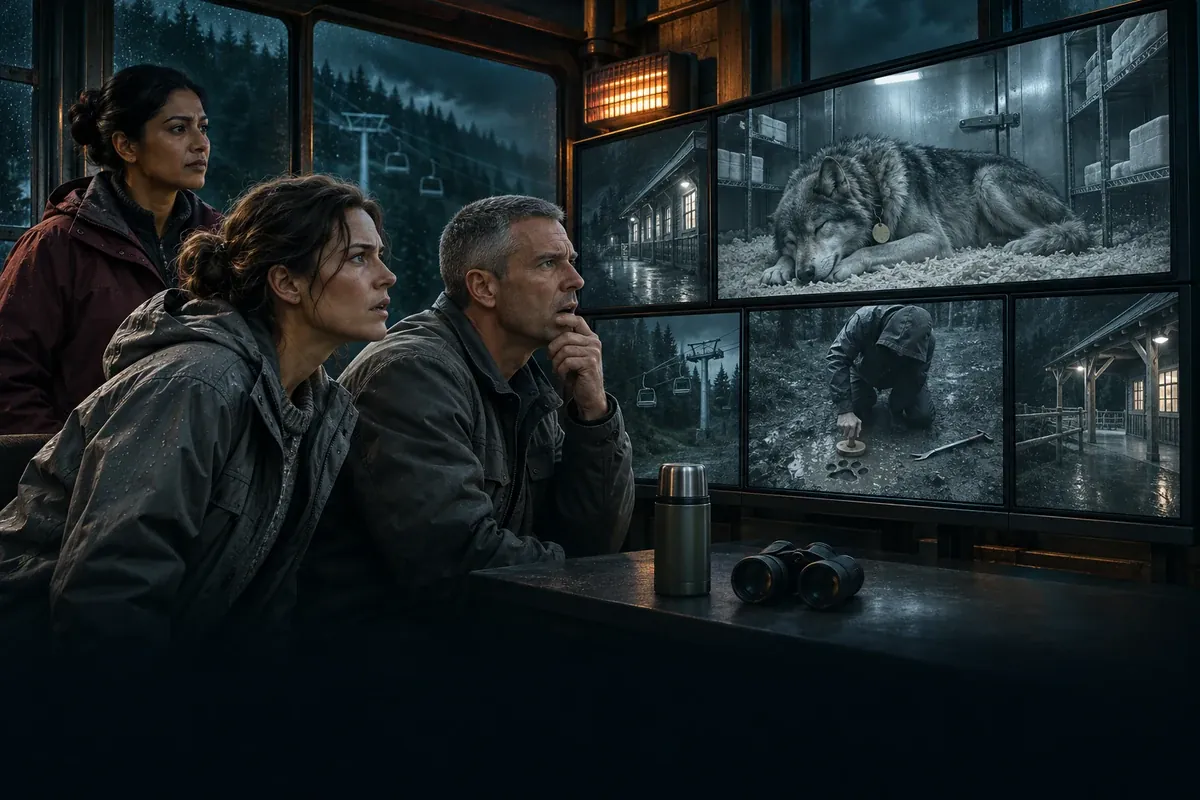
We watched from the old lift operator’s cabin, a glass-walled shed on stilts above the lodge, with a heater, six screens, and Priya Nambiar in the corner doing a crossword puzzle with great calm. She was the only one of us who looked as though she had done this before.
“They’re all in by dusk,” she said. “Lodge freezer, diner cellar, root cellars, the three stalls that survived. Mick and Teo double-latch each other. Everyone has a spotter at the door.” She filled in a word. “It’s a very hard crossword.”
At nine-forty the first screen changed.
It was the lodge kitchen, in infrared. The walk-in’s new door stood closed, with a new hasp, and a brand-new brass padlock. The camera inside the box was a gray, grainy oval of cedar shavings, a wool blanket, a rubber bumper.
A man was sitting there, on the shavings, with his back to the wall. He wore a gray T-shirt. I knew the shoulders.
“Teo,” I said, barely aloud.
Teo’s hands were flat on his knees. Slowly, as though listening to something far away, he lifted his head. I watched him turn his face to the little lens.
Then the picture jerked.
I had expected it to be fast. I had expected something like a film, a sudden convulsion, a flash. It was not like that. It was long, and it was slow, and it was, for a moment, simply terrible: a man folding in on himself in the grainy dark of a freezer, his spine curving, his hands closing into something that was not hands. It lasted perhaps ninety seconds. I did not look away. It felt like the only courtesy available.
When it stopped, there was a gray wolf in the freezer, the size of a pony, with a heavy skull, pale, patient eyes, and a canvas collar with a numbered brass tag. It shook itself once. Then it lay down on the shavings, put its muzzle on its forepaws, and began, calmly, to wait.
Beside me, Brice Quillan had stopped breathing. My own hands had gone cold around the thermos. There was a wolf in a freezer, and the wolf was the man who had put his hand over mine on a workbench, and the strangest part, the part I would think about for months, was how little it frightened me. It only made me want to open the door and sit down next to him until morning.
“Mr. Quillan,” said Priya, without looking up from her crossword. “Do sit. It is very common to feel faint.”
He sat. He did not speak for eleven minutes. When he did, it was a small, hoarse, decent sentence. “I have been very rude to that man,” he said, “in my head. About a bear.”
“He’ll forgive you,” I said. “He apologizes to door frames.”
The hours went by like furniture being moved in another room. Priya finished her crossword and began another. Brice watched the freezer feed without blinking. At twelve I counted the screens twice, because I wanted something to count.
At 2:14 in the morning, the fourth screen went from gray to white.
It was the Grange hall camera, the one Brice had mounted after the patrol hut. A security light had clicked on above the hall’s side door. Under it, in the cold glare, a man was walking up the path.
He wore a dark hood and canvas work gloves, with a long, heavy pry bar in one hand. In the other, dangling by a strap, was something that looked like a wooden mallet with a flat, carved face.
“Priya,” I said. “Where is everyone?”
“Locked in.” She was on her feet. “All of them. I counted at midnight. Everyone is in.”
On the screen, the man swung the pry bar through the hall’s front window. The glass came down in a long, soft crash. Then he bent down, set the carved mallet against the frozen mud, and pressed.
He lifted it away. On the ground, as clear as a signature, sat the print of a perfect wolf’s paw.
Brice Quillan stood up slowly. He was shaking, a little, all through his big, careful body. He put one hand flat on the glass.
“Everything you told me about the animals is true,” he said. “And not one of them did that.”