

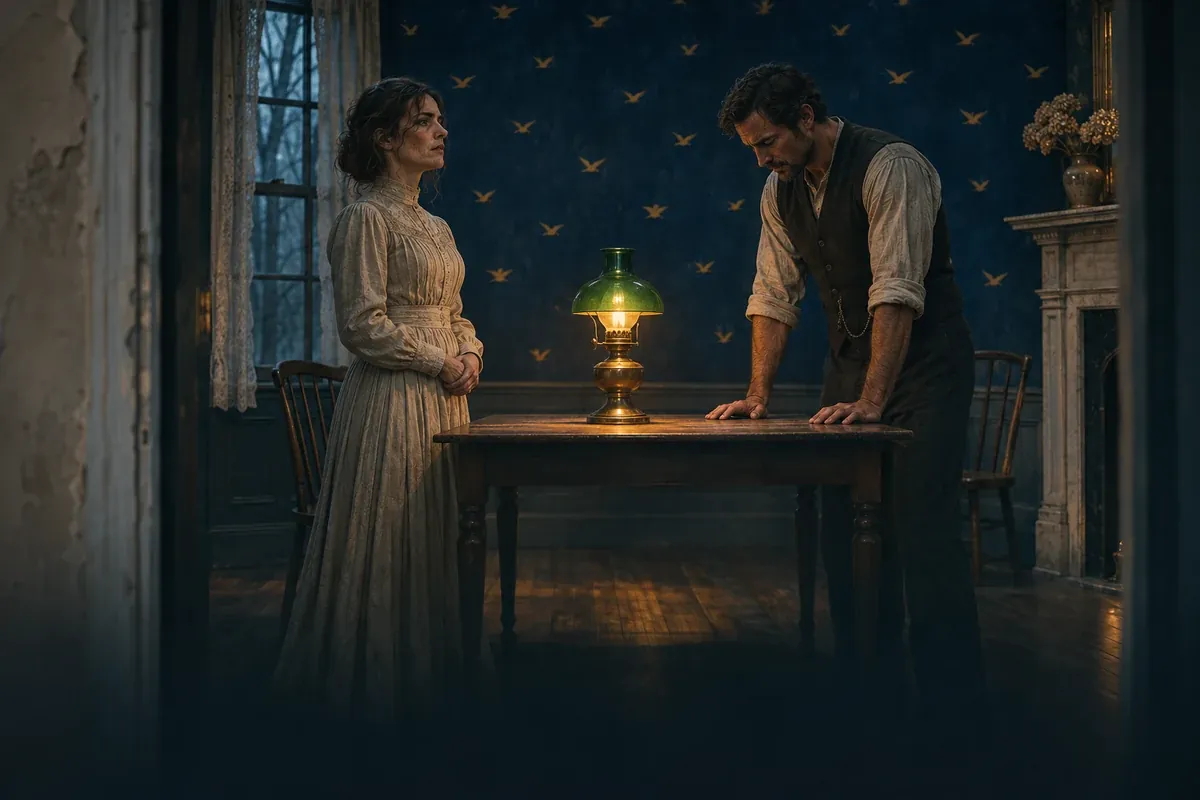
Hannah did not scream. She would think about that later, with something close to pride.
What she did was stand in her socks in the hallway of a house that was supposed to be empty, watching a woman in a cream dress walk the length of a room she had stripped to the plaster that afternoon. Every board creaked under the woman's feet. The creak came a half second late, as if the sound had to travel.
"Han?"
Cal was on the stairs. He had a pillow crease down one cheek and a flashlight in his fist, and he was coming down slowly, one hand on the rail, in the careful way of a man who has checked a lot of load-bearing walls.
"Don't," Hannah said, very quietly. "Don't come any closer. Just look."
He came down beside her. He looked.
She felt him stop breathing. She felt it through her shoulder, which was touching his.
"That's not a work light," Cal said.
"No."
"The paper is back."
"Yes."
"Okay." He tapped the flashlight against his thigh. "Okay. Carbon monoxide. We're hallucinating. I'll check the detector."
"Cal."
"I'm going to check the detector."
"Cal, there's a man."
There was. He had come in from the far door, the one that led to the dining room, which was a bare slab and a sawhorse in the real world and a polished table in this one. He was tall, with a dark beard trimmed close and a face that had once been quick to laugh and had forgotten how. His right hand was scarred across the knuckles, little white seams, the kind a person gets from a hundred cuts on glass.
He stopped at the edge of the lamplight. He did not look at the two people standing in the hallway. He looked at the woman.
"Lenore," he said. "Sit down."
"I'll stand."
"I would rather you sat."
"I would rather you had told me." Her voice was low and even and Hannah's stomach went out from under her, because she knew that kind of voice. It was the one you used when you had already cried it out and were speaking from the other side. "Say it again. I want to hear whether it sounds different the second time."
The man closed his eyes.
"I signed the house over to Gideon Pell," he said. "As security for the loan. For the new furnace. Eight thousand dollars, Lenore, and if the contract fails he takes the works and he takes the house, and I have two months to see that it does not fail."
"You signed it," the woman said. "You signed it without telling me."
Hannah's hand came up over her own mouth.
She had not meant it to. It was just that the line landed somewhere that had not been prepared. She felt Cal's eyes slide toward her and she looked straight ahead.
"It was my decision to make," the man said.
"It was my house."
"It is my name on the deed."
"It was our children's house." The woman turned, and for the first time Hannah saw her face. Thirty-five, maybe, hair coming loose, a mouth pressed so flat it looked drawn on. She was not beautiful the way women in old portraits were. She was tired. "I'll take them to my cousin in Albany. The seven-ten in the morning. You may send for us when you've decided what you owe us."
"Lenore."
"The seven-ten."
"Then go," Ansel Verrill said.
It was a terrible thing to hear. It was not an angry thing to say. It was the sound of a man leaving a door unlatched so that someone else would have to close it.
The woman looked at him for a long second. Then she picked up her skirts and walked out of the lamplight and through the opposite doorway, and her footsteps went up the back stairs, one after another, each one arriving late.
The man stood alone in the room.
Hannah looked past him, because something at the edge of her sight had moved. On the front staircase, inside the hall, no more than six feet from where she stood, a child sat on the third step.
A little girl in a white nightgown, hair in two crooked braids. Barefoot. One fist pressed to her mouth and the other holding something small and blue.
A bird.
The child was looking at her father through the banister, not blinking. She did not look at Hannah. She did not look at Cal. She did not seem to hear the floor creak under her own small weight.
Cal's hand found Hannah's. It was cold.
"Don't talk to her," Hannah whispered, and did not know why she'd said it.
The man in the parlor put his hands flat on the table that was not there. He stood like that for a long time. Then he reached for the lamp and turned the wick down, and the room went dark with him in it.
For a second Hannah's eyes would not adjust. Then the work light in the hallway ticked on, the one with the motion sensor Cal had installed, and the parlor was a parlor again. Bare plaster. A ladder. A steamer on a drop cloth. The blue bird on the mantel, throwing a tiny stain of light.
The staircase beside them was empty. The cold had gone as if someone had shut a door on it.
The clock on Cal's phone said 11:58.
"Eighteen minutes," Cal said, and his voice was almost his own. "I'd like that on the record. Whatever that was, it was eighteen minutes, and it started at 11:40."
"You're going to check the detector."
"I am going to check the detector." He did. It said zero. He checked the second one, the one by the furnace, and it said zero. He tested the gas line with a soapy brush. He opened the cellar door and stood at the top of the stairs for a moment, and came back up without comment.
They did not go back to bed.
They sat at the kitchen table, under the bare bulb, with the pie dish between them. Cal drank a glass of water. Hannah drank something stronger that she had been saving for closing day.
"It's a residual," Cal said finally. "Old houses hold things. Moisture, mold, there's a hypothesis about low-frequency sound. I read an article."
"Cal."
"I read an article, Hannah."
"She said, You signed it without telling me." Hannah looked at the pie dish. "That's what she said. Like it was a thing people say."
Cal said nothing.
He was looking at her in the particular way he had lately, the look of a man who has found a gap in a wall and has not decided whether he wants to know what's behind it.
"It's a line," she said. "People say that. People sign things."
"Sure."
"I'm going to call Dot in the morning."
"She told us not to be in there after dark."
"She told us."
"So she knew," Cal said, and she watched him choose not to say anything else.
They went up at two and lay in the bed on the second floor with the lamp on and the covers up. Neither of them slept. At 3:07 they were listening. Pickle was under the bed. She had been under it since 11:38 and she had stopped whimpering around two, which Hannah found worse.
The first sound was a stair taking weight.
Not a creak. A firm, even step, a man's weight on old oak, the sound of someone coming to stand at the foot of a staircase.
Then a voice. Calm. A little hoarse. Not loud. It carried the way a voice carries in an empty church.
"One," it said.
Cal's hand closed on her wrist.
"Two."
A pause, as if someone were waiting for an answer.
"Three."
Another pause. Longer.
Hannah counted along. Cal. Hannah. The dog.
"Four," said the voice.
She heard it clearly. She heard the small rustle of someone, below, who had expected a different total.
"Four," the voice said again, quieter, like a man reading a sum he had checked twice and still did not believe.
Then nothing.
There were three of them in the house. She counted again to be sure.
Three.