

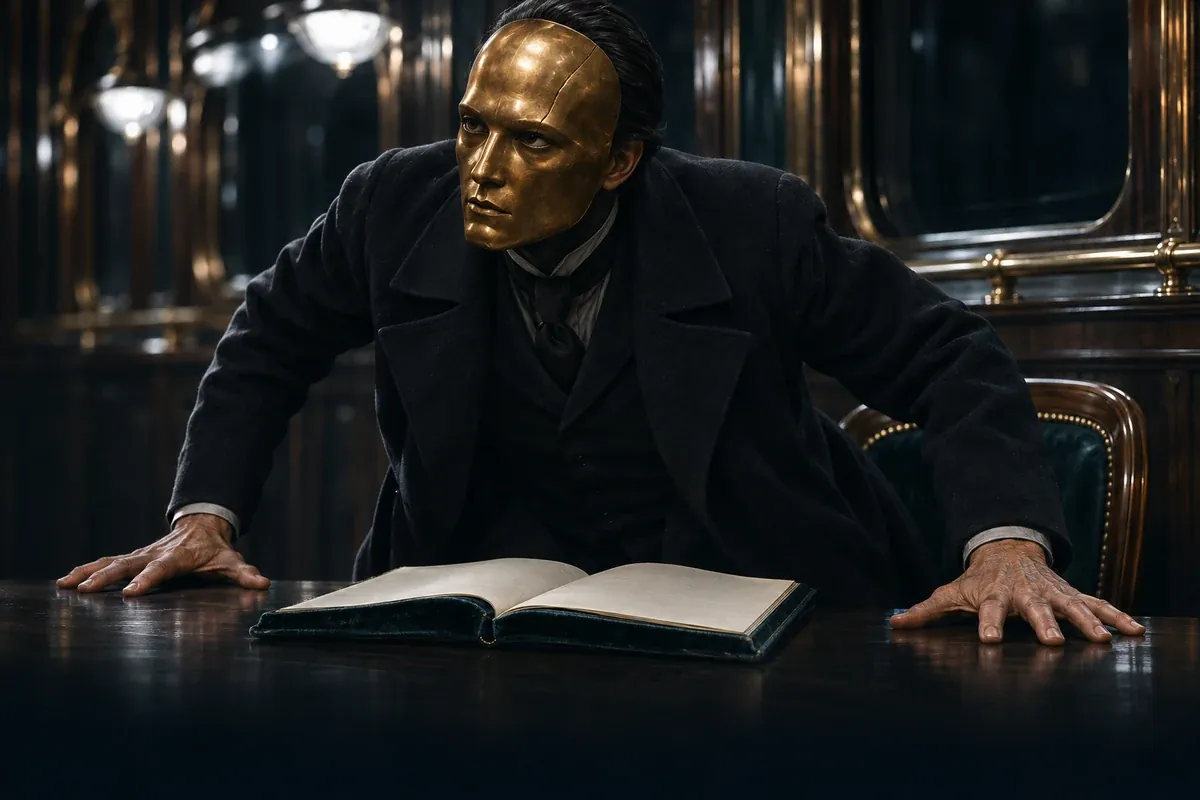
Pell wore the other coat for the hearing, though he swore it was the same one.
It was three o’clock on Friday afternoon and the Gallery Car had filled to the rafters. Two hundred benches, and every one taken: the clinic’s intervenors in the front rows with their halos of green numbers, the greenhouse people in their aprons, Ines Valdivia with a ribbon of seal around her wrist and a paper cup of something from Pearl, and behind them, standing two deep along the walls, everyone else. Nobody paid for a seat. Pell had ruled that gallery observers stand, and the entire Meridian Line had taken him at his word, down to the last coat on the last rail.
I sat at the long table on the left of the lectern with Yun on one side of me and Teague on the other. Teague had brought his briefcase. He had put it on the table, unopened, like an offering. Pearl sat directly behind us in the front row, knitting.
Across the aisle, at the right-hand table, sat Veen, alone, hands folded, with the velvet-bound ledger of the Carrier open in front of him, and I watched a little dread settle in the crowd as people looked at him and then, one by one, looked away.
“The Gallery will come to order,” said Pell.
The Examiner’s coat was darker than the Clerk’s, or maybe just buttoned higher. He sat behind the high lectern with the long black board at his back. A single lamp burned on the board above him, illuminating the column of names, and the blank punched hole at the bottom of it, and the new lines I’d watched go up all day under it: WHITLOCK, C. A., and a dozen more.
“This is the matter of the Motion of the Carrier,” Pell said, “under Clause 61, to strike the Petitioner’s Standing and dismiss Docket Number One. The Examiner reminds the Gallery that sound is billed. The Examiner further reminds the Gallery that this is not the first session of the docket. It is a procedural hearing. No testimony of substance will be taken. Mr. Veen.”
Veen rose.
He rose the way he did everything, without sound or hurry, and he stood a moment looking not at the Examiner but at the benches, as if remembering faces. When he spoke, it was in the same fine tired voice, and for the first time since I’d met him I thought I heard something beneath it. Not menace. Fatigue. The fatigue of a man who has lost an argument he never expected to have and is not allowed to say so.
“Clause 61,” said Veen. “Champerty and Maintenance. I will read the text. ‘No person shall, for consideration, solicit, finance, or direct litigation by persons who are not parties to it.’ The rule is old. It is older than the Tariff, I am told. It protects passengers from persons who would use them as instruments against the Carrier.”
“Mr. Veen, the Examiner has read it,” said Pell. “The Examiner is aware of what it says.”
“The Examiner will forgive me. The record requires it.” He turned a page. “The petitioner, Mr. Finch, opened a clinic at ten o’clock this morning. He solicited passengers to dispute charges. He financed their disputes by posting surety from his own Standing. He directed their filings, through a Mr. Teague, a Mr. Raman, and a Mrs. Whitlock, each of whom acted at his instruction. That is solicitation, financing, and direction. What the Carrier asks the Examiner to find is the fourth element: consideration.”
He let it sit.
“What did he gain?” said Veen, softly. “The Carrier submits that the petitioner has gained Standing. And more than Standing: influence. A hundred-odd intervenors owe their place on the board to him. When the first session convenes, he will have thirteen allies among the parties of record. That is consideration, Examiner. An advantage of value, obtained by the solicitation of non-parties. The Carrier asks that his Standing be struck and the docket dismissed.”
It was good. That’s the thing about Veen I keep coming back to. He was a persecutor and a thief, and he had never once told a lie in front of me, and his argument was good enough that for about a second I believed it. I looked at the benches. I saw people nodding.
I looked at Pearl. Her needles had gone quiet. She gave me the smallest shake of her head, the one you give a student who is about to answer a question he doesn’t know the answer to: not yet, not that one. I put down the notebook and picked it up again, and found, to my surprise, that I knew exactly which page I wanted.
“The Carrier calls its first witness,” said Veen. “Porter Felix, of Record, cars eighty-eight through eighty.”
Felix rose from the last bench of the front row with his hat in his hands and walked up the aisle with the stiff, apologetic gait of a man who has been asked to deliver his own eulogy. He took the little brass witness stand beside the lectern. His holes had arranged themselves into something formal.
“Porter Felix,” said Veen. “You carried notices for the Petitioner this morning.”
“I carried forty-three, Mr. Veen, and thirteen class notices. I carried them back as well.”
“Did the Petitioner direct you to carry them?”
“He said please,” said Felix. “Eleven times. A direction under the Tariff is a command or instruction. Please is a request. I looked it up in the glossary before lunch.”
“Was Mr. Finch paid for his assistance?”
“No, Mr. Veen. I would also like to say that I was not asked that question until now, and have already filed the answer under ‘Did the Petitioner direct you,’ where it has been since nine o’clock.”
A ripple of laughter went through the Gallery. Pell lifted one hand. “The Examiner notes the witness’s filing system.”
Veen did not smile. “One further question. In your observation, did the Petitioner solicit passengers?”
“To solicit is to approach unprompted,” Felix said thoughtfully. “Mr. Finch sat at a card table. Passengers approached him. I would say that the table solicited. The table was rented from Mrs. Brandt.”
“I resent that,” said Odile, from the third bench.
“Mrs. Brandt is a party, not a witness,” said Pell.
“No further questions,” said Veen, wearily.
“I have a statement,” said Felix, “which I misfiled.”
“Which is?”
“That I am glad of the clinic.”
“Stricken as nonresponsive,” said Pell, in a tone that did not strike anything. “Noted.”
“Mr. Finch,” said Pell. “You may respond.”
I stood. I had the notebook in my hand, and Teague had slid a legal pad toward me with three words printed on it in his small, careful capitals: DEFINITION. DEFINITION. DEFINITION.
“Examiner,” I said. “I’d like to read Clause 61, subsection (b).”
Veen did not move. I watched the crack above his left eye, and I’d have sworn it twitched.
“’Consideration, for the purposes of this clause, means Fare paid or promised.’” I looked up. “Fare. Not Standing. Not influence. Fare. It’s the next sentence after the one the Carrier read.”
There was a silence in the Gallery. I could hear the lamp.
“The Carrier did not read the definition,” I said, “because the definition ends the motion. I didn’t take Fare. I didn’t promise anyone Fare. I charged nothing. The clinic’s table was rented from a party of record, Mrs. Brandt, for six Fare an hour, and the six Fare came out of the Committee’s collection jar, which Mr.
“Raman will tell the Examiner is a mason jar.” A small, nervous ripple of laughter. “I posted surety, and lost a hundred and fifteen Standing of it. If that’s consideration, Examiner, then I was paid in the opposite direction.”
“The Carrier notes,” said Veen, evenly, “that the petitioner receives a commission on his citations. Ten percent.”
“I do.”
“Which accrues to his grace instrument. Of which he is the beneficiary.”
I’d been waiting for it. I’d been waiting for it for hours, in the antechamber, over the dishwater coffee, because it was the only argument Veen had that wasn’t a lie. And I had the answer. It had come to me at five fifty-eight that morning, in the pale white print of a Rule 12 reply.
“Examiner,” I said. “The Carrier’s own answer to my first interrogatory is on the board. ‘The grace instrument was issued by a passenger of Coach Section.’ It wasn’t issued by me. It wasn’t issued by the Carrier. The commission goes into the instrument, and the instrument belongs to the man who issued it.” I paused. “So if there’s consideration anywhere in this docket, Examiner, it’s flowing to him. Not to me.”
Veen’s mask had turned toward me. It was completely still.
“The Carrier moved under Clause 61 to find a person who financed this litigation,” I said. “I’d ask the Examiner to take the Carrier at its word. The Carrier has already told us: somebody financed it. Somebody gave a fare inspector seventy-two hours of grace before the doors ever sealed, and put him in a position to file. I’d very much like to know who. So would the Carrier, apparently.”
Pell’s face rippled.
I’d never seen it do what it did then. The holes rearranged themselves, one by one, from patience, through something like surprise, into a pattern so complex and so quick I couldn’t read it. When it settled, it settled on something almost like pleasure.
“The Examiner will take a moment,” said Pell.
He took eleven minutes. I counted. Nobody in the Gallery said a word; nobody paid for the silence, because the car was a courtroom and the Tariff had apparently decided it was free. The lamp burned. Teague straightened his tie nine times. Yun’s knee jiggled under the table, and at some point Pearl’s needles started up behind me, click, click, steady as a clock, and something in the room lowered by half a pitch.
“The Examiner rules,” said Pell, at last.
He folded his hands on the lectern.
“First. Clause 61(b) defines consideration as Fare paid or promised. Standing is not Fare. The Carrier’s motion, to the extent that it relies on Standing or influence as consideration, is denied.
“Second. The Carrier alleges, in the alternative, that the petitioner receives a commission on citations. The Examiner finds on the present record that the commission accrues to a grace instrument whose issuer is, by the Carrier’s own Rule 12 answer, a passenger of Coach Section other than the petitioner. If there is a financer of this litigation within the meaning of Clause 61, the Examiner finds that it is the issuer of the instrument, and not the petitioner.”
A murmur went through the Gallery. Veen did not move.
“Third. Clause 61(d) provides a remedy. Where a financer is identified, but not a party, the Examiner may require disclosure of his identity as a condition of the docket’s continuation.” The holes stilled. “The Examiner so requires. The petitioner shall disclose the identity of the issuer of the grace instrument of 72:00:00, as a condition of continuing. Disclosure shall be made at or before the first session of the docket.”
I felt the floor go out from under the bench.
“Examiner — I don’t know who it is.”
“Rule 12(d) privilege protects the Carrier’s answer until the first session,” said Pell, quite gently. “It does not protect the petitioner. The petitioner may find out the way anyone does. By asking.” He looked down at me, and there was something in the weave of his face that I would have called sympathy, in a man with eyes. “The Examiner notes that the first session cannot convene until all parties are present. The petitioner therefore has the time it takes the Conductor to attend.”
Which was never.
Which was exactly, entirely, never.
I’d been given a condition I couldn’t meet, in a docket that couldn’t start, under a rule that said nothing happened until it did, and the only man who understood what that meant was standing across the aisle, with his hands folded, looking at me with the weary courtesy of a person who had known the outcome the whole time.
“I have one more matter,” I said. My voice sounded strange. “Under Rule 6(b). I’d like to move that the Clerk open the Collections ledger number four-twelve, which is in my possession, for use as evidence of the Carrier’s collection practice.”
Veen moved. It was the first sudden movement I’d seen him make. He came half out of his chair, and I swear that in the lamplight the crack over his eye had lengthened by a hair.
“The Carrier objects,” he said. His voice had gone level, so level you could have laid a rule against it. “That ledger is Collections property. It was taken by a salvage asset. Title is defective. The petitioner holds it on a claim of — “
“On a valid Lost and Found claim,” I said. “It’s in the docket line.”
“The Carrier objects in the strongest terms.”
I looked at him. I didn’t say what I was thinking, which was that a man who had been calm for three days had just stopped being calm over a book. He saw me look. His hands, which had been folded, were open on the table.
“The motion is reserved,” said Pell. “The Clerk will take it under advisement. The Clerk will rule in due course.” The holes did something small and unreadable. “The hearing is adjourned.”
The Gallery came apart with a noise like the end of a long church service. I stood with my hand on the notebook, not quite able to move, while Yun hauled me up by the elbow and Teague, white as paper, packed his briefcase.
“You won,” Yun said, shaking my arm. “You won. The motion’s dead. They can’t strike your Standing, they can’t — “
“I lost,” I said.
“You — “
“I’ve got a condition I can’t meet. Name the issuer. By the first session. Or the docket doesn’t continue.” I looked at the board over the lectern, at the long dark column of names and the single blank hole. “Which means they don’t have to dismiss it. They just have to wait for me to run out of time. And they’ve got all of it.”
“Do they?” said Pearl, at my shoulder. She had set down her knitting. She was looking at the clock above the doors, a big brass clock with a plain white face and black hands, which I’d stopped looking at somewhere around Wednesday. It said twenty minutes to six.
“What?”
“It’s Friday evening, Inspector. The Carrier can wait until Monday if it likes. It can wait until the Fourth of July. But you’ve got a courtroom to be in on Saturday morning at ten.” She said it very gently. “I’d take a look at your own clock.”
I hadn’t said a word to her about Prue.
Veen had come up the aisle. He walked to within an arm’s length of me and stopped, and for a moment the whole Gallery seemed to hold its breath. He looked at me with the brass mask, with the punched holes where eyes should be.
“Mr. Finch,” he said, in the fine tired voice. “You have until the first session to name the man who bought your grace. I would choose the answer with care. The Carrier already knows it.” A small pause. “I find that I do not enjoy knowing.”
He bowed. He didn’t wait for a reply.