

TUCK FERREIRA. $412 (EXAM FEE). ASK HIM WHAT I MADE HIM CARRY.
I wake at 4:50 a.m. on the left side of a bunk, in the dark, in my coat, with a dead man’s sentence sitting on my chest.
TELL HIM I LIED. I read it eleven times last night by the glow of the wheelhouse compass light. It did not improve. Port Marrow’s only hotel closes October to April, and Lourdes offered me a bed in her house, and I said no, because the estate’s principal asset needed to be inventoried. That is the official reason. The unofficial one is that I could not sleep under the same roof as the woman who knew Gus better than I ever will.
The Wilhelmina groans against her lines. The barometer by the helm reads 29.2. Somewhere below me, the bilge pump coughs twice and quits.
A boot hits the ladder.
I keep my eyes shut, which is cowardly, and which I can defend as tactical. Footsteps cross the wheelhouse deck. They stop. I know that stop. For three years of my life I woke to the sound of a man standing very still beside a bed, deciding whether to wake me.
He is looking at the bunk. At which side of it I picked.
Nobody says anything. Then the boots move off, the hatch to the engine room lifts and clanks, and the flashlight beam goes down into the dark. I open my eyes and breathe.
I have not been on this boat in nine years, and I still sleep on the left.
“You can stop pretending,” Mateo says, coming back up with grease to the wrist. “Bilge is eight inches. She’s taking water at the shaft.”
“How much per hour?”
“Enough.” He wipes his hands on a rag. “Rules.”
“Rules?” I sit up. My neck makes a noise like a drawer sticking.
“Rules.” He is not looking at me. He is looking at the chart table, at the green canvas tally book I have set there with a legal pad squared against it. “Dad wrote them. Fine. But I’m not here for you. I’m here because Mom has a roof and Ingrid holds the note on it. Anything past that, you ask first.”
“I would like to remind you that I’m the executor.”
“Executor,” he says, and for a second it sounds almost like a joke. Then he goes down the ladder, and the boat settles an inch lower where his weight leaves it.
By seven, the sleet has stopped and the sky has gone the color of dishwater. Lourdes’s is a counter and four stools and a wall of bait coolers, with a deep fryer going at the back, and the smell is garlic and diesel and sugar. Every person on Skerry Island comes through that door once a day. I am the only one who stops on the threshold.
“Eat first,” says Lourdes.
She puts down a plate of pancit before I have a stool. I eat. She watches, and does not speak, and when I am done she takes the plate away and puts down another. This is not hospitality. This is a woman buying time with noodles.
“The house,” I try. “Dale told me the note is Halvorsen’s.”
“Eat first.”
Behind me the bell on the door jingles, and I turn.
Tuck Ferreira stands on the mat with a hood up and his hands jammed in his pockets, the posture of a boy waiting to be told what he did. Nineteen. A split lip healing. He has Gus’s old watch cap, the gray one with the burned edge.
“Ms. Kessler.” His eyes slide to Mateo, who has come in behind him and taken the far stool without a word. “Honest to God, I don’t know what this is about.”
I open the book on the counter. Entry one. Gus’s block capitals, pressed deep enough to groove the paper. “Mr. Ferreira. This estate owes you four hundred and twelve dollars for an exam fee.”
“Honest to God, I never asked him for that.”
“It says he owed it.”
“Honest to God, I don’t even have an exam.” Tuck laughs, high and wrong. “I don’t want anything. Honest to God, I never touched anything on that boat.”
Nobody said he did. The counter goes quiet in the particular way of a small town hearing a name it has already used. Lourdes stops wiping. Two men at the end of the bar put down their coffee.
I understand then what the island has been saying, in the lowered voice it uses on the dock. The boy found Gus dead in the wheelhouse on the fourth of November. The strongbox was open when the state trooper flew in. People can do arithmetic.
“I paid for the license class in September,” Tuck says, faster, to the counter. “I mean, I was going to. I took the first part. I couldn’t sit the second, I didn’t have the fee, and he said, he said—”
“He said he’d cover it,” I say, “and then he died.”
“I didn’t take it. Honest to God.”
“Tuck.” Mateo has not raised his voice. He has not moved. “You found him. You called me before you touched anything. I’ve got the call log on my phone.”
The boy stares.
“You’re not a thief,” Mateo says. “Anybody who says you are can say it to me.”
He says it to the room. It is the longest sentence I have heard him say since the plane. At the end of the counter, the two men pick up their coffee again, carefully, and find something to look at.
Tuck’s face does a thing I recognize from clients: the moment someone realizes they have been believed. He sits down hard on a stool. Lourdes puts a plate in front of him without looking.
I count four hundred and twelve dollars out of my own wallet, because the estate account is frozen until probate opens, and because I am the kind of person who writes myself a receipt for it on a napkin. Tuck signs the page with the pencil I hand him. His signature is a kid’s, all loops. He crosses the entry out with one diagonal line, slowly, as if the line might hurt.
“There’s one more thing,” he says. “What he made me carry.”
He pulls a cord out from under his collar. On the end is a brass key stamped with a number: 14.
“Honest to God,” says Tuck, and then, to everyone’s astonishment including his own, stops.
“He said keep it till the lawyer came. I didn’t know it was you.”
I slide the key into a clear evidence sleeve from the box in my bag. I label it in my tidy hand. Entry 1, key, brass, 14. Mateo watches me do it, and I can feel him decide not to say anything about that, either.
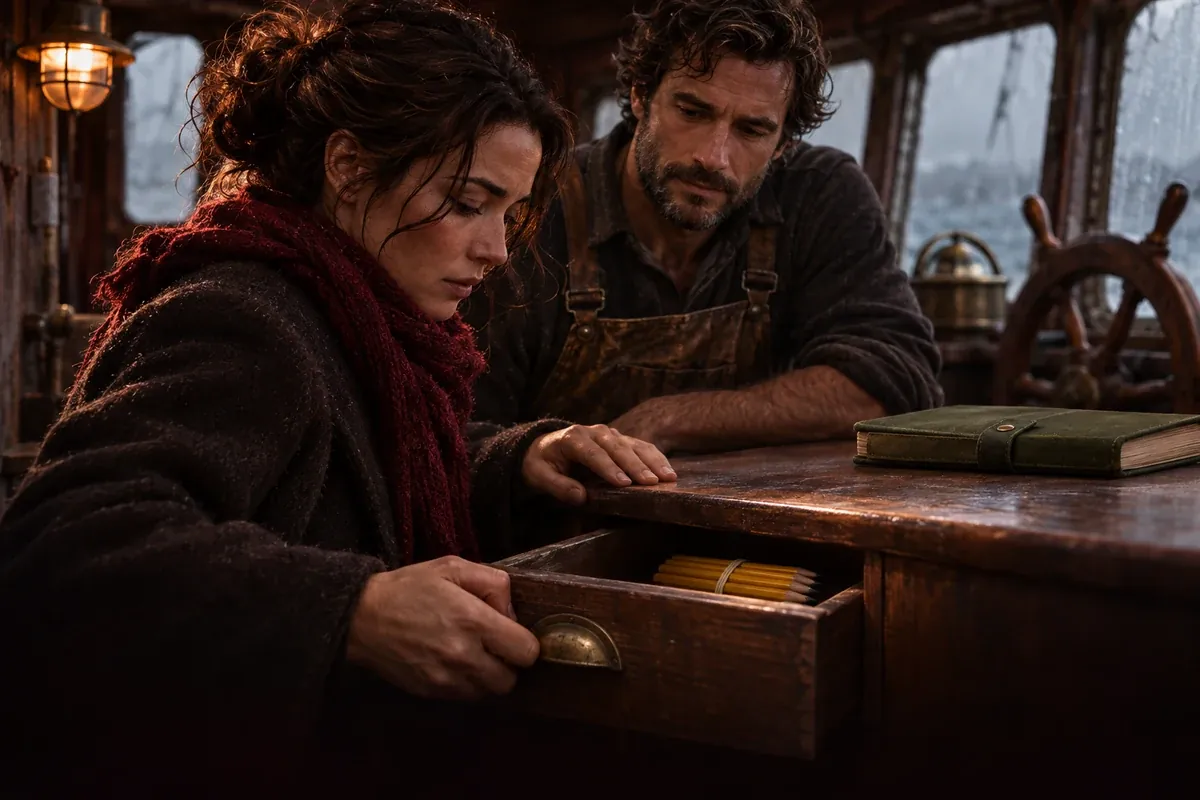
We find the lock an hour later. It is the chart drawer under the Wilhelmina’s table, a drawer Gus never let a soul open. The key turns without effort.
Inside, no charts. A rubber-banded bundle of pencils, yellow, sharpened to the same exact length.
I count them. Forty-one.
“He had to have done them all at once,” Mateo says quietly, behind me. “Took him a week, sitting in here.”
It is the most human thing either of us has said to the other. He hears it too, and steps back.
On the dock he stops at his old truck, the dented gray one with the rust blooming over the wheel well, and hands me the keys without looking. “You’ll need it. Sixty-two days.” A pause. “And we don’t talk about Toby. Not till I say.”
“Not till you say,” I echo, and it sounds like an agreement.
It is not, and we both know it. I am carrying entry forty-one in my coat pocket.
He walks away up the dock. I climb into the cab, and something white is tucked under the windshield wiper, damp at one corner, as if it has been waiting a while.
A cashier’s check, made out to me for $2.1 million. Clipped to it, a card in a fine fountain-pen hand.
I’d hate to see this cost you more than it’s worth. I’m only asking as a friend.