

Every bride has a place where the fabric pulls. Cora Lenz’s is her left shoulder, where she holds the whole truce.
I see it the second she comes through my door, at three on Saturday afternoon, in a camel coat the color of a wet street. She has her chin up and her shoulders squared, and under the wool the left one rides a half inch higher than the right, the way a person carries a bucket they have been told not to spill. If I took in a quarter inch there she would let out a breath she has been owing since March. But Cora Lenz does not look like a woman who wants a quarter inch of anything.
She is twenty-four. She has red-brown hair pinned back so severely it must hurt, a freckled, intelligent, tired face, and a mouth she keeps very still. Behind her on the sidewalk two men in dark overcoats stand on either side of a black car, looking at the street like men whose job is to be looked at looking.
“They stay out there,” says Cora, as the door closes. “My father’s idea. I’d rather not have them in the room. They breathe on the silk.”
“It’s my shop,” I say. “They can breathe wherever you like.”
“Low tide at six, God willing,” she says to no one, and looks around.
The shop looks the way it always looks, which is like a place where a lot of women have cried quietly and been given a cup of tea. Two Singers under their covers. The cutting table. The rack of garment bags. The cone of lamplight in the back corner, where Mabel stands in her half-finished muslin with her cardboard tag around her neck. Cora’s eyes go to her at once and stay there, and something in her face does a thing I have only seen on women at the altar, a small private flinch, a woman recognizing a thing she has been told about.
“Well,” she says. “There she is.”
“Please go behind the screen,” I say. “Strip to your slip. Shoes off. I’ll take your measure, and then we’ll talk about the silk.”
“No.”
She says it kindly, the way you say no to a waiter. Then she sets her handbag on my cutting table, squares it to the edge, and takes off her gloves one finger at a time.
“Use the mannequin,” she says. “Everyone does.”
I have a standard answer for this. Brides are shy; mothers are worse. “A gown cut to a mannequin fits a mannequin, Miss Lenz. I’m very good at what I do, but I can’t drape a body I’ve never seen.”
“You’ve been cutting to Mabel for twelve years.” Cora lays her gloves in the bag. “Every treaty bride in the Line. Delia Sable on Thursday. The Okonjo girl last spring. Mara Lindqvist in March.” She says the last name the way you put your foot on a stair you suspect is rotten. “You never put a tape on a single one of us, did you? You took the tag on her neck and you cut to that.”
“The tag is the Registry’s standard.”
“It’s the Registry’s dress.” Cora turns. “That’s what they call her. At the Counting House. At the Bell Platform. In my father’s study, when he thinks I’m not listening. The Registry’s dress. Every bride the Line has cut a treaty for since your mother died has been fit to that form, and no one has ever told you why.”
I do not say anything. In the back room the steam press hisses once and goes quiet.
I want to say that it is silly. It is a mannequin. I want to say I know my own shop, and my own trade, and the standard bride has been the standard bride since before I could thread a needle, and that the Registry sends the tag every March with a bag of batting and a card in my mother’s handwriting that says Let out or take in by the figure on the tag, and that every year I do.
I take a brass gauge ring from the envelope, the kind you slide over a limb to read its girth, and I pad Mabel with batting until the ring fits, and I swap the tag for the new one, and I have never once held a tape to her.
I have never once held a tape to myself, either. I make my own dresses, loose, in black, because they are easy to hem. I stopped looking at the numbers when I was twenty.
“I’ll show you something,” says Cora, “and then you can decide whether I’m crazy.”
She stands in front of the lamplit dress form, and for the first time since she arrived she looks at me directly. She has gray eyes, very clear, very tired.
“Go on,” she says. “Take her measure. Properly. With a tape.”
“Miss Lenz—”
“I’d do it myself. But I’ve been told it’s better if you do.”
Her left hand has drifted to her stomach. She takes it away again, quickly, and tucks it behind her bag, and with her other hand she takes a sleeve of saltine crackers out of the pocket of her coat and eats one with the flat, steady concentration of a woman taking a vow. I file that. I do not know why. A good fitter files everything.
I go to the cutting table. My white tape is where it always is, but my fingers go past it to the yellow one, the old stiff yellow one with the burned black end that has been lying beside the cashier’s envelope for two days like a thing that might bite.
I have not picked it up since Rafe Dunmore put it down. I have walked around it, set a cup on the envelope, moved the ticket from my pocket to a drawer and back. It is lighter than I remember. It still smells, very faintly, of lavender and machine oil.
I stretch it out. The brass tip clicks against my thumbnail.
“Nape to waist first,” I say. My voice is not quite mine. “It’s a clean place to begin.”
I begin at the top of Mabel’s spine, where the plaster dips into a little hollow behind the neck. I run the tape down the line of the back, the way my mother taught me, with one finger anchoring the tape and the other riding lightly beside it. The tape goes down under my hand like a river. At the waist I stop, hold the tape, and read the number.
Sixteen and a half.
I read it again. I read the tag on her neck.
Sixteen and a half.
Well, the tag is the tag. It is accurate. That is what a tag is for. I tell myself so, quite clearly, in my own voice, the way you tell a child about thunder.
Then I move the tape around her bust, snug under the arms, and read it. I run it round her waist, and her hip, and down the arm.
Bust, thirty-five and a quarter. Waist, twenty-seven. Hip, thirty-eight and a half. Arm, twenty-three. They go into the air one by one, a flat little litany, and each of them matches the tag in the clerk’s square hand to the quarter inch, and I stand there with the tape hanging from my hands and my pulse going in my ears and think: well, of course. The Registry knows how to use a tape.
“Now yourself,” says Cora.
I laugh. It comes out wrong. “That’s a mannequin.”
“Do it.”
“I’m not going to strip in front of a customer for a—”
“It’s a theory,” she says, very gently. “I would like to be wrong. I’d like to be wrong so badly you have no idea. Please, Miss Quarrie. One number. The waist.”
Something in her voice undoes me a little. So I do the thing a seamstress does with a stubborn customer: I take the tape and wrap it around my own waist, over my black work dress, snug, the way you do for a quick check, and I pull it tight, and I read.
Twenty-seven.
I stand very still.
“Nape to waist,” says Cora.
I lift my hair and run the yellow tape down my own back, from the knob of the spine to the narrowest place, with Cora holding the end at my nape without my asking, because she has apparently done this before for someone. She reads the number out loud in her low, even, weather-forecast voice.
“Sixteen and a half.”
“Bust,” she says, and I do it. I do all of it, under the lamp, with a stranger’s hands steadying my shoulder, bust and hip and arm, and I do not say the numbers aloud because there is no need. They are the same. Thirty-five and a quarter. Thirty-eight and a half. Twenty-three. They are Mabel’s numbers, which are the tag’s numbers, and they are mine to the quarter inch, and I have been dressing a plaster woman to my exact measure for twelve years and never put a tape on either of us.
I remember Pruitt on his brass scale with his cloth tape and his good manners, every March. For the licence.
“It goes deeper,” says Cora. “Look at her left hip.”
I know before I look. Mabel’s left hip sits a half inch lower than her right. I have always thought it was a flaw in the casting, a pleasing asymmetry, the sloppy genius of my mother’s hands. A line of tiny pinholes runs down the plaster there, six inches long, curving, close and regular as a seam. I have pinned a hundred bridal sashes against that line without asking what it was for.
I put my hand on my own left hip, over the dress, where the long surgical scar runs under the cotton. Fourteen years old. A bad joint, a month in a plaster cast, a surgeon with a fountain pen who drew the line on my skin before he cut. My mother stood beside the table while he drew it. She had a tape around her neck and a dress pin in her mouth and she said nothing at all. I remember thinking how oddly she watched, as if she were taking something down.
The pinholes in Mabel’s hip follow the scar, stitch for stitch.
“She’s you,” says Cora softly. “She was always you. Your mother rebuilt her every winter after your birthday, the way you’d let out a child’s coat. After she died, the Registry sent the tag and the batting so nobody had to.”
“Why?” It is almost a whisper. “Why would anyone do that?”
“So that every bride in the Line would be cut to your shape.” She is not looking at me anymore. She is looking at the floor. “So that when the day came, there would be a dress that fit you and no one else, hanging in the Registry in somebody’s hand. That’s all I know. That’s all anyone’s ever told me.”
The room has gone very quiet. I take the pins out of my mouth and discover that I am not holding any.
That is when the lights go out.
It is not a flicker. The overhead bulb, the gooseneck lamp, the green standby light on the steam press, the glow of the street through the front windows, all of it goes out at once, and the shop is dark in the way a closet is dark. Somewhere above us a refrigerator shudders and stops. Out on Sumner Street I hear a man’s voice shouting something and a second voice shouting back, and then a thump, a heavy one, that I feel in my feet.
“Power cut,” I say. “It happens when the tide is wrong.”
“It isn’t the tide,” says Cora.
She has a flashlight. Of course she does. She takes it from her handbag, a little brass thing the size of a lipstick, and clicks it on, and the beam hangs between us, yellow, full of dust. Her face in the light is very pale and very calm. I find I am gripping the tape so hard the brass tip has left a dent in my palm.
Outside, the voices have stopped.
“Your men,” I say.
“My father’s men.” She does not move. “They’re not very good at their jobs. I’ve been counting on it.”
Then I hear the key.
It is a small sound. It is the sound of the street door’s lock, the old brass lock I have turned every night for twelve years, a key sliding in from the outside and turning with a long, careful, well-oiled click. The bolt shoots home. And on the heels of it comes the same sound at the back, softer, from the air shaft: the second lock. Click. Click. Like a very patient animal closing its jaws.
I run to the street door anyway. I try the knob. It turns and does not give. Through the glass I see the black car at the curb and the sidewalk empty in the dark, no men, no one, only a long wet gleam where the rain has started, and a shadow, maybe, at the corner, that could be a man or a mailbox. I bang the glass with the flat of my hand. Nobody comes.
“Don’t,” says Cora. “If they wanted us out, we’d be out. They want us here.” She puts the flashlight in my hand. “Hold that. Steady. I have to give you something.”
“What?”
She pulls off her right glove, finger by finger, and turns it inside out, and from the lining of the fourth finger she takes a key. It is very small, no longer than my thumb, black with age, with a bow like a clover leaf and a short, fat stem. It has been in her glove, she says, for a month.
“Someone put it there,” she says. “I found it after a funeral in August. Folded in a square of tissue paper, in my glove, with a card. I thought it was Rafe Dunmore’s idea of a joke. I’ve carried a dead woman’s key in my glove for a month, Miss Quarrie, and every morning I think I’ll throw it in the Salt Market and every morning I put the glove back on.”
“What did the card say?”
“Give this to her after she measures.” Cora presses the key into my palm and folds my fingers around it with both her hands. They are cold and very firm. “It’s hers. Your mother opened her. Open her.”
“Open who?”
She does not answer. She only tilts her head at the corner of the room where the beam of the flashlight has swung and fallen, and where Mabel stands in the dark with her tag around her neck and her shoulders sloped, listening.
I walk across the back room with Cora’s light in my hand and a dead woman’s key in my fist. The floorboards creak. Under the dress form’s collar, just under the hollow of the plaster nape where I began my measure, I can see now that something is there that I have not noticed in twenty-three years, a hole the size of a pencil lead, pinched in the plaster, rimmed in a thin ring of tarnish. It has been behind the tag all along. It has been behind the tag since the day I was six.
It is a keyhole.
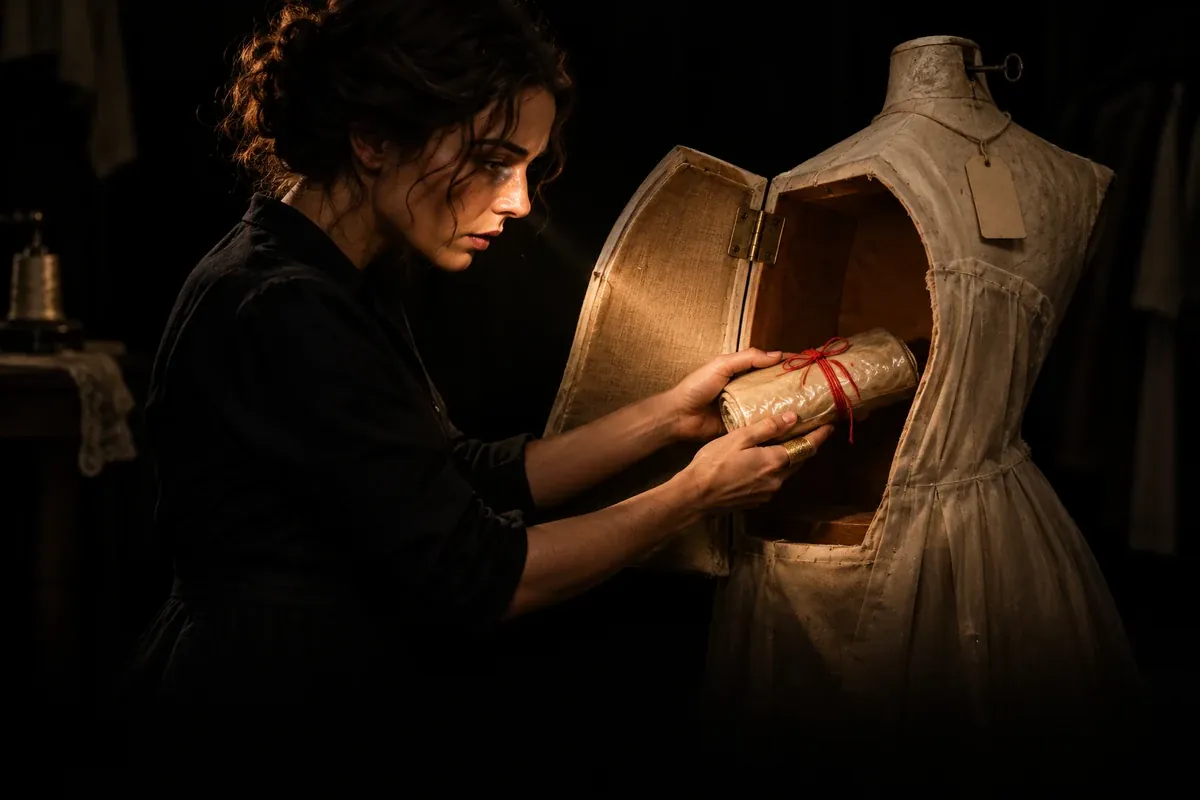
I put the key in. It slides home as if it has been oiled. When I turn it, something deep inside Mabel’s chest gives a small, old, grateful click, and her torso unlatches along a seam I had always thought was a casting line. It opens like a cabinet. The front half swings away on a hidden hinge, and the smell that comes out is horsehair and linen and cedar, and under it the thin brown sweetness of very old paper.
Inside, in the hollow of the plaster, wrapped in a square of oilcloth tied with red cord, there is a roll.
I take it out. My hands are shaking. I cannot make them stop and I do not try. Cora is holding the light for me in a hand that is very steady indeed, and she says nothing at all, and I unwind the cord, and unfold the oilcloth, and under it is a sheet of heavy cream paper, waxed on both sides, folded in thirds and soft at the creases from the years.
It is a marriage contract.
I know the form the way I know a stranger’s coat by its collar. The Registry’s seal runs along the top, a lantern in a circle of water. Beneath it, in the cramped, upright copperplate of a Line notary, are the terms, which I cannot read in the dark and do not need to. It is the bottom of the page that matters. Two lines for two signatures, a bride’s line and a groom’s, and beneath them a date.
The date is twenty-nine years ago last October. Three months before I was born.
The bride’s line has been signed. It has been signed in fading brown ink, in a young woman’s round, careful hand, and I know the hand, because I have seen it on a thousand patterns and on one guest check in my apron pocket. Beside it, in the notary’s copperplate, in a different ink: the bride’s name, in full.
Penelope Ruth Quarrie.
My name. A name that was not yet a person when somebody wrote it down. A name my mother chose for a child she was still carrying, and signed over to the Line like a debt.
“Oh,” says Cora Lenz, very softly, behind the light. “Oh, I’m sorry. I’m so sorry.”
I do not hear her. I am looking at the groom’s line.
It is blank. Twenty-nine years of blank. But there is a pen lying across the fold of the oilcloth, a black fountain pen with a gold nib, uncapped. I touch the nib with my thumb because I cannot not touch it. It comes away wet. The ink is a deep, fresh blue-black, not brown, and it has not had time to dry.
Somebody has been in here. Somebody has been inside Mabel, in the last day or two, with a key I did not know existed, and has taken a pen and uncapped it and laid it down beside a name that is mine and a line that is empty, and left, and locked my doors from outside.
In the street door’s lock, I hear the key turn again.
It is slow. It is not hurrying. It turns a quarter inch and stops, the way a person might stop who is trying to decide whether to come in.