

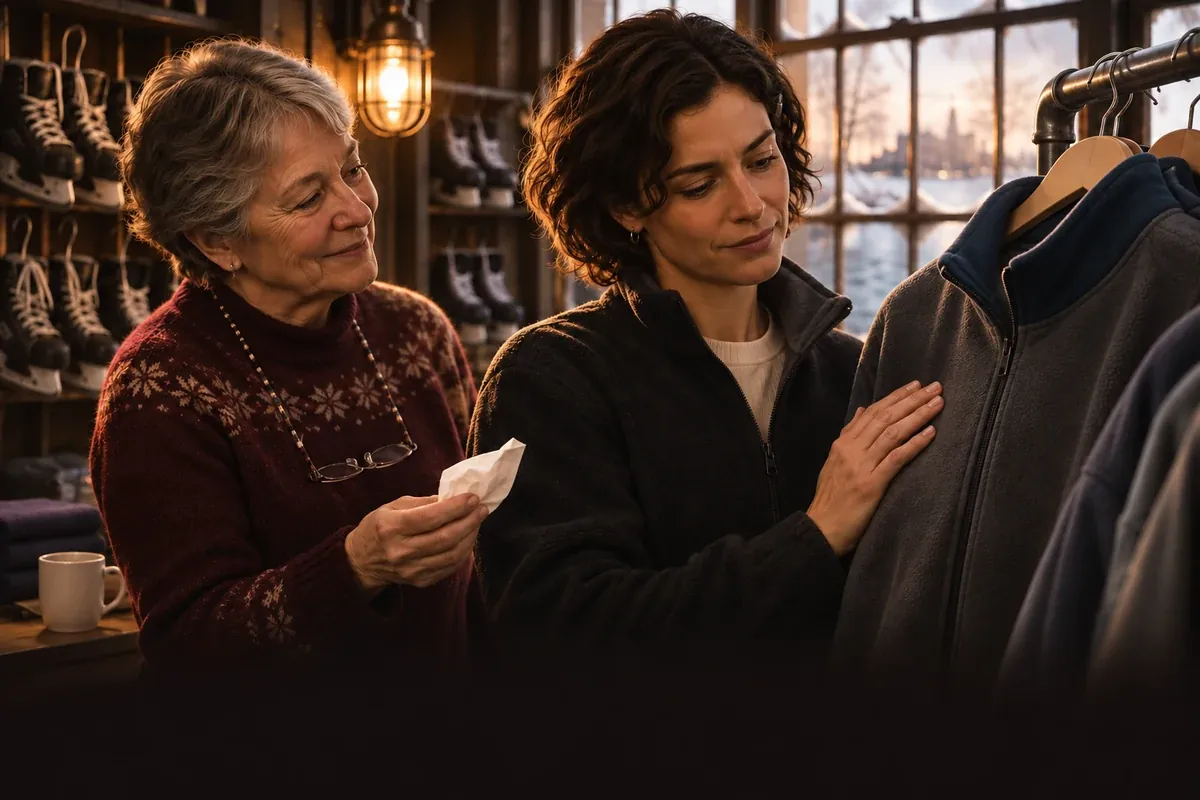
Thea Navarro had made one rule on the drive in from the airport hotel: she would not look at the ice first.
She looked at the ice first.
The Wick sat at the end of Pier Road, a low brick building that had been a lamp factory before it was a practice facility, and the old second sheet was glassed in along the hallway so that anyone walking to the medical suite had to pass the players. At 6:40 on a Monday in February, the first line was running a drill under hard white light. Blades hissed. Somebody laughed.
Number 19 was the third skater in the line.
She had not seen him in eight years, and the first thing she noticed was not his face. It was his left leg.
Every time he crossed over to turn, the hip hitched. It was a tiny thing, a hesitation on the way down into the cut, and he hid it with a tilt of the shoulders that a stranger would call grace. Thea had spent a decade learning to see exactly this. Trunk lean, short stride, weight shifted away from the pain like a man stepping around a sleeping dog.
"Noted," she said under her breath, to nobody.
"You grew."
The voice came from behind her, low and gravelly, and the arms that followed it were already around her ribs. Thea turned inside the hug and found the top of a gray head under her chin.
"Dot," she said.
"Little Theodora." Dolores Whitcomb let go, held her at arm's length, and examined her with the cheerful ruthlessness of a woman who had been issuing skates in this building for thirty-eight years. She wore a reindeer sweater in February and a pair of readers on a beaded chain. "Skinny. Short hair. I like the hair. You eating?"
"I had a banana."
"A banana is a snack that thinks it's a meal." Dot pressed a steaming mug into her hands. It smelled like cinnamon and something stronger. "Don't tell Priya. Walk with me, honey. I'll get you through the room before it wakes up."
"Before it what?"
"Before it finds out you're here."
They did not make it. The practice ended while they were still in the hallway, and the players came off in a rush of cold air and sweat and gear bags, loud and huge in the narrow corridor. Thea had worked with athletes since graduate school. It never stopped being strange how big they were when you stood in a hallway with them.
A rookie with a boyish face and an enormous bag nearly walked into her and apologized to the wall. A goalie with a pale braid down his back looked at her mug, then at her, and said gravely, "You are the doctor. Do not touch the post."
"What post?"
"Any post."
"That's Mick," Dot said. "He's fine. He's Finnish."
A big defenseman with a broken nose and a tired, kind face stopped, tilted his head, and said, "Cap's going to want to be warned about this," before sliding past into the locker room.
Then the corridor emptied in a way that felt arranged.
Eli came off the ice last.
He was out of his helmet, hair dark with sweat, one glove tucked under his arm. Thirty-three, and he looked it in the places where it counted, around the eyes and in the careful way he put his weight down. He had been twenty-five the last time she touched his face. She was not going to think about that.
He saw her.
He stopped walking. The goalie, the defenseman, a dozen bodies in the doorway behind him, all of it went quiet as though someone had pulled a plug. Thea counted, because counting was what she did when she had no other plan.
One. Two. His eyes were the same gray-green of a lake before weather. Five. A muscle moved in his jaw. Nine. Dot very carefully did not breathe. Twelve.
Fourteen.
"Dr. Navarro," Eli said. "Welcome to Brindle Harbor."
His voice was perfectly level. It was the voice a man uses at a funeral for someone he didn't know well.
"Captain Brandt," Thea said, and was proud of her own level voice. "Thank you."
"If you need anything from the room, Dot will see to it."
"I will," said Dot.
"Good." He gave one short nod, put his weight on his right leg to turn, and walked into the locker room. It was the leg he stood on when something hurt.
He had always done that. She had told him so, once, in a kitchen, laughing.
"Well," Dot said brightly, into the silence. "That went great."
"Dot."
"I'm just saying nobody threw anything." She slipped her arm through Thea's. "Come on. I have a surprise."
The surprise was in the equipment room, which smelled of leather, tape and floor wax, and looked like the inside of a very organized hurricane. Skates hung in rows from the ceiling by their laces. A padlock shaped like a goose sat open on the cage door. On a rolling rack by the window hung one gray team fleece with a harbor-blue collar.
Over the heart, in brass-colored thread, it said: T. NAVARRO. TRAINING.
"I had the girl at the embroidery shop do it Thursday," Dot said. "Before you said yes. In case you said yes."
"You couldn't have known I'd say yes."
"I'm sixty-seven, honey. I don't know anything. I just buy the thread early."
Thea put her hand on the fleece. It was soft and slightly too big. For eight years she had walked into new buildings as a stranger, with a badge and a clipboard and a reason for being there. She had not expected to walk into this one and find her own name already waiting.
"Thank you," she said, and her voice did something it had not done in the corridor.
"Don't you cry on my fleece." Dot handed her a tissue anyway. "Priya's waiting in her office. She's very nice. She talks in lists. Go."
Priya Raman's office was glass on three sides and looked out over the harbor, where the lighthouse on Pier Nine was still turning against a gray sky. The general manager was forty-one, in a camel blazer, and had the exhausted precision of a woman who had been awake since the previous Thursday.
"Three things," Priya said, shaking her hand. "One, welcome. Two, the Navarro Protocol pilot starts with twenty-five players, and you have full access to the training staff. Three, the Fitness Certification."
She slid a thin blue folder across the desk.
"Under the league agreement, a player with a medical question over the length of his contract can name an independent evaluator. The club approves the name. The evaluator reports in writing by March 14, and the report is final unless the league's board overrules it." Priya said the last part carefully. "Dr. Navarro, you should know this is not a normal job."
"I did notice the silence in the corridor."
"That was not the part I meant." A small, tired smile. "Read the first page."
Thea opened the folder.
The form was plain. Player: Brandt, Elias J. Date: December 20. Club medical contact: G. Pryce, MD. A line for the requested evaluator, where someone had written a name and credentials in a square, slanted hand she would have known in the dark.
Navarro, T. Doctor of Physical Therapy.
Under it, a signature. Elias J. Brandt.
She had seen that signature on birthday cards and on a grocery list taped to a refrigerator. She had seen his name on one voicemail notification that she had never opened.
"He asked for you by name," Priya said quietly. "Mr. Stroud approved it the same day."
Thea closed the folder very gently, as if it might wake.
Eight years ago she had walked out of Eli Brandt's life because he would not tell her the truth about his own body. And he had chosen her, out of every clinician in the country, to look at it.
She did not know yet whether that was an apology or a trap.