

THE COURT: The defendant shall remain within the boundaries of Sable County at all times pending trial.
MR. MARCHAND: Understood, Your Honor.
Birch Landing is eleven miles across the bay. It is inside Sable County by a margin of nine hundred yards.
I know because I looked it up on the courthouse steps, in the four minutes it took me to be a coward. He chose this boat the way he’d choose a tow route. Public, wet, and inside the line.
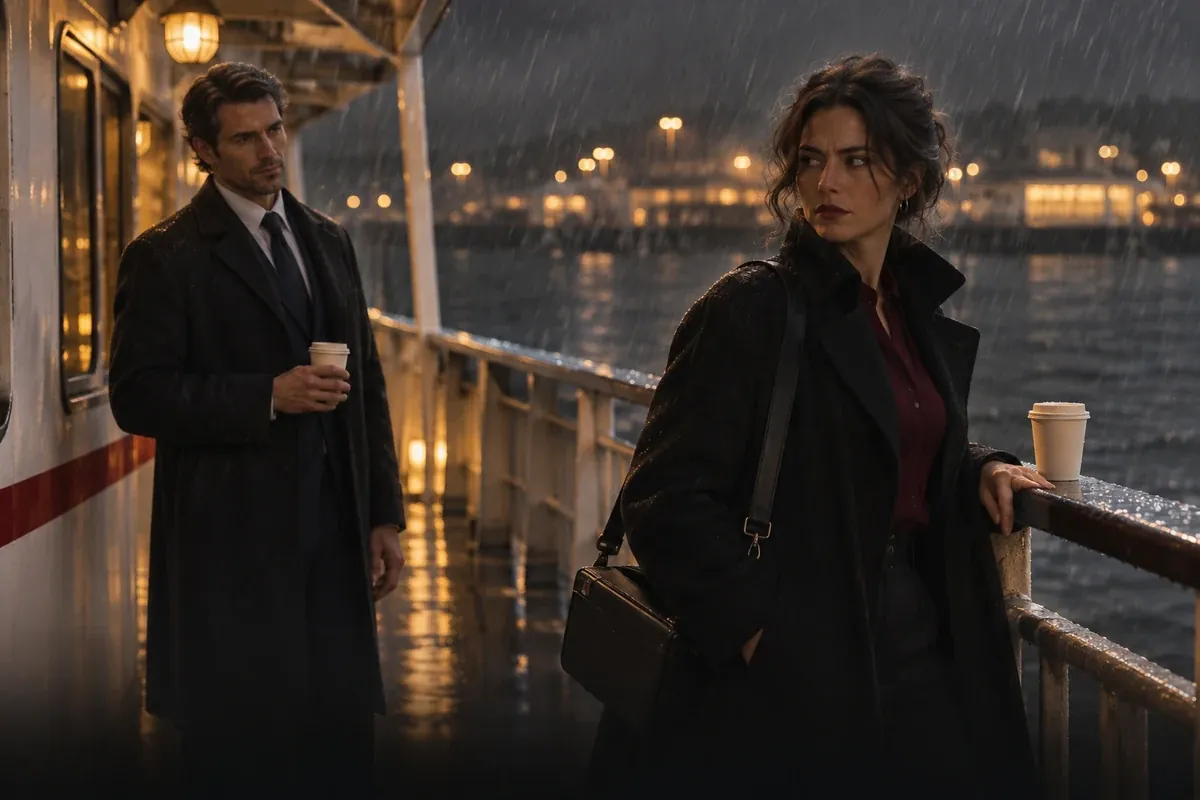
The 6:10 pulls out on schedule. It is a squat white car ferry with a red stripe and a diesel cough, and tonight it is carrying two pickup trucks, a florist’s van, and about forty people who have all found the one dry corner of the deck. Rain slants in off the water. I stay at the rail with my machine strapped to my shoulder and the collar of my coat up.
For nine minutes, nobody comes.
For nine minutes I am almost relieved. I tell myself he was bluffing, that he is a man who sends cryptic texts because they are cheap and make him feel clever.
Then a boot scrapes behind me.
“I brought coffee,” says Jude Marchand. “I didn’t know how you take it. I thought about that for longer than I should have.”
He sets a paper cup on the rail at my elbow. He keeps the other. He does not stand beside me. He stops six feet away, upwind, with his hands where I can see them, and I notice it the way I notice every deliberate thing in a room. He is making himself easy to read.
I leave the cup where it is. “I should be in chambers right now.”
“You should.”
“A defendant who contacts the court reporter outside the courtroom gets a mistrial. If I tell Judge Lyle, you lose five weeks and your bond.”
“If you tell Judge Lyle,” he says, “she’ll ask who you are. I can’t think of a way for that conversation to go well for either of us.” The rain beads on the shoulders of his coat. “So tell her, if you want. I’ll stand here and wait.”
Of all the replies I had prepared, this was not one.
“I’m going to talk,” he says. “You don’t have to. I understand that’s something of a specialty with you, listening for hours while other people say it. I’d just ask that for once you don’t type it.”
I almost laugh. It comes out as breath.
“Five years ago,” Jude says, “on the morning of the fifteenth, my yard’s tow truck brought in a sedan from the harbor lot. Abandoned, engine cold, keys in it. It happens twice a week. My driver ran the plate by habit.” He pauses. “It was Walter Prejean’s.”
The deck lurches under a swell. I put a hand on the rail.
“Walter had been missing for about nine hours by then. By noon his wife was on the local news asking for him. I stood in my yard at seven in the morning, looking at his car, and I did the arithmetic. I’d paid that man twenty thousand dollars every quarter for three years. I’d given it to a stevedoring firm, in a plain envelope, with a line in somebody’s books that said consulting.”
Fenner Stevedoring. Consulting. I kept those books. I wrote that word with my own pen.
“I had the car moved to the back row and told my crew to stack hulls around it. A tug and two shrimp boats, to be exact. I never opened the trunk. I told myself it was a stolen car, and if the police wanted it they’d come ask.” Something shifts in his jaw. “Nobody came for five years. And in June, a demolition crew started crushing the back rows for a condo developer, and the trunk came open on its own.”
“Walter Prejean was in it.”
“Walter Prejean was in it.” He says the name quietly. “Everything I told Ms. Doss about that night was true except the part I left out, which is that I knew whose car it was and said nothing. She’s building a defense around that. It’s not a very sturdy one.”
“You’re telling me you hid a body for five years.”
“I’m telling you I hid a car. I didn’t know about the body.” He tips his head, and the scar through his eyebrow catches the deck light. “That distinction is going to matter to a jury. It doesn’t matter at all to Evangeline Prejean, who sits in the second row and knits something enormous. I’m not on trial for what I did. I’d like that noted. I’m on trial for what somebody else did, and I’d like to be held responsible for my own crimes.”
It is the strangest speech I have ever heard from a man accused of murder.
“Why are you telling me?”
“Because,” says Jude, “yesterday you were a handwriting sample. A girl who kept books and ran. Today I watched you read your own name out loud in front of fifty people, with your uncle four feet away, and your voice never cracked.” He holds my gaze. “I wanted to know what that costs. I think I’m looking at it.”
My pulse is in my ears. “You know who I am.”
“Ada Fenner. Thirty-two. Left Port Sable the night of October fourteenth, five years ago, on the last bus to Mobile. Spent a year in a steno school under someone else’s paperwork.” He says it as lightly as a man reading a menu. “I could tell Judge Lyle tomorrow morning. I won’t.”
“That’s a threat.”
“That’s an inventory.” He lifts the coffee, drinks, and sets it down. “A threat would be if I told you what I wanted. I haven’t told you. Do you see? I could be very rude.”
I stare at him. The ferry shudders and turns toward the Birch Landing channel markers, green and red, wobbling in the dusk.
“I haven’t asked you to testify,” he says. “I won’t. You’d be walking into a courtroom to say the name of the man who raised you, and I know what that sentence costs, because I’ve been paying for my own for five years.” He is quieter now. “I’m asking for one true thing. One fact you’d give a stranger. After that, you can go below deck and I’ll go back to being a client with a very expensive lawyer.”
“Why would I give you anything?”
“I’ve given you a car, a bribe, and a missing commissioner,” says Jude. “I’d say I’m ahead.”
The rain is thick on the wire of the rail. I think about Doss’s question on the floodlight, which only I could have answered. I think about my uncle’s wedding ring, turning.
“I was not a thief,” I say.
My own voice sounds odd to me, rusted, unused. I have said maybe two dozen true sentences in five years, and all of them were about the weather.
“I know,” says Jude. “Thieves don’t keep honest books.”
For a second neither of us moves. The horn sounds, long and flat, over the water. Birch Landing’s terminal lights come up through the rain.
“What did you do with the honest books?” he asks.
I don’t answer. It’s the first answer I’ve ever refused to take down, and I can see that he understands exactly what it means.
“All right,” Jude says softly. “I’m going to ride back on the 7:40. If you want to find me, I’ll be on the covered deck. You’ll want it, it’s dry.”
“You said that in your text.”
“I thought it deserved repeating.”
The ramp comes down with a bang. I pick up my machine and the cup of coffee I never touched, I don’t know why, and I walk away from him down the ramp, and I don’t look back until I have reached the dock.
He hasn’t moved from the rail. In the wet light he looks like a figure bolted to the ship.
The terminal is a low shed with a ticket window and a vending machine. In the lot behind it there is a long gray sedan with its engine running and its parking lights on, and a tall man in a raincoat leaning against the hood with his hands in his pockets.
I know that coat. I have not seen it in five years, and I could pick it out of a thousand.
“Evening, Miss Ada,” says Cosmo Teague. He doesn’t smile. He sounds tired, and that is the worst thing about it. “Your uncle would like a word.”