

The knife in my hand had been rubber six seconds earlier. Now it had an edge, the man across from me had stopped laughing, and the safety wall behind him was growing teeth.
“Everybody off the blue mats,” I said.
A reasonable instruction. Calm. Specific. The sort of thing an instructor said before demonstrating how to fall without turning an ankle into a bag of loose parts.
The wall bit through a climbing hold.
“Red mats too. Go.”
Nineteen adults were on the floor at Second Wind, counting customers and staff. My customers had received a warm-up, a lecture about hydration, and my heartfelt assurance that the knife-defense portion used harmless props. I had been lying for six seconds. A personal record for speed, if you excluded job interviews.
Rhea Coates got the nearest three people moving. She coached volunteer basketball on weekends, which meant she could herd frightened adults with the practiced contempt of someone accustomed to unpaid referees. Milo Penn stood behind the front desk, staring at a sheet of light hanging over the register.
“Dani,” he said, “does the waiver cover extradimensional activity?”
“Only if you spelled it correctly.”
My own sheet appeared when I tried to look at his. It followed my eyes, a neat gray panel without a visible source.
Rounds Integration. Local trial active. Eighty participants registered. Choose an opening class. Trial exits remain closed until first mastery is demonstrated.
Three titles glowed beneath it. Waker. Bulwark. Castoff.
I didn’t have time for descriptions. Behind my sparring partner, the wall peeled away from the concrete and stood up. What I had mistaken for teeth were climbing grips arranged along a long, flexible head. Its body consisted of woven crash mats, cable, and pale plates that looked like broken bathroom tile.
My partner, a forklift operator named Del, raised both hands. He was still holding the second knife. Its new point shook between us.
“Put it on the floor,” I said.
He looked at me. “The thing?”
“The knife, Del.”
He dropped it. Good. One sharp object I could stop worrying about.
The creature took his raised hands as an invitation.
I shoved him toward Rhea and stepped in. The old right knee objected immediately. It didn’t buckle, which was its usual opening argument. Tonight it went straight to the part where it explained why I should have chosen a career sitting down.
The creature’s first limb swept across my chest height. I ducked, stabbed at the joint, and discovered that the new blade was real but my ability to fight a gym wall remained theoretical.
It hit a pull-up rack behind me. The rack bent.
Waker: movement and precision. Bulwark: position and defense. Castoff: progression through replacement. Opening requirements unmet.
“Waker,” I said.
Something tightened under my skin. I felt the room in separated pieces: the angle of the blade, the patch of dust beneath my left shoe, the second creature-limb beginning a slower sweep from the opposite side.
Class accepted. Level one. Stamina twelve. Skills available: Quickstep, Parry, Sting.
Quickstep arrived as an urge to place my foot somewhere I couldn’t reach.
I listened.
The world jerked sideways. I traveled two yards in a blink and crashed into a rolling equipment bin with the elegance of a person being delivered. One point of stamina vanished from the panel. Pain remained firmly in stock.
The creature’s sweep passed through the place my legs had occupied. A customer screamed. Another asked if this was a demonstration. Rhea told him demonstrations cost extra and pushed him toward the changing-room corridor.
I came up with the bin between me and the creature. It smelled of hot plastic. The tiles along its chest shifted, showing a shallow hollow full of gray threads.
“Del,” I said, “how’s your balance?”
“Bad.”
“Then sit down somewhere far away.”
Milo climbed over the front desk. He carried the first-aid bag, a flashlight, and the jar of inexpensive hard candies we used to reward children after holiday workshops. This was adults-only night. Apparently he had decided emotional support didn’t require an age limit.
“The front door opens into another room,” he said. “I tried it. Big room. Full of broken statues. Then it shut.”
“What about the glass?”
“Same room.”
The creature lowered its head. Its feet, which had been loose bundles of cable, stiffened into hooks.
“Get everybody through the changing rooms,” I told him. “Count them.”
“You’re included in everybody.”
“Put me down as probable.”
It lunged.
Parry knew what to do before I did. I turned the blade against a descending tile edge and felt a narrow strip of cold climb my arm. The impact still hurt. My elbow bent too far, and my shoulder struck the bin. But the blade slid aside instead of through my neck.
One stamina. Reduced impact, one direction. Good to know the magic had read the same cheap instruction book I had.
I aimed for the hollow chest.
Sting pulled my arm straight. The knife struck a thread bundle with enough force to punch through. Two stamina. The creature gave a metallic cough, then dragged me forward by the trapped blade.
I let go.
That decision probably saved my fingers. It also left me unarmed while the only weapon I owned stuck out of a moving wall.
“Okay,” I told it. “Very persuasive.”
I kicked the bin. Wheels rattled across the mat, hit the creature’s hooked feet, and stopped. The creature fell onto it. I ran the other way.
The changing-room corridor was only fifteen yards long. A school group had once complained it was too far from the water fountain. I wanted those children here to appreciate the efficient planning.
Rhea waited at the door. A new round shield covered her left forearm, broad as a serving tray, charcoal gray with three light rings around its rim. She had chosen faster than I had.
“Buckler,” she said. “I thought it might stop something.”
“Excellent business model.”
“What did you pick?”
“Poorly, apparently.”
She watched the creature wrench itself loose. My knife remained in its chest. The bin had lost three wheels.
“I’ll cover the door,” she said.
“You don’t know what that shield does.”
“I know what a door does.”
I couldn’t fault her reasoning. She stood at an angle, shield forward, right hand gripping the frame. I fetched a pair of weighted exercise clubs from the rack beside the corridor. Four pounds each. Hard rubber, still rubber. The universe had opinions about which props deserved promotion.
The creature charged.
“Low,” I said.
Rhea dropped her shield. I ducked behind her as the head struck. Light flared across the three rings. One went dark. Rhea slid a foot backward but remained standing.
The creature had expected more distance. Its neck bent over the rim. I hit the exposed knife handle with both clubs.
The blade punched deeper. The gray threads snapped.
Its head struck the floor beside my shoe, jaws still working. The rest of it sagged into the equipment it had stolen. A climbing grip rolled across the mat and stopped against Rhea’s toe.
Encounter survived. Twenty mastery marks. Salvage available.
My hands began shaking now that shaking was no longer likely to get them cut off.
Rhea lifted her shield. Two rings remained lit. “That was a thing.”
“Please put that in the incident report.”
“Are you bleeding?”
I looked at my sleeve. A thin line of red ran from a shallow forearm cut. I hadn’t felt it. That seemed less like a bonus than a reminder to check the rest of me.
“No important blood,” I said.
She gave me the look normally reserved for teenagers trying to hide a concussion.
Inside the women’s changing room, seventeen people sat on benches or stood beneath the row of coat hooks. Milo crouched in front of a man with a twisted ankle. He had folded a sweatshirt beneath the heel rather than trying to force the foot straight. The small, sensible action gave me something to look at besides the glowing menus.
The man asked whether he should stand when we left. Milo told him we would decide after someone checked the ankle. No promise. No panic. Just the next question in an order we could manage.
I realized Milo had already become useful without a class. I made a mental note to remember that when the panel began assigning numbers to everyone.
Del held a paper towel over a cut on his cheek. The water fountain hissed steadily into a growing puddle.
“Seventeen here,” Milo said. “Nineteen with you two. Everyone from the floor.”
“Phones?”
“No signal. Some screens show the class menu. Some show emergency numbers that don’t connect. I picked Surveyor.”
“Can you survey us a way out?”
“I’m starting with the water fountain. It’s angry.”
His gaze sharpened. A line of blue light traveled along the wall, revealing pipes beneath the plaster. He touched his temple, winced, and pointed at the shutoff cover near the floor.
Rhea passed him a club. He pried the cover open and turned the valve. The fountain stopped.
A man near the lockers began laughing. He kept laughing until his shoulders shook. Nobody told him to calm down. We had all witnessed enough unexpected plumbing for one evening.
I leaned against the doorframe and examined the class panel properly.
Might three. Speed four. Endurance three. Read four. Stamina seven of twelve. Mastery twenty of one hundred.
The three skills had cost four points. The sprint and hauling myself upright had taken another. Ordinary exertion counted too; the panel just gave the named mistakes better labels.
The skill descriptions were short. Quickstep moved me two yards over clear footing. It did not make me intangible. Parry reduced one directed impact through a held object. Sting concentrated a thrust along an existing edge or point. None claimed to fix cartilage. I appreciated an honest disappointment.
At the bottom, a fourth line had appeared.
First mastery requirement: attain level two, then demonstrate an independent advance.
“Independent advance,” I read aloud.
Milo looked up. “That sounds like one of those clauses that becomes expensive after you’ve signed.”
“We haven’t signed anything.”
He gestured toward the glowing shield on Rhea’s arm.
Fair point.
I cleaned the cut with the first-aid kit. The alcohol stung more than the monster had, which said something unkind about preparation. I wrapped it and checked the frightened group. Two minor cuts, one sprained ankle, one man breathing too quickly, and seventeen versions of the same question: who was responsible for getting us out?
I knew what happened if I let them settle on me without argument.
“Rhea handles people,” I said. “Milo handles information. I handle anything that tries to bite. If you know first aid, tell Rhea. If you have tools, batteries, food, anything useful, say so. Please don’t hide a knife because you think it’ll make you safer.”
Del raised a guilty hand.
“The other one?” I asked.
He took it out of his sweatshirt pocket. “I picked it up.”
“Thank you for demonstrating the exact behavior I was discussing.”
He surrendered it without complaint. That mattered more than the mistake.
A woman named Patrice had worked urgent care. Two people carried pocket tools. Someone produced a bag of protein bars from a backpack. The panicked man accepted half a bar and a task: tally names, not just heads. He wrote them on the back of the class waiver with a shaking pen.
Before I went back out, Patrice caught my sleeve.
“Your group needs a destination,” she said. “Sitting in here is fine for five minutes. It gets ugly after twenty.”
She had pulled the benches together to keep the injured ankle raised. Her hands were steady now that she had something specific to do. I recognized the strategy. Mine involved a knife and was therefore harder to recommend.
“The front court,” I said. “Whatever used to be outside. I’m checking it.”
“That’s a direction.”
“It’s the best I have.”
She nodded without pretending that was enough. “Then give us a time. If you aren’t back, what do we do?”
I wanted to say I’d be back. A clean promise, easy to understand, with no useful basis. The instructors in my old league had made promises like that before competitions. You’ll be fine. Your leg will warm up. Trust the training.
“Three minutes,” I said. “Rhea decides what happens after that. She’s seen the thing we killed. She knows the shield. Don’t follow me because you hear yelling.”
Patrice took the pen from the name-taker and wrote three minutes on his sheet. She had made my brave little exploration into an accountable task. I liked her immediately and wished she had arrived ten years earlier.
Del stood when I passed him.
“Let me come,” he said. “I can carry stuff.”
“You can help Milo inventory the bags.”
“I ran.”
“You followed an instruction. I give them because I enjoy being obeyed, but also because some are good.”
He studied the cut on my arm. “I thought the knife was fake.”
“It was.”
“I could have hurt you.”
“Yes,” I said. “Then you put it down. Keep doing the second part when it matters.”
He sat. It wasn’t a speech that restored his confidence or forged a lifelong bond. He was a man who had nearly stabbed someone, and I was a woman who had nearly been stabbed. We had both earned a minute without pretending otherwise.
At the door, Rhea checked her shield again. The rings stayed at two. She tried dismissing it, then summoning it back. No free refill. We traded a look over that finding and left the remaining charge alone.
I went out for my first knife.
The wrecked creature had no heart, no organs. Its gray thread bundle unraveled when I touched it, leaving a white bead the size of a marble. The panel called it a novice core. It offered no useful explanation of novice, which I suspected was deliberate.
I put the bead in a zippered pocket. The knife came free with a twist. Its edge was nicked near the point, already bearing the cost of magic I hadn’t understood.
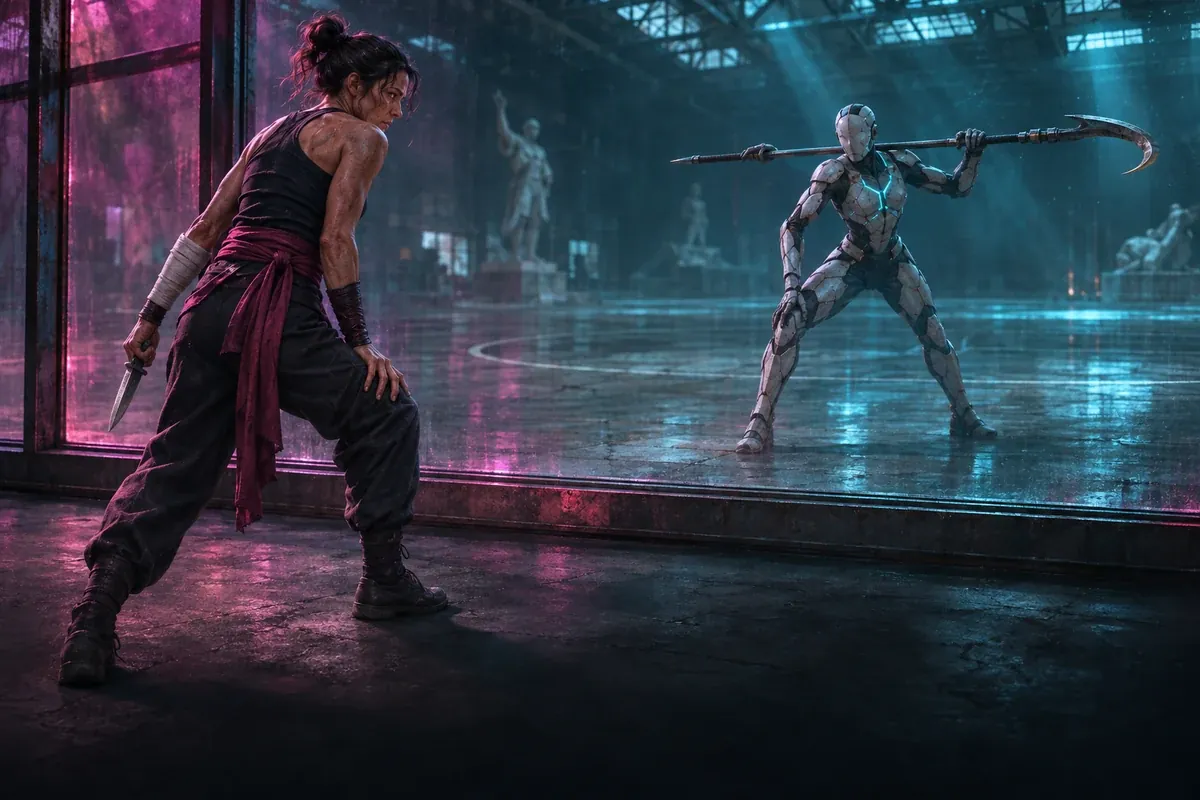
The gym’s main windows no longer showed the grocery parking lot across the street. Beyond them stood an enormous indoor court, roof lost in dusty light. Broken figures lined its far wall. Some had swords. Some had hands like paddles or stones. One wore a skirt of narrow metal strips that stirred without wind.
I pressed a palm to the glass.
A gray notice appeared.
Trial boundary. First mastery incomplete.
Behind the glass, something tapped once.
I pulled my hand away.
The nearest figure had moved. It stood thirty yards from the window now, head tilted, one foot carefully placed before the other. A hook-bladed spear rested across its shoulders. Its body was made of overlapping white plates, but unlike the gym creature, these belonged together. They had been shaped for speed.
The figure tapped the spear butt against the floor twice.
I knew that rhythm. Forward, check the other fighter’s reaction, forward again. I had taught it to beginners for years. Any decent fighter could recognize it. There was no reason it should feel personal.
Then it favored its right leg.
I glanced down at my own stance. Weight on the left. Right knee guarded. A small habit, meaningless to most people, glaring to anyone who spent an evening watching me pretend it didn’t hurt.
The figure adjusted its spear.
It had been watching.
“Milo,” I called, keeping my voice level. “Can you read what’s outside?”
He approached with his flashlight. The beam reflected off the glass. His Surveyor light passed through it and drew a blue seam around the figure’s chest.
“Discarded class body,” he said slowly. “Spear. Level four. Directive: trial enforcement.”
“Anything about how to beat it?”
“No.” He swallowed. “There’s a line about behavior.”
“Read it.”
“Acquisition in progress.”
The figure took another step. This time it matched my pace exactly.
Behind us, the changing-room lights dimmed. The gray boundary notice turned amber.
Boundary grace expiring. Field opens in sixty seconds.
I looked at the knife, the long court beyond the windows, and the ceramic fighter learning how I stood.
“Good news,” I told Milo. “I found the practical portion.”