

Cinderhand sounded considerably more impressive before I read the fuel requirement.
Palm Spark could ignite dry material I touched. Ash Veil needed loose ash and three stamina. Coal Flick needed charcoal and two. I could become a dangerous woman around a neglected barbecue. Against a spear, the advertising seemed optimistic.
The other options were Glassrunner, which required glass footwear I didn’t own, and Deep Listener, which began with twenty minutes of motionless concentration. I looked at the broken armor, my injured knee, and Milo waiting for an answer.
“Fire,” I said. “We’re choosing fire.”
“We?”
“You’re in charge of telling me when it’s a terrible idea.”
“I’d like a salary.”
“I’d like an exit. Let’s negotiate after payroll exists again.”
We spent the next two hours doing something almost embarrassing in its simplicity: preparing. The system hadn’t given the trial a visible deadline. I had nearly mistaken urgency for a rule.
Del’s pairs brought twenty-six more adults from two adjoining rooms. One group had fought a creature made of seats. The other had barricaded themselves inside a storage closet while a metal insect dismantled their fitness bicycles. Rhea organized a safe route back through our gym. Nobody pretended we had accounted for the entire trial. Forty-five people stood with us; thirty-five remained somewhere in the other branches.
Milo found a panel showing those branches. Their entrance lights were green. Alive, according to the description. It didn’t mean uninjured. It didn’t mean safe. We left written directions at every door we could reach and sent the two least exhausted volunteers to watch the junction.
Patrice checked my knee. I let her, which probably counted as an independent advance in my private moral development.
“Old injury?” she asked.
“Yes.”
“Unstable?”
“Sometimes.”
“Tonight?”
“Not yet.”
She disliked that answer exactly as much as I did. She wrapped it with an elastic bandage, tested my circulation, and told me that a bandage was not permission. I agreed. Agreeing was free.
By the end of the rest my stamina had climbed to ten of fourteen. My ribs hurt less when I breathed shallowly. We had gathered cotton cleaning rags, paper towels, two spray bottles of water, a steel wastebasket, and a bag of plain charcoal from the gym’s outdoor grill cabinet. We actually owned a grill. Six months of uneaten staff appreciation lunches had finally produced a benefit.
I burned a handful of paper in the wastebasket with a disposable lighter. No brand on it, no instructions beyond the thumb wheel. It worked. Ordinary fire remained ordinary fire.
The pale dust inside the spear body’s chest was not ash. I tested a pinch with the Cinderhand description open. Unsuitable fuel. Good. We could stop considering whether to use the remains of a possibly complicated being as a smoke screen.
Milo watched me crush cooled charcoal between two plates.
“What will the new body copy?” he asked.
“My current tree. The way I used it.”
“Your injury?”
“Attributes. Recorded execution. It doesn’t mention tissue.”
“Then it might favor your knee without having the knee.”
I stopped crushing.
He made a small apologetic gesture. “Salary work.”
I tried to picture it: my cautious stance, without my reason for caution. A fighter who could abandon the weakness as soon as it discovered the weakness wasn’t real. We needed a plan that didn’t depend on a permanent limp.
Rhea had taken a shield from one of the newcomers. Hers still existed, empty rings and all. The borrowed one was ordinary plywood with a metal handle, part of a historical fencing display someone had brought to their room. She liked it better than a glowing shield that made her count down to helplessness.
“We get the people through first,” she said. “You don’t stand here proving something while the gate’s open.”
“The menu says overcome it for a legacy skill.”
“The menu isn’t paying Patrice for picking pieces out of you.”
That settled the immediate question.
We positioned everyone along the court’s left edge. The gate stood eighty yards away. Between us and it, broken training figures slept beneath a dust-coated scoreboard. Nothing moved when Milo scanned them. Inactive, he reported. No guarantee on how long.
We still had a problem with the thirty-five people in other branches. Rhea made me say it aloud. If we opened the gate and left immediately, some might never hear about it.
Milo brought the branch panel closer by asking it for a route. It unfolded into a map of rooms, narrow connectors, and four gate symbols. Our court served one of the gates. The other three had already registered independent advances.
“Why didn’t ours open then?” I asked.
“Separate group conditions,” he said. “The registration total covers the whole trial. Our branch includes those three rooms. Forty-five assigned to this court now. The other thirty-five have active routes.”
“Active isn’t evacuated.”
“No. But look.”
Small green points moved toward the other gate symbols. Two vanished. A number beside the nearest symbol changed from eleven to nine.
Evacuated. The system supplied the word when I focused on it. I asked whether vanished meant dead, transferred, or some other expensive technicality. It answered: participants have crossed trial boundary alive.
I hadn’t expected the straight answer. I asked twice more anyway.
We sent a volunteer to the junction with the written map. Anyone who found a straggler from another group could point them toward us while our gate remained open. Patrice assigned people to help Vernon and two others who needed support. It was a small amount of organization against a large amount of impossible architecture. It was also better than assuming everyone beyond our sight had become somebody else’s problem.
Rhea waited until the others had moved out of earshot.
“You don’t have to do this just because you’re the instructor,” she said.
“I’m the only person who’s reached the condition.”
“Right now. We could try another fight. Someone else could level.”
“One hundred marks for everybody? With empty shields and people who thought this was a fitness class?”
“I didn’t say it was a good alternative.”
I looked at the white body pieces against the far wall. The spear fighter had killed our expectations with far more efficiency than it had tried to kill us.
“If somebody else wants it, I’ll tell them everything the menu says,” I said. “I won’t make this into a courage contest.”
“I’m talking about you, Dani.”
That landed harder than I liked.
I had a habit of turning concern into a logistical objection. Solve the objection, move on, avoid the part where someone worried because I mattered rather than because I stood nearest the danger.
“I’m scared,” I said.
Rhea nodded once. She didn’t tell me fear made me brave. She didn’t tell me I would win. We were both adults; neither of us needed a decorative lie.
“Then we write down the new skills,” she said. “If you freeze, Milo can remind you.”
He took the chalk. On a clean piece of wall, he wrote fuel, touch, sight. Beneath that: keep moving right.
The last instruction was for my habits. I hated it more than the others.
The safe square he had marked waited in the center.
Before I crossed the chalk line, I checked the fuel pouches one last time. Ash left, charcoal right. Knife still ordinary metal, no longer guaranteed a magical thrust. Milo repeated the three new costs aloud while Rhea watched the route to the gate.
“Spark one. Veil three. Flick two.”
“And no fire inside anyone,” I said.
“The description says existing combustible material.”
“Good. I want the universe to keep writing that down.”
I put a water bottle where the first burning rag would land if I dropped it. We weren’t starting a fire in the only path available to forty-five frightened people.
I stepped into it.
Tutorial replacement. One-time early tier access. Current skills will be removed. Body attributes persist. Replacement creates an autonomous castoff. Pursuit may continue beyond trial boundary.
I selected Cinderhand.
The three skills went out of me.
I hadn’t realized how much room they occupied until the space emptied. The certainty behind a foot placement. The cold line that steadied a blade. The little tug that promised a thrust could reach through resistance. Gone. My hands still knew six years of practice. My body still knew a bad knee. The magic had left both to work things out between them.
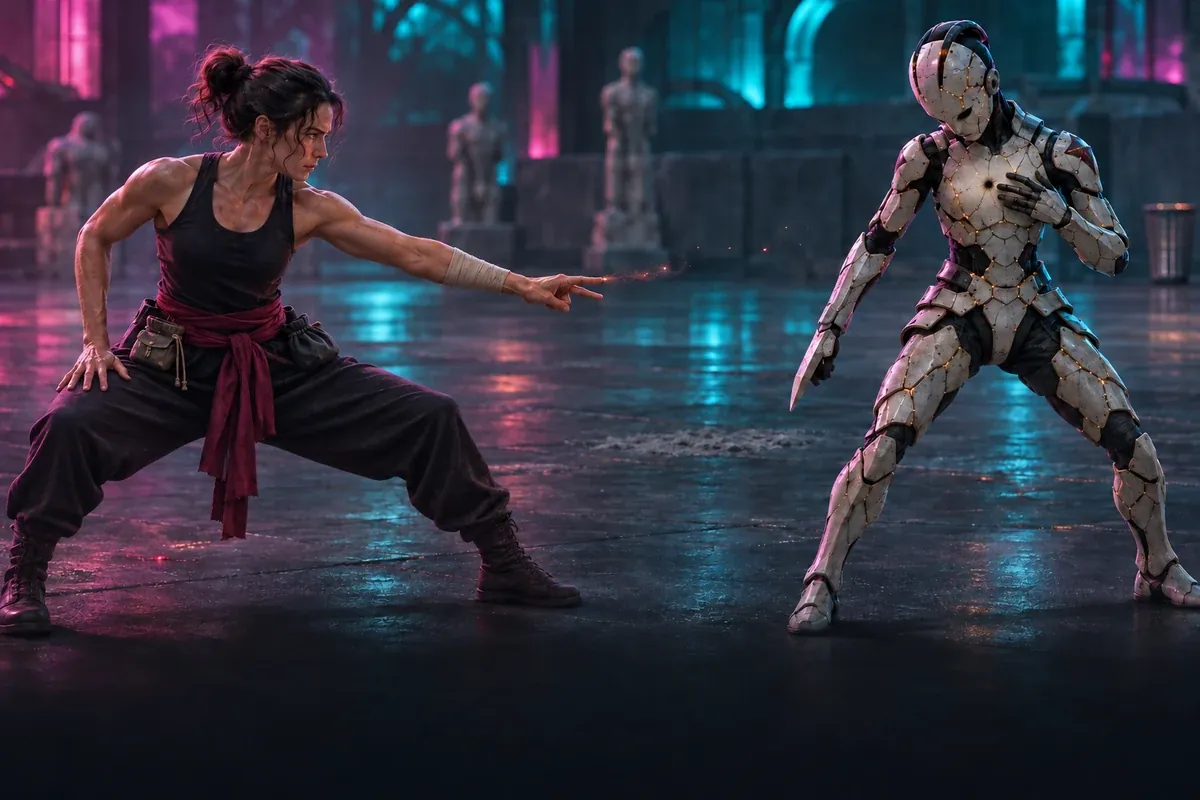
A white shape formed ten feet away.
It began as a loose cluster of plates, assembling around a narrow spine of dark fibers. Legs. Torso. Two arms. A shallow face ridge without eyes. Its left shoulder bore the triangular scuff from my gym uniform, copied as a darker patch in the ceramic.
I hated that detail.
My battered shirt had been cheap. It didn’t deserve to become an identifying mark on my problems.
The figure opened its right hand. A short blade grew along the forearm, narrow and blunt-backed, similar in length to the knife I held. It took my guarded stance. Left foot forward. Right foot ready to withdraw.
Castoff active. Pursuit target: Dani Rusk. Legacy candidate unresolved.
The gate opened.
Rhea shouted the movement order. Forty-three people began crossing the court in a ragged line. Milo stayed with me. Rhea stayed behind them, walking backward with the plywood shield.
The castoff looked at my knife.
“Please don’t take this personally,” I told it.
It came at me.
Quickstep. Two yards. I had known it would use the skill and still almost failed to move. It closed the gap with an abruptness I remembered from the inside. From outside it felt like somebody had edited the middle out of a bad decision.
I blocked physically. No Parry arrived to help. Metal scraped ceramic. The figure drove forward, stronger through the same line because it had no fear of my edge.
I slid sideways. My knee nearly folded. The castoff’s blade cut across the waist of my shirt and opened a thin line of heat along my side.
Palm Spark cost one stamina. I used it on the rag in my left hand.
Cotton caught. I threw the burning rag at its face.
The figure stopped. Only a moment, enough to assess a kind of attack I hadn’t made before. I retreated toward the steel wastebasket. Milo moved in the opposite direction, keeping his flashlight on the figure’s feet.
It brushed the rag away.
No panic. No pain response to exploit. The fire blackened its cheek, and the figure adjusted its pursuit path around the burning cloth.
“Hypothesis one,” Milo said, “unhelpful.”
“I hate peer review.”
The castoff lunged again. I threw a handful of ash.
Ash Veil.
The gray cloud thickened in midair. It swallowed the figure, its blade, the chalk square. Three seconds of blindness. Three stamina. Six remained.
I ran.
A blade stabbed out of the cloud at the exact height of my retreating knee.
I had moved left. Of course I had moved left. My castoff didn’t need to see a habit I performed whenever frightened.
Milo hit me with the flashlight beam, then swung it across the floor to my right. A wordless instruction. Go the direction you dislike.
I went right.
The knee hurt. It held.
We reached the first partition while the castoff emerged from the thinning ash. It looked at the burning rag. Then at Milo. Then at me.
It was acquiring context.
The gate crowd had reached the halfway point. Rhea was helping Vernon, whose ankle could no longer bear him. Del had taken the man’s other arm. They moved at the painful pace of three people discovering how badly walking could be designed.
The castoff glanced toward them.
I slapped my knife against the partition.
“Here.”
The figure turned.
Same directive as the spear fighter. Me first. I could use that, provided I accepted the cost of remaining interesting.
I took a piece of charcoal between two fingers and activated Coal Flick.
A hot bead snapped from my hand and struck its chest. Ceramic darkened. The figure rocked back half a step. The charcoal crumbled into ordinary dust after impact. No giant explosion. No heroic wall of flame. A small, accurate sting with a heat component.
Four stamina. Two more flicks, or one veil and a spark.
The castoff looked down at the mark. It touched the dark patch with its free hand. Then it raised the hand in the exact position I had used to fire.
For one horrible second I thought it could copy the new tree too.
Nothing happened.
It lowered the hand.
“Only recorded skills,” Milo said. “It tried. It couldn’t.”
I wanted to celebrate the limit. The figure Quickstepped around the partition before I found time.
I dropped the knife.
Deliberately. A new action, one with no sensible place in my old fighting pattern. The castoff’s blade shifted to cover a thrust that wasn’t coming. I kicked the steel wastebasket into its shins and jumped backward.
The basket rang against its legs. Hot ash spilled between us. It hopped clear rather than charge through, and I saw another limit: the body didn’t know whether heat could injure its joints. It was testing, the same as we were.
Milo picked up my knife as he passed. He didn’t hand it back. He put himself between me and the gate, offering me a reason to keep running.
We ran.
At the arch, Rhea stood beside a new figure. A man in patched brown armor, carrying a tool that resembled a hunting crossbow with a circular jaw instead of a bow. A white disk hung at his throat. The man from the road. He had returned when the gate opened.
“Your shed?” he called.
“Yes,” I said.
“Fresh?”
“What gave it away?”
He lifted the weapon. The jaw opened with a clean mechanical snap.
“Keep moving. I can take it.”
I should have been relieved.
Then I saw the spear body’s warning in my head. Protect the quiet ones, the hidden warning had said.
“Take it where?” I asked.
“Reclamation.”
The castoff came around the partition. Its blade was low now. It had learned that my right knee wasn’t the only interesting part of me. Its stride lengthened, no longer favoring its own right leg.
Milo had been correct. My weakness had been an inherited assumption. It had already discarded it.
The hunter aimed.
A smaller creature burst from beneath the inactive scoreboard.
It had six legs and a narrow body of dark slats. I heard the scrape of metal along stone as it skittered toward the last evacuees. Rhea turned, shield up. Del pulled Vernon through the gate.
The castoff stopped pursuing me.
It looked at the creature. At Rhea’s shield. At the creature’s low approach beneath the rim.
Then it used Quickstep.
It struck the six-legged thing from the side, driving its forearm blade between the slats. Both bodies tumbled across the stone. A shriek of grinding metal filled the arch.
The hunter fired.
I shoved the weapon upward.
The circular jaw flew over the fighting figures and bit into the stone partition. A thin cable snapped tight behind it. The hunter swore and rounded on me.
“That was worth six cores,” he said.
“It just saved her.”
“It changed targets.”
“Why?”
“How would I know? Move.”
He tried to haul the jaw loose. The castoff rolled away from the dead slat creature, its left shoulder hanging at an unnatural angle. It looked at Rhea, then toward me.
I expected it to charge.
Instead, it stepped between her and the scoreboard.
The panel flickered across my vision.
Pursuit interrupted. Objective conflict detected.
Milo saw the words reflected in my expression. “Dani?”
The hunter ripped his weapon free. He raised it again, this time with the heavy jaw aimed squarely at the castoff’s broken shoulder.
I stepped into his firing line.