

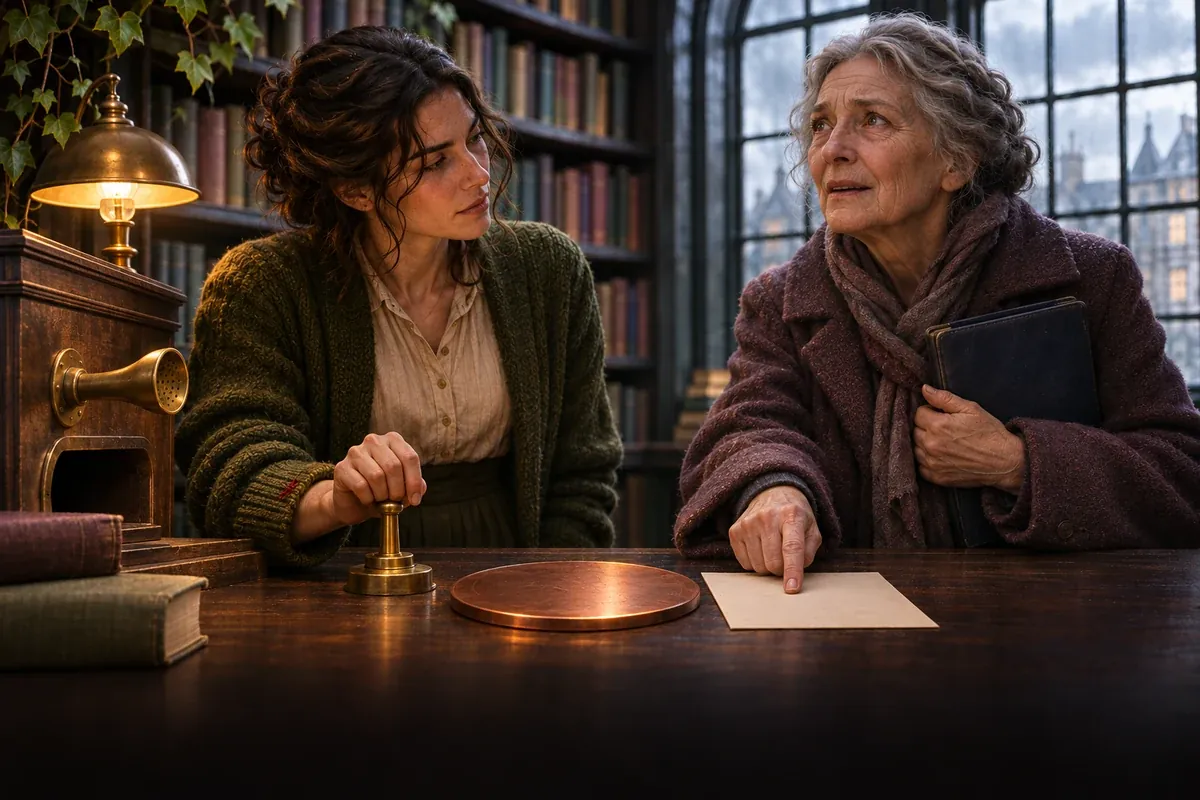
Elsbet Vale remembered her niece’s address, the color of her front door, and the exact words she intended to say about the soup. She had forgotten the way home.
Junia found her standing between Local Navigation and Weather, holding a volume of channel charts against her chest. The copper plate on the returns desk was cooling. A dark thread had vanished into the spine of a book.
“I meant the old harbor,” Elsbet said. “The route we walked when I was a girl. Not the road I use now.”
Junia set her binding knife down. “Wick, will you fetch Mara? Tell her there’s no emergency.”
“There was no emergency when the ceiling fell in either,” Wick said, already finding his coat. “I shall use the reassuring voice.”
The front bell rang as he left. Salt air pushed between the shelves, carrying wet leaves and somebody’s burnt toast. The Lending House of Saltmarsh had stood beside the harbor for two hundred years. It had survived three floods, an unpopular extension, and six committees that thought books should be sorted by the moral improvement they offered.
Junia hoped it could survive another morning.
She took the slip from Elsbet. Named recollection: route to the old harbor, as walked with mother. The fine had been agreed against a late memory folio on coastal navigation. Final consent was signed. The tiny box beside linked recollections was blank.
“Who handled this?” Junia asked.
Elsbet looked at the return chute.
“The voice said it was a simple one.”
The brass tube beside the chute made a soft click.
“The route is accurately bounded,” the Archivist said. “The new road follows the old one for two hundred yards.”
“Which makes it linked.”
“The overlap is incidental.”
Junia turned the plate over. The final-consent imprint was still red beneath the copper. Not yet set. She pulled the recall lever, laid the slip flat, and waited for Elsbet to place her finger beside the signature.
“This reverses the transaction,” she said. “You keep the book fine. We will discuss another way to settle it.”
“Will I owe more?”
“No.”
Warmth moved through the plate. The book on the shelf gave a small sound, like a person turning over in sleep. Elsbet drew in a breath.
“There’s a pothole by the baker,” she said. “I had forgotten the pothole.”
Junia smiled. Her hand stayed on the lever until the red imprint faded.
She asked Elsbet to describe the first turning after the door. Right past the baker, left at the rain barrel, then the lane with the uneven curb. Elsbet answered briskly, annoyed now instead of frightened. Junia made her own notes after the woman had finished. The mistake belonged to the procedure, and the record needed to show it. She would not leave Elsbet’s embarrassment as the only trace of what had happened.
“Please continue to avoid it.”
At the desk behind them, a man set a leather case on the floor. His coat was dark with rain. He had the patient expression of somebody accustomed to watching an explanation become more complicated while he waited.
“Does that happen often?” he asked.
“The pothole is a civic disgrace.”
“I meant the memory.”
Junia folded Elsbet’s slip over the blank box. “Are you returning something?”
“Not that I know of.”
He took a card from his pocket. Corwin Ashby. Office of Civic Lending. Beneath the name was a stamped authorization Junia had been expecting for six weeks and hoping not to receive at all.
The closure review had arrived wearing an excellent coat.
Mara came in with Wick, apologizing to her aunt before she knew why. Junia explained the reversed transaction and arranged an extension on the folio. Elsbet left with her niece’s arm through hers and the determined air of a person who meant to complain about a pothole to the correct official.
Corwin held the door for them.
Junia watched him watch their route through the reading room. Doors first, she noticed. Exits, stairwell, return chute. Then shelves. Most visitors looked at the books first.
“You can use the binding room,” she said. “It leaks less than the office.”
“A recommendation fit for a travel guide.”
He followed her past the public tables. She moved her father’s apron off the spare chair. The canvas was stiff with old paste. Behind the desk, her appointment book lay open at tomorrow’s requests.
“I need your lending register, consent schedules, complaints, and retention policy,” Corwin said.
“In that order?”
“Unless another patron forgets an exit.”
He didn’t deserve the irritation that rose in her. He had seen a dangerous error. She had fixed it, which was the distinction she was clinging to and probably the wrong one.
“Seven days,” he said, showing her the order. “Sundown on the seventh. I recommend continued operation, restrictions, or transfer to central custody.”
Junia read the last phrase twice.
“Transfer includes the memory collection.”
“It includes everything listed as library property.”
“Those books belong to people.”
“Then that should be easy to establish.”
She looked toward the locked door beneath the stairs. Nothing about that door had ever been easy.
The Archivist sounded from the room’s smaller brass tube. “All records will be made available in due course.”
Corwin turned toward it. “Good. Due course begins this afternoon.”
After he went to hang his coat, Junia opened the ordinary register. She could give him circulation, receipts, extensions, repairs. Names attached to memories required more care. Some patrons had trusted the library with things they couldn’t bear to say at their own kitchen tables.
Closing would protect nobody if the collection went to a place they couldn’t reach. Keeping it open by hiding errors would protect them even less. Junia knew both things and hated how little help knowing was.
Wick brought tea and a plate of scones arranged around the chip in the good china.
“How bad?” he asked.
“He counts exits.”
“That could be useful during the next committee meeting.”
She rubbed the red darn on her cuff. “Did you process Mrs. Vale’s consent?”
“No. The Archivist covered the desk before opening. I was patching the west gutter.”
Junia wrote that down. For once, the gutter was not the most urgent repair.
By closing time, Corwin had filled six pages with small neat writing. His lower-case g remained open at the bottom, an odd little unfinished hook. Junia noticed because she repaired books for a living, and the shapes people left on paper mattered to her.
“Tomorrow,” he said, “I’d like to see how a fine is calculated before anyone pays it.”
“You may find it dull.”
“I should welcome that.”
After he left, she checked every slip handled that morning. Three extensions. Two cash payments. Elsbet’s reversal. One record with a reference number instead of a name.
From beyond the returns chute came a man’s voice, thin as sound through a closed window.
“Tell him I kept the blue cup.”
Junia stood. The public room was empty. The voice wasn’t Wick’s, and the Archivist never used a cup.
She lifted the chute flap. A thread of cold air touched her fingers. Somewhere underneath the floor, a book was open when nobody had signed to read it.