

Tessa’s first story concerned a freezer that had tried to make ice out of an employee’s lunch.
It was not a good story. She spent too long explaining the broken thermostat, then forgot what the employee had brought. Kit helped her guess. Dumplings, maybe. As he considered dumplings, his breathing became uneven again, and Nell understood that conversation was covering the problem rather than solving it.
Tessa looked at Nell without stopping her story. Nell pulled the stool closer, making room for a second person instead of arranging a row of spectators. Kit watched them settle around him.
“You can say if it’s boring,” Tessa told him.
“It is boring.”
“Good. That’s the main thing you need to know about maintenance.”
He tried to laugh and had to stop. Nell saw the calculation cross his face: whether the laugh would cost more than he could spare. She wanted to ask him to explain it, then heard how much that request would resemble another task.
She held up the resort telephone so he could see what she meant to do. “I’m calling now.”
He nodded. Della took a step toward the phone and then stopped, as if she had expected Nell to ask which number. The emergency card was screwed to the wall beneath the handset. Its corners were dirty from people touching it while they waited for a line. Nell read the address from it. She would not trust herself to remember a building number just because she needed to sound competent.
She called the emergency number printed beside the recreation-room telephone. A dispatcher answered on the third ring. Hearing an ordinary, slightly bored voice nearly made her sit down.
Nell gave the resort address, the service entrance, and Kit’s name. She described what she could observe, separating it carefully from what she suspected. The dispatcher asked questions. Nell answered them without looking at Della.
“He seems better while he’s being spoken to,” she said. “But it starts again when he isn’t paying attention.”
She repeated the instructions she was given and put Tessa on the line. Kit objected to the cost of an ambulance. The objection, being familiar and reasonable, frightened Nell more than his first request had. A person could be making financial decisions while something fundamental quietly stopped working.
“I don’t know what your charge will be,” she told him. “I know we need them here.”
“My aunt can drive.”
“Can she be here now?”
“No.” He pressed the towel between his palms. “She works mornings.”
The dispatcher was still listening. Nell let Kit hear her report that he was asking about alternatives, rather than telling the voice on the phone that he was being difficult. Kit stared at the handset through the rest of the exchange. When Tessa took it, Nell stayed beside him.
“Did I do something wrong?” he asked.
“During the haul?”
“Anywhere.”
“No.”
Nell had said the word before thinking through how much certainty she was claiming. Then she thought it through and said it again. Whatever she didn’t understand about the equipment, Kit had not earned this by handling it badly.
He let go of the towel with one hand. The room seemed to have placed him back at the beginning of an exam, where a mistake might be discovered and counted against him after the result. Nell moved her completed form out of his sight. It could not help him now.
Della waited until the call ended.
“We have an on-call consultant for training stress.”
“They can talk to the crew when they arrive.”
“There’s a protocol.”
“Then fetch it.”
The director pressed her lips together. “I’ll have to retrieve the folder.”
Nell moved the folding table so Kit faced the open side door. Warm air carried the smell of cut grass through the room. She wanted him to see an exit, a garden hose, a beetle blundering against the doorstop. Things with no interest in what happened to him.
“Did you ever have this before?” she asked.
“No.”
“Anything during the training on Friday?”
“The dummy was heavy.” He made a brief face. “That’s not what you mean.”
“It’s still worth telling me.”
Tessa listened to Kit rather than Nell. She counted softly when his attention slipped, using the same calm voice she’d used to speculate about frozen dumplings. She did not announce that she was doing it. Kit noticed anyway.
“You’re going to get tired,” he told her.
“I have an extremely boring job. I’ve trained for this.”
He laughed once, then took another careful breath.
Nell knelt beside him so he would not need to look up. “We’re going to keep someone here. You don’t have to manage how tired we get.”
“That’s what people say at first.”
She had no useful answer. A promise made in the first ten minutes did not cover the next ten hours. She asked Tessa to call another staff member to relieve her, and Tessa used her own phone to reach a man named Eamon in the grounds shed. He agreed to come to the service entrance and guide the crew in.
Tessa gave him a plain route. The guest entrance was farther away and the summer desk wasn’t staffed. She asked him to bring the service gate key even if he thought the gate was open.
“People shut things,” she said when she ended the call.
Nell asked where she could get another chair. Tessa pointed with her chin. Nell went to fetch it, took three steps, and turned back when Kit’s eyes followed her.
“I’m in the room,” she said.
“I know.”
She brought two chairs. One went beside Kit. The other sat a little farther away, leaving space for the arriving bags and the people who would know what to ask. Setting a place for help seemed a small absurdity until she saw Kit look at it.
Tessa handed her phone to Kit. A metronome app was running. Kit listened, following the rhythm, then asked her to slow it down. The request steadied Nell. He was finding a preference inside the thing being done to him.
They tried the phone rhythm only while Tessa remained beside him. Nobody asked him to stay silent to see what would happen. When Nell began to phrase such a question, she heard the purpose beneath it and stopped. A useful observation could happen without being manufactured.
Kit looked toward the cups by the tap. “Can I have my bag?”
Nell put it within reach. He wanted his phone charger. There was no drama in the request, which was why she nearly cried when he made it.
Help was moving toward them. Nell made herself remember that.
At the pool edge, the dummy’s chest continued its steady rise and fall. Della had pulled the vest back over the slot, leaving the blue thread visible beside its hand. Nell could still feel the cool air against her fingers.
She fetched her phone and took a short video from the edge, keeping Kit outside the frame. The movement was too small to look alarming on a screen. An expensive model with an excellent internal pump. She needed to know what the pump ran on.
“Can I look at that thing?” she asked Tessa.
“You already did.”
“Without opening anything.”
Tessa considered the dummy. “I can show you where the equipment cupboard is. I’m not its technician.”
“Who is?”
“That’s a question I’ve been asking since April.”
“Is the light on the same circuit as the pool equipment?” Nell asked.
“There is no pool equipment running. It’s drained.”
“The basin?”
“Separate room. Separate supply.”
Nell looked up at the vents. “And the sound could travel?”
“Sound travels. A torso moving isn’t a wiring question.”
Tessa said it without contempt. It was a boundary, offered before Nell turned a maintenance electrician into the person responsible for every strange thing in the room.
“Fair,” Nell said.
“I can check what I can see. I’m not taking that chest apart while he sits here.”
“Neither am I.”
Tessa went only as far as the step rail. From there she could see the vest move. She watched through two cycles, then returned to Kit. Her face had changed in the time it took. Nell had wanted another witness to make the scene more manageable. Instead, she had given another person something she couldn’t make manageable for herself.
“What did you see?” Kit asked.
“It’s moving,” Tessa said.
“Like I should be.”
Neither woman answered quickly enough. Kit looked down at the app and adjusted the volume himself.
Tessa stayed within speaking distance while Nell checked the cupboard beside the shallow end. It contained floats, straps, spare paper tabs, and a binder of laminated photographs. No batteries, charging unit, controller, or power supply. The models on the shelf were older than their vests. Their gray surfaces had been patched with different shades of gray.
A plastic case at the back looked promising until Nell unlatched it. It held replacement buckles sorted by size. She shut it again and tried the cupboard’s lower shelf. The folded straps smelled of rubber and dust. No fresh machinery smell, no warmth, no hidden cable threaded through the door.
She resisted the urge to pull everything onto the floor. An untidy search would give her plenty to do, and the room already had enough work that would feel productive while someone else did the difficult part.
“Anything?” Tessa called.
“Nothing that answers it.”
“Then come here a second.”
Nell did. Tessa wanted to stretch her jaw and drink. There was no mystery in that. Nell took the nearer chair and let Kit choose the subject. He asked whether the drive back down the mountain was bad. She described the wide turns and the single patch of loose gravel near the service fork. Tessa drank, checked her phone, and stayed close enough to take over when Nell ran out of road.
It was a poor system with too much depending on two people’s attention. They were allowed to say so. Nell told the dispatcher that when she called for an update, then returned to the cupboard for a specific document rather than another hopeful search.
Nell checked the photographs in the binder against the model in the pool. The same seam beside the ear appeared in an image dated three years earlier. A technician in the photograph held the detached chest panel toward the camera. Behind it was a shallow pocket and a solid molded rib cage. There was nowhere for the pump Nell had imagined.
She photographed that page as well. An old photograph could be mislabeled. It could not tell her the inside of the current model. She wrote those limits under the image rather than treating a useful absence as proof.
Through the cupboard door, Kit asked Tessa whether she could keep the rhythm while he answered a message. She told him to take his time. He dictated two sentences to his aunt, abandoned a third, and asked Tessa to send them. Nell heard the effort in deciding how much worry a family could usefully receive at once. She went back to the shelves with a more specific question: what had changed between Kit’s ordinary Friday practice and the exercise she had signed today?
There were gaps in the schedule where someone had written equipment available. Kit had spent those hours practicing the parts he could do alone. Nell asked him about Friday from the cupboard doorway, close enough for Tessa to correct her if the question became too much.
“Rope. Getting it onto the mat. Keeping the head from banging.”
“Same model?”
“I think so. The wrist string was on it.”
“Anything like this then?”
“No.” He glanced toward the pool. “I’d remember.”
Nell wrote no reported change, then shut the binder. She had almost made him defend his memory because she didn’t like what it implied.
“Do you want me to stop asking?”
“For a bit.”
“All right.”
He went back to his phone. Tessa read his aunt’s reply aloud after he gave it to her. Nell turned away while they discussed what to send back. Even now he deserved a part of his life that did not become an observation in her notebook. She checked the time instead. The crew was still coming. Every few minutes, she had to make the fact feel true again.
Under one shelf lay a shoe.
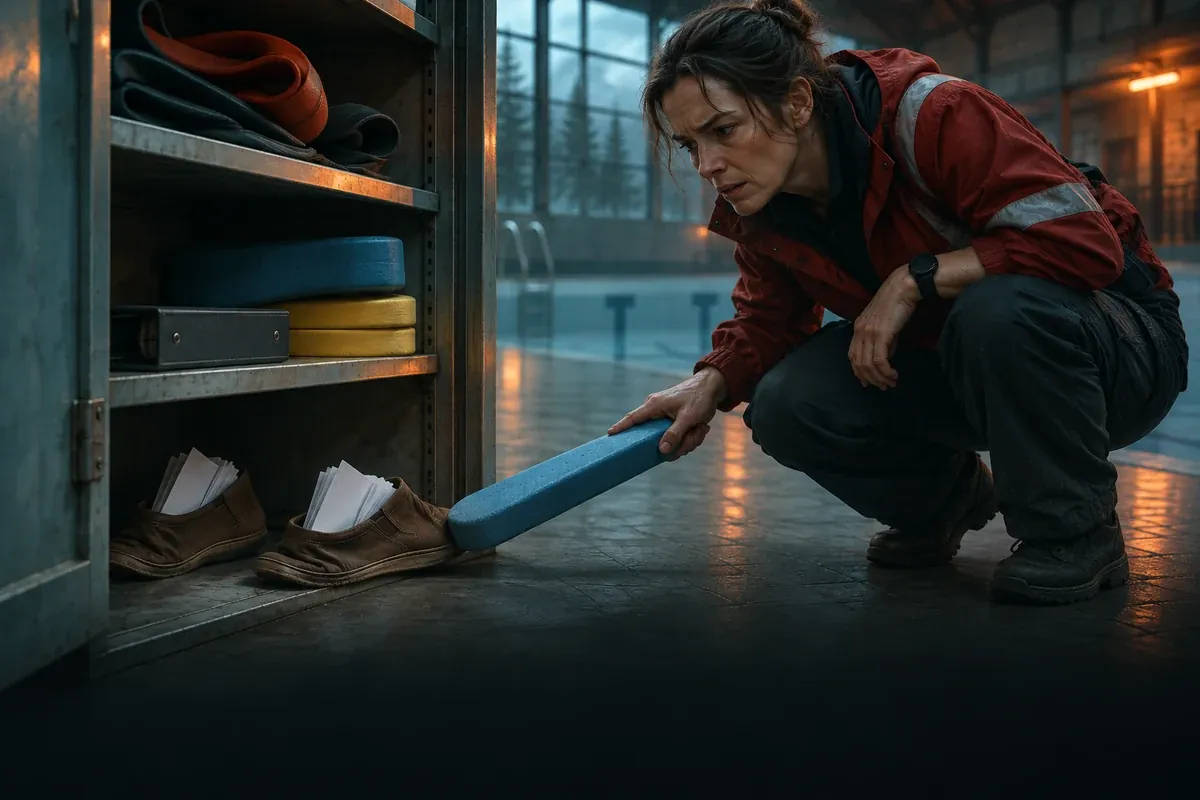
It was a small adult slip-on, brown, with its heel crushed flat. Nell moved it with the end of a float and found a second shoe underneath. Both had been carefully stuffed with blank evaluation forms.
“Lost property?” she asked.
“Maybe.” Tessa had come to the cupboard doorway. Kit remained visible behind her. “I haven’t seen those before.”
Nell left the shoes where they were. She photographed them and the shelves. There was no benefit in assigning every misplaced object a meaning before she knew why a young man couldn’t stop counting his breaths.
Omar Pell appeared in the side doorway carrying two paper cups. He looked from Kit to Nell and put both cups on the table without offering either.
“What’s happening?”
“We’re waiting for medical help,” Nell said.
“Crane said he was taking a break.”
Omar took off his jacket and draped it over the empty chair. He did not ask Kit for an explanation. That spared Nell a conversation she had been preparing to control.
“You wanted the coffee without sugar?” he asked him.
“That’s yours.”
“Then this has started well.”
Tessa shifted her stool to give Omar room. Nell noticed him rest his weight on one leg and started to ask about it. He tapped his ankle before she could.
“Old. Usual. Nothing interesting.”
Nell let it go. She was beginning to find every movement suspicious. That would not make her observant; it would make her exhausting.
Kit looked at Omar’s lanyard, then at his own. Nell saw the question coming and waited for him to ask it. He only pulled his empty clip beneath the towel. Omar had brought coffee because that was what a person brought to someone on a break. Nell did not yet know how to tell him what else he had walked into.
Kit looked at the cups. “I was going to buy you one.”
“Then you owe me.” Omar drew up a chair. “Save your energy for being stingy later.”
Nell asked him when he had last seen Della.
“Ten minutes ago. She did my dry haul before she went upstairs.”
“Evaluated it?”
“I thought you were doing the final sign-off.”
“I am.”
Omar’s right hand went to his lanyard. The lower half of his tab was gone.
Tessa stopped in the middle of a count. Kit drew his own breath and looked at her, waiting for the next number. She resumed immediately, her voice unchanged.
Nell walked to the shallow end. A second dummy lay on a trolley behind a canvas screen. It had no blue thread. Its feet had been turned outward, a deliberate adjustment she remembered Omar making during the warm-up. At the center of its chest, below the gray surface, something clicked.
She did not touch it.
“Omar,” she said. “Sit down beside Kit.”
“I’m fine.”
“I believe you. Sit down anyway.”
He took one step toward the table. His body listed sideways as if the floor had quietly changed its angle. He caught the doorframe and held it, astonished.
The second dummy turned its feet back to parallel.