

Juniper Ostrowski has read the first paragraph of her own Notice of Default over my shoulder and has asked me four questions, none of which I can answer without breaking the rules.
“Who’s the Obligor? Is that me? Why does it say Draw the First when I never had a first anything? Is this a joke from the guys in the plaza?”
“Miss, I have to read it all before I can take questions.”
“Is that a rule? Who made that rule?”
It’s 11:40 on Thursday night at the Wash-N-Go on Fenton Avenue. She’s sixteen, in a gray hoodie with the sleeves pushed up, behind a folding table loaded with other people’s towels. The fluorescent tubes buzz. Eight dryers line the back wall, and seven of them are dead, scorched black around the door seals like burned toast. The eighth turns by itself with nothing in it, humming one low note.
Stack’s text came at 11:21. FENTON AVE WASH-N-GO, SERVE J. OSTROWSKI, FRIEND. Cutter was supposed to ride with me. He remembered something in his car. He said he’d catch up.
I read on. “Pursuant to the terms of the Draw, the Obligor is advised of the amount outstanding, being—“
The paper warms in my hand. I look down and the next line is printing itself in front of me, red, rolling out under the black type like a fax from a bad dream.
NO LENDER OF RECORD.
My voice stops by itself. I’ve served four hundred of these. I have never seen the paper argue.
“What does that say? Is it supposed to be red? Did you do that?”
“No.” I turn the page over. The back is blank. “It’s a flag. It means nobody lent you anything.”
“Then why am I in default? How can you owe money you never borrowed?”
She has her arms crossed over the hoodie like a fence. Behind her, on a shelf under the register, a coffee can sits with a rubber band around it. Bus ticket money. I price the can without wanting to. Maybe two hundred and ten dollars. That’s a one-way to somewhere that isn’t Pell Mills, and it’s about forty dollars short.
“The rules say I can’t take an unlendered core,” I say. “Not ever. It’s the one thing the agent can’t touch.”
“So you’re leaving? Is that how it works? You just go?”
“Somebody sent me for a reason.”
“Is it the dryers?” She flinches as soon as it’s out. “Did I wreck them? Is that why you’re here?”
I look at the burned machines. She wrings her sleeves in her fists.
“Don’t they go when it storms? Not here, anywhere, like out at somebody’s house, up on the hill? Do you ever notice your laundry gets dry real fast when the sky does that weird thing? Like hail that counts?”
Audit weather. A Sixth Draw’s tribulation, a balloon payment coming due with lightning that reads the ledger. She’s been standing in the wash of strangers’ balloon payments for months, drying her jeans.
She picks up a wet sweatshirt from the table. It steams in her hand, sudden and thick, and goes dry before she has finished lifting it.
“Is that supposed to happen to people?”
The door chimes.
Three notes, whistled. Up, up, down.
“Boss,” says Cutter Raines from the doorway, brightly, like he just found a ten on the sidewalk. “Good news and bad news. Bad news first, there’s no paper. Good news, neither of us has to fill out a form.”
I put myself between him and the table without deciding to. “She’s unlendered. You can’t take her.”
“Boss, boss. Who’s talking about taking? I’m doing a wellness check.” He steps in, and the lights flicker under his boots. “Tonight’s off the books. Stack wants a girl with no lender in a box, and you want a clean career, and the girl wants a bus. Three people, one bus. Somebody doesn’t get a seat.”
“You’re a Fourth Draw.”
“I’m a Fourth Draw who doesn’t mind getting hit. That’s the difference, boss, I’m cheerful.” He cracks his neck. “Whistle, whistle.”
He launches. A laundry cart goes across the room faster than a cart should, loaded with towels, and I take it on the shoulder and spin into the folding table. Junie screams, a short high note. Cutter’s second step is already coming down on the linoleum.
The dryers answer.
Seven dead machines shudder at once. The bolts shear with a crack like a firing line, and the round doors slam open and shut, open and shut, and the whole bank lunges off its pads and slides across the floor. A dryer takes Cutter in the hip and pins him against the soda machine with a clang that rattles every window on the block.
“Is that me?” Junie says, white-faced, hands up. “Am I doing that? Why is it listening to me?”
“Keep doing it!”
She doesn’t know how. I do know how to do one thing she doesn’t. When Cutter bellows and shoves the dryer back a foot, I do the thing I’m not supposed to do. I reach for the warm thing under my ribs, the one nobody lent me and I never reported. I take a sliver off the top, burn it, and drive it into my fist.
The punch lands on Cutter’s jaw like a thrown anvil.
He goes sideways. Blood on his teeth, a laugh in his throat. He wipes his chin and stares at the heat leaking off my knuckles, and the grin changes shape.
“Huh,” he says. “Huh. Boss. That’s not a carry. That’s native. That’s a Third Draw living in a Recovery Agent’s chest with no paper on it.”
He saw. He is a witness. I’m still trying to figure out what to do with that when he hits me back.
The room tilts. A wall comes up under my spine and I’m on the floor with Cutter’s knee on my sternum, right over the place where something old sits warm. His breath is minty. He is smiling like someone with nothing left to lose who hasn’t noticed.
“You’re on the wrong side of the order, boss,” he says quietly, so only I can hear. “You should read the paperwork you signed.”
“What order?”
“Oh, you’ll get it. Everybody gets theirs.”
The humming dryer, the eighth one, the one nobody ever put out of its misery, stops humming. Then it screams.
Junie has the door open. She’s standing in front of it with her palms out, and a column of heat comes off the drum like a blast furnace’s breath and takes Cutter off me and through the air, across the folding table, into a rack of detergent. Boxes burst. A white cloud goes up.
“Is this what you wanted?” Junie yells at the ceiling, at no one, at the world. “Is this what everybody wanted?”
I’m already up. I grab her wrist, grab the coffee can with my other hand, and we’re out the back past the trash cans before the white cloud settles.
My sedan has a hundred and ninety thousand miles and a bad starter. It turns over on the second try, and I run three lights on Fenton Avenue with a sixteen-year-old in the passenger seat, clutching a coffee can.
“Where are we going? Are you taking me to him? Should I be getting out?”
“The courthouse.”
“Is that safe?”
I think of Winnie’s space heater and her yarn. “Safest place in the county.”
On the second light, I reach for the color of the front door of the house I grew up in, and my hand closes on a cold shelf. The skim has cost me a door. It was a door, and I walked through it every day for eighteen years, and it had a color.
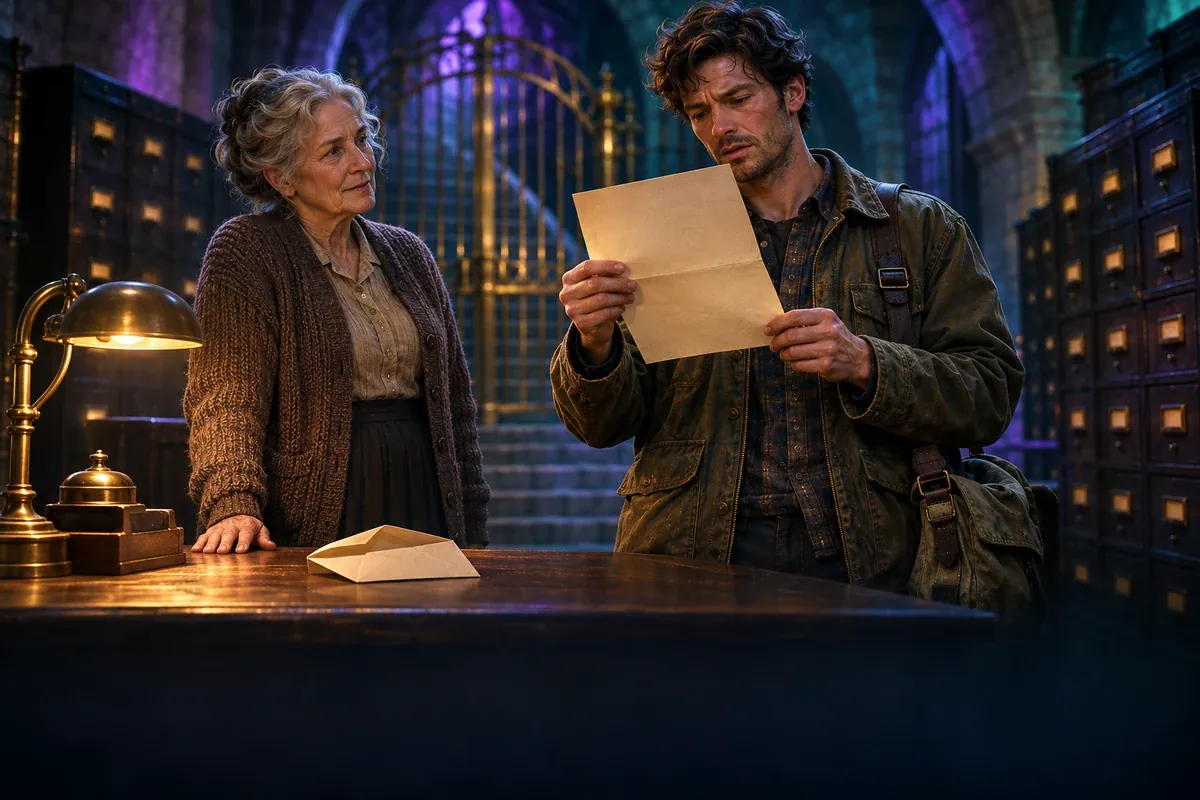
Midnight. The brass gate, the limestone stair. Winnie is awake, which she never is, standing at the foot of her desk in her cardigan with her needles stowed. She looks at Junie, and at the coffee can, and at me.
“Counselor,” she says. Very gently. “Sit down.”
She hands me an envelope. It’s the heavy cream kind, the kind with the seal on the flap, and it’s already open. I pull the paper out and unfold it.
The Notice of Default inside has my name on it, a seventy-two-hour clock, and a signature I would know anywhere, because it’s mine.