

Zeke wanted to sell the module for scrap. Nia wanted to push it back out the airlock. I wanted to eat something that wasn’t sugar gel, and none of us was getting what we wanted.
We had dragged it out of the Hollow with two minutes of margin and one stripped winch. It rode home in the cradle under a cargo tarp, six meters of Authority black, like the world’s largest casket. At Cinch we docked at Nine on the Basket and kept the hold doors shut. Nobody scans a licensed hold without a warrant, and warrants cost more than scrap.
“Six tonnes of steel at forty a tonne,” Zeke said over breakfast, stirring a skillet he had magnetized to the table. “That’s two hundred and forty scrip and a headache, cher.”
“Nobody buys what they can’t title,” Nia said. “And it’s warm.”
“It’s warm because it’s stupid,” Zeke said, with less conviction than his étouffée.
“We keep it,” I said. “Until I know what it is.”
Nobody argued, which scared me more than if they had.
Cinch smells like fry oil, hot solder, and six thousand people’s laundry. It is five drums and a hundred clamped hulls on Span 5, and the main street is a ladder. The rail dealer on the Basket paid twenty-one hundred for my coolant line, and my share came to six hundred and ninety scrip. I walked it up three levels to Spin Doctor, a laundromat where the dryers ran day and night, and climbed the stairs to the office above.
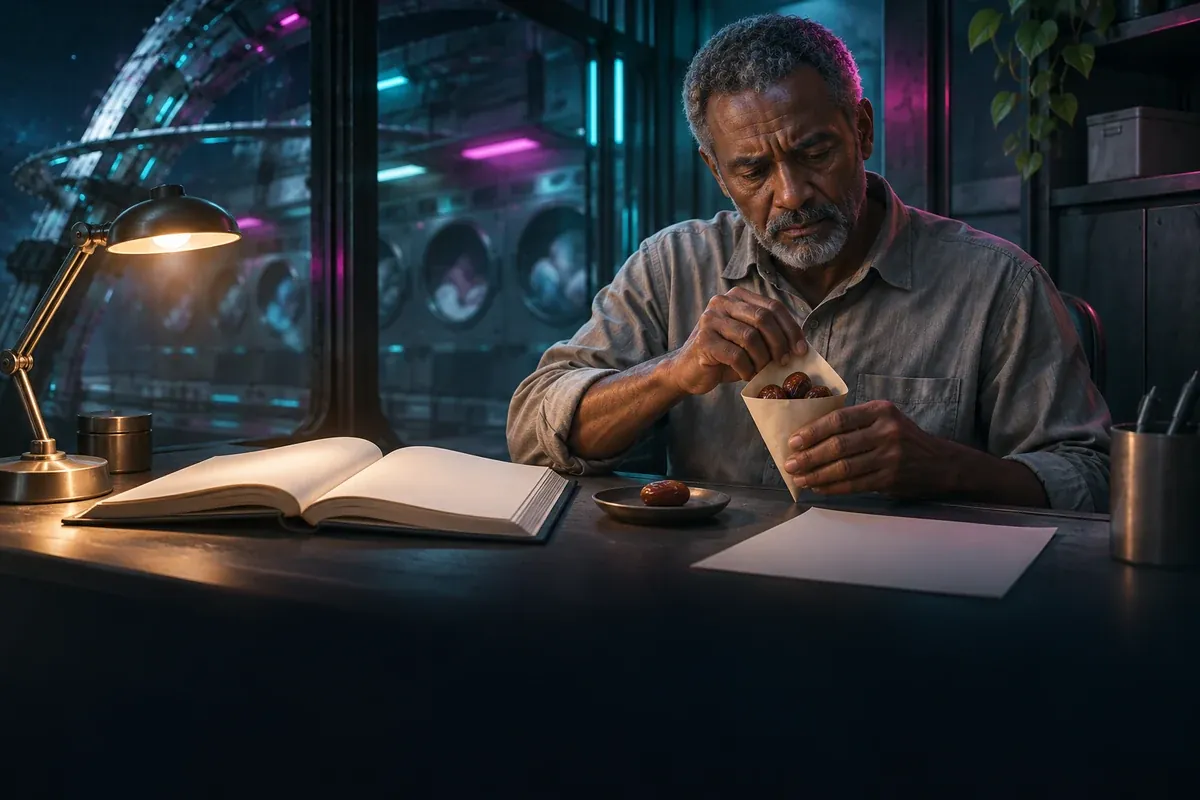
Sol Abdi was sixty-one and tidy as a folded form. He ate dates from a paper cone, one at a time, like pills. He kept his accounts in a paper ledger because he claimed paper was the only thing in the Reaches that couldn’t be locked from somewhere else.
“Six-ninety,” he said, counting it on his desk. “Friday’s twelve-sixty.”
“Friday’s Friday.”
“Interest is interest, walaal. Say it in writing.” He turned the ledger around and I signed for the partial. “Where did you pull the rail?”
“Old galley block in Span 12.”
He wrote that down. I had never been a good liar, but Sol never looked up when he wrote, so I got through it.
“What’s a Class Z?” I asked.
A date stopped halfway to his mouth. In the three years I had sat in that chair, I had never seen Sol Abdi put a date down. He put it down.
“Where did you hear that word?”
“Stencil on a bulkhead. Authority junk.”
“Authority junk,” he repeated softly. He closed the cone with great care. “It’s a ghost, Tobe. The Registry had a form for it once. Forms are like people. When they’re gone, we stop asking where they went.”
“That’s not an answer.”
“It is the only one I have on paper.” He opened a drawer, took out a contract, and slid it over. “Lowtide Drum has a leak. Birdie Halvorsen called at six this morning because she can’t afford anyone else, and I can’t afford to tell her no. Fifteen-twenty for six hours.”
“Why can’t you tell her no?”
“She fed me for a month once, in a bad winter.” He picked up another date, looked at it, and set it aside. “Go and get paid, walaal.”
Lowtide Drum is a can four hundred people live inside, spinning at the end of Span 8. Inside it has grow-lights, a Little League diamond painted on the deck with Velcro bases, and laundry strung across the axis like flags. A girl of about nine met me at the airlock with strips of cooking foil taped down her left forearm.
“Is that a rig?” she asked.
“It’s a good start.”
“Does yours hurt?”
“Only when I’m right,” I said.
Birdie Halvorsen was seventy, brown as a walnut, with a tool belt she wore like a gun. She took my hand in both of hers and looked at the silver strips on my forearm.
“Your mother patched this drum with a welder and a pair of kitchen scissors,” she said. “She’d be glad you came.”
I didn’t say anything. My mother had died when I was nine, in a slow leak on Cinch Drum 2 that nobody found in time. I had been trying to find that leak ever since, in every plate I touched.
The hiss was on the outer skin, near weld seam forty-one. Birdie’s people had patched the visible crack three times since March, and three times it had come back. Nia held the Mercy against the drum while I went out on a short line with Zeke’s doubler plates and a tube of what he called faith and tape.
I put my palm flat on the plate. Pennies flooded my mouth, bright and thick, right where the crack showed. Bleed twenty. Fine.
“It’s the seam,” Birdie said in my ear. “It’s always the seam.”
“It’s the seam that shows,” I said. “Give me a minute.”
My mother used to say the crack that shows isn’t the one that kills you. She said it about hulls, and I think now she said it about a lot of things.
I walked my palm along the plate. Pennies, pennies, then three meters off, under a skin of old paint, a sour thread in my mouth like milk left out overnight. Fatigue. A hairline, running into the joint where the plate met the spoke.
Then, for one second, the whole plate lit up in my mouth.
Every stress line, every weld, every half-healed crack in the drum, laid out like a diagram on my tongue, clean as a blueprint. Pennies, sour milk, cold water, all of it in order. And under all of it, a thread of something sweet that did not belong in a vacuum, something like peel.
Then it was gone. Bleed thirty-four. Something warm ran over my lip and floated up inside my helmet in a slow red bead.
“Tobe,” Nia said. “You’re bleeding.”
“It’s fine. Thirty-four.” I turned my face into the helmet liner, which only smeared it. “It’s not the seam. It’s there, ten o’clock from your light, three meters left of the weld. Under the paint.”
“That’s not a Tier 2 read,” Nia said slowly. “Tier 2 doesn’t do three meters.”
“Adrenaline.”
“Mm,” said Nia, who had flown with my father for two years before she flew with me.
It took three hours. We stitched the real crack with doubler plates and glue, then the false one for good measure, and when the sealant went dark, the hiss stopped as if somebody had told it to. In the airlock, the girl with the foil rig handed me a paper napkin for my nose.
“You look like you lost a fight,” she said.
“I won it,” I said. “It just took a while.”
Lowtide paid fifteen hundred and twenty out of the drum’s emergency fund, and Birdie wouldn’t let me count it in front of her. My cut came to six hundred and eight. Sol already had six-ninety from the coolant money; Friday’s note needed another five-seventy. I sent that from the Mercy’s galley table while Zeke put a plate of rice in front of me and Nia pretended not to look at my bleed ticker, which she can’t see, but which she always seems to know.
Thirty-eight scrip left. A new record low.
The slate chimed with Sol’s receipt. A moment later his face came up on the screen, small and gray and kind behind the glass.
“Received,” he said. “That’s Friday paid on Monday. Your father would have said I was getting soft.”
“Is Lowtide’s fee on the books?”
“Lowtide paid you, walaal. I took nothing.” He rubbed his thumb along his knuckles, the way he did when he wanted a cigarette he’d quit nineteen years ago. “Listen. Whatever you found in the Hollow, say it in writing before you say it out loud. To anyone.”
“Sure,” I said.
He cut the line.
I sat there with a plate of rice going cold and thirty-eight scrip in the world.
I had told Sol Span 12. I had never said the Hollow.