

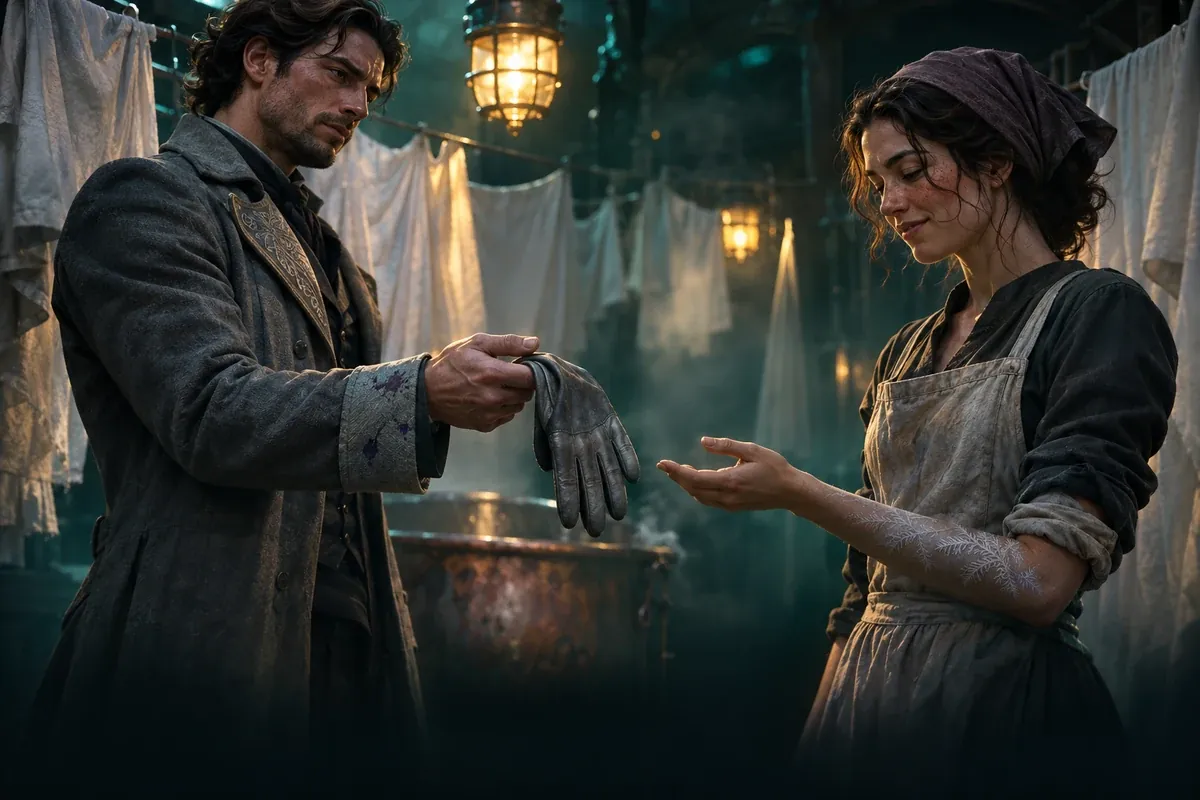
By morning, Lucan Sterne had been awake for twenty-nine hours and was still carrying one of the Rook's gloves.
He noticed it in the lift to the Chief Magistrate's study. It was kid leather, silver-grey, and lined with a faint pale rime that had not melted in his coat pocket all night. It smelled of cold stone and crushed mint.
He put it away again and told himself it was evidence.
"Lucan, my boy." Aurelian Pell rose from behind a desk the size of a small boat. He was sixty-six, silver-bearded, and wrapped in a cardigan that had been darned by three different women. "Sit. Eat something. You look like a ghost who's been audited."
"Chief Magistrate."
"Aurelian, when it's only us." Pell nodded to the corner. "And Captain Skell, who has opinions."
Captain Jory Skell of the Chain Watch stood by the window with his hands clasped behind his back, a scar cutting from his ear to the corner of his mouth like a second smile. He did not look like a man who had opinions. He looked like a man who had a rope in his pocket.
"Hang her from Bellwether's stay at dawn," Skell said. "The whole city sees it. The Thaw is thirty days. People need to know someone is paying."
"People need Spring, Captain." Pell pushed a tray across the desk. "Lucan. Look at this."
On the tray lay a flower pressed between two sheets of waxed paper. A gentian, deep blue, gone nearly black at the edges. The evidence tag read: Almanac Tower, vault floor, cradle of the Spring ampoule.
Lucan looked at it for a long moment.
He had seen eleven of the Rook's gentians. Eleven burglaries, eleven small blue flowers left behind with the courtesy of a calling card. Every one had been folded once down the middle, the crease sharp, like a love note. The kind of thing you did with your thumb in the dark, in a hurry, because you wanted to be remembered.
This one was pressed flat. Perfect, tidy, and dead.
"I'll find her," Lucan said.
"I know you will." Pell's hand rested on his shoulder, warm and heavy. "I taught you to. Eight days, my boy. I can't hold Skell back longer."
"Eight days is generous," said Skell, and smiled with the scar.
On the way out, Lucan passed his clerk's desk. Edda Pym looked up from the stack of papers she was filing, filing, and filing again, a small, iron-grey woman of forty-four with spectacles on a chain.
"The flower," he said, very low.
"Pressed flat," said Edda, not looking up. "I noticed on the broadside sketch. I assumed you hadn't wished to say so in front of the Captain."
"Edda."
"Noted," said Edda, and went on filing, and he loved her fiercely for it.
The Underdecks began where the sun gave up.
Lucan took the long stair down from the Terraces, past the last proper lamp, into a haze of laundry steam and wet rope, and the first breath of it nearly flattened him. Lye, woodsmoke, boiled onions. Forty thousand people, living on the underside of a sky-city, and every one of them had a clothesline.
He had been born four streets from here. He had told the Bench he came from the Terraces, and the Bench had not checked. Nobody checked a man who spoke well and wrote clean.
Wash Row hadn't changed. Mother Tansy's laundry still had the green door, the chipped copper vats, the girls with their sleeves rolled to the elbow. He went through the front, past the mangle, into the drying room where sheets hung in rows like sails, white and damp and silent.
"Tansy?"
The floor went out from under him.
It wasn't a fall. Frost spread across the flagstones in a flash of white lace, slick as glass, and his boots flew out and he landed on his back with all the air going out of him. A cold hand pressed a cold blade lightly to his throat.
"Don't," said a voice, "make me explain it again."
He looked up.
She was crouched over him in a laundress's apron, her dark hair tied up in a scarf, her sleeves rolled to show the white ferns branching up both forearms. She looked tired and furious and entirely, infuriatingly alive.
"Miss Rook," said Lucan, from the floor. "You are under arrest."
"I'm under a sheet, Your Honor. It is not the same thing."
"There are four Watch patrols on the stair."
"There are none. I've counted. Your friend Skell believes I am in the Crown, filling my pockets." She leaned a fraction closer. "Where's my glove?"
"In evidence."
"I'd like it returned."
"I'd like Spring returned."
For the first time, something moved in her face. Not guilt. Something closer to temper. "I didn't take it."
"That is what everyone says."
"Oh, is it?" She sat back on her heels, the blade never wavering. "Tell me, Your Honor, you've read six months of my work. Does that look like me? A vault in the Almanac Tower? Four guards, a seal-lock, a ward-line nine inches thick? I pick pockets and snuffboxes. I steal from people who can afford to be wrong about me. I do not steal the weather."
"Then you're an artist who has been given a very large canvas."
"Do you hear yourself?"
"I hear that the flower was pressed flat."
She went very still.
"Yours are folded," said Lucan, evenly. "Once, down the middle, with a thumb. The one in the vault was done by someone with time, a press, and a book. I noticed it this morning. I haven't told anyone but my clerk. So I have a suspect who's lying to me, and a flower that's lying to me, and I would be very grateful if one of you stopped."
The blade lowered by half an inch.
"Well," said Tamsin Rook slowly. "You're not a fool. Only a magistrate."
"I am considering whether those are the same thing."
"Come with me tonight. The Almanac Tower, eleventh bell. I'll show you the vault. If I'm lying, I'll hold out my wrists and you can put on the cuffs yourself."
"I'll put them on anyway."
"Then what do you lose?"
He thought about it. He thought about Skell's scar and Pell's tired hands, and the pressed flower on its tray, and Lanthorne, forty thousand people on the western edge hanging from a whale that had stopped eating.
"If you're running," he said, "I'll find you."
"I'd be disappointed if you didn't." She stood, and offered him a hand.
He took it. Cold fingers, very strong. He rose and brushed lye off his coat, and then, because it seemed the thing to do, he fished in his pocket and held out her glove.
She stared at it.
"Evidence," said Lucan, "has been returned to its owner."
For a moment the corner of her mouth did something unwilling. "That's the first illegal thing you've done," she said. "I'm so proud."
The Almanac Tower was a stack of grey stone and green glass at the north end of the Crown, built when the city was young and people had still believed in recording things. Edda's forged-enough authority got them past the night porter. Nobody stopped a magistrate with a clerk's note and a tired face.
Eleventh bell found them on the ninth landing, in front of the great iron door of the Season Vault.
It was open.
Tamsin put a gloved hand against his chest, which was neither necessary nor, he found, unwelcome. "Don't touch anything," she whispered.
"I am a magistrate. That is my entire profession."
The vault was a round room lined with four glass cradles, one for each season. Autumn glowed amber, steady and proud. Summer glowed too, though thinner, like a lamp turned low. Winter's cradle sat empty, its ampoule out in the city where the cold belonged. And the last cradle on the left, Spring, was dark.
An old man lay in front of it on the floor.
Archivist Dunstan Pryce. Seventy years old, in his nightshirt and carpet slippers, with a gentle face and a dark stain spreading beneath his chest. His eyes were open.
Tamsin made a small, wounded sound, and went to her knees.
Lucan walked to the cradle instead. It was nothing but glass and brass. The wax seal across its lock had been broken, and, pressed deep into the red stub still clinging to the hinge, was a perfect, crisp impression.
A scale and a feather.
Lucan knew it the way he knew his own handwriting. He had cut that die himself, at twenty-four, the day they gave him the Bench.
It was his seal.