

The door took Tessa Noll’s right boot, then her whole leg, and Mina had three seconds to decide whether to shut it on her.
A brass hatch could cut through a thigh. Mina had seen the aftermath. She hooked her elbow through the rescue rail instead and caught Tessa’s harness with both hands.
“Let go of the wrench,” she said.
Beyond the fitter’s dangling feet, the South Throat inhaled. Dust, loose bolts, and a man’s yellow lunch cloth shot into the open intake. The city should have been drawing air up that shaft. Something below was drawing harder.
Tessa still held the wrench.
“It’s in the latch,” she said. “If I let go, you lose the door.”
The brass under Mina’s elbow began to bend.
Across the lock, Orris Vane drove a steel bar through the manual wheel. His left boot found the wall. His right skidded on the polished floor.
“Give me a number,” Mina called.
“Bad one.”
“Orris.”
“Point six outside. Still falling.”
Bellmouth’s air sat at one mark. Her body knew the difference before her mind finished the subtraction. Her ears ached. Tessa’s face had become a pale, furious wedge above a harness pulled tight enough to bruise bone.
Mina shifted her grip to the chest strap. The left side of her own chest answered with its usual deep rasp, the scar left by Sump Seven. She had been hiding that sound from the rescue captain for nine months.
The rescue captain was gone now. So was half the early shift, scattered into shelter alcoves when the intake reversed.
No one remained to hide it from.
“Unclip the tool belt,” Mina said.
“That’s two months’ wages.”
“I’ll write you a sad song.”
“I want a good one.”
Tessa’s free hand worked at her waist. The belt dropped, struck the floor once, then flew into the throat. The wrench stayed in the latch. She had looped its retaining cord around her wrist.
Mina’s boots moved another inch.
She needed less pulling force on Tessa. The old rescue cloth on her belt was only six feet long, waxed canvas folded around a wire rim. Standard equipment for putting a breathable pocket over a worker’s head. It would not close the shaft. It might cover enough of the opening to give Orris a chance.
She could not hold the harness and open the cloth.
“Tessa. My left hip. Blue pouch.”
The fitter looked down at the space beneath her.
“Look at the pouch,” Mina said.
Tessa reached. A rivet burst out of the rescue rail. It struck Mina’s cheek, hot and small. Mina tightened her elbow against the next upright and felt the skin split beneath her sleeve.
Tessa pulled the cloth free with her teeth and shook it open.
For a moment the canvas filled like a sail. Then it wrapped itself around Mina’s head.
The world became wax and the sour smell of old breath.
She had closed a hatch in darkness once before. Cal had knocked from the other side. Three fast taps, one, two. Their childhood signal for let me in.
Her hands began to open.
Tessa struck her wrist.
“Stay here.”
The words cut through the remembered knocking. Mina bit down on the cloth, dragged one corner clear of her nose, and shoved the rim toward the bottom of the doorway.
Air slapped it flat against the opening.
Tessa’s body rose six inches.
“Now!” Mina shouted.
Orris threw his full weight onto the bar. The hatch moved. Its lower edge scraped the canvas, caught Tessa’s boot again, and stopped.
“Foot out,” Mina said.
“It’s twisted.”
“Out of the boot.”
Tessa planted her bare left foot on the door frame. Her face changed. Mina knew that expression: a worker measuring how much pain a job would cost, and finding the answer inconvenient.
She pulled.
The right boot stayed in the hatch. Tessa came free with a sharp cry that the throat swallowed.
Mina hauled her over the rail. They landed together. Orris kicked the bar. Brass struck brass, and the door slammed shut on the abandoned boot.
For half a breath, the room went quiet.
Then the hatch lifted out of its lower hinge.
It did not fly inward. The pressure pinned it outward against the rim. A narrow black seam opened along the bottom, where the boot held the gasket apart.
The seam screamed.
Orris looked at the wheel. His steel bar had bent into a shallow bow.
“How long?” Tessa asked.
“Long enough to leave,” Mina said.
She took the fitter’s arm and pulled her toward the inner door. Tessa could stand on the injured ankle if she kept her knee straight. Orris abandoned the wheel and followed.
The inner door did not open.
Its gauge needle sat against the stop. The safety dogs had locked when the intake reversed. Bellmouth’s engineers had been very careful to prevent one failed chamber from taking the whole city with it.
They had also been careful to put the release on the city side.
Orris struck the door with the bar.
“Three in South Lock!” he shouted. “Three breathing!”
A faint answer came through the metal. Mina could not make out words.
Tessa pressed her cheek against the frame. She had a fitter’s habit of listening with her whole face.
“They’re bringing the equalizer,” she said.
The outer hatch groaned.
“How long?” Orris asked.
“Too long,” Mina said.
Her rescue cloth fluttered beneath the crooked hatch. The room’s air was going through that thin seam, taking warmth with it. Frost formed on the brass below the handle.
Mina went back.
Tessa caught her sleeve. “You can’t hold a door.”
“No.”
Mina knelt beside the seam and pressed the wire rim of the cloth flat. The canvas was torn. A slit the length of her thumb snapped open and closed as air rushed through it.
She put her palm over the slit.
Cold hit her skin hard enough to burn. The suction pulled her wrist down. She leaned her shoulder into the cloth and worked her other hand beneath its folded edge.
She had plugged damaged breathing hoods before. Keep the patch flat. Spread the force. Leave no edge for the air to lift.
This patch was her.
The pull reached her chest.
Mina had no sensible explanation for that. Her palm was on waxed canvas, her lungs inside her ribs, and the space between them should have belonged entirely to the world. Yet she felt the escaping air tug at something behind her breastbone.
Her left lung seized.
She remembered Cal’s knocking again. She pushed the memory away because it was useless, because a memory could not turn a wheel or free a trapped boot, because Orris had a daughter waiting above the lock.
She drew one careful breath.
The tug became a hollow.
Words appeared at the edge of her sight.
Sustained differential recognized.
Adaptation available: Pressure Diver.
Reserve formation requires living breath. Accept?
Mina knew people who had been offered classes while falling, starving, or bleeding out. The Measure had poor manners and no interest in providing a second opportunity.
“Yes,” she said.
Something opened inside her without opening her body.
Air entered a space she had never possessed. It came hot, though her palm was freezing. Her pulse jumped. A tightness spread around her ribs, below the old scar.
Reserve capacity: four liters at one-mark equivalent.
Captured: two point one liters.
Differential tolerance: point two mark.
The words blurred. She could feel the captured air, a round pressure held beside the act of breathing. Her lungs continued working, rough and ordinary. The new space sat somewhere her hands could not reach.
The seam stopped pulling against her palm.
For one absurd second, she thought she had solved it.
Captured: three point eight liters.
Heat burden rising.
The next breath scraped through her chest. The reserve was almost full. The slit remained open beneath her hand, and the throat below still wanted everything.
She needed to put the air somewhere.
Mina looked at the twisted boot in the gasket.
“Tessa. Can we move that heel?”
“With a pry bar.”
“Orris has one.”
“It’s bent.”
“So is everything else.”
Tessa crawled beside her. Blood had soaked the fitter’s sock. She took the bar from Orris, set its bowed tip under the boot heel, and pressed.
The slit under Mina’s palm widened.
She felt the reserve fill completely.
Four liters. That was all. The Measure had given her a cup while a river emptied through the wall.
Her vision narrowed. Heat crawled up her throat. She could release the air into the room, but the seam would take it straight back and her hand would freeze again.
The boot needed a shove away from the gasket.
She put her free hand against its sole.
“On three,” she said.
“Which hand are you using?” Tessa asked.
“I’ll tell you afterward.”
Mina did not know how to empty the reserve. She knew what it felt like to let a controlled breath pass between nearly closed lips. She pictured that small opening, and the shape of her hand on the boot.
One.
Pressure pushed against her palm.
Two.
She made the opening narrower.
Three.
The boot snapped out of the hatch. Orris caught Tessa by the back of her coat as she fell. The heel struck the far wall and broke in half.
The gasket seated.
Mina’s left side went white with cold.
She made a sound she hoped the others would mistake for a laugh, then folded over her own knees.
Reserve: empty.
Technique recognized: Cup.
Uncontrolled discharge. Tissue stress recorded.
“Useful observation,” she told the words.
Tessa was beside her, pulling the cloth away. Mina tried to help and discovered her left hand had become a remote, stupid object. She could see it. She could not persuade it to close.
Orris wrapped both her hands in his coat.
The inner door rattled. A voice came through, clearer now.
“Stand clear. We’re equalizing.”
Mina lifted her head. The hatch remained seated, but a dark wet line crept across the lower hinge plate. Not water. Sealant, squeezed from its bed by force it had never been built to hold.
“Tell them to hurry,” she said.
Orris did.
The equalizer took twenty-seven breaths. Mina counted every one because she had no better way to keep from trying the new reserve again. Its emptiness had a strange appeal, the promise of a tool she could reach without asking anyone to hand it over.
That was going to be a problem.
The inner door opened onto four rescuers, two blankets, and Sela Fen with her medic’s bag already unbuckled.
Sela took one look at Mina and said, “What did you do?”
“Improvised.”
“I dislike that word in a breathing injury.”
Tessa was put on a stretcher. Orris insisted he could walk, then accepted a shoulder when his knee buckled. Mina turned back to the lock before Sela could catch her chin.
The upper gauge, the one connected to Bellmouth’s main intake, had begun turning backward.
The pipe feeding the city rattled overhead.
From somewhere in the market galleries came the deep, slow note of the air bell.
Once meant a faulty valve. Twice meant take shelter.
It rang a third time.
Mina had heard that signal only during drills.
Sela guided her away from the lock with a hand between her shoulder blades. They passed through a narrow corridor lined with breathing hoods. Some were gone already. At the far end, a boy stood on a crate fitting a hood over an old woman’s gray braids.
People were behaving well. Mina had always found that more frightening than panic. Panic used up the easy choices. Quiet people were saving themselves for the difficult ones.
“How many hurt?” she asked.
“Six that reached us,” Sela said.
“And the intake?”
“The bell tells you what I know.”
They emerged into the South Gallery. Bellmouth opened around them, terraces and rope bridges hanging in a cavern too wide for any lamp to find its far side. Morning shutters stood open over fungus beds. Carts waited at the bakery. A line of laundry stirred toward the intake shaft.
The laundry should have stirred the other way.
Mina stopped.
At the center of the gallery, a brass relief pipe rose from the floor beside a public water basin. A small safety whistle sat at its top. It was designed to warn if the intake pressure exceeded the main line’s rating.
The whistle made no sound.
Dust was going into it.
She put her good hand over its opening and felt the gentle, steady pull.
A city could survive a broken hatch. They had spare hinges. Tessa could make a gasket from scrap if she had to. The intake reversing meant the whole column of air beneath them was moving in the wrong direction.
“How much stored?” Mina asked.
Sela hesitated.
“Mina.”
“Tell me.”
“Six days at normal use. Longer with rationing. Less if the storage seals see the same reversal.”
The new reserve inside Mina remained empty. Four liters, when a whole city needed breath. She pressed her palm harder against the relief pipe, as if she could hold the answer shut.
Across the gallery, someone began lowering the morning shutters. A child complained that the beds would lose their light. A woman told him to fetch his grandmother’s mask.
Sela took Mina’s wrist off the pipe.
“You’re coming to the infirmary.”
“I need to see where it’s drawing.”
“You need to learn whether your ribs are freezing from the inside.”
That was a good argument. Mina hated those.
She let Sela turn her toward the stairs. Tessa’s stretcher passed them, the fitter sitting upright despite a rescuer’s objections. In her lap lay the rescued wrench.
Tessa raised it when she saw Mina.
“Still owe me a song.”
“After I learn to breathe.”
“Work on both. I’m particular.”
Mina managed a smile. It hurt the cut on her cheek.
At the first stair, Sela made her stop again. The medic pulled Mina’s collar aside and touched the pale skin above her left ribs. Mina flinched before the fingers reached it.
“That’s a surface burn,” Sela said. “How far does it go?”
“I don’t know.”
“And how long has your left lung sounded that way?”
Mina watched the stretcher disappear into the upper passage. She could lie, go home, and be back at the rescue rail before the next shift knew she had left. She had maintained that arrangement for months. A competent worker was allowed to get tired. Nobody demanded a reason for every cough.
Then the relief pipe ticked behind her.
“Since Seven,” she said.
Sela’s face stayed still. That made it worse.
“You’ve been doing lock work with an unreported pressure injury.”
“I passed the shift test.”
“You learned the test.”
Mina had. Three shallow breaths could sound perfectly clean if she stood straight and kept her shoulders down.
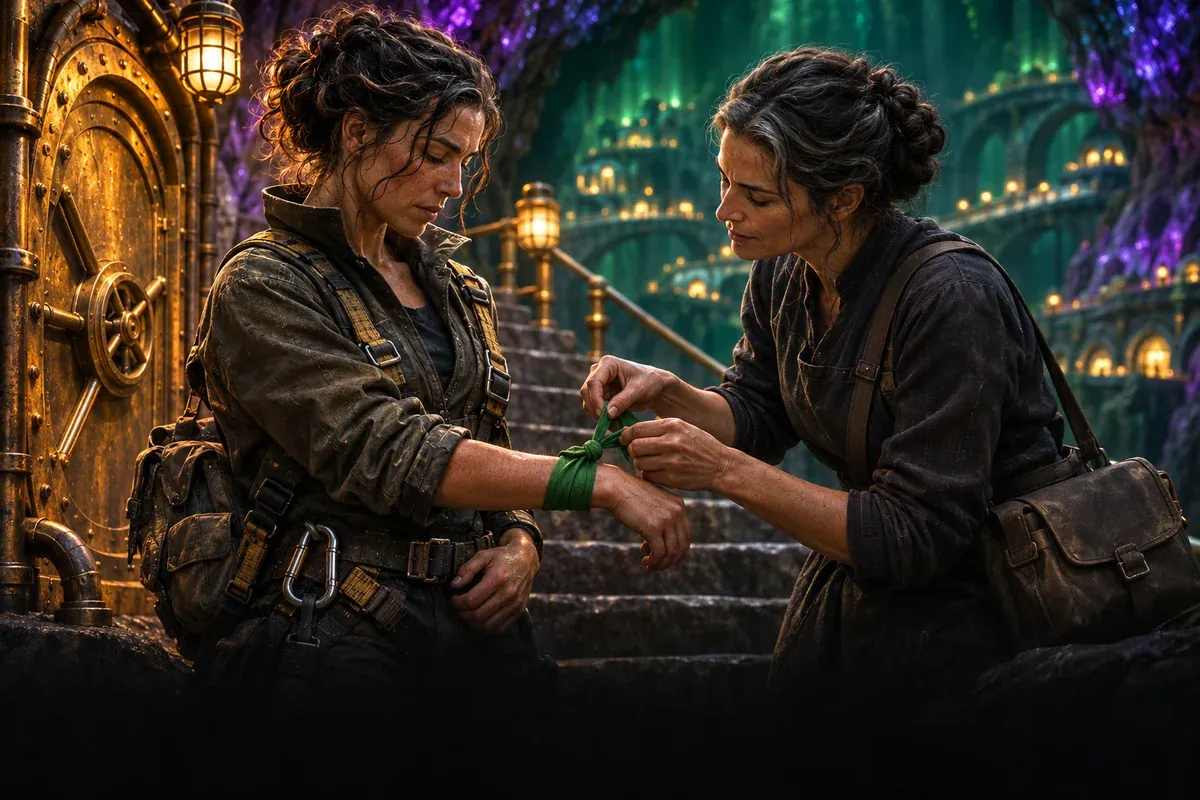
Sela opened her bag and took out a length of cloth. She tied it around Mina’s wrist, green side outward. The infirmary used green for people who could walk but needed watching.
“Now your next crew will know,” she said.
Mina wanted to pull the cloth off. Instead she watched Sela knot it where her stiff fingers could not easily undo it.
A rescue worker came down the stairs with a slate tucked beneath his arm. He glanced at the green cloth and crossed Mina’s name off the next lock rotation.
It was a small movement. She felt it more keenly than the cold in her side.
“Someone has to go below,” she told Sela.
“Then someone has to come back healthy enough to tell us what they found.”
Mina started up the stairs. She kept the green cloth on.
Below their feet, through stone and brass and the city’s ordinary morning noises, something vast drew another breath.