

The gray thing in the pipe had teeth on its underside.
Mina saw them when Orris tilted the lamp. A fringe of little white hooks lifted from the brass, then vanished beneath a sheet of flesh no thicker than her glove.
“Dust mantle,” Tessa said. “Don’t give it your face.”
“That was my second choice.”
“What was your first?”
“Leaving it alone.”
The mantle slid over the route cylinder. Its skin matched the dust so closely that Mina lost it whenever it stopped moving. A second mantle lay farther down the pipe, spread across a filter screen.
They were not large predators. They ate insects, pipe fungus, and anything small enough to fit beneath them. A worker’s hand qualified if the worker was careless.
Tessa fitted a socket over the grate’s upper bolt. She had borrowed tools from the cargo crew: two wrenches, a hammer, three uneven lengths of wire. Orris had found her a new chair, this one with four reliable legs and no wheels.
“Pressure first,” Mina said.
Orris set a small gauge against the inspection port. Its needle steadied a little above one mark. Safe enough to open if they did it slowly. The clean air coming from the pipe would move into the cargo pit rather than pull them down.
“Flow’s stronger than it was,” he said.
“Means somebody needs it more,” Tessa answered.
She eased the bolt back half a turn. Air hissed around the grate. They waited for the sound to weaken, then released the lower bolts.
Mina took the first weight. Her left hand held. She made herself notice that before she trusted it with more.
They laid the grate against the wall.
The nearest dust mantle flattened.
Mina lowered a broom into the pipe. The creature did not move until the bristles came within a hand’s length. Then it folded around the broom head so quickly that the handle jumped in her grip.
The teeth made a sound like someone tearing stiff cloth.
“Hungry,” Orris said.
“They all are,” Tessa said. “The old screens used to bring them insects.”
Mina pulled the broom. The mantle held the bristles and the pipe at once. She could have hauled harder, but a broom head dropping loose would put an angry animal between her and the cylinder.
She let the handle go slack.
The creature loosened its grip to climb toward the wood.
Orris slipped a flat shovel beneath it. Tessa rang her wrench against the grate, a sharp metallic note. The mantle flinched toward the sound. Orris lifted.
It came off the pipe in a soft gray fold.
They tipped it into an empty scrap bin and put the lid on. The lid rattled once.
“One,” Mina said.
“Don’t count,” Tessa said. “They hear confidence.”
Mina checked her rope. Orris checked it after her. She lowered herself into the pipe feet first, keeping her shoulders against its upper surface. The slope was gentle, but dust lay over brass polished by years of moving air.
The route cylinder waited below her right boot.
She hooked it with her heel and drew it closer.
A seam opened in the dust beneath it.
The second mantle had moved.
Mina brought her knees up before it could reach her bare throat. It struck the sole of her boot and wrapped around the leather. Teeth scraped metal on her heel plate.
She planted the other foot against the pipe and stopped sliding.
“Rope,” she said.
Orris took the strain immediately. Her harness tightened. The mantle pulled the other way, using more of its body than she had thought possible. It spread across half the pipe.
Mina’s boot began to peel off.
“Of course,” she said.
“Take it off,” Tessa called.
“I’d like to own two by the end of the day.”
She reached toward her belt for a knife. The mantle lifted a pale edge toward her moving hand. Underneath, the teeth formed three overlapping rings.
She stopped reaching.
A brief rush of air might lift it from the leather. She could feel the empty reserve ready beside her breath. There was plenty of air in the pipe.
She cupped a little.
Warmth formed under her bandage. Alongside it came a bitter taste, sharp enough to make her tongue curl.
Contamination suspected.
Reserve intake halted.
Mina coughed.
The mantle lunged toward the movement. She kicked, striking brass with her heel. Pain jolted through her hand where she caught herself.
“Up,” she said. “Now.”
Orris pulled. Mina kept the bitten boot braced against the creature. It rode with her, a gray flap attached to her foot. Tessa slid the shovel between leather and flesh. She pressed with the uninjured side of her wrist.
The mantle came loose.
It fell down the pipe, caught the filter screen, and spread there. Mina scrambled out with the cylinder clutched beneath her elbow.
Her mouth tasted of old coins.
Tessa dropped the shovel and stared at her wrist. A narrow red line ran from the cuff to the heel of her hand. The metal had heated while she pushed through the flow.
Orris shut the inspection grate as far as the crooked bolts allowed.
“We’re done for a minute,” he said.
Mina wanted to object. Then she looked at Tessa’s wrist and sat beside her instead.
The fitter had not made a sound.
“You burned it.”
“You bruised your hand.”
“That wasn’t an exchange I offered.”
“Good. Terrible bargain.”
Orris brought clean water. They washed Tessa’s burn and Mina’s scraped glove. The new bruise swelled across the back of Mina’s left hand, dark beneath the knuckles.
She opened the route cylinder with her right.
Inside lay a roll of oilcloth, a little packet of filter pellets, and a letter so old the ink had bled into blue ghosts. The drawing remained clear. It showed the old intake pipe running down through White Sill to a settlement named Lowglass. Below Lowglass, two curved passages met at something marked TURN LUNG.
The main intake joined there.
Mina held the drawing flat against her knee.
“It’s a bypass,” she said.
Orris leaned over her shoulder. “Was a bypass. Drawing’s older than my daughter.”
“Older than you,” Tessa said. “That hinge symbol went out when the east works closed.”
A note ran along the drawing’s lower edge.
Pilot flow returns through counterline. Do not cap blind.
Someone had underlined the last four words hard enough to scratch the cloth.
Mina thought of the safety whistle drawing dust inward. The city knew its main intake. Most workers had forgotten the smaller lines wrapped around it.
If the counterline still carried clean air, it could show them where the reversal began.
She looked at the grate.
“We need a sample from farther down.”
Orris said nothing.
Tessa held up her burned wrist.
“I’m not going back in,” Mina said.
“Good opening,” Tessa said. “Continue.”
Mina unfolded the rescue cloth. Its thumb-length tear remained. Sela had told her not to work a boundary. She had just tried to swallow dirty air without knowing what was in it.
The class did not make judgment for her. It only gave her new ways to make the same mistakes.
“We build a sampler,” she said. “And a filter.”
Tessa looked at the packet of pellets. Her expression changed from resistance to professional interest.
“Those are old reed-char. Might still work. Might have eaten damp for twenty years.”
“How do we find out?”
“We use something less expensive than your lungs.”
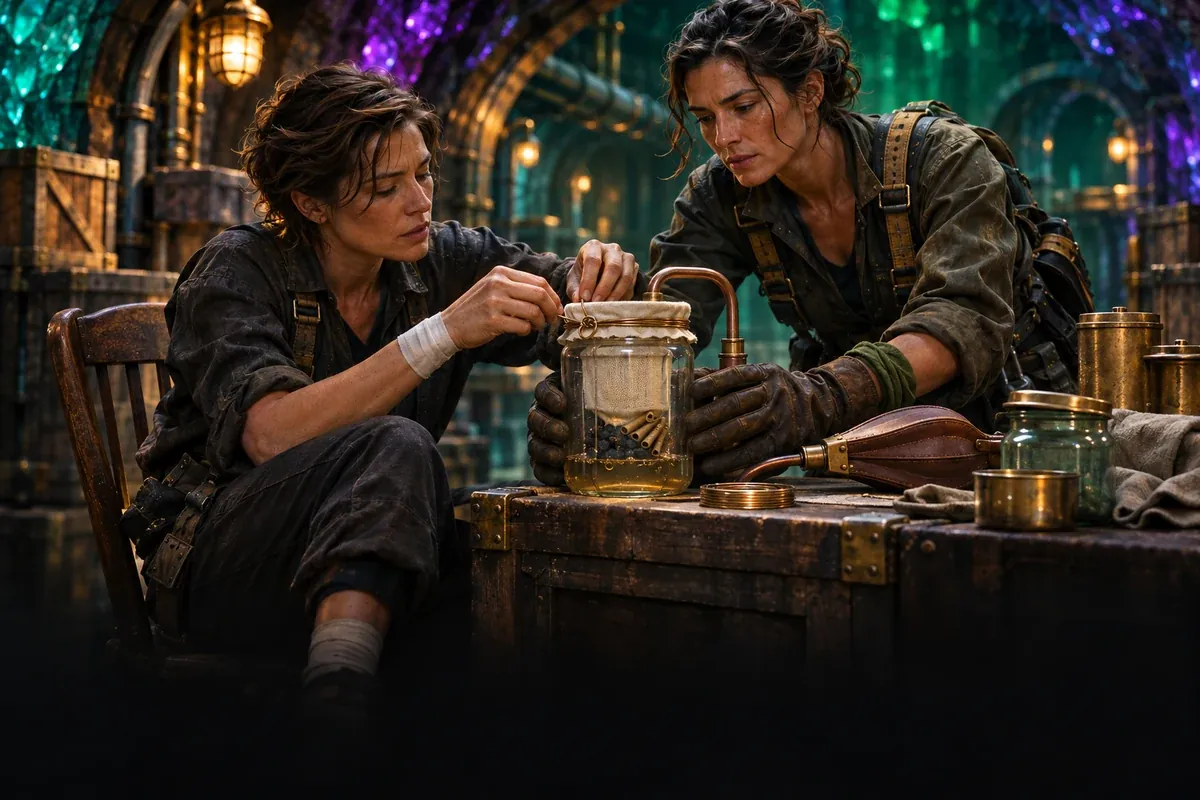
The cargo crew gave them a clear jar and a length of copper tube. Orris fetched a small hand bellows. Mina helped Tessa tie a sleeve of clean cloth around the pellets, then fit the sleeve inside the jar. Tessa’s injured wrist stayed close to her body; she held the small pieces against her knee and made Mina turn the wire.
It took longer that way. Nobody suggested she stop.
They tested the arrangement with air from the pit. Orris pumped. Mina held the test lamp against the outlet. The flame stayed blue and steady.
“Now the pipe,” Tessa said.
Mina ran the copper tube down through the grate until its tip rested past the first filter screen. Orris worked the bellows. Air passed through the pellets and into the jar.
A yellow stain bloomed along the cloth sleeve.
The lamp flickered orange, then steadied.
“Still dirty,” Mina said.
“Less dirty. Change pellets.”
They divided the remaining packet. The second sleeve stayed pale at its outer edge. The lamp gave a clean blue flame.
Tessa made Mina smell the outlet without inhaling deeply. The bitter metal tang was gone. That proved little about every possible poison, and Tessa said so. It did prove the pellets captured whatever had first stained the cloth.
“Keep the intake small,” she said. “Watch the sleeve. If it yellows through, you stop.”
Mina cupped half a liter from the outlet.
Warmth gathered under her ribs. No warning appeared. She held it for three breaths, then released it through the test lamp’s chamber.
The flame remained steady.
She emptied the reserve completely before speaking.
“That works.”
“For this gas,” Tessa said. “Here. Today.”
Mina nodded. Tessa waited until she said the words aloud.
They had a usable sampler. Getting it past the damaged screen without feeding it to the mantle remained a problem.
Orris considered the dented scrap bin. Something scratched under its lid.
“Do they like their own company?” he asked.
“Usually,” Tessa said. “Until there’s food.”
He tied a cord around the bin’s handle and set it on a trolley. Mina understood his plan a moment before he said it. The mantle in the pipe hunted movement and vibration. The one in the bin could provide both.
They rolled the bin across the floor to the grate. Orris lifted the lid just enough to let the captured mantle taste the air.
Its gray edge reached toward the opening.
The mantle in the pipe began to climb.
Tessa tapped the bin with her wrench. Once, then again. The second creature accelerated, rippling up brass with the quick uneven motion of a rug being shaken out.
Mina caught herself leaning away. She forced her feet to stay still.
Orris laid the shovel across the grate, forming a narrow bridge into the bin. The first mantle flattened along one wall. The second came over the shovel and struck it.
The sound inside the bin was unpleasantly soft.
Orris shut the lid. Two gray edges squeezed against the rim, then withdrew.
“Company,” he said. “Briefly.”
Tessa laughed once and pressed her wrist into her lap.
Mina lowered the sampler.
The tube passed the screen. Deeper in the pipe, the current tugged on it, stronger than the gentle flow at the grate. She fed another six feet, then another. The drawing showed a sampling spur just before the pipe split.
The tube struck something solid.
She moved it sideways until it slipped through.
A low note came up through the copper, too deep to be a whistle.
Orris put his palm on the tube. “That’s a valve.”
“Opening?”
“Closing.”
The current stopped.
For a breath, all three of them held still.
Then the copper tube jumped in Mina’s hand. Air came up it warm and fast. The jar’s cloth sleeve ballooned. Tessa grabbed the clamp and pinched the line shut before the glass could break.
Mina’s reserve remained empty. She had not tried to catch the surge.
She felt absurdly proud of that.
Orris put his ear to the tube after they had bled its pressure off.
“Someone working the valve?” Mina asked.
“Could be a person. Could be the cycle.”
He listened longer.
“Twelve counts,” he said. “Then release. Same each time.”
Mina held the route drawing beneath the lamp. The Turn Lung symbol was shaped like two chambers around a central throat. One fed the main intake. The other fed the narrow counterline.
“It’s breathing,” she said.
Orris looked at her. “A machine can breathe.”
“Something below is moving on a cycle. If we know the cycle, we can get through.”
Tessa touched Lowglass on the oilcloth with a clean finger.
“If the old settlement’s still there, they know it better than we do.”
Mina pictured the vertical distance. White Sill. Lowglass. Turn Lung. She had done rescue descents below the city, but never beyond the old cargo junction. People who traveled deeper hired pressure hunters and took weeks.
Bellmouth had six days. Less now.
A shout came from the freight lift. Sela stepped out carrying a medic’s bag and a face that suggested she had already heard about the well.
Mina put down the drawing.
“I didn’t go in the low gas,” she said.
Sela looked at her bruised hand, then Tessa’s wrist, then the bin, which rattled hard enough to move its trolley.
“Give me the shorter account.”
They did. Sela listened while she dressed Tessa’s burn. When Mina described the reserve warning, the medic’s hands paused.
“You stopped when it warned you?”
“Immediately.”
“That’s worth keeping.”
She examined Mina’s chest. The frost burn had not spread. Her pulse remained fast. The hand would bruise badly but the fingers moved without the sharp pain of a break.
“Rest tonight,” Sela said.
“We need to descend.”
“I heard that part.”
“Then you know why.”
“I know why people hurry. I patch the results.”
She finished the dressing and took the drawing from Mina. Her gaze traveled from Bellmouth to Lowglass. Something in her expression shifted when it reached the lower settlement.
“Edda Rill,” she said.
Orris straightened. “Still alive?”
“As of three months ago. Traded for lungwort. Complained about my prices. A healthy sign.”
“Who’s Edda?” Mina asked.
“A Pressure Diver who got old.”
Mina looked at the green cloth tied around her wrist.
Sela folded the drawing carefully, avoiding the worn creases.
“You don’t go tonight,” she said. “You eat, sleep, and let me check you in the morning. Then, if you’re still determined to be foolish, you take people equipped to keep you foolish for longer.”
Tessa picked up the sampler.
“I can make this portable.”
“You can barely walk,” Mina said.
“I can make that portable too.”
Sela gave the drawing back. Beneath her thumb, the scratched warning remained visible.
Do not cap blind.
Before they packed up, Tessa opened the sampler and spread the stained cloth on the crate. The yellow had reached farther than Mina remembered. A tiny channel ran along the jar’s rim where the wire had pressed the fabric out of shape.
“Leak,” the fitter said.
“The lamp stayed blue.”
“Lamp needs enough air to burn. You need more than that to make sensible decisions.”
She cut a fresh gasket from the unburned edge of Mina’s rescue cloth. The cloth was ruined for its old purpose anyway. Mina watched Tessa fit the new seal, check it with broth-colored water, and retighten the wire until bubbles stopped escaping.
They tested the jar again. This time the yellow stain spread evenly, with no pale shortcut along the edge.
Tessa gave Mina the damaged gasket. “One more thing for your collection.”
The bent hook already occupied her pocket. Mina put the gasket beside it and felt both objects settle against her leg.
“I’m going to need a larger pocket.”
“Or fewer mistakes.”
“Pocket’s more likely.”
Sela closed her bag. “Bring both of those tomorrow. I want the people going with you to see them.”
Mina started to protest that the people were already here. Then she understood. Sela wanted the errors to travel with the successes. She folded the stained cloth into a clean scrap and packed it where everyone could reach it.
Mina had once closed a hatch because a gauge told her no one beyond it could still be alive.
This time she would go down and look.