

The intake form said WOLF, HIT BY TRUCK, and under “Owner” somebody had written CASH in block letters, which told me two things before I even got the exam room door open. One: whoever filled it out knew we billed ranchers on credit and strangers up front. Two: whoever filled it out had done this before.
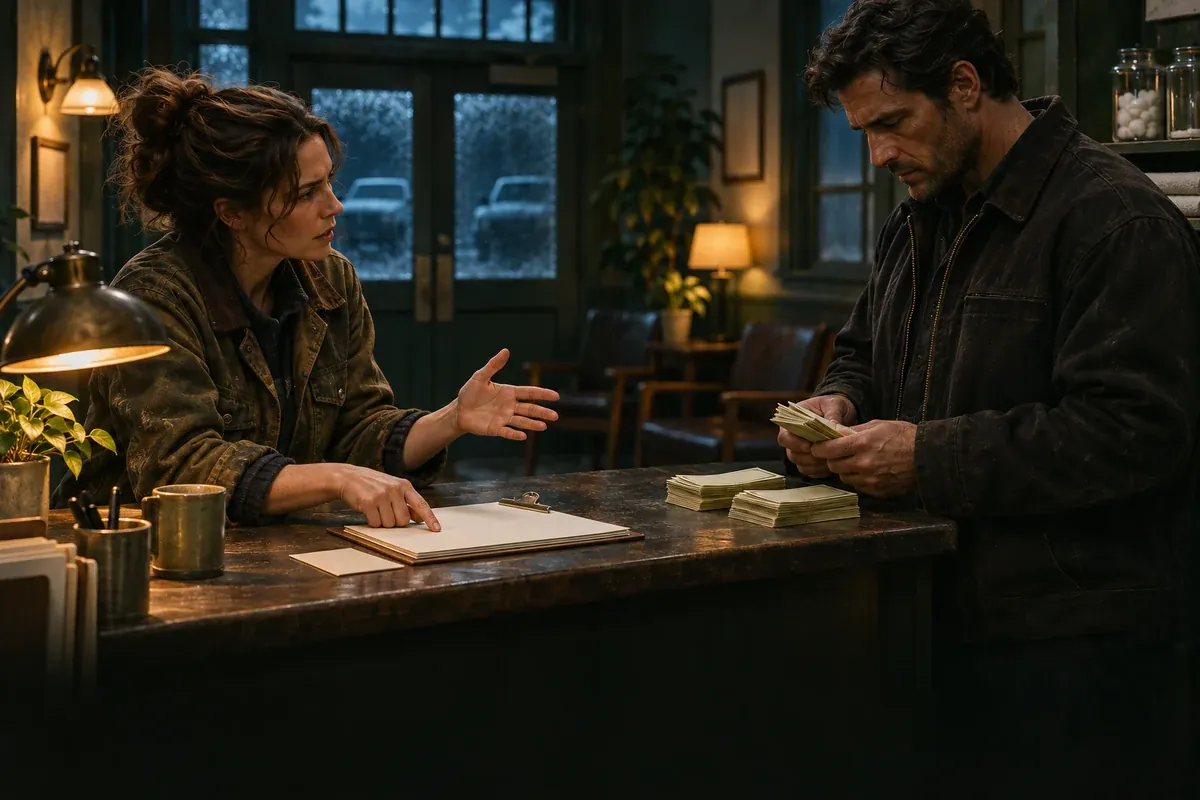
I’d been asleep on the cot in the back office, boots on, because a mare over in the Shale Flats was due to foal and her owner called me every time she so much as sighed. The buzzer at the front gets wired straight to a bell above that cot. By the time I had my hands washed and my brain halfway booted, Jo was already standing in the hall with her coat over her pajamas, holding the clipboard like it had personally lied to her.
“Six guys,” she said. “One wolf. No trailer, no stock rack, nothing. They carried it in on a tarp like pallbearers.”
“Carried a wolf.”
“Carried a wolf,” she said. “A big one. Rowan, they’re not talking. Not to me, not to each other.”
Lark County gets wolves. We’re four drainages over from designated recovery territory, and every couple of winters some yearling with bad judgment follows the elk down and gets himself shot or clipped on Route 11. What Lark County does not get is six grown men in work jackets delivering one to the only vet clinic open past six, in the dead hours of a Tuesday morning, and standing around my waiting room like an honor guard.
The animal on my table changed the shape of the night the second I saw him. Male, gray with black guard hairs along the spine, and big the way a draft horse is big — not fat, just built on a different blueprint. A hundred and forty pounds if he was an ounce.
Wild wolves run eighty, maybe a hundred for a monster. His left foreleg was wrong in three places, blood was coming off the tarp in strings, and his breathing had that shallow click I hate, the one that means the chest wants to quit and is being talked out of it minute by minute.
He was also looking at me. Hit-by-truck animals look through you, mostly, off at whatever wall the pain lives behind. This one tracked me across the room, pupils even, and when I put my hand flat on his neck to find a pulse, he held still the way a patient holds still. On purpose. Like he’d decided something about me and was staking his life on it.
“Okay,” I told him, because I talk to all of them. “You picked the right dive bar.”
Cars don’t do what his X-rays showed. A bumper breaks a leg in one place, maybe two, and tumbles the body — road rash, cracked ribs on one side, gravel in everything. His ribs were whole. There was no gravel. The foreleg was shattered mid-shaft in a tight spiral with two clean breaks above it, the kind of pattern you get from torsion, from something that grabbed and twisted.
And there was hardware in there. An old surgical plate, titanium by the brightness of it, seated along the radius with four screws, bone remodeled over the edges. Years old. Wild wolves do not have orthopedic surgeons. Wild wolves do not have medical histories.
Jo saw it on the monitor the same second I did and said nothing, which is one of the several hundred reasons I pay her more than I pay myself some quarters. She drew up the induction dose when I called for it, ran the numbers back to me out loud like always, and if her voice was a half-step too level, that was between her and the clipboard.
Surgery is honest work. Whatever was strange about the night, the leg itself was just a bad jigsaw puzzle, and I’d done the puzzle before. Flush, reduce, plate — his second plate, so now he had a matched set — wire the spiral, close in layers.
His blood pressure tried to leave twice and we hauled it back with fluids and a unit of the canine whole blood I keep for exactly never, because stocking it costs me money I don’t have and the one time I skipped it a cattle dog died on this table. His heart was slow for a canid. Strong, but slow, a big bell instead of a snare drum. I logged it and moved on, because at three in the morning you treat the patient in front of you and interrogate the chart later.
At some point I surfaced enough to notice that one of the six men had not stayed in the waiting room, which is a rule I enforce with everyone short of armed law enforcement.
He stood just inside the surgery door with his back against the wall, out of my light, out of my way, so completely still that my hindbrain had filed him under furniture. Tall. Dark work jacket, no logo. Forty, give or take. He watched my hands the whole time, not the wolf’s face, which is what family does — family watches the face.
“Out,” I said.
“No,” he said. Not hostile. The way a wall isn’t hostile.
I had a scalpel in one hand, a wolf open on my table, and no spare personnel to make it a thing. “Then you’ll stand there and you won’t talk, and if you faint I’m leaving you where you drop.”
“Agreed,” he said, and that was every word he spent for two hours.
Somewhere in the middle of wiring the spiral, my hands steady and my mind unsupervised, I took inventory of my audience. He didn’t fidget. He didn’t ask how it was going, which every owner asks at the worst possible moment. When Jo needed around him to the autoclave he moved before she said anything, a half-step, precise, like a man who had spent a lot of time being too large for rooms.
And when the monitor stuttered at the bad minute — pressure sliding, that cold quiet that comes into a surgery like a draft — he didn’t make a sound, but I felt him arrive at the table edge the way you feel weather change. If he’d touched anything I’d have thrown him out bodily or died trying. He didn’t. He just stood there radiating a thing I had no name for at 3 a.m., and when the pressure came back up, he went back to his wall.
“Family?” I asked the room, eyes on my field.
“Yes,” he said, and the word had gravel under it.
“Then you can hold his foot.” I said it to be cruel, because owners always say yes and then go green. He came forward, cupped the big hind paw in both hands exactly the way I showed him, thumbs along the metatarsals, and held it like it was a job he’d trained for. The wolf’s heart rate, which had been climbing, settled. I filed that away too, in the drawer where I was putting everything I couldn’t afford to think about yet, and asked for the next wire.
We closed at 4:40. I stripped my gloves, rolled the drape, and had Jo set the big crate in recovery with the heat lamp while the patient came up out of anesthesia slow and steady, leg splinted and wrapped, drain in, catheter taped. His vitals had no business being that good. I wrote it down anyway: what I did, what I gave, times and volumes, every line initialed. I write everything down. There’s a story behind that habit and it costs me nothing to keep, except sleep, which was already spent.
The tall man paid in the waiting room while his honor guard filed out to two trucks I never heard start. Hundred-dollar bills, counted flat on the counter, in the amount I quoted plus four hundred I hadn’t. “For the blood,” he said, which meant he’d either heard me call for the unit through a closed door or knew what a transfusion costs, and I couldn’t decide which option I liked less.
“He stays at least three days,” I said. “That leg comes apart if he moves wrong. I mean a crate, I mean sedation if he fights it, I mean nobody heroically carries him anywhere on a tarp.”
“Three days,” he repeated, like he was translating it into a language with no word for three. Then they were gone, and the night shut behind them the way water shuts behind a fish, and I stood in my own waiting room listening to the compressor hum and thinking that in eleven years of rural practice nobody had ever paid a wolf’s bill in cash without asking a single question about whether the wolf would live.
Jo stayed to help me clean, because she’s Jo, and we worked the surgery suite back to inventory with the radio off. She didn’t say anything until she was wringing out the mop, and then she said, “You want me to call Fish and Wildlife in the morning?”
By the book, yes. A wolf in hand gets reported, tagged, the whole federal paper trail, and I am a woman who worships the book for reasons that are on file with the Colorado veterinary board. I looked at the cash drawer, and the crate, and the clean count of hundreds that said someone expected me to choose, and I heard myself say, “Let me think about it,” which we both knew was a whole answer wearing half an answer’s clothes.
“Okay,” Jo said. She pulled her coat on over her pajamas and stopped in the doorway. “For what it’s worth. Six guys carried that animal twelve miles of bad road at two in the morning instead of letting it die warm somewhere. I’ve met a lot of poachers. None of them ever did that.” Then she went home to sleep three hours before her shift, and left me with the part of the night that was mine to hold.
I didn’t go back to the cot. I pulled the office chair into recovery, which I do with the bad ones, and I sat with my feet on a feed bucket and my coffee going cold, and I watched the big gray chest rise and fall under the heat lamp until the lines of the room went soft.
Here is what I know for certain about the next two hours, because I have replayed them more times than any other two hours of my life. The crate was latched; I latched it. The recovery room door was shut; it shuts itself.
I slept, because I was forty hours into a thirty-hour week and surgery adrenaline burns off like fog. And nothing woke me — no latch, no door, none of the crate-rattling a hundred-and-forty-pound animal makes when it stands up wearing a fresh splint. Whatever happened in that room happened quieter than my own breathing.
The mare owner’s ringtone is what got me. Shale Flats, 6:52 a.m., false alarm, she’s waxing but not dripping, go back to sleep, Doc. I had the phone to my ear and my eyes on the crate before I was awake enough to know why my chest had gone cold.
The crate was open. Not broken — open, the latch turned like a person turns a latch.
The splint was on the floor beside it, unwrapped neatly, vet wrap rolled back up into a tidy little cylinder, which is a thing no animal has done in the history of animals.
And in the corner, on the pile of clean blankets Jo stacks for the parvo pups, a boy was asleep.
Nineteen, maybe. Long limbs he hadn’t grown into, dark hair stuck to his forehead, hospital-pale. Somebody had dressed him in a set of my coveralls from the laundry shelf, the ones with MERCER VETERINARY on the back, and gotten his left arm into the sleeve over a fresh, clean surgical dressing — my dressing, my tape pattern, moved from a foreleg to a forearm as neatly as if I’d placed it there myself. An IV catheter was still taped at his wrist. Canine catheter. My initials on the tape.
I want it on the record that I checked the obvious things first, because I am that kind of person even at 6:53 in the morning with the floor tilting. The back door: locked, deadbolt thrown, my key still hanging on my belt.
The windows in recovery: painted shut since before I bought the building, a code violation I keep meaning to fix. The drop ceiling: intact, dusty, undisturbed. There was one wolf-shaped absence in my clinic and one boy-shaped presence, and between them, on the floor, that neat little cylinder of rerolled vet wrap sat like a signature.
I stood there with my dead phone in my hand doing the math nobody can do, counting the ways in and out of my locked building, and the clinical part of my brain — the part that holds the scalpel steady when everything else is yelling — noted that his breathing was deep and even and his color was better than any post-op patient had a right to look, and that the bandage, when I crossed the room on legs I couldn’t feel and lifted the edge with two fingers, covered a line of my own sutures in human skin, healing like the surgery was a week old.
The boy didn’t stir. Patients don’t, when they trust the building.
“You should sit down,” said a voice behind me, low, from the doorway that I had locked, and I turned around with a roll of vet wrap raised like that was going to accomplish anything.
I didn’t sit down. I did a fast assessment of my own vitals — heart hammering, airway functional, no imminent syncope — and then one of the boy, because triage doesn’t care how impossible the patient is. Pulse at his wrist: slow, strong, a big bell instead of a snare drum.
The same heart I’d logged at 3 a.m. under a hundred and forty pounds of gray fur. Temperature warm. Pain response: he frowned in his sleep when I palpated near the dressing and muttered something that might have been “five more minutes,” which is not a phrase I have ever gotten out of a wolf.
My hands were steady. I’d like that noted as well. Whatever was detonating in the back of my head, my hands have an arrangement with me that predates my opinions, and they went on checking the catheter site like it was a Tuesday. It was, technically, a Tuesday.
The tall man stood in my recovery room doorway holding two cups of gas-station coffee, and in the gray light of 7 a.m. I finally got a decent look at his face: tired in the architecture, not the surface, the kind of tired that’s structural. He set one cup on the counter where I could reach it without being reached, which I noticed, and hated noticing.
“His name is Micah,” the man said. “The leg was my fault. I’ll tell you as much as I’m able to, and then—“ He paused, and there was something terrible and polite in the pause, like a man choosing silverware at a funeral. “Then I need to know what it costs for you to forget tonight.”