

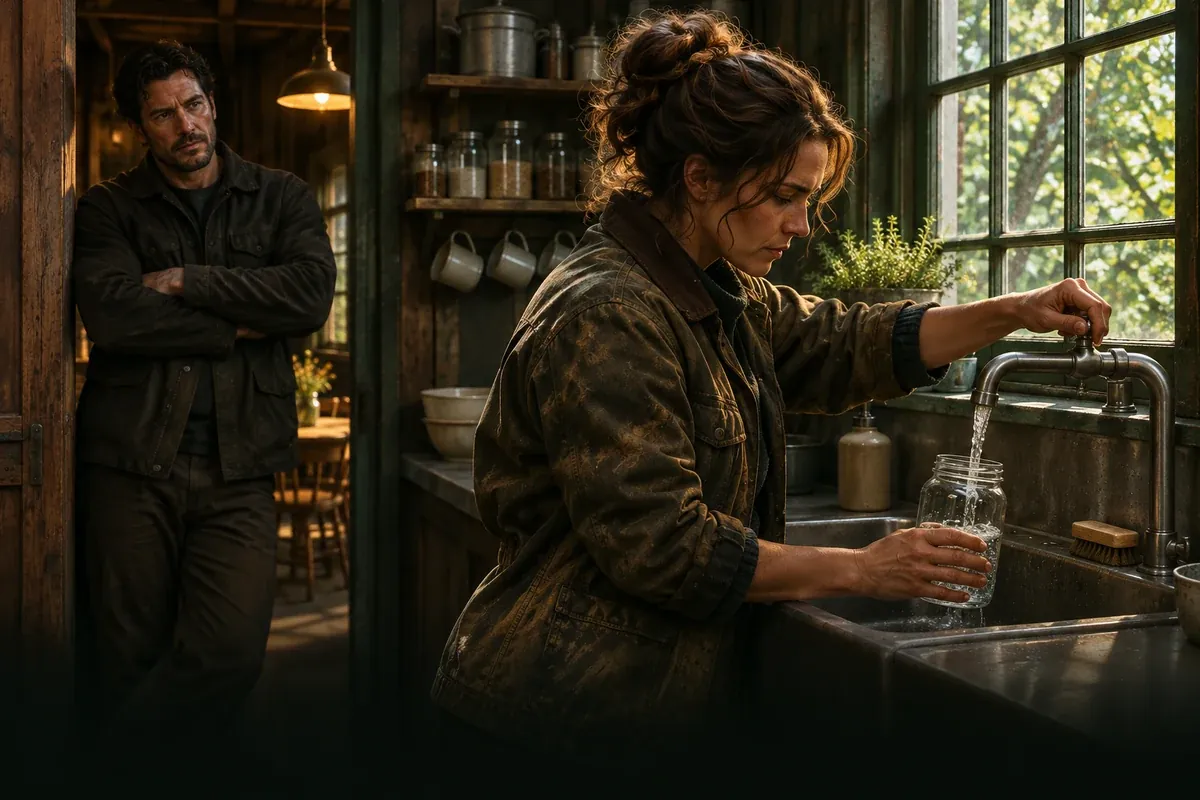
The council met at nine the night before, in the mill, and I was not invited and heard all of it anyway, because Dane called me at 11:40 from the truck and gave me the full transcript the way a man reports a surgery that went long. Forty minutes of arguing. Three votes. The old guard — Harl and two others — wanted me quarantined from the valley and paid in silence. The middle wanted me on a short leash.
Von had apparently stood up and said that if the pack could trust a man with a chainsaw and a grudge, it could trust a woman with a microscope, and that if this was going to be the hill they died on, she’d like to die with better data. Essa had said almost nothing until the end, and then had said, “She sat on a stool beside the boy,” and that had been that.
“What was the margin?” I asked.
“Eleven to four to let you in,” Dane said. “I’m told it’s the closest the Landing has voted in forty years.”
“Who were the four?”
“I’ll introduce you,” he said. “They’ll be the ones watching your hands.”
I’d said fine, and I’d meant it, and I’d lain awake anyway doing the math on how many things in my life ran on eleven to four.
The council said yes, which is how I ended up riding shotgun in Dane Hollis’s truck up eleven miles of Carrow Creek road with a field kit between my boots and a cover story drying on my lips.
Jo had the clinic; Jo also had a new line item in her mental ledger, because I’d told her I was taking a herd-health call at “the Hollis place” and Jo knows Hollis Timber doesn’t run cattle. “Ranch dogs,” I’d amended. “Lots of dogs up there.” She’d handed me the kit and said, “Tell the dogs I said hi,” with a face you could have notarized documents on.
The road did what mountain roads do: got honest. Pavement, then gravel, then two ruts holding hands through old burn and new lodgepole, the creek flashing in and out on the left like it was checking on us. Dane drove the way he did everything — unhurried, exact, both hands — and made exactly no small talk, which suited me, because I was busy rehearsing how to examine patients whose existence I’d agreed not to chart.
“Rules,” he said finally, as we crossed a cattle guard that had never seen a cow. “Ask before touching anyone. Some of the old ones remember worse clinics than yours. Don’t go past the firebreak on the ridge — not danger, courtesy; it’s denning ground. And whatever Essa says in front of people, don’t contradict her in front of people.”
“Those are good rules,” I said. “Here are mine. In an exam, I outrank everyone, including you — you can veto who I see, but not what I do once I’m seeing them. Nobody handles my samples but me. And if someone’s dying, I treat first and apologize to your council later.”
He turned his head, and I got the full attention of those timber-colored eyes for one second longer than road safety strictly allowed. “Agreed,” he said, and something in the word had more floors than the word needed.
The Landing wasn’t what I’d braced for. I’d half expected a compound — wire, dogs, suspicion with a zip code. What sat in the bowl of the valley where the old mill used to run was just a town that had decided not to mention itself: two dozen houses in no particular hurry, wood smoke, a ball field mowed into the meadow, laundry lines running like sheet music, and the mill itself, re-roofed and repurposed, big doors open to the September light.
People moved between buildings with the unhustled purpose of folks who all know the same schedule. Somewhere a table saw sang. It looked, if I’m honest, like every town in Lark County wished it looked and didn’t.
What it did not look like was sixty people carrying a secret with four graves in it. But then, waiting rooms never look like what’s in the charts.
They’d set me up in the mill office — good light, running water, a steel table somebody had scrubbed to surgical standards and covered with a quilt out of some instinct I didn’t have the heart to overrule. Essa was already there, arms crossed, my self-appointed residency director. The line formed the way lines form in small towns: nobody admitting they’d come early, everybody present.
I saw eleven patients before noon. Ask permission, every time; hands shown empty first, every time — Essa’s quiet coaching, and it mattered, I could see it matter in shoulders that came down a quarter-inch. A logger with a shoulder that clicked (old tear, badly healed fast, the curse of a body that closes wounds before anyone checks the alignment). Twin girls, seven, one of whom had stuffed a huckleberry up her nose with the commitment of a true scientist.
A pregnant woman, twenty-six, who wanted to know — asked flat out, chin level, eyes scared — whether the sickness could cross a placenta, and I had to tell her the honest thing, which is that I didn’t know yet, and watch her nod like she’d already filed my answer under the long list of things this year had refused to tell her.
And then the ones I’d really come for. Orla Keen, sixty-one, Alma’s cousin — because of course the dead had cousins; the dead had a whole valley — who’d been “tired since June” and had stopped shifting in August because, she said, the wolf felt far away, like a phone ringing in another house. Her gums were the color Essa had described: winter sky. Capillary refill slow as thaw.
I pressed, counted, wrote. Under the portable scope I’d lugged up the mountain, her smear showed the frost-rosettes in rows — denser than Micah’s, rafts not flakes — and in that cold office, with the saw singing outside and the quilt under my slide box, the thing stopped being a case and became an outbreak. Attack rate unknown. Vector unknown. Index case: not Micah. Micah was just the one who’d met a trap.
That stray thought snagged on something. I wrote it down too.
“How long,” Orla asked, while I drew her blood and Essa held the tubes with the ceremony of a woman holding someone’s whole book. Not how long do I have — people almost never ask it straight. Just: how long.
“I don’t know what this is yet,” I said. “But I know what it isn’t. It isn’t fast. Alma went weak in spring and was with you until summer’s end — that’s months, and months are a doctor’s favorite thing in the world, because months are enough time to be wrong in twice and still get it right.”
Her mouth did something that was almost a smile. “Eat red meat. Rest when the wolf feels far — don’t reach for it, you’ll spend coin you need. And when I call Essa with instructions, follow them even if they’re strange.”
“They’ll be strange,” Essa said, deadpan. “She puts things in purple tubes.”
Lunch arrived as a referendum: half the valley suddenly needing to walk past the mill office with casseroles, pie, a thermos of coffee that could have stripped paint, each delivery a pretext to get a look at the human the alpha had let inside the fence.
I ate standing up and let myself be looked at. An old man with a face like a hatchet full of weather — introduced only as Harl — looked longest, then said to Dane, not quietly, “She smells like antiseptic and horses,” in the tone of a man finding, to his annoyance, no fault in it.
“Thank you,” I said. “It’s a professional blend.”
A beat. Then Harl laughed — a surprised, rusty sound, like a gate not used to opening — and after that the casseroles stopped being surveillance and started being lunch.
That was also when I met Von. She came in off a log truck in steel toes and a high-vis vest, Dane’s bones under an entirely different attitude, shook my hand like a door-to-door salesman working on commission, and said, “So you’re the vet. I want you to know the betting pool had you calling the government by Tuesday, and I had money on you, so don’t make me poor.” Then, to her brother, with a thumb jerked at me: “I like her. She can do my physical.”
“You had a physical.”
“Essa listened to my chest with her ear and told me to stop smoking. That’s not a physical, that’s a mugging.”
I did her physical. Von’s lungs were fine — better than fine; everything about Von was built like the log truck — and her blood went into my cooler with the rest, labeled with the dog-pseudonyms that were becoming a kennel of lies in my second notebook: BISCUIT, PEPPER, DUCHESS, SAWDUST.
Von read her tube upside down and demanded to know why she was SAWDUST when Orla got to be DUCHESS, and I explained the names were assigned by a strict clinical algorithm of whatever I thought of first, and she said that was the most honest medicine she’d ever heard of, and somewhere in there I realized I was having a good day. On an outbreak investigation. Inside a secret. It had been a while since the job felt like this much of a calling, and I chose, professionally and firmly, not to examine why.
Mid-afternoon, while the line thinned, I asked the question I should have asked first, the one every outbreak investigator learns to ask before she learns to ask anything else. “Where does your water come from?”
Von, wiping her hands on a rag, answered like it was the dullest question in the world. “Creek. Intake’s up above the mill, a half mile, concrete box Dad’s grandfather poured. It goes to a settling tank behind the mill and from there to everybody’s tap. Eighty years, no problems. Best water in the county. Ask anyone.”
“Does everybody drink it?”
“Everybody drinks it. We’re not savages, we don’t have a filter pitcher.” She grinned, and then watched my face, and the grin went wherever grins go. “Rowan. What.”
“Probably nothing. It’s the question you ask.” It was nothing like nothing. I asked her to show me the tap, and she did, and I stood at the kitchen sink of the mill’s break room and let the water run over my wrist, and it was cold and clear and smelled of stone and nothing else, and I stood there feeling stupid for the spasm of suspicion. Water that has killed people doesn’t smell like it. That’s the whole horror of water.
Dane had followed us in, quietly, the way he followed everything. He leaned in the doorframe and watched me fill a clean sample jar and cap it, label it in my terrible handwriting — SAWDUST-TAP, the dog database proving flexible — and he said, “The intake’s been there since the thirties. Nothing’s changed.” He said it carefully, not in argument. He said it like a man handing over an alibi he hoped to be wrong about.
“Then it’s a negative and I’ll tell you so,” I said. “I’d be thrilled. I want a very boring answer to this question.” I wedged the jar into the cooler beside the blood and watched his face. “What is it you keep doing?”
“Doing.”
“With your hands. Every time I ask for something. You put them in your pockets, like you’re afraid they’ll volunteer.”
For a second I thought I’d gone too far. He looked at me with the full weight of the timber-colored eyes, and he took his hands out of his pockets and looked at them as though I’d named some ugly habit of a relative.
“When people ask me for things,” he said slowly, “I’m used to saying no first, because no is cheaper to take back than yes. You asked for the council, and the ledger, and the tap, and I’m trying to — “ He stopped. Started over. “I’m trying to let the answer come out in the right order.”
“That’s a very specific thing to be working on.”
“It’s been a very specific year.” And then, just before it could turn into anything, Von shouted from the next room that Orla Keen had thrown a casserole dish at a nephew, and the moment broke into pieces, and he went to separate his people while I stood alone at the sink with one hand still under the water, and I noticed that my pulse was doing something my own pulse does not do.
I told myself it was caffeine. It was a Tuesday-grade lie and I told it well.
The light was slanting gold through the big doors when I finally asked Essa for the thing I’d been circling all day. “The ledger. You said you keep the records. I need dates — when each of them sickened, when they stopped shifting, when they died. Patterns live in dates.”
The office went quiet in the way the recovery room had gone quiet, a pack-silence, opinions moving on channels I don’t receive. Essa looked at Dane. Dane looked at the quilt on the steel table and said nothing in a way that said: her call.
She brought it wrapped in a flour-sack towel, a green cloth book worn gray at the corners, and she did not hand it to me. She sat, opened it on her knees, and turned it so I could see — her thumbs anchoring the pages, a librarian of the dead guarding circulation. The entries ran back decades.
Births in brown ink, deaths in black, a steady human weather of heart and age and one logging accident a generation — and then this year, clustered like shot: Alma Keen, first weak 14 March. Rusty Keen, first weak 2 May. Gideon Troke, first weak 8 July. Micah Lane, 9 September, written in pencil, because Essa Birdwell did not commit a yearling to ink.
March. May. July. September.
“Essa,” I said, and I heard my own voice go flat and careful, the voice my hands get when the monitor stutters. “These are eight weeks apart. Almost to the day.”
She looked down at her own ledger like it had bitten her.
“Outbreaks don’t keep calendars,” I said. “Weather doesn’t. Water doesn’t. Deficiency doesn’t.” Outside, the table saw had stopped, and the quiet had the whole valley in it. “Schedules keep calendars. Doses keep calendars.”
Dane had gone very still by the door, one hand on the frame, and when he spoke it was low enough that the words stayed inside the room with us, where I understood — too late, the way you understand a dropped scalpel on the way down — he had been keeping every fear this year had handed him.
“Then somebody,” he said, “is giving it to us.”