

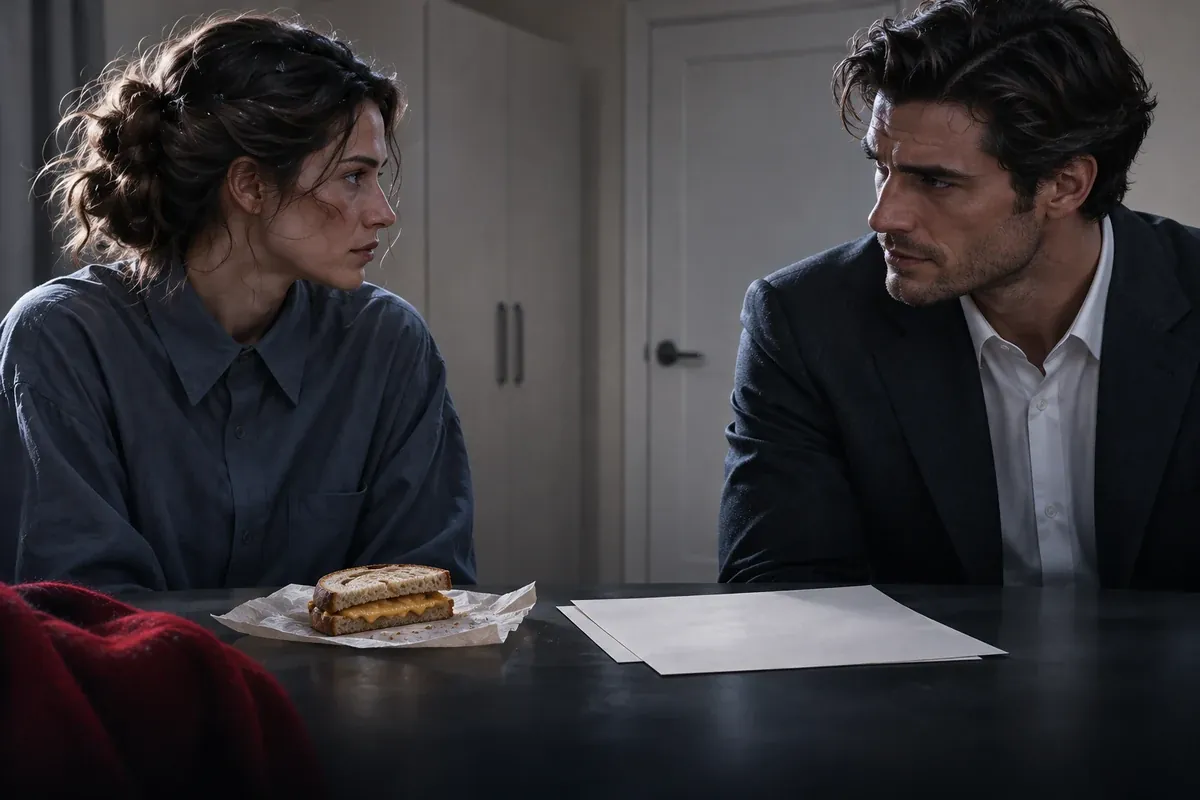
By four o’clock, I had two bandaged wrists between us, a promised sandwich, and an offer from a woman who sold public-relations disasters by the hour.
“Stabilize the narrative,” Yvette said.
We sat in an unused dressing room. Someone had taped a paper star to the door, but the glue had failed on one corner. It sagged over my name. The dress lay in a laundry basket like evidence of a very expensive picnic.
Mara had supervised the removal of both clasps. Oren had sealed the reservoirs separately, photographed the serial numbers, and left to put the evidence in his locked inspection room. Dr. Venn had made us wash our hands twice.
I still sensed Ellis on the other side of the table. It was unpleasant to know exactly how false a feeling could be and feel it anyway.
Yvette slid a statement across the table.
It described me as a longtime family friend who had graciously stepped into an unprecedented personal situation.
“I’m a contractor,” I said.
“People respond to a relationship.”
“Then give them yours with your payroll department. That one’s overdue.”
Ellis made a sound into his water glass.
Yvette’s gaze sharpened. “You were paid promptly today.”
“Because he paid me. I’ve worked your shows before.”
She opened her bag and produced a second sheet. This one had a figure at the top large enough to make me stop speaking.
A public appearance fee. Two days of access, one joint statement, reasonable cooperation with event publicity. Reasonable took up almost no space on the page. It could have swallowed a week of my life.
“That’s separate from the stunt payment,” she said.
“What’s an appearance?”
“A photograph. A brief greeting. Perhaps a reception, if the physician approves.”
“Under my name?”
“The name can be discussed.”
I pushed the sheet back. My fingers wanted to hold it. There were bills in my bag with corners softened from being opened too often. I knew what a sum like that could do. I also knew how expensive it became when somebody else got to define what I’d sold.
“You need a performer, use a performer agreement,” I said. “Dates, duration, purpose. You need a witness to change her story, that’s another kind of transaction.”
Yvette smiled at Ellis, inviting him to apologize for me. “She’s upset.”
“I was listening to the question.”
My neck grew hot. I disliked being grateful for something as small as a man refusing to translate me into a more convenient woman. I disliked Yvette noticing.
She tapped the number with one polished nail. “You’re entitled to think about it.”
“Then leave the copy.”
“You can photograph it.”
I did, including the small print. I wasn’t brave enough to trust myself with the original. If I kept it on the table, I’d spend the next hour making money do an impersonation of safety.
The screen on my phone showed a message from Jessa: Got it. In a session. Call you after. Please answer.
I answered with one word. Yes. I didn’t add a joke where the promise should be.
A young assistant appeared with a call for Yvette. She excused herself, taking her statement. The paper star finally fell off the door.
Ellis picked it up and set it on the table.
“She’ll come back with a better offer,” he said.
“For me to pretend this was romantic?”
“For you to stop being inconvenient.”
“I charge more for that.”
He smiled properly then. It changed his face from handsome, expensive trouble into a person who might know a good joke. I looked away before my nervous system could take credit for anything.
After Yvette left, the assistant returned with the sandwich. She asked Ellis whether I’d eat chicken or cheese. I waited. He waited too. The assistant looked at me, flushing.
“Cheese, please.”
“Sorry.”
“You can save yourself time by asking the person holding the stomach.”
She laughed, set the plate down and brought me a shirt from the unclaimed wardrobe stock. I checked the label for pins before putting it on. The sleeves were too large. That felt luxurious after three hours inside a costume somebody else had fitted to a different body.
Ellis stayed by the mirror while I changed behind the portable screen. He answered a call about the arena closure. I could hear him repeating the distinction between a temporary inspection hold and a canceled event. He gave no prediction about reopening. Whoever was on the other end tried three times to get one.
When he hung up, I asked, “Does that work often?”
“What?”
“Saying you don’t know until they believe you.”
“Less often than I’d like.”
I came around the screen. He looked at my face, then the borrowed shirt, and asked whether I wanted the laundry bag for my own clothes. I had no clothes to put in it except the ruined dress, which wasn’t mine. The practical gap between getting paid and being able to leave had never seemed so wide.
“My bag’s in wardrobe,” I said. “Wallet, jacket, boots I don’t mind ruining. I’d like it brought here before someone decides it’s part of the set.”
He called the assistant by name, which improved my opinion of him another fraction. She brought the bag herself. We checked its contents on the table. She seemed embarrassed by the old scarf wrapped around my lunch container. I was embarrassed by the stack of overdue notices beneath it.
Ellis turned to the mirror while I put them away. He did it casually enough that I didn’t have to acknowledge the favor.
“You don’t have to keep protecting me from every awkward thing,” I said.
“I wasn’t sure whether looking away would be worse.”
“Depends why you’re doing it.”
He considered that. “I don’t need your bank balance to decide whether you deserved a safe platform.”
It was an answer I could live with. I handed him the other half of the sandwich. He accepted it without mentioning the uneven cut.
We had met twice before this morning. Once when I’d doubled a ceremonial leap for another bride. Once at a safety briefing he’d left early. I’d remembered his suit. He’d apparently remembered my boots.
“Did Maris know you hired me?” I asked.
“Yes. She approved the substitute rehearsal. She hates heights.”
“And you were still going to get married.”
He moved the star with one finger. “We were going to make a joint announcement canceling the engagement after the exhibition. The rehearsal was supposed to fulfill the venue contract without her doing the jump.”
“Why rehearse a wedding you weren’t having?”
“The exhibition was sold months ago. Maris designed the clothes. Her mother sold a love story. Canceling one shouldn’t have meant canceling the other.”
“Did anyone tell your mother-in-law that?”
“Repeatedly.”
Maris’s absence changed shape in my mind. Maybe she hadn’t been kidnapped. Maybe she’d gotten tired of repeating herself.
“Is she safe?”
“I don’t know. She left a message saying she needed a day. That was yesterday morning. I reported her missing this afternoon when she didn’t answer.”
He showed me the message. No sentimental farewell. Just: I have to finish one thing before I can come back. Please don’t let her announce for me.
The last word had been underlined twice.
“I’d like to help find her,” I said.
“You don’t owe us that.”
“No. I owe myself an explanation. Whoever did this expected a substitute. They didn’t need my name. They needed my wrist.”
He considered that for a while.
“You’d have better access if people thought we were cooperating.”
“We are cooperating.”
“I meant socially.”
“You want a fake bride.”
“I want my contractors to stop sending you through service entrances while they invite me upstairs.”
That was a better answer than I had been prepared for.
I pulled the blank side of Yvette’s abandoned meeting agenda toward me and wrote TERMS at the top.
Ellis looked resigned. “I deserved that.”
“One. We say the recognition is disputed. No kissing for cameras. No claiming fate. No announcing anything on my behalf.”
“Agreed.”
“Two. Separate rooms. Separate keys. I keep my phone, money, transport, and the right to leave.”
“You already have those rights.”
“I enjoy making a list.”
“Then write them down.”
“Three. I approve every stunt I perform. Oren approves the rig. Nobody substitutes equipment after inspection.”
His jaw tightened. “Absolutely.”
“Four. We share evidence with Mara and the county investigators. We don’t keep a juicy discovery for the hearing because it would make a better scene.”
“That sounds directed at someone.”
“I work in entertainment.”
“And the hazard payment?” I asked.
“Independent assessment. Oren’s, if you approve him.”
“I do. It goes to me. It doesn’t become a donation to make everyone feel better.”
Ellis nodded. “Were you expecting that?”
“A producer once offered to give my fee to injured performers. I was an injured performer. Apparently I was the wrong kind.”
He wrote down the payment arrangement himself. The movement was unshowy. He asked for my account details through his bookkeeper rather than promising to hand me an envelope later.
I thought of Jessa’s last message: You don’t have to pay me back before you call.
Money was easier. It came with a number you could reach and a receipt that said you were finished. My sister had never offered either. I had been treating that as a defect in her terms.
He took the pen when I offered it and added a fifth term. Either person could stop the public arrangement immediately. Neither would owe an explanation to an audience.
I added that personal touch required asking.
We read the draft aloud. I had learned that trick from a stunt rider written in print so small it nearly qualified as embroidery. Trouble hid more easily on a page than in your own mouth.
At the part about Oren approving the rig, Ellis stopped.
“If he refuses, do we cancel the event?”
“We cancel my participation. I can’t promise what other people do.”
He crossed out we and wrote Cleo. That was better. I wanted the authority to decline my own risk, not a grand new responsibility for every person in the building.
At the evidence clause, I stopped.
“You need to understand something. If I find something that hurts you, it still goes to Ames.”
“I understand.”
“Not after you talk to counsel for a day.”
“I’d need legal advice about my own obligations. But I won’t ask you to delay yours.”
I looked up. I had expected a reassuring promise he couldn’t keep. The qualification irritated me and made the promise more useful at the same time.
“And you don’t tell me what to say.”
“No.”
He asked whether I expected him to defend me on every public question. My first reaction was yes, of course. It was followed by the less pleasant realization that I couldn’t write my way out of being responsible for my own mouth.
“I expect you to correct things you know are false,” I said. “If you disagree with me, say that. Don’t spring it on me for a camera.”
“That goes both ways.”
“Yes.”
The last word scraped on the way out. Being treated as an equal had inconvenient terms. Other people got to be disappointed in you without becoming the villain of the scene.
We added a place for any appearance request to be written separately, with a time limit and the right to refuse. The engagement language would be limited to explaining why we were seen together while the recognition was disputed. We would give no staged romantic gestures. I crossed out a proposed phrase about standing united. It sounded like a brochure for a wall.
Ellis asked what we’d say if someone wanted to know whether we liked each other.
“We can say we’re still discussing the invoice.”
He set the pen down and laughed. It was a small laugh, with very little performance in it. I found myself listening for when it ended.
Then a knock came at the door. A member of his staff had brought a room reservation at the territory guesthouse. Two suites, adjoining, billed to event hospitality. I read the address and slid it back.
“Hotel. I’ll book it.”
“It has good security,” Ellis said.
“And your staff can authorize keys. I don’t know them.”
His face tightened. For a moment I thought he was going to explain why my fear was unfair to nice people who had done nothing wrong.
Instead he nodded. “Then a hotel.”
I used my own phone and my own card. The confirmation made an alarming dent in the four thousand dollars. Having a door that nobody in production managed was worth the dent.
We prepared a message to Mara and ourselves, ready for a photograph of the signed page. I set my phone beside the pen.
The paper star sat between us, one corner bent. I flattened it with my palm. Its glue had picked up lint from the carpet and would never hold properly again.
“You can throw it away,” he said.
“I know.”
I left it on the table. I was working up to knowing a thing without having to act on it immediately.
He read it, signed Ellis Voss, and slid the page back.
I checked that every crossing-out had both our initials. He asked whether I wanted a witness. I said Mara could acknowledge receipt; the page was a working agreement, not a new ceremony. That distinction seemed to relax us both. We had enough people prepared to turn ordinary cooperation into something neither of us had requested.
“Not Maris Keene,” I said as I signed.
I photographed the page beside the clock and sent it with the prepared message. Ellis asked me to forward the original image too.
“Never.”
The dressing-room mirror reflected us sitting three feet apart with a sandwich between us. Nothing in that image deserved a soundtrack. I was starting to like it.
Then his phone lit up. A file notification appeared across the screen before he turned it over.
TOWERFALL — CONFIDENTIAL INQUIRY.
I knew the title. I knew the ugly square logo in the corner of the document thumbnail. My stomach went cold before I could decide what to do with my face.
“Why do you have that?”
He looked at the phone, then at me. The easy expression disappeared.
“Cleo.”
“It usually has my name under the part about reckless conduct.”
“The territory acquired the report when the performance company folded.”
“Acquired how?”
“A confidential settlement.”
“Did you read it?”
“Yes.”
Outside, someone rolled a costume rack down the hall. Wheels squeaked on every fourth turn. I counted three squeaks before I could speak.
“You watched me get on that platform this morning knowing people believed I caused Towerfall.”
“I knew you had current certification. Oren recommended you.”
“That wasn’t the question.”
He set the phone on the table, facing me this time.
“I accepted the report as finished business,” he said. “I shouldn’t have.”
My first instinct was to leave. I could already feel the door handle in my palm.
Instead I drew a line under the six terms and added one more.
No private files about either of us withheld from the other.
Ellis read it. He didn’t tell me the file was privileged or complicated or probably nothing I hadn’t seen.
He unlocked the phone.
“There are annexes,” he said. “I don’t think you were given them.”