

Minutes of the special meeting of the Port Okun Harbor Council, October 16, 8:02 a.m., cannery break room. Recorded by V. Tolliver, who was not asked to record them and has a pen.
Item one: there is a slate bolted to the sodium light over the fuel dock, and everybody has now seen it.
Nobody in the room has said so out loud, and that is the thing I write down. Forty-odd people are packed between the vending machines and the time clock, in raingear and bathrobes and one full tuxedo jacket, a man who got married yesterday and apparently has not been to bed. The coffee urn is empty. The window over the sink looks out at the fuel dock, and no one will look at the window.
I look at it. I have to. It is a slab of gray stone about the size of a door, hung in the air with no bolts, glowing at the edges like a phone at night, and I read it on the way in with my hand pressed flat against my left side, where I am wearing a bruise.
[BOUNTY BOARD. Zone 4. Posted by the Intake. Any resident may sign the Culler charter and claim coin for the removal of Fauna. Coin is redeemable as diesel, steel and medicine. GUTTER GULL, LV 14: 3 coin. HARBOR RAT, LV 6: 1 coin. RED KING CRAB, LV 31: 400 coin. Culling is permitted. Culling is recorded.]
Culling is recorded. I read that line five times and I still don’t like it.
“Item two,” Odalys says, and bangs a thermos lid on the table. She has changed her shirt. She has not slept either. “Item two is the animal. Veronica.”
“Present,” I say.
“The animal is in your van.”
“He’s in the lot out back, with the van. Yes.”
“He has been there since five o’clock yesterday.”
“Since a quarter to seven,” I say. “I have the intake time on the form.”
Somebody laughs. It is the wrong kind of laugh, short and strained, and Odalys’s mouth flattens.
This is the part of the meeting that I could have written the night before. The council is five people at a folding table, and I know each of them by their dogs.
Odalys has a beagle. Rudy Almquist, fuel dock, has a spaniel who eats drywall. Dot Lindqvist from the school kitchen has a pair of corgis that bark at the radio. Marcus Teel, who manages the cannery, has a cat with one eye, and Lorraine Okafor, the pharmacist, has a parrot that says Order up. Not one of them voted for me and none of them ever needed to. I am the line item they never had to defend.
I have also spent eight years on their wrong side of the same vote. It is not a good place to start from.
“The question is simple,” Odalys says. “The harbor has a hundred and ten tons of crab gear on the water and no crew who will take it out while there is a thirty-one on the dock. We have a Board, which is paying coin for kills. We have a crab, which is, as I understand it, worth four hundred coin. I am not going to tell you what four hundred coin is. Rudy?”
“Diesel,” Rudy says. “About eleven hundred gallons, from what I can read. And that’s just the one.”
“Eleven hundred gallons,” Odalys says. “And we are standing here arguing about whether to feed it.”
“Forty pounds of herring a day,” I say. “That’s what it costs. I know what that is. I’m not asking the council to pay for it.”
“Good,” says Marcus Teel.
“I’m asking you not to kill him.”
“Veronica.”
“He’s not a threat. He walked up a ramp.”
“He walked,” Odalys says, “into your van. Do you know what else walked?” She does not wait. “At four this morning a dozen gutter gulls took a baby’s blanket off a porch on Third with the baby still in it. The mother broke a rib getting to her. These are things we now live with, and I was told by the State of Alaska at six thirty, by phone, from somebody in Anchorage who sounded like she was crying, that nobody is coming.”
“That’s not Dennis,” I say.
“Who?”
My face goes hot. I had not meant to say the name in public.
“The crab,” I say. “He has a tag. His name is Dennis.”
The silence is awful. In it, someone at the back of the room says, in a weak and hopeful voice, “Like the mug?” and somebody else says, “Hush.”
Odalys puts down the thermos.
“Item three,” she says. “I move that the shelter’s line in the harbor budget be reduced to zero for the remainder of the fiscal year, and that the animal control officer be directed to dispose of the animal by noon. All in favor.”
“Aye,” says Rudy, not looking at me.
“Aye,” says Marcus.
“Aye,” says Dot, very quietly.
Lorraine Okafor says nothing for a long time. Then she says, “Aye,” and I hear her mean the opposite.
“Opposed.”
Nobody. I look at my own hands, which are shaking, and I do not say a word.
“The ayes have it,” says Odalys. She does not look pleased. She looks like a woman who has swallowed something with a hook in it. “Record it, Roni.”
I write: Voice vote, 4 to 0, shelter budget to zero. The pen goes through the paper.
The money hardly matters. The shelter’s line is two hundred and sixty dollars a month, and I have been covering the difference out of my own pay since the contract was cut. The vote is a sentence, though. It says what I am, the way the System said it: the woman who takes care of the thing nobody else will.
I am halfway through the room when the first bruise lands.
It comes without warning, the way a stitch does when you run. A sharp, blunt pressure along my left ribs, as if a hand with a very large thumb has put its whole weight on me and turned. I make a sound and fold at the waist. Somebody catches my elbow. Somebody says my name.
I can feel, very clearly, a long way off, a pinch of hunger that is not mine.
“Roni,” Dot Lindqvist says. “Honey. What is it?”
“Nothing. I’m fine. It’s an old injury.”
It is a lie by omission, my specialty. I have eaten a protein bar, a coffee and a half of a banana, and Dennis has eaten twenty pounds of the herring that was in the shelter freezer, which is half of what the System billed me for yesterday, and the other twenty he went without.
The Lot is telling me about it in the only way it can. I pull up the front of my shirt by an inch and look. The skin below my ribs is turning the color of a plum, in a neat curved shape, with two small points on one side.
It is a pinch. It is exactly the shape of a pinch.
“Unpaid costs are paid by the Warden in other ways,” I say under my breath.
“What?” Dot says.
“Nothing.” I let go of my shirt. “I have to go feed my crab.”
Nobody says anything to that.
The door bangs open behind me.
“I’ve got it,” Tuck Moreau says. “I’ve got it? I’m sorry I’m late. I wasn’t going to say anything but you said forty pounds, and he’s a big guy, so I figured, like, a lot, so.”
He drops a hockey bag on the floor. It sags, and a thin white frost spills out of the zipper, and under it, packed in six-pound blocks, is herring. A lot of herring.
“Where did you get that?” I say.
“My grandpa’s freezer? In the shed? He’s got, like, a whole chest of it from the summer run. He doesn’t even eat herring.” He shifts, looks at my side, looks away. “It’s sixty pounds? It’s, like, a day and a half?”
“Tuck.”
“It’s fine. He said it was fine.” He did not ask his grandfather, I can tell, because his face does the thing it does when he says something is fine. He is a bad liar, and I know about it because he is better at it than anyone I have ever met.
I should say something. I do not. I take the bag.
“Roni,” Odalys says, from the table, and there is nothing left in her voice but tiredness. “Noon.”
“Copy,” I say.
I do not say I will do it. That is the omission.
The cannery lot is a flat gravel apron with a loading dock on one side and the water on the other. By ten the clouds have rolled in and the wind has found its footing, and Unit 1 sits at the far end with the back doors open, the way a person sits on a porch.
Dennis is out on the gravel. He has crept down from the van on his own and is lying with his legs folded around himself like a collapsed lawn chair, and when I open the first block of herring, he lifts his head and looks at the water.
“Eat,” I say. “Please.”
He eats. He is slow. He puts one piece of herring in his mouth at a time with the smaller claw, careful, and between pieces he taps. Three. Two. A long gap. Three. Two.
“I’d give a lot to know what that means,” I say. “I’m really sorry I can’t.”
“It means L,” says a voice behind me, “and the next one is I.”
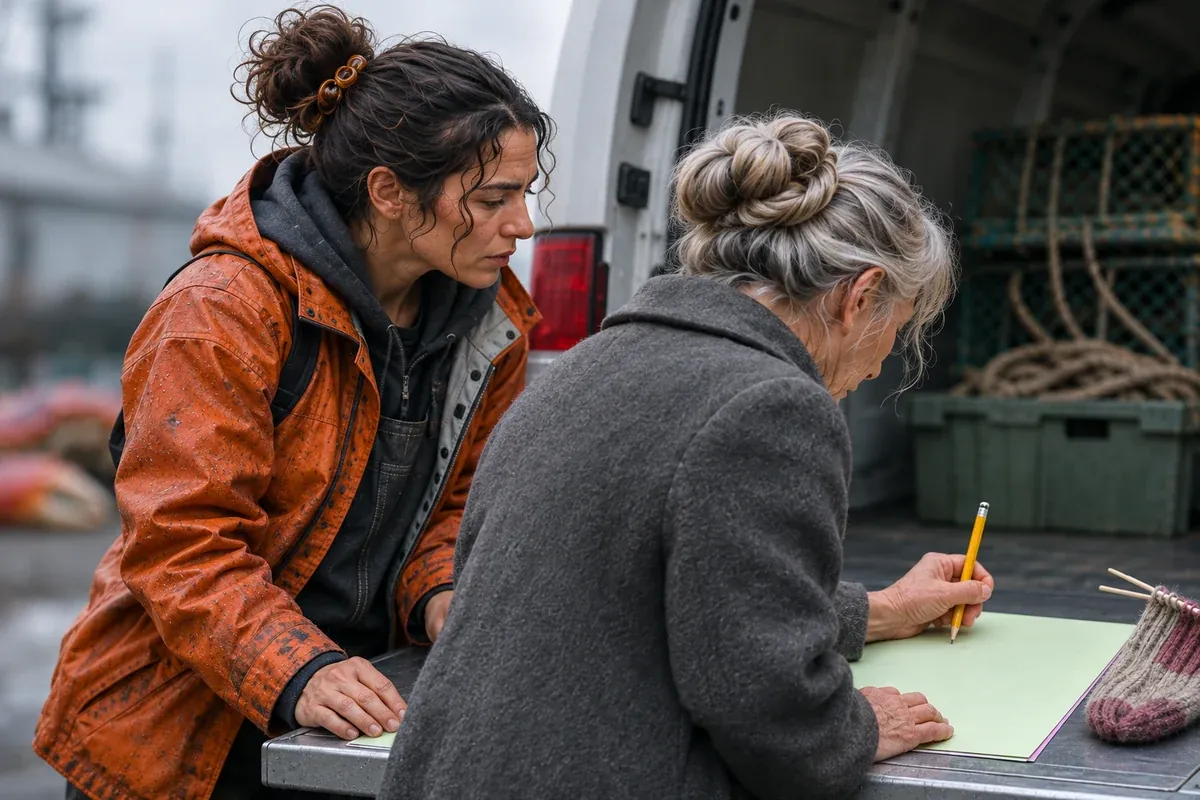
I turn so fast I pull the bruise. Ines Petrovich is standing at the edge of the gravel in a wool coat the color of a wet street, a cane in one hand and a half-finished sock in the other, needles clicking. She is seventy-nine. She has lived four hundred yards from this slip her whole life, and I do not know how long she has been standing there.
“Mrs. Petrovich,” I say. “You shouldn’t be out in this.”
“Glass is falling,” she says. She does not elaborate. “My Anton was a radioman on the Polar Mist for thirty-one years. I could read a key before I could read a recipe.” She looks past me at the crab. “He is saying license. L-I-C-E-N-S-E, over and over. He thinks you are slow.”
“I am slow,” I say. “I don’t know what a license is.”
“Neither does he, I would think. But he seems very sure it would help.” Needles. One, two, three. “Do you mean to kill him, Veronica?”
“No.”
“The harbormaster does.”
“The harbormaster is scared.”
“So is the crab.” She turns the sock, counting under her breath. “Forty-one. Forty-two. And the animals on the dock, and the gulls, and the one who killed them. I watched from my window. It was a very clean piece of work.”
It takes me a moment. “Cal Varga.”
“He was on the fuel dock at eight with the harpoon gun on his back. He signed his name on that slate and the whole thing lit up like Christmas, and then the gulls came in to the lamp the way they do, and he shot every one of them. Nineteen. I counted. The town cheered.” She looks up. “I thought you should know that the town cheered.”
I did not see it. I was inside, and I heard it only as a roar from the street while Odalys was reading the budget. I think about the line that says culling is recorded, and about the way Cal Varga stood at the rail of the Marguerite last night and did arithmetic.
I also think about his frame, which I read on my way in. The town sees CULLER, LEVEL 31. My Nose is eleven, and it lets me see things that are not meant for the town, a small gray line beneath his name in a color that is not the town’s color. It said Strikes 12.
Nineteen gulls later, if Ines counted right, that is thirty-one. I do the sum twice and it does not improve.
“Mrs. Petrovich,” I say. “What does a license do?”
“I have no idea,” says Ines. “You should ask the form.”
“What form?”
She nods at the van.
It is lying on the van’s tailgate, pale and flat, where nothing was a moment ago. A single sheet of paper. Not a glowing notice. A sheet of real, soft, pale-green carbon paper, three layers deep, the kind that used to come in triplicate, with a perforated edge and a ruled grid and a little printed seal of a lighthouse with a loop at its top. It is warm when I pick it up, like a dish from the oven. It smells very faintly of sea.
[LICENSE. Form P-1. A Warden may issue a License to any impounded creature for which a willing Keeper can be found. The Keeper signs below and assumes responsibility for the conduct of the Kept. Conduct marks are recorded against the Keeper. A Licensed creature is protected from the Board and from the Order.]
“The Order,” I say.
“What order?” says Ines.
“I don’t know,” I say. “It doesn’t say.”
There are fields on the sheet, and I read them aloud because I do not know what else to do with a form. Animal: Dennis, red king crab. Keeper. Duty of care. Conduct clause. Under Duty of care a line of print reads: To feed, house, restrain and answer for. Under Conduct clause it reads: Every harm the Kept does is a mark upon the Keeper. At forty marks the Keeper is reclassified.
“Reclassified as what?” I say.
“It doesn’t say,” says Ines.
“It doesn’t say.” I look at the sheet. “It’s a contract.”
“I have signed a good many,” Ines says. “Give it here.”
“Mrs. Petrovich, it says every harm he does is a mark on you. I don’t know what a mark is. I don’t know what it costs.”
“I know what your mother’s hip costs,” says Ines, “and I know who has paid for the gaps in the shelter budget. I am seventy-nine. I have a house and a kitchen and a cannery slip my husband loved. The harbormaster means to have this animal killed before lunch. I mean to see one more season of the whistle.” She holds out her hand. “Give me the form, Veronica. The pencil is in my hair.”
It is. She pulls it from her bun, a short yellow stub of a carpenter’s pencil, and licks the tip.
“Anything he does,” I say. “Anything.”
“Then he had better be good,” says Ines, and she looks at Dennis. “Do you hear me? You had better be very good.”
Dennis lifts the claw and taps. Three. Two. Gap. One tap, firm, like a nod.
Ines signs her name. Ines Petrovich, in a hand like old lace. The carbon bleeds. The paper goes warm, and then warmer, and then it goes into my hand like a hot coal and out the other side as light.
[LICENSE ACCEPTED. KEEPER OF RECORD: I. PETROVICH. KEPT: DENNIS (RED KING CRAB). CONDUCT MARKS: 0 OF 40. REHOME COMPLETE. Experience awarded: Level 3. Standing 1. Calm 12 to 14. Kennel 1 is empty.]
Level three. I have gone from one to three on a piece of paper and an old woman’s pencil. I feel the Calm come in, like warmth into cold hands. Under my ribs the bruise lets go all at once, as though a large thumb has lifted.
Dennis lifts his head and does something that I will describe in the log as a sigh.
Then the bounty slate, a hundred yards away on the fuel dock, flickers. I can see it from here. It is a very bright, very big gray door hung in the air, and a line on it vanishes. RED KING CRAB, LV 31: 400 coin. In its place a different line, in gold: DENNIS (LV 31). PROTECTED. KEEPER: I. PETROVICH.
“He’s off the board,” I say. “He’s off the Board.”
“Is that good?” Ines says.
“I think that’s the best thing that has happened to anybody since yesterday.”
“Hm,” she says, and goes back to her sock.
That is when Pell shows up.
He is the wide kid from the Marguerite, the one who held the corner of the net last night, and he has two friends behind him and a gaff on his shoulder and his numbers over his head. DECKHAND, LEVEL 7, and under it, in the gray Pound color, I cannot help seeing, a number of his own: Strikes 0.
He has been listening. He is drunk, I think, or sleepless, or somewhere in the far country between the two.
“Four hundred coin,” he says. “That’s what I heard.”
“Pell,” I say. “He’s licensed. He’s off the Board.”
“I just want to look.”
“Pell.” This is Dot Lindqvist’s son. I held him at the shelter when he was nine and he cried over a cat I had to take to Dr. Pruitt. “Put it down.”
“I’m not doing anything.” He steps forward. He is smiling in a way that I do not like, and he is not a mean kid, and he has a fear in him like a knife. “I just want to see it. I want to see if it’s real.”
He puts one boot on the crab’s shell.
I have time for a half a word. Then Dennis moves, short and quiet, the way a door closes in an empty house, and Pell is on the gravel with his boot in a claw and his mouth open and no sound coming out. It does not break the boot. I notice that. The claw sits across the leather with the exact pressure of someone holding another person’s wrist to say, I will let go when you apologize.
“Okay,” says Pell in a thin voice. “Okay. Okay, I’m sorry.”
Dennis lets go.
Pell scrambles back, gasping, hopping on his good foot. His friends pull him away. He is limping, but he will have a bruise and not a break. I am already moving, soft voice in my throat, Okay, okay, it’s over, and I am so busy with Pell that I do not see Ines until the sock drops into the gravel.
She has put out her left hand and turned it palm up in the gray light, the way she checks a dropped stitch.
On the palm, small and neat and black as printer’s ink, is a ring. About the size of a dime. It has appeared with no more fuss than a watermark. A single thin circle, and under it, floating in the air in the Pound’s gray, a line: CONDUCT MARKS: 1 OF 40.
“Oh,” says Ines. “That’s what a mark is.”
“Mrs. Petrovich—”
“It doesn’t hurt.” She turns the hand. “It is rather like a coin.” She picks up the sock with her right hand and brushes the gravel off and goes back to her needles, and I stand there with my throat closed up, because it is the first time that anybody has paid for one of my decisions in front of my face.
“I’m so sorry,” I say.
“Forty-four,” says Ines, and knits. “Forty-five.”
I spend the afternoon at her kitchen table because she says I will not argue, and I do not. Her kitchen is yellow and small and warm, with a window on the harbor and a radio tuned to nothing, and on the doorframe of every room, I notice, hang dog tags. Brass, steel, a few cheap aluminum ones. They are on nails, hung by their chains, and they tick against the wood when the wind gets in. I count eleven on the front door alone.
“Anton’s,” she says, following my eye. “The dogs we had.”
“There are a lot of them.”
“There were a lot of dogs.” She sets down a mug of tea in front of me. “Eat your soup, Veronica. You look like you’ve been put through a wringer.”
I eat the soup. It is very good. For forty minutes the island does not exist and my left side does not hurt and there is no crab in my life.
It is the nicest forty minutes I have had in months, and I spend them with a stranger’s name on a form in my head: Keeper of Record. A person who has agreed to answer for another’s harm.
At two in the morning I do the other thing, the thing I have done every night for six months, 183 nights now, and I make myself do it the way I always do. I don’t look.
Kennel Twelve is at the end of the row. The slot is a six-inch gap at knee height, with a steel pan that slides. I put in a can of cat food and a bowl of water and a handful of Dennis’s herring, because it is what I have, and I say what I always say. “Good night.”
Something shifts inside the dark. I think it shifts. It is the sound of fabric. It is so faint I could have invented it.
I stand there with my forehead nearly against the steel, my heart going. And then I do something I have not done in six months. I say, very softly, “Is anybody in there?”
Nothing. A drip from the sink. A gull on the roof. Out in the harbor, Dennis has gone home to the slip under Ines’s license, and the shelter is as quiet as a held phone line.
I turn to go, and a notice opens.
It does not open at the edge of my vision, where the others do. It opens dead center, so that I cannot look past it, small and bright and plain. I know before I finish reading that nobody else on the island will ever see it, and I do not know how I know.
[DESTRUCTION ORDER, ZONE 4: ISSUED BY THE POUND. 29 DAYS.]