

The sign says LEAVING TAMARACK COUNTY, COME BACK SOON, and somebody has put a shotgun hole through the second O.
I am doing forty-one in a forty-five, with the heater off and every window down, at 5:48 on a Saturday evening in late October. In the glove box is a glass thermometer that read 101.4 when I left Ketterly. In the back seat is a wrapped scarf for my mother, who turns sixty-three tonight and has booked a table for three at a restaurant in Pittsburgh with cloth napkins. I told her I would drive myself.
I am not doing this to defy Dee Fanning. I am doing it because Dee is sixty-four and lives in a condo and believes in things. I have a number on my palm and a fever, and my working theory is that the number is a chemical burn from a brass pen and the fever is a virus. A theory is only worth what it costs to test. The county line is the test. It is a quarter mile ahead and it is just a painted stripe on a bridge.
Nine hundred feet. The steering wheel is hot under my hands. I tell myself it is the sun on the dash.
Five hundred feet. The vinyl of the wheel has gone soft, with a tackiness that was not there at the stop sign. My palm is lit, a dull red 366, and my pulse is knocking behind it like a tenant.
Two hundred.
I put on my turn signal for no one. I cross the painted stripe at forty miles an hour, and for one full second nothing happens, and I think, there. Folklore.
Then the car door handle melts in my left hand.
It softens, like candle wax held to a thumb, and takes the shape of my fingers. I let go. My hand does not want to let go. It wants to take the handle with it, take the door, take the whole warm lovely hatchback and put it in a pile somewhere dark. The wanting is not a thought. It is a hunger in the knuckles.
Something is crawling on my collarbone.
I look down the neck of my cardigan in the rearview. Along the bone, from the notch of my throat out to the shoulder, there is a line of small hard shapes the color of a dull penny. They overlap. They are warm. They are, God help me, neat.
I brake. I swing across the gravel shoulder with both hands on a wheel that is no longer quite a wheel, and I turn the car around on a two-lane road in four moves, a feat I have never accomplished in a parallel-parking test. I cross the stripe back, northbound, doing sixty.
At the other side the scales slide away from my skin like a tide. The handle goes hard under my fingers. It keeps my fingerprints.
I park behind the Gas-and-Go and shake for eleven minutes. I count them.
My phone rings. MOM. I let it ring four times and answer it in the voice I use for the public.
“Tollivers’ Corner, this is Ruth.”
“Mom, it’s me.”
“I know it’s you, honey. I got you a table for three. Pat’s here and I have a very good fish.” A pause. “You’re not coming.”
“I think I have the flu.”
The pause is so long that I can hear a restaurant behind her, cutlery and soft jazz, a place with napkins. “Marguerite Anne,” she says. “Are you hurt?”
“No.”
“Then eat soup,” says my mother. “I’ll bring a quart by.” She does not say what she knows. She says, “Happy birthday to me,” very dryly, and hangs up, and I put my forehead against the steering wheel and listen to the plastic tick as it cools.
When I get out, my pockets clink. I do not own anything that clinks. I turn them out on the hood. Out comes the diner’s spare back-door key, the janitor’s ring with eleven brass keys on it, a stranger’s key on a bottle-cap fob, and a county-issue pen that is not mine.
I do not remember taking any of them. They are very nice keys.
I get back in the car and drive to the courthouse, and I do not give the janitor’s ring back, and I notice that I do not.
The archive after hours is cathedral quiet and the color of weak tea. I take the stairs slowly because they are steep and because I am seventy percent sure I will find an empty room. I find Jonah Ashcombe sitting on the third step from the bottom, forearms on his knees, a paper cup beside him.
“Your mother’s coffee,” he says, not looking up. “She sent it with a kid at noon. No note.”
“She does that.”
“I know.” He raps two knuckles on the stair. “You went out to the county line.”
“I don’t see how you could know.”
“You smell like hot brass.” He lifts his eyes, and the brown has gone gold clear to the pupil. “And your father’s car does that when it’s overheating. You’re driving it like it’s on fire.”
My father’s car. Half of what I own belonged to someone who is dead.
“What did you swear?” he asks.
The brass rule is thirty feet away, and I am nowhere near it. But I am tired and hot, and I have felt the door of my own car try to become a part of me. I say it plainly.
“I promised him I would see his title clear within a year and a day.”
Jonah closes his eyes. “He took a Tolliver,” he says, to the floor. “Of course he did. He collected people. He called it a lien, like you could put a lien on someone’s ribs.”
“It’s on mine.”
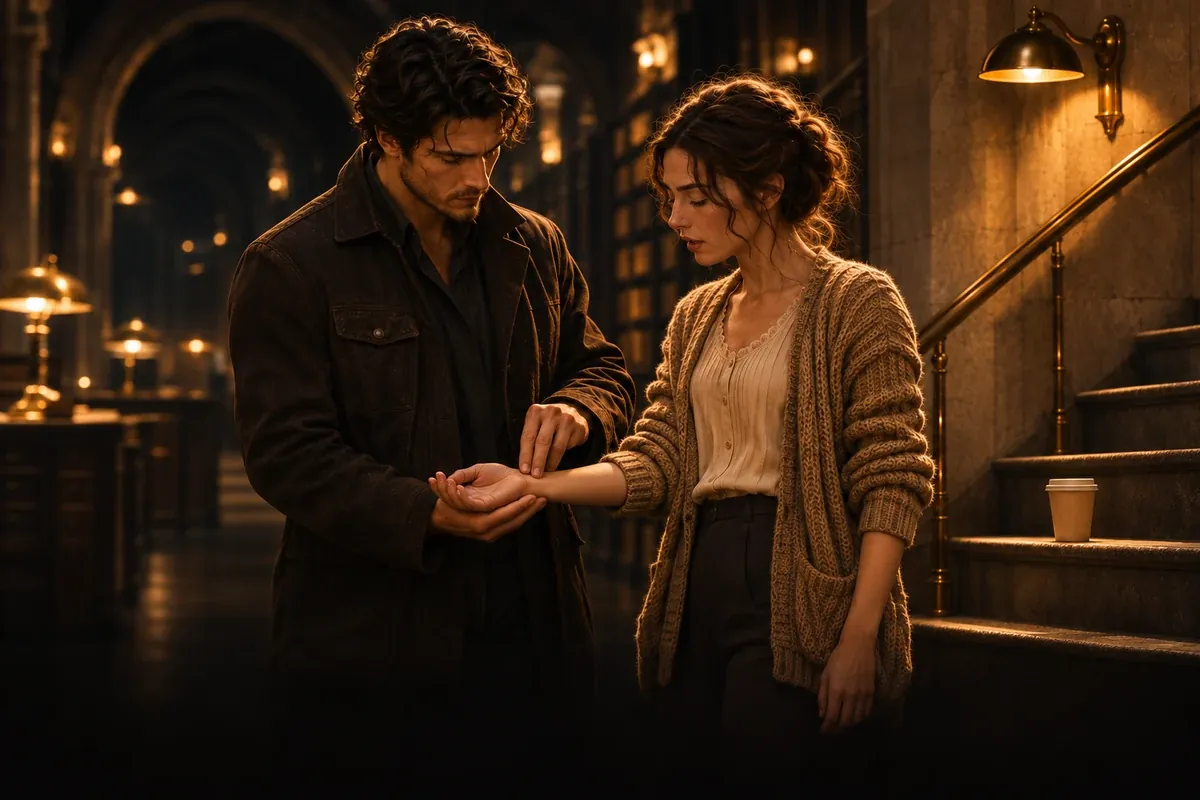
He stands. He is careful about it, the way you stand near a horse that has been struck. Then he does a thing I do not expect. He puts two fingers on the inside of my right wrist, where the pulse is, where nobody has touched me since the number came, because Tully yelped this morning at the handoff of a file folder and showed me a blistered thumb.
Jonah’s fingers are cool.
They do not burn. They do not even flinch. He holds my wrist like a man taking a pulse, and I stand in the dim with a fever of 102 and feel his hand, only a hand, for the first time in fourteen years.
“Fire doesn’t hurt me,” he says, low. “Never has. It’s the one thing he gave me.” His mouth tightens. “You’re warm.”
“Noted,” I say, and my voice does something I will not discuss.
“Ms. Tolliver?”
Tully is at the mouth of the stacks, white as paper, a ledger against his chest. He stares at Jonah’s hand on my wrist and decides not to ask.
“I wasn’t snooping,” he says, which means he was. “I went down to the vault to check the Z-book sign-out. Because someone signed it out. Last night. 3:12 a.m.”
“I was asleep on the break-room cot at 3:12.”
“Yeah.” He turns the vault log toward me. There is the line, in the margin in blue ink: Vol. Z, out, 3:12 a.m., and a signature.
M. Tolliver. Looped T, the double-l down-stroke, the little hook I got from my father and he got from his. It is my handwriting. It is better than my handwriting.
I walk to the counter and pull Volume Z toward me. Jonah follows. The pen warms in my pocket before I touch it.
The new page is just after Halvard’s instrument. It is dated Saturday, 3:12 a.m., and it is very short.
Received: one living left hand, in good repair, conveyed for the use of the Estate.
Under it, someone has begun the signature. M. Toll
My left hand lifts off the oak.
I did not tell it to. It rises from my side, takes the brass date stamp from its cradle, and sets the stamp on the page. RECEIVED. Thump. It dips my own pen, finishes the signature, and loops the last r with a flourish I have not made since I was twelve.
Then it blows on the ink to dry it, and turns to me, and waves.