

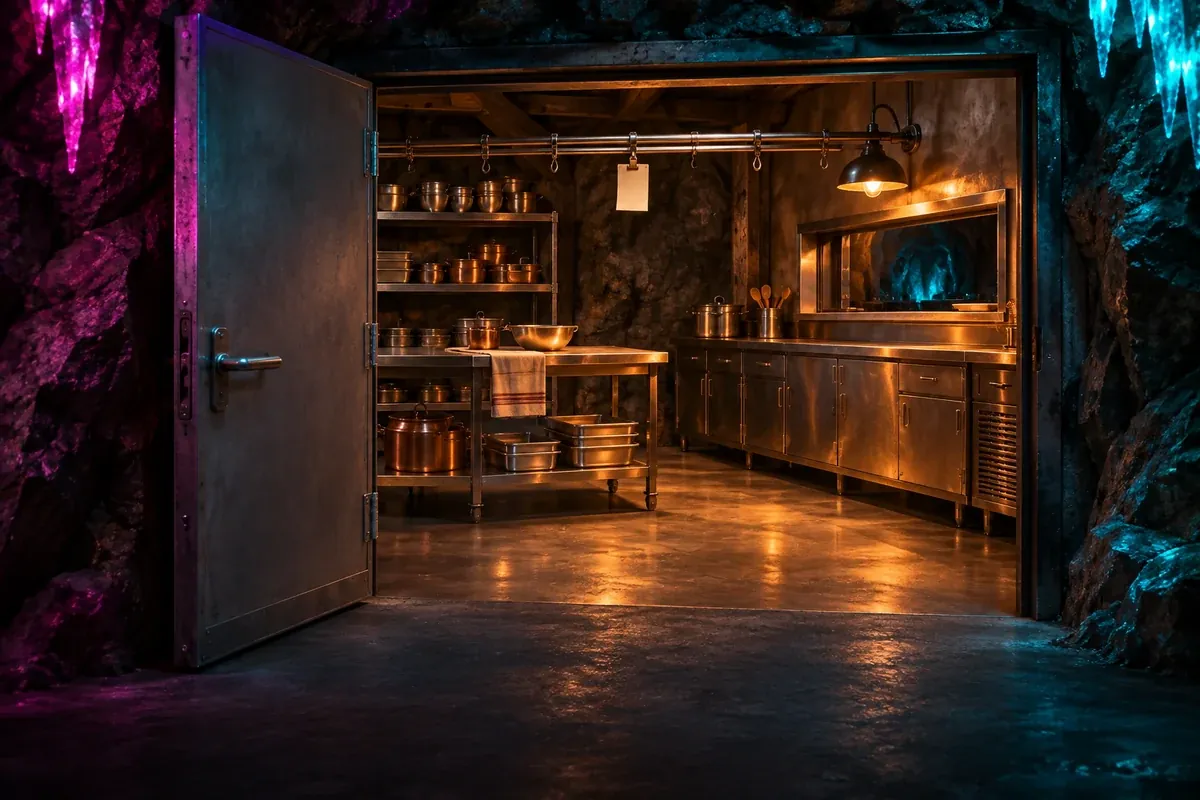
Corbin Hale told one person, who told her sister, who told a half-empty church, and by ten the next morning sixteen people were climbing down a ladder that had been rated for four.
[DAWN. HUNGER -10. UPKEEP -7. APPETITE: 18 / 500.]
[GUESTS ENTERING: 16. HUNGER: 8 / 10 (avg). SUSPICION: 6 / 10 (avg). Party leader: Birdie Lusk, 67, Mayor.]
“Chef,” Pip said, in the voice of someone reading his own obituary. “That’s sixteen.”
“I can count.”
“I have eight plates.”
“Then we have eight plates and a dish pit named Doug.”
Doug went green, which I took for a yes.
“And, Chef.” Pip pointed a claw at the big iron pot on the back of the range. “I started the beans. You said something yesterday about beans keeping. I found a crate behind the flour and put them in water last night and kept the fire low. I’m sorry. I didn’t ask.”
I looked through the lid. Forty pounds of dried red beans had simmered since three in the morning into something creamy and nearly done, and Pip had been awake for every minute of it. He had a burn on his thumb and a bean on his ear.
Twenty-two years in kitchens, and a kobold had just solved my lunch rush without being told. I opened my mouth to say three corrections and shut it again.
“That’s good, Pip,” I said. “That’s really good.”
He stood up an inch taller. Then I tasted the pot, and the beans needed three things, and one of them I couldn’t get from a mine.
[PANTRY (MEMORY): Cayenne pepper, 1 jar. Cost: 8 APPETITE. Memory attached.]
I paid it. The jar landed on the shelf with a memory stuck to it like a price tag. Mémère’s kitchen in Thibodaux on a Monday, washday, the radio low, her wrist turning steadily over a pot of red beans. She was telling me that a cook who measures cayenne doesn’t trust his own tongue. I hadn’t thought about her in a year. I hadn’t called her, either, and then I couldn’t.
I had ten points of Appetite and sixteen guests. I pushed the memory to the back of the shelf and went to work.
There is a chest in the first room. I had forgotten it, because the Tin Cup Company had walked right past it, and it had been polite enough not to move. Its window opened as the townsfolk came through.
[STAFF AVAILABLE: Lorraine, mimic. Condition: lonely. Upkeep: 4 per dawn. Note: repeats the last thing she heard.]
I hired her on the spot. She opened her lid just as a woman in a Sunday hat stepped through the door, leaning on a walking stick, a ledger under her arm.
“It talks!” said Lorraine, in Corbin Hale’s voice, and snapped shut on the stick.
“Well, I’ll be,” said Birdie Lusk. She did not scream. She gave the stick a firm yank, and the chest gave it up with an apologetic little burp. “Whatever you are, hon, I’m sixty-seven, I just climbed eleven levels of ladder, and I’d like my cane back.”
“Ma’am, that’s our coat check,” I said. “She only eats umbrellas.”
“It’s a cane.”
“Cane’s close enough, apparently. Lorraine, walking sticks are not umbrellas.”
“Not umbrellas!” said Lorraine.
Behind Birdie, fifteen people stood in the dark with their hats in their hands. A man holding a hat full of eggs. A woman with a jar of honey. An old miner with a cough and a lunch pail, who looked at the glowing rock the way some men look at a preacher. They had all come with something. Nobody had come empty-handed, which told me more about Tallow Gap than the sign at the town line ever could.
I had six seats. I put six people at the long table and ten on the old ore carts parked along the wall, which Doug polished until they shone like booths. Pip ladled. Lorraine, who learned fast, started calling “Behind!” at everyone who passed her, in Pip’s voice, until it began to sound like hospitality.
“Corner!” she shouted, as a girl walked by.
“Heard,” said the girl, delighted.
The beans came with a skillet of cornbread. I had no cornmeal until the miner’s wife dug a sack from under her coat, and no butter until somebody produced two pounds from inside a coat. A line of people stood and shifted from foot to foot, waiting for a bowl. Eight plates, sixteen guests. I called a table turn in the middle of the lunch, Doug swept through the bowls like a tide, and the second wave sat down at warm iron.
I had never run a service so ugly or so well.
[SATISFACTION: 9... 8... 8... 10... 7...]
Nearly all of it was climbing. Then the window flagged one guest who wasn’t.
[GUEST: Danny Pettis, 9. HUNGER: 10 / 10. SUSPICION: 9 / 10. MOOD: Waiting for the catch.]
He sat on an ore cart beside his grandmother with a full bowl in his lap and his spoon in his fist. He wasn’t eating. He watched every adult in the room like they might take it back.
“Pip,” I said, quietly. “The cornbread. Honey butter. Take Danny a corner piece.”
Pip went over with the skillet, and I watched his hands steady. “Please, Mr. Danny,” he said. “The Chef says he needs a nine-year-old’s opinion. Grown-ups can’t tell if it’s sweet enough.”
Danny looked up at him. A real kobold, holding a skillet. Then he took the bread, bit into it, and chewed with grave attention.
“Needs more butter,” he said.
“Very important,” Pip whispered.
The boy ate the cornbread, then the beans, then the second helping, while the whole table pretended not to notice.
[SATISFACTION: 10 / 10. MOOD: Waiting for the catch changed to: Relief. Seconds.]
When the last bowl went into the pit, Birdie Lusk was still sitting at the head of the table with her ledger open. She added a column of figures out loud, the way some people pray.
“Sixteen plates, two turns, one boy needing seconds. Hon, what do I owe you?”
“Nothing,” I said. “It’s on the house.”
“Everybody owes somebody something.” She wrote in the ledger and underlined it twice. “We don’t take charity in Tallow Gap. We take trade. You’ll have eggs by Friday, and honey, and the Grange ladies’ butter. Salt was right, by the way. Beans soft and not mush. Who taught you?”
“My grandmother. Mémère.”
“Well. Give her my regards.”
“She passed.”
“Then give them to her anyway,” Birdie said, and pushed herself up on her stick.
Pip carried the last of the plates to Doug as the townsfolk filed out, loud and full. I tallied the day.
[SATISFACTION (16 guests): avg 7.5. APPETITE: +240. APPETITE: 250 / 500.]
[GIFTS RECEIVED: eggs 22, honey 1 jar, butter 2 lb, ham bone 1, onions 12, cornmeal 1 sack. Total: 6.]
[GUESTS SERVED: 20 / 20. ROOM ZERO: UNLOCKED.]
On the map, the black square under my stone lit up with a single outline. A door had appeared in the back of the Heart chamber, behind a stack of rotting timber that had not been there that morning. It was an ordinary door painted gray. On it, in chipped white enamel, someone had stenciled KITCHEN. STAFF ONLY.
“I’ll go, Chef,” Pip said. He lit a stub of candle, and the flame shook.
“You don’t have to.”
“Sorry. I think I do.”
I couldn’t follow. Room Zero was a blank on my map even with the door open. I could only listen to his claws on the stone and the wheeze of the hinge.
His breath caught. “Chef. It’s a kitchen.”
“What kind?”
“A real one. Steel table, steel shelves, a long counter with a window cut through the wall. A lamp over the window is on. It’s warm, Chef.” He took a step. “There’s a rail across the top with paper on it. Only one piece.”
“Read it to me.”
He read slowly, the way a kobold reads when he learned his letters off a sack of flour. “Table twelve. Two brunch. Allergy, shellfish. Fire.” A pause. “The twelve has a loop at the bottom. Like a fishhook.”
I had made that twelve a thousand times. Nobody else in the world draws it that way.
“Chef,” said Pip, very small. “It’s still warm.”
It was the ticket I had died holding, and somebody had been keeping it hot.