

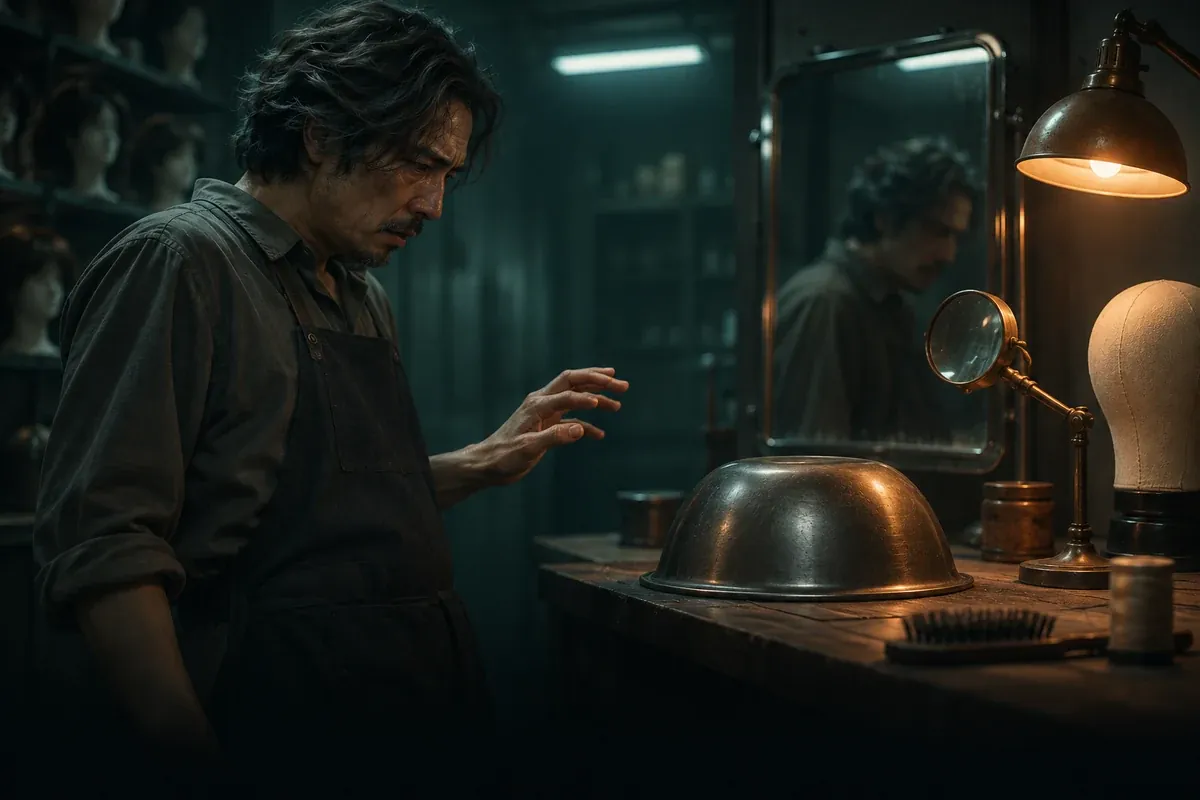
The eye was on the inside of the wig.
Gareth Noll turned the cap over, expecting the glass head beneath it to have cracked. The eye turned with the cap. Its lid closed against his thumb, warm and unpleasantly familiar, as if he had caught his own skin in a zipper.
He set it on the bench.
For thirty years he had explained to customers that hair could feel strange without being wrong. An unfamiliar part. A different weight. Their own faces showing through a frame they hadn’t chosen yet.
This was wrong.
The lid opened. Where an iris should have been, tiny ridges made a whorl. He held his thumb beside it. The patterns matched down to the small straight interruption where he’d cut himself opening a tin.
His hand blinked.
That was the only description he could find. The pad of his thumb tightened over the first joint, then released. He hadn’t moved it.
Beyond the workshop door, the arcade’s cleaning machine passed with its soft, foolish tune. There were six shops left in Bellwether Junction’s indoor mall, if one counted the room that rented mailboxes. Noll Custom Hair would be gone by Friday. He had told himself the silence after closing would be a relief.
Now he wanted someone to come in and complain about parking.
He put a mixing bowl over the cap. The bowl rocked once, then stopped.
The thing beneath it was his old teaching piece, a narrow cap he’d made to demonstrate hand knotting. It had spent years in a drawer. While clearing the shop for its sale, he’d decided to finish its perimeter and use it in the photograph for the inventory.
Three evenings of work. Thousands of small, exact movements. Enough to remind a buyer what the tools could do in the right hands.
His thumb tightened again.
He took his magnifier off. The ridges looked ordinary. There was a puncture near the edge of the nail where he’d caught himself with the knotting needle on Monday. He pressed beside it. Nothing moved. He pressed harder and left a white mark that slowly filled pink.
The bowl clicked against the bench.
Gareth went to the front door, turned the sign to CLOSED, and locked it. His reflection in the glass watched him move. At fifty-two, he had thinning gray hair, a long nose, and the stooped posture of a man who had spent his life looking down at something delicate.
He had planned to grow a beard after retirement. A ridiculous plan. As if his face were waiting for him to stop working before becoming his own.
On his desk lay a brochure for a long rail trip through the western hills. He had circled no departure date. He didn’t even especially like trains. What he liked was the idea of being somewhere people couldn’t arrive at a desk and ask what he could do about the way they looked.
The phone rang.
He let it ring twice, wiped his hand on his trousers, and answered.
Colm Dacre wanted to confirm Friday. His company bought small specialist businesses, kept the useful stock, and combined their customer lists with a fitting service on the west side of town. He had offered enough for Gareth to pay the shop’s debts and rent a small place near the rail line, where he could spend a year doing nothing in particular.
“Any problem with the inventory?” Colm asked.
“No.”
Gareth looked at the bowl.
“I found one piece that isn’t suitable for sale. I’ll mark it.”
“Fine. Training stock?”
“Yes.”
“Keep it if you want it.”
He didn’t want it. He also couldn’t say why without sounding like someone no longer capable of handing over a business. Colm needed Gareth through the transition, introducing customers and describing work that no spreadsheet could adequately record.
They agreed on ten Friday morning. Gareth hung up and wrote TRAINING CAP — EXCLUDED on a yellow label. His left hand kept trying to smooth its edge before he had stuck it to anything.
He pinned the label to a corkboard instead.
At the bench, he lifted the bowl with a pair of long tweezers.
The eye had moved closer to the cap’s edge. Around it lay a thin pink membrane, wet without leaking. A fold beneath the eye suggested a cheek. He could see the individual knots through the membrane. Each hair doubled back into the mesh exactly where he’d put it.
He had made no error in the work.
That fact frightened him more than an obvious mistake would have.
He fetched an empty drawer and lined it with a clean towel. He used the tweezers to lower the cap inside. It caught on a corner, one strand stretching between the mesh and the bench.
The strand seemed too fine to carry any weight. Yet his left index finger curled as it tightened.
Gareth stopped.
With his right hand, he slid the towel beneath the strand. His finger relaxed. He lowered the drawer carefully. The strand came away from the bench and lay on the cloth, making a small, precise loop.
He stood with his left hand held away from his body.
The gesture embarrassed him. There was nobody there to see it. He was still embarrassed.
His last fitting of the week was Rena Saye, who had been his customer for fifteen years. He called her before he could decide not to.
“Your piece is ready,” he said. “But I need to reschedule the fitting.”
“Does ready mean ready, or ready except for something you’ve decided I ought to want?”
“Ready. There’s a problem in the workshop.”
“Water? Electrical?”
“Something with a teaching sample.”
“Gareth, I’m not buying the teaching sample.”
He tried to explain that the problem needed his attention. Rena said she had taken the afternoon off and would come for her own piece. She was perfectly capable of taking it home without him arranging every hair around her ears.
He had known she would say that. Part of him had called because he needed someone who wouldn’t obey.
Afterward he washed his hands. The water was comfortably hot. His left hand turned the tap off before his right was finished.
He turned it back on. The left hand reached across again.
“Stop,” he said.
His voice sounded absurd in the tiled washroom. He wrapped the hand in a towel and held it against his chest until it stayed still.
There was a framed certificate over the sink, one of the minor honors he had never put in the front room because he’d thought displaying it would look needy. In the glass he saw himself cradling his own hand as if it were a small injured animal.
He went back to the drawer.
The cap had turned itself inside out. The membrane was underneath now. Hair lay across it in the parting he always made first, a little to the left of center.
On the towel beside it, loose strands formed five narrow loops. They looked like the beginnings of fingers.
He reached for his phone to photograph them. His left hand reached for the knotting needle.
He caught that wrist with his right and held it.
The two hands struggled quietly over the bench while the drawer, and everything in it, remained still.