

Gareth waited until Rena had gone before he used the scissors.
He would have to admit that later. At the time, he called it making use of an empty workshop. She had a shift to finish, a life that didn’t consist of keeping him from doing something stupid. He had promised to call before removing the strip. He told himself cutting one loose hair wasn’t removal.
The hair lay across the glove, dark against white. He could follow it from the cap to the small puncture beside his thumbnail. It looked impossible. Looking away made no difference to the little pressure inside the joint.
He opened the scissors with his right hand.
The first cut made his left thumb fold.
The second brought blood.
It wasn’t much. A thin red line appeared beneath the nail, then a drop gathered at its edge. Gareth set the scissors down and pressed the puncture with a pad of gauze.
The pressure moved deeper.
Something slid beneath the callus at the base of his thumb. He watched a tiny ridge travel toward his wrist. The severed end on the glove curled tightly into itself, dragging the cap half an inch across the drawer.
Gareth made a sound he had never heard from himself.
He put the scissors in a tin and closed the lid. He held his hand above the cap until the pain diminished. The line between them had become visible, no longer a single hair but a bundle as fine as a drawn stroke.
He called Rena.
“I cut it.”
“Are you hurt?”
“Yes.”
“How badly?”
“I don’t know.”
She told him to sit down. Her voice didn’t become soft or maternal. She asked whether the bleeding stopped with pressure. He said it did. She asked whether he could move his hand. He could, except when the material tightened.
“I’m coming back. Don’t make that a reason to try one more thing.”
He stayed in the old reception chair.
To occupy his right hand, he counted the things on the bench: two brushes, one needle, a small empty dish, the glove. At five, his left fingers began to arrange them in the order he would use them. He put his right hand over the left and counted the ceiling tiles instead.
Rena came with a padded scarf and a plastic storage box. She laid the scarf in the box and moved the entire drawer lining onto it, keeping his hand beside the cap. The pull eased.
They couldn’t take the thing into a waiting room. They also couldn’t leave him with a damaged hand and no ordinary help. After a long discussion that made him feel both foolish and very frightened, he found he could move away if Rena held the cap’s edge open with the glove underneath it.
A pale loop stretched between his fingers, then withdrew below the callus. The pain stopped at his wrist.
“We haven’t got rid of it,” he said.
“I can see that.”
He called a car. Rena stayed beside the box until he returned.
At the walk-in clinic he described a puncture, a possible foreign fiber, bleeding, and involuntary movement. He didn’t describe the face. The clinician cleaned the wound, looked at his thumb, and told him what changes would need immediate attention. She couldn’t see a foreign object to remove. She advised him to stop the work that had caused it and arranged further assessment if the movement continued.
He didn’t ask her to certify that he was imagining things. He had hoped, secretly, she might.
Beside the treatment room hung a mirror with a label asking patients not to adjust the light above it. Gareth caught himself considering the clinician’s hair, the angle at which she’d pinned it back, the little uneven space above her ear. Even frightened, he was still making strangers into potential work. He looked down at his bandage until she finished speaking. She had asked him a question. He needed her to repeat it, and found admitting that harder than describing the blood.
In the car back, his bandaged thumb tapped against his knee. Once, twice, a pause. The rhythm of turning a knot, seating it, releasing the tool.
The driver asked whether he played an instrument.
“No,” Gareth said. Then, because the man was watching in the mirror, he added, “Not anymore.”
He had never played one. He didn’t know why he’d said that. It was an answer that ended the conversation without making the driver uneasy. He had made answers like it at work for years.
Rena had opened the workshop’s rear window. Cold air came through the room. The face in the cap had flattened while he was gone. It had no expression he could recognize. The little pencil form remained on the bench.
She showed him a second form.
It was made from loose hair arranged in the same two boxes. The lower box contained a dark oval where a name might go.
“I didn’t touch it,” she said. “It did that while you were out.”
Gareth looked at his bandage. The tapping had stopped when he entered the shop.
“What did it use?”
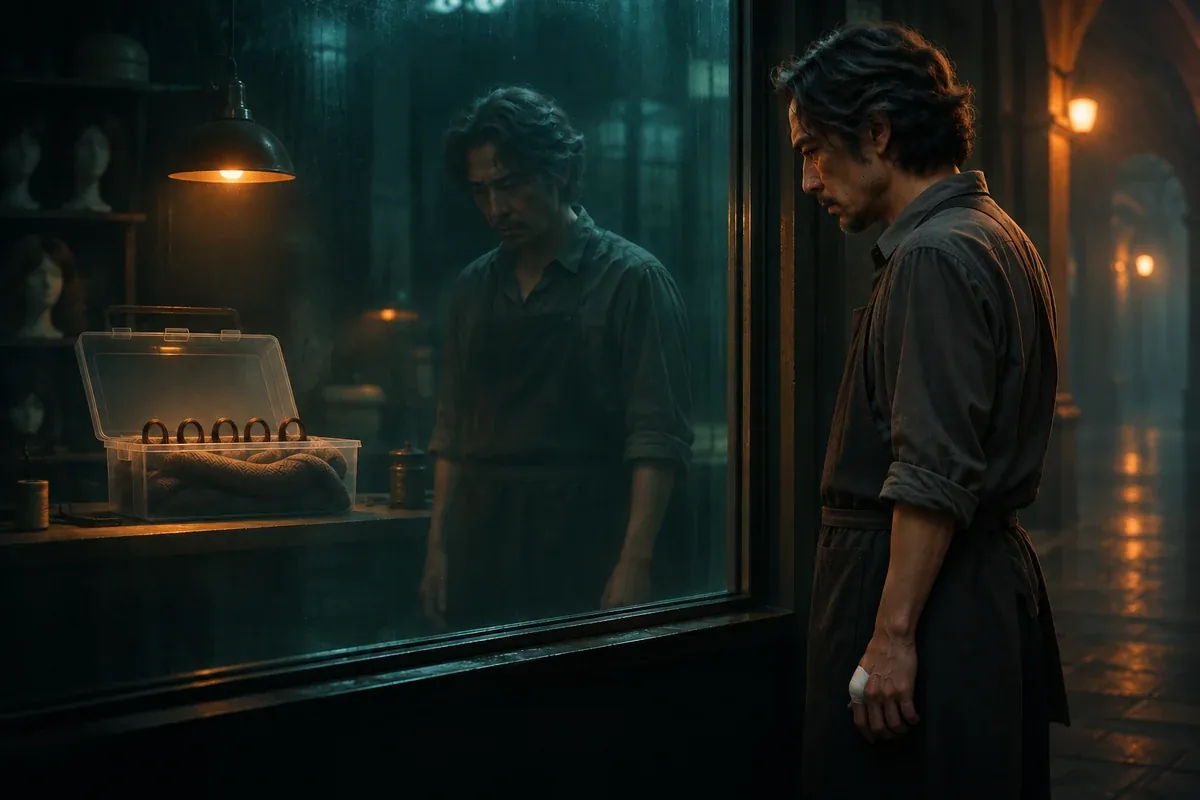
She pointed to the five thin loops beside the cap. They were longer now, jointed at intervals with small knots. At their ends the fibers split into tiny fans. He could see which one had served as the pencil grip.
“Those aren’t hands,” he said.
“No,” Rena said. “They do a good impression.”
He sat down at the far end of the bench. He wanted to tell her to leave, wanted to give her a sensible explanation for what she had seen. Both impulses were partly about making himself the only person in the room who could decide what happened next.
Instead he asked whether she would be willing to help him look at the strip without cutting anything.
“Not tonight.”
He looked up.
“I’m tired. You’re hurt. And I haven’t eaten my half of the lunch I brought.”
He had expected her to refuse because she was scared. Her exhaustion seemed almost offensive, then entirely reasonable.
They closed the cap inside the box without sealing the lid against his remaining line. Rena adjusted the scarf until the tension stopped changing. He could move his hand. The bandage stayed dry.
She made him say where he was going and when he would call. He resented that too, until he remembered what he had done the moment she left.
At the reception counter she checked her own wig one more time. Mesh, knots, elastic. Ordinary. She put it on without looking in the mirror.
Gareth’s left hand rose.
He caught it before it reached her face. She watched him hold his own wrist, and for once he didn’t offer an apology that asked her to comfort him.
“I keep wanting to fix the corner,” he said.
“I like the corner.”
“I know.”
“Do you?”
After she left, he switched off the lights. In the darkened window his reflection lifted a hand. He kept both arms down.
Then he saw the window reflected the workbench behind him. From the box, the cap had raised its five narrow loops into a shape like a greeting.