

The council of the Four Rivers met on the fourth morning before the Trial, and six of its eleven chairs were empty.
I counted them from my place at the foot of the table, where Brannic had put me with a stool, a cup of tea, and the strict instruction to look like furniture. The long tent with the good carpets had been laid out as it always was: the great table, the maps, the brazier, the king’s plain folding chair at the head.
But along the left-hand side, where the river-port grandees had always sat in a row of rings and velvet, five chairs stood pushed neatly under the table with their cushions squared. The sixth was Ostrev’s, at the head of the row. The chancellor’s chair had been left a hand’s width out from the table, like a person who has stood up in the middle of a sentence.
“They left by the sacristy road at the third bell,” said Brannic. He stood beside the king’s chair with his ledger held against his chest, and for once he was not reading from it. “I did not stop them. I had no orders to. I am sorry.”
“You were right not to.” Cassian was reading a letter. He read it twice, and put it down on the table very gently, as a man puts down a thing that might go off. “Ostrev writes that he has taken counsel with the river guilds, and the guilds with the Order, and that the harbour barges will not carry grain, salt, or lamp oil to the Iron Fold until the cutter is surrendered. He writes that he regrets the necessity. He writes that he is, as ever, my servant.”
“The harbour barges carry nine-tenths of the camp’s supplies,” said Brannic. “I have nine days of bread. Eleven if we go to half rations.”
“And then?”
“And then the soldiers eat the horses, Majesty. And then they eat each other, or they go home.”
Nobody laughed. The five loyal councillors, who were all that remained, three garrison captains and two river-engineers who had never in their lives sat at a table with rings on it, looked at their hands. I looked at my tea. The coil lay quiet at my wrist, at the twelve paces between my stool and the king’s chair, and I felt, with a perfectly clear and entirely unwelcome intelligence, that the whole of this was my doing.
“I could go,” I said.
“No,” said the king.
“It is nine days of bread against one cutter.”
“Maren.” He did not raise his voice. He did not need to. “Tell me what Hale would do with you in the first hour.”
“I do not know.”
“Neither do you want to.” He looked at the five councillors, not at me. “I am not asking the council to like this. I am asking it to count. Brannic?”
“There is the southern road,” Brannic said, slowly. “Calde. The Caldic grain corridor was the whole purpose of the treaty. It is a three-day wagon haul from the border depots. But the treaty is void, and the ambassador’s barge...”
“Is Caldic soil,” said a voice from the tent flap, “and so is its hold. It is full of grain.”
Every head turned. Odile stood in the doorway with her hair braided and a ledger of her own under her arm, in the plain gray traveling dress that she had worn every day since the Basilica as if it were a flag. She had not slept either; I could see it. But she had the bright, scrubbed, dangerous look of a person who has been made to carry something for twelve years and has just been told she may hit someone with it.
“Highness,” said Cassian.
“I read my father’s letter again.” She came forward and laid her ledger on the table, open to a page of tidy figures in her own small hand. “The grain was sent with the dowry. It is dowry grain. It belongs to me. The ambassador and I have been through the manifest. There are four hundred tons in the barge’s hold and at the Whitecape depots, and I intend to give it to the Iron Fold in exchange for a single concession.” Her chin came up. “I should like to be told what I may do about my father.”
The five loyal councillors stared at her. Brannic’s mouth moved slightly.
“I was going to say,” said Cassian, “that I would be honoured by any assistance you cared to give.”
“I do not want to give assistance. I want to give grain. They are different.” She tapped the page. “One is a gift, and carries obligation. The other is a sale. You will pay my father a fair price, and I will be your supplier, and in a year I will have a treasury of my own and nobody will be able to read my thread.”
There was a very long pause.
“Brannic,” said Cassian.
“Majesty.”
“Draw up a contract.”
“I have one,” said the quartermaster. “I drew it up at the third bell, in case.”
Odile laughed. It was the clear, startled, wholehearted laugh of a girl at a wall with a pear in her hand, and it went round the long tent like a bell, and the five loyal councillors, who were frightened and tired and had expected a siege, looked at each other and began, very cautiously, to smile.
That was the morning. I should like it known that it was a good morning. I will say it again in a moment, because the night went differently.
The supper came at the usual hour on a tin tray, carried by a scullery boy of about fifteen with a smudge of soot on his nose and a face so carefully blank that I should have seen it at once. I did not. I was reading, and tired, and Jory was asleep on the end of the cot with his mouth open.
The boy set the tray on the camp table, bobbed, and went. A bowl of barley broth. A heel of brown bread. A cup of the dark, bitter tea Brannic had begun to send me in the evenings, the king’s own blend, on the unspoken theory that anyone who drank it for a month could survive anything.
I drank the tea first. It was the only part I really wanted.
I remember that the first sip was bitter in the usual way. I remember that I turned a page. I remember that I put the cup down, and that it clinked on the saucer, much too loudly. And then I remember, from some distance, the odd sensation of the floor sliding quietly out from under the cot, like a rug drawn by a very polite hand.
The coil screamed.
It did not burn. It did not tighten. It screamed, and the sound was not in my ears but in my wrist, in my chest, in the whole architecture of the thing, a long, terrible, silent note of alarm that was not mine. It was a shout, relayed to me from a hundred paces away through a thread I had not asked for. Don’t. Don’t eat. Maren, don’t.
I tried to stand. The tent lurched.
I heard a rush of boots and the thud of a tent flap torn from its loops. Hands caught me before I hit the floor. A sword clattered somewhere. And a voice I knew said, thick and savage and much too close, “Spit it out. Maren. Spit it out. Look at me. Spit.”
“Cassian,” I said. My tongue was heavy as felt.
“I have it.” His thumb was at my pulse. His other hand was against my cheek, and the fire in the coil had gone down to a low frightened beat, and I could see his face above me, white and furious and unguarded, entirely unarranged. “I tasted it. Through the thread. I was in the map tent and I tasted bitter metal. Loom-lead. It is in the tea.”
“I only had a sip.”
“One sip.” His voice cracked. “That is all it takes. Hobb! Get Hobb.”
I should like to say that I fainted heroically. I did not. I lay on a cot in a camp tent with my head in a king’s lap while an old man with a face like a thumbprint in dough forced something vile and gray down my throat, and Jory, awake and gabbling, swept the mouse’s cage off the camp table to safety and stood on a stool holding the tea-cup at arm’s length as though it were a viper.
“Parsnip refused it,” he said in a high voice. “He refused it. He sniffed it and went to the back of the cage. He is a very wise mouse. I am going to buy him cheese for the rest of his life.”
“Loom-lead in the infusion,” said Hobb, grimly, over my head. “Very fine, very dilute. It would not have killed her, Majesty. Not tonight. It was meant to make her sleep. Deeply. For a day or two.” He pressed a rag to my forehead. “A person asleep can be carried anywhere.”
“Where?” said Cassian.
“Out of the radius.” That was Brannic, from the flap, with his ledger in one hand and a scullery boy by the collar in the other. He had the look of a man who has been counting something in the dark and has finally reached the total. “Majesty. May I present the gentleman who brought the tray.”
The boy stood with his head down and his shoulders shaking, and I saw that he was not a boy at all, not really, but a thin, frightened child of fifteen in a borrowed apron, with soot on his nose and tears tracking through it. He had been a hospice runner, he said, in the Basilica close. A man in a half-mask had given him a silver mark and told him it was medicine, a kindness, a way to help a poor sick woman sleep. He had been promised another mark when she was carried out. A cart would be waiting at the east gate before dawn. A boat at the third quay.
“A boat,” I said, from the cot, in a small voice.
“To Harrow Reach,” said the boy, hiccuping. “He did not say it. But the boat flew a black pennant. They all do, that go there.”
Cassian said nothing at all. I had never seen him say nothing like that. His hands, on my shoulders, were perfectly gentle, and the muscle along his jaw was working like a man’s who is holding a great weight on a very small hinge.
“Brannic,” he said at last, quietly. “See that the child is fed, and given a bed in the infirmary tent, and put under the protection of the crown. He is not to be hurt.”
“Majesty.”
“And find the man in the half-mask.”
“It will be Castellan,” I said. “Or one of his clerks. He was in my mother’s cellar eleven years ago, and he is a Reader, and...” I stopped, because the tent was beginning to spin again, and Hobb said sharply that I was to lie still.
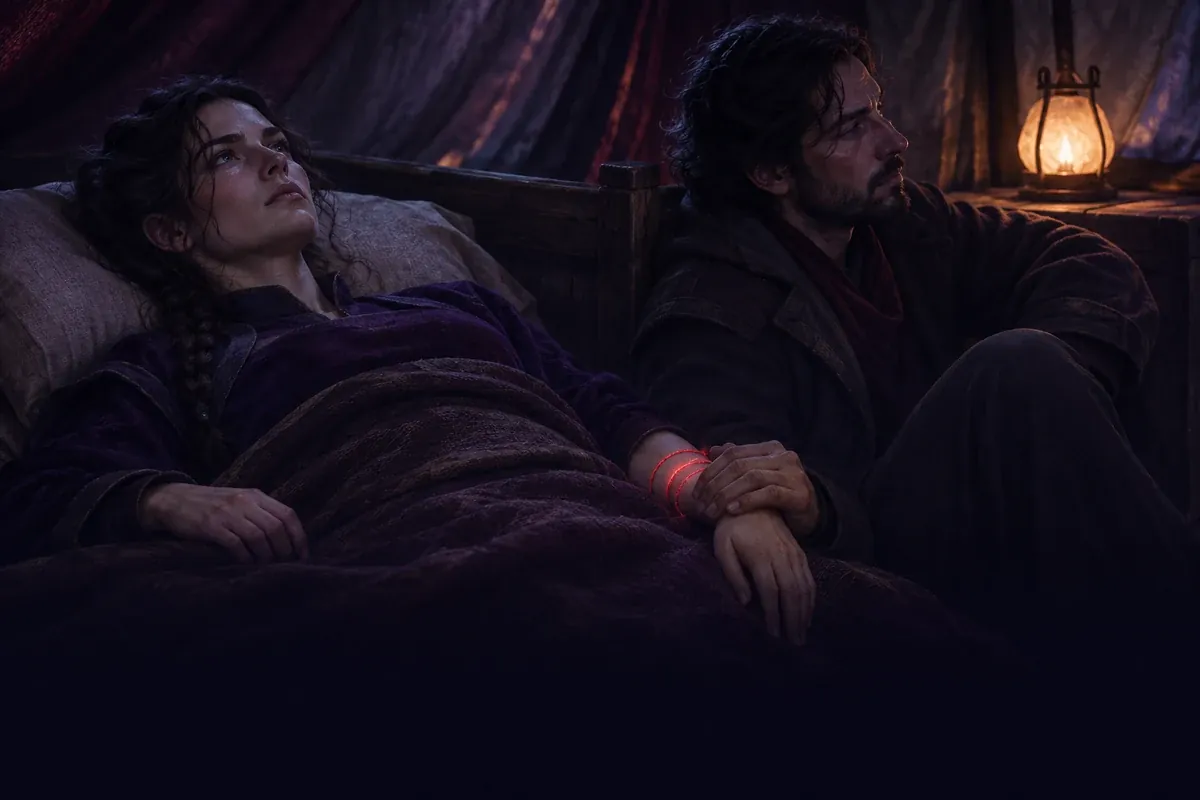
I lay still. After a while the others went, one at a time, Brannic with his captive, Hobb with a promise to return, Jory with Parsnip and a stern look that said he would be in the next tent and was not under any circumstances to be sent away, until the lamp burned low and I lay on my cot with my head on a camp pillow and the king of the Four Rivers sitting on the floor beside me with his back against the cot frame, one hand still lightly around my wrist.
“You do not have to stay,” I said.
“I know.”
“The radius is a hundred and seven.”
“I know what the radius is.” He did not move. “I have known it for six weeks. I have measured it in my sleep.” After a time he said, to the lamp, in a dry flat voice with no ornament at all, “I should like to tell you something, and I should like you to hear all of it before you speak.”
“I am poisoned and I am not going anywhere.”
“Yes. That is why I am saying it now.” He drew a breath. “I have been sighted since the fire.”
The lamp hissed. I lay very still.
“Eighteen years,” said Cassian. “I did not tell Brannic. I did not tell the Order. I did not tell my father, who could not have borne it. I woke after the nursery with my shoulder broken and the sight in my eyes, and I looked at the world, and I saw what you see. Every thread. Every bond.
Every slack bright line across every roof.” He turned his head slightly, so that I saw the edge of his scarred cheek. “And I saw mine. It ran taut. Not slack, like other people’s. Taut as a bowstring, humming, and it ran west to a place on a map that had no name on it, a blank, a smudge, a place I had never been.”
“The dye quarter,” I said, slowly.
“Spindle Street.” His voice was very low. “For eighteen years I looked at that blank on the map and did not know what it was. Brannic told me I was mad to take Virelle. He drew me a hundred reasons. It is a river city with no real defences and a dozen ways to starve a siege. It was strategically ridiculous.
I took it anyway.” A small bitter breath. “I told myself it was the ports. I told myself it was the Order. I did not tell myself the truth, which was that for eighteen years something had been pulling me west, and I had decided that if I was going to be a puppet, I would at least choose the direction.”
I thought of the first night in the tent. The taut, humming line, running out through the canvas toward my roof.
“It was pointing at me,” I said.
“I did not know it was a person. I did not know it was a cutter. I did not know it was a woman with a bad sense of self-preservation and an excellent contract clause.” His mouth moved. “I knew only that when I walked into that tent and you looked at me, and I felt you look, it stopped. The pulling. It stopped as if a hand had closed on the other end.”
“Cassian.” I struggled up on one elbow. The tent swam and steadied. “That is not romance. That is a trap. Someone spun that thread to point at Spindle Street. At the one cutter in the Four Rivers who could unmake it. You were not following your heart. You were being delivered.”
“Yes,” said the Hollow King, and for the first time he smiled, small and cracked and quite without defence. “I have thought of that. I have had a great deal of time to think of that.” His fingers tightened, very gently, on my wrist. “But I find, Maren, that I do not mind being delivered to you.”
I lay back on the pillow. I looked at the canvas. I heard the camp’s counting-house quiet around us, and the lamp, and, a long way off, a sentry calling the hour. And I found that I had no answer, none at all, and that for once it did not feel like losing.
“Sleep,” he said. “I will hold the radius.”
“That is not how a radius works.”
“It is how mine does.”
I did not sleep. But I lay with my hand in his for the rest of that long night, and the coil lay silent and warm and total between us, like a held breath finally let go, and in the dark, quite distinctly, I felt a thing begin that I had no word for, very small and very stubborn, like the first green shoot in a salted field.