

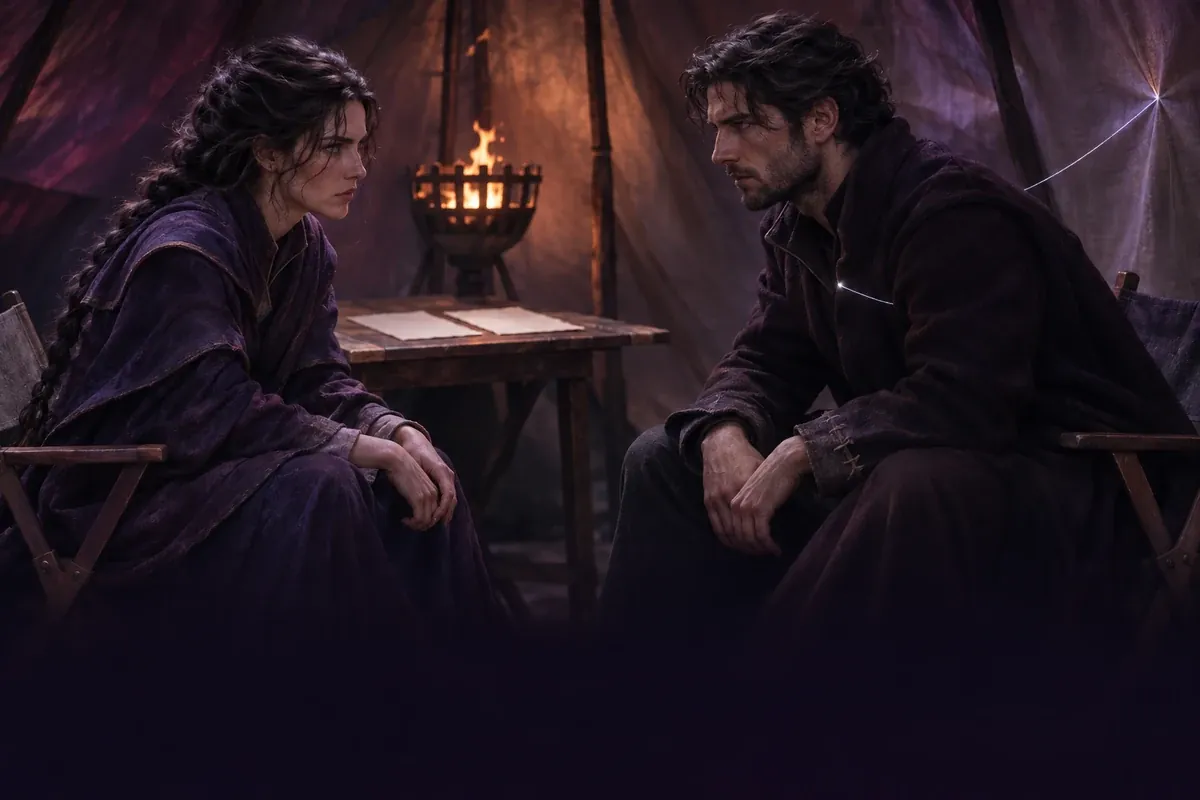
They call the king’s camp the Iron Fold, and the name is a shepherd’s joke with teeth: a fold is where you pen what you own. It stood on the drained fairground east of the walls, a city of canvas and timber laid out with a ruler, and the first thing I learned about Cassian Dreth, walking its lanes between two soldiers in the rain, was that he was the sort of man whose tents stood in rows. The second thing was the quiet. Three thousand men, and I heard tools, and tarps, and one dice game being lost somewhere with dignity. Conquerors’ camps are supposed to sound like taverns. This one sounded like a counting-house.
They took my shears at the royal tent, which I expected, and gave them back, which I did not. The captain — Brannic, I’d heard the gate guard call him, in the tone men use for superiors who read inventories for pleasure — held the bundle out to me with the cloth folded exactly as I’d folded it.
“He’ll see you alone,” Brannic said. “You’ll want to be sensible. He’s had a long war.”
“I’ve had a long occupation.”
“Yes,” he said, unoffended. “That’s the kind of thing I meant.”
The tent of the King of the Four Rivers held a map table, a camp bed with a soldier’s blanket, two folding chairs, a brazier, and no gold anywhere that I could see unless you counted the firelight. He was standing over the map when I came in, and he did me the courtesy — I understood later it was a test — of staying turned away a moment longer, so that my first sight of the most feared man on three rivers was his back: tall, dark-haired, in a plain campaign coat, shoulders carrying that stillness some big men have, the stillness of a drawn bow deciding.
And because he was turned away, he did not see what I did in my first heartbeat alone with him, which was what every cutter does to every stranger out of habit older than manners.
I looked.
Sight is not seeing. Eyes give you the man: thirty-odd, winter-pale, a conqueror in a coat that needed mending at one cuff. Sight gives you the heart’s rigging, and the doctrine, the ballads, the mocking broadsheets were all agreed on what I’d find in Cassian Dreth: nothing. The Hollow King. The man the Weaver skipped. The Readers of three cities had knelt at his request and found no thread to sell him, and he’d paid them for their silence so poorly that everyone knew.
Doctrine, ballads, and broadsheets were wrong.
The thread rooted at his sternum like anyone’s. But where a bonded man’s line runs slack out into the world — a long lazy curve that minds its own business until you tug it — his ran taut. Hard taut, humming taut, a mooring line in a storm swell, so tight it had worn a kind of brightness into itself. I had seen perhaps ten thousand threads. I had never seen one under load.
It ran out through the canvas wall, west.
Toward the city.
“You’re staring, cutter.” He’d turned. His eyes were the gray of river ice and exactly as warm, and they were fixed on mine with an attention that had weight to it, and I realized I had been standing in the royal tent gaping at the king’s chest like a girl at a fair.
“Appraising,” I said. “You’re paying for the professional habits either way.”
Something crossed his face too fast to invoice — amusement, or the memory of it. He gestured to a folding chair and took the other himself, which kings do not do; kings make you stand. He sat the way soldiers sit, without ceremony, forearms on knees, and studied me as if I were a river he intended to cross at the cheapest ford.
“Maren Vael. Third-generation cutter. Your grandmother severed the Tolliver succession bond and survived the scandal; your mother disappeared eleven years ago on church business the church denies exists. You hold the only cutting license north of the Salt Reach, you’re two hundred marks short of your brother’s buy-out, and your guild charter lapses at midwinter unless a sovereign renews it.” He recited it without paper, the way he probably recited fodder counts and bridge tolls. “Have I missed anything?”
“The mouse,” I said. “Guild has a mouse. Parsnip. He’ll want feeding if you hang me.”
“I don’t hang tradespeople for being summoned.” He reached into the map table’s drawer and set something on the wood between us, and the room changed shape around it the way rooms do around certain objects: my brother’s levy paper, the Hollowmere assignment line still drying. Beside it he set a second paper, blank but for a signature and the wolf seal. An open writ. “I need a cut. Tonight. Price it.”
“The king of four rivers has no thread,” I said. “The Readers of three cities agree. It was in all the broadsheets; there were songs.”
“Price it,” he said again, patiently, “as if the songs were wrong.”
Here is what I knew about Cassian Dreth from the war just lost: that he took Virelle without burning it, which the grateful called mercy and the clear-eyed called arithmetic; that his father, old King Aldric, had ended his reign as the church’s glove puppet, wed to a Reader-revealed queen who filed his decrees smooth before he signed them; that there had been a fire in the Dreth nursery eighteen years ago that the Order called an accident, and that the queen died in it, and two royal children died in it, and the surviving prince had grown up to be the kind of man who conquers the church’s richest cities and does not kneel at loom-rails.
And here is what I knew from the humming line running out of his chest toward my city: the Hollow King was bonded, taut-bonded, bonded like a ship dragging anchor, and no Reader had found it because — the certainty arrived whole, cold — no Reader had been allowed to truly look and live wealthy afterward. He knew. He had always known.
“You want it severed,” I said. “Not read. Not traced to see who’s on the other end. Severed.”
“If I wanted it traced I’d have hired someone to trace it.”
“Most people want to know. Pay the tithe, learn the name, buy the ribbon. It’s considered the entire point of having a soul.”
“Most people’s souls can’t be used to open their cities’ gates.” He stood — the drawn bow, loosed into motion — and went to the map, and put one finger on Virelle, then moved it south and east across kingdoms he did or didn’t own, I honestly couldn’t tell from the lamplight. “You asked why six soldiers in the rain. Here is the whole of it, and it leaves this tent with you at your brother’s peril. A bonded king is a door with a key.
It doesn’t matter who holds the key — a princess, a dyer’s girl, a shepherd, I’m told the Weaver has a sense of humor. The moment the Order finds the other end of that thread, they own it. They’ll gild the person, groom them, marry me to them with every trumpet on the river, and then everything I am — armies, treasuries, law — runs through a heart I didn’t choose, prepared by men I know. It is how they took my father. It is how they take everyone. I have watched it done.” He turned from the map. “I don’t intend to be done to.”
“So cut the key,” I said slowly, “and the door locks forever.”
“The door becomes a wall,” he said. “Walls are reliable.”
I’d like to say I hesitated for fine reasons. The true list was shorter. One: the Shear Court burned cutters for exactly this — severing the anointed — charter or no charter, and Veska Lor was already in my city smelling for a reason. Two: nobody mourns a bond like the person who swore they wanted it gone; I had swept enough ash to know that even walls weep.
Three, and largest: the thread was taut. Taut means strain, and strain means the other end was holding on, or being held, and I had learned at six years old, watching my mother work, that you never cut what you don’t understand, because the cut is forever and your understanding is not.
“Whatever you’re paying,” I said, “it doesn’t cover cutting blind. A line under that much tension — something is wrong with it, and I don’t sever wrong things until I know which kind of wrong. Let me trace it first. Quietly. Three days.”
“No.”
“One day—“
“Cutter.” He came back to the chair opposite and sat, and this close the gray eyes were not ice after all; ice is dead, and these were the river in thaw-flood, everything moving fast under a hard surface. “Every day that thread exists is a day someone can find it. Veska Lor dines with my quartermasters tonight and asks charming questions about local trades. You will understand that my patience has a garrison schedule.” Then, quieter, with the first crack of something human in it, tired and iron both: “I have been holding a door shut my whole life. I am asking you to take it off its hinges.”
The brazier popped. Somewhere outside, the dice game ended and the camp’s enormous quiet closed over it.
He saw me weighing it, and, unnervingly, let me. Men with armies press. He waited with his hands loose between his knees, as though he had decided early that a cutter’s silence was information and he was in no hurry to spoil it. I used the time to look at the tent properly. A desk squared to the edge of its rug. A stack of letters under a river stone, every seal unbroken, all of them stamped with the Order’s silver loom. A camp bed, because the Four Rivers’ conqueror had declined the governor’s villa and slept under canvas with his soldiers. A mended cuff, mended badly, by someone who had learned to sew from necessity and not from love.
“One question first,” I said. “Whoever is at the far end of that line, a princess, a shepherd, the Weaver’s sense of humor, they will feel it go. A door closing in a far room, I tell my clients. Tomorrow some stranger in this city wakes lighter than they have ever been and has no idea why.”
“Good.”
“They have no say in it.”
“No,” he agreed, without apology. “Neither did I when it was tied.” The thaw-flood eyes did not leave mine. “You think me callous. I would rather you thought it now than found it out later. I have buried children who were somebody’s door, cutter. A queen who was somebody’s key. I will take a stranger waking up light over that, and I will carry the guilt of it, and I will pay you extra for the part where it sits badly with both of us.”
It was almost a joke. I think he had forgotten how they were built. I found I disliked how much I believed him.
Under my ribs, where the guild keeps its conscience, a very small voice said: he is asking you to do what you do for twenty-five marks, for the one man alive who can afford the best reason. And a larger voice, with my brother’s name in it, answered: and he has the lists.
“My price,” I said. “My brother’s release from the levy, written and sealed tonight, no reassignments, no clerical accidents. The guild charter renewed under your crown for thirty years, your signature, not a regent’s. Two hundred marks—“ I watched his mouth begin to be amused and revised upward on principle, “—three hundred marks, for the guild, taxed at nothing. And your word, whatever that trades for these days, that no one hangs, burns, or questions a cutter in your cities for lawful work. In writing. All of it.”
“Done,” he said, so fast that I knew I had underpriced it, and we both knew I knew, and the almost-amusement reached his eyes and died young there, like everything else seemed to.
He called for Brannic. Papers were brought, written, sealed — I watched the wolf press into red wax over my brother’s name and felt the day’s second understanding slide home: this man had maneuvered me here with a levy list and would honor every clause with the same indifferent precision. Mercy and arithmetic. The grateful and the clear-eyed could both go home satisfied.
“Tonight, then,” I said, gathering my shears. “I’ll need salt, an open flame, and an hour’s quiet. And — fair warning, since no Reader ever gave you one. The cut passes through me, not you, but you’ll feel it go. Everyone does. Like a door closing in a far room.”
“Good,” said the King of the Four Rivers, with the whole of his war-quiet camp around him and that humming, straining, westward line running out of his heart toward my city. “I have never liked that room.”
It should have been nothing to me. A client’s line is a client’s business; you cut at the root; you never look down the line. But walking out into the rain between the tents, I made the mistake every apprentice is beaten out of early.
I looked where it pointed.
West. Over the walls. Into Virelle — into the river quarters, dropping low across the dye canal, threading the crooked lanes I could have walked blind. Toward Spindle Street, where the guild’s salt lamps were burning, where I had left the door on the latch for the mouse.
It is a city of ninety thousand souls, I told myself. The line crosses a thousand roofs. It points at none of them in particular.
I told myself that the entire way back.