

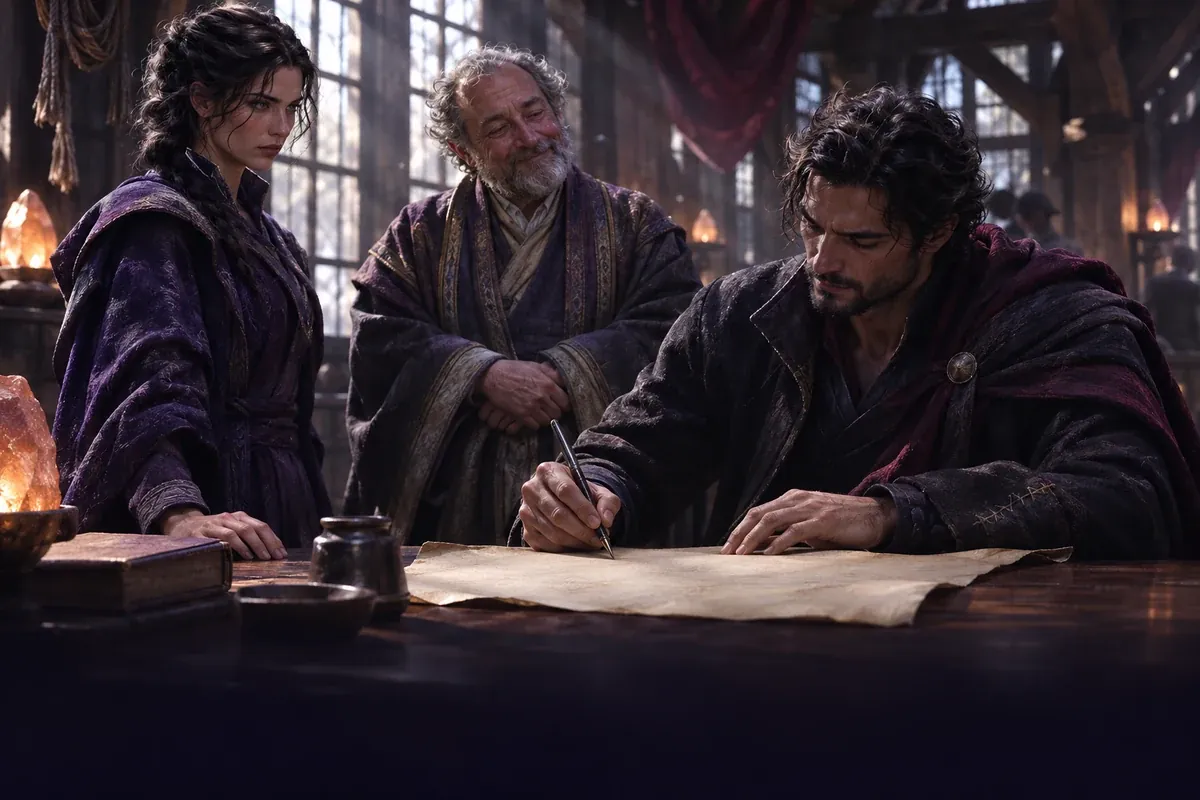
The guild’s charter renewal had to be signed in Virelle, in the old hall on Spindle Street, under the old vellum, with the guild master and a witness of the crown present. Cassian could have sent a clerk and a seal. He chose, instead, to ride into the city he had conquered with six guards, a quartermaster, and a leash around his cutter’s wrist that did not allow her to sign anything in his absence, and he called it a courtesy to the charter.
“It is a courtesy to the radius,” I said, as we passed under the east gate, and Brannic made a small noise that might have been a cough.
It was my first look at Virelle in daylight since the night they took me. The city had not changed and everything in it had. The dye canal ran its Tuesday color, a thick marigold, past shuttered stalls. Soldiers stood at the bridge heads with the bored posture of an army that has not yet been tested by boredom. Women hung washing across the lanes, and the washing looked like surrender flags and also like laundry. And every doorway, I noticed, had been marked at shoulder height with the same chalk sign, a small looped knot. I had last seen it painted on the shuttered house of a man whose bond I once cut, the winter after my mother vanished.
“What’s the knot?” Cassian asked, reading my face.
“A tie-mark. The Order’s parishioners chalk it where there are cutters’ clients. A way of saying, we know what happened in this house.” I looked away. “It used to be rare.”
“It is not rare now,” said Brannic, writing something down.
Hobb met us in the guild hall with the whole of the guild standing behind him: all four of them, counting the apprentice who is nine and cannot see anything yet. He had put on his formal robe, which smelled of camphor and sixty years of salt, and he did not look at my wrist, which meant he had looked at it from the other end of the room.
He bowed to the king as one bows to weather. The charter came down from its case. The clerk read the old words, mercy, cruelty, abandonment, mortal mismatch, and Cassian Dreth, King of the Four Rivers, took the guild pen, and signed thirty years of protection for the last legal cutters on the continent in a hand as plain as a ledger.
“That is it?” he asked, setting the pen down. “No incense?”
“We are not an incense trade, Majesty,” said Hobb, with enormous gentleness, and I loved him for it with a force that startled me.
It was done by noon. It should have been the end of the day’s risk, and I was fool enough to think so. I had been allowed an hour to collect my grandmother’s papers from the strongroom, and I went down with Pell and a lantern, and Cassian, who has never been able to leave a person alone with a document, came down after.
The low vault smelled of salt and mouse and four generations of Vael ink. Pell held the lantern. I knelt among the oilcloth bundles and did the thing archivists dream of and cutters dread, which is to find what you are looking for in the first box. My grandmother’s testimony file, in her cramped brown hand, under a sheet of paper that read Parsnip’s great-grandfather, Caldic, see also hearsay.
Cassian stood at the foot of the stair with his arms folded, watching me with the stillness of a man who does not know where to put his hands in other people’s rooms. After a while he said, to the shelves, “Your mother’s ledger. The last page. You read it.”
I had not told him. I had told Brannic only that the guild’s papers had given me a lead. But the thread had been telling me things for two weeks, and it was a fair guess that it could be made to tell in both directions.
“You tasted it,” I said.
“I woke at the third bell with ink in my mouth. Old ink. Salt and a woman’s handwriting.” His jaw moved. “I thought I was ill. Then I thought: the cutter has been reading something she is afraid of.”
“I am not afraid of it.”
“No,” he agreed, in the voice that had said no to the Reader’s confirmation. “You are the least afraid person I have ever hired, and the most careful. I am trying to learn the difference.”
I put the testimony file down. In the lantern light the vault was very small, and the radius, a hundred and seven paces on open ground, felt a good deal shorter. “Tell me about the fire,” I said. “Not the broadsheet. Not the Order’s version. I would rather hear the wrong version from you than the right one from the Reader-Superior.”
He was quiet so long that Pell, behind the lantern, began to study the ceiling.
“My father was a weak man who knew it,” Cassian said at last. “He was proud, and he was lonely, and the Order sent him a queen. Ilvane. Revealed, certified, confirmed in the Basilica under a thousand candles. She was pretty and attentive and she read his dispatches before he did. By the third winter, the Order was signing his decrees.
By the fifth, he had stopped noticing.” He looked at his hands, the plain knuckles. “She had two children. They were five and three. I was fifteen, and I spent the autumn watching a gilded woman steer my father the way a drover steers a bullock, with a stick and a smile, and I did nothing, because I was fifteen and I believed fate was fate.”
“And the fire?”
“I don’t know who set it.” The flat statement came out like a stone set down. “Perhaps the queen, because she had finally understood what she was. Perhaps my father, because he had. Perhaps the Order, because a puppet that wakes up is a liability. I was in the east tower, because that was where I read. I smelled smoke. I ran for the nursery.” His voice did not alter at all, and that was how I knew what it cost. “The door was warm. I could hear the three-year-old calling for her mother. I broke my shoulder on the lock. I did not get through in time.”
He let that stand in the lantern light. “They bricked the window afterward,” he said. “That is all that remains of that story, that the window is bricked, and that I conquer cities.”
I had no guild words for what I felt, so I used the client’s. “I’m sorry,” I said. “For all of it. I know it is nothing.”
“It is not nothing.” He met my eyes, and the thaw in them held. “It is the first time anyone has said it to me without wanting something.”
Overhead, faint through the old timber, a handbell rang once, and then a dozen more.
We were in the low vault, forty paces from the street door, quiet as a pair of thieves, when the bells began.
Not the Basilica’s great bell, which is a bronze and measured thing. These were the small bells, the parish handbells, dozens of them, ringing in the ragged unison of a crowd that has been taught a rhythm. Cassian’s head came up. Pell dropped a roll.
“That is the Weaver’s Day vigil,” Hobb said from the stair, gone gray. “The Order marks the god’s first knot on this day every year. They process from the Basilica to the river. They are not meant to come down Spindle Street.”
“Who told them that?” asked Cassian.
Nobody answered. We went up.
The street was full by the time we reached the door, and it was the wrong kind of full. The vigil was in front of us, three hundred people in white wool and silver thread, with Readers in half-masks at the head carrying the great loom-staff, and the Order’s banner hanging limp in the windless noon. The faithful sang. They were not looking at Cassian. They were looking at the guild’s door, at the old looped knot someone had chalked on it that morning, and at me.
“Knife-witch,” said somebody in the crowd, conversationally.
Then another, a woman’s voice, high with a fervor that had been waiting all its life to be useful: “She cut my sister’s bond. She cut it and my sister died of the quiet.”
That was a lie, or half of one. Her sister had been Marta Hessing, a pewterer’s wife, who came to the guild two winters ago with her wrist in a sling, and who I had freed from a man who broke it. She had died of a lung fever in the spring. Her thread had not been what killed her. But a crowd does not need a half-truth to be whole.
“Majesty,” Brannic said, very quietly, at Cassian’s elbow, “we should withdraw the way we came.”
“The way we came is behind this crowd.”
“Yes.”
Cassian looked at the vigil for the length of a held breath, and I watched the war-quiet settle on him like a coat, and I knew, with the sick instinct of a woman who has measured her own leash in mud, what he was about to do. He was going to walk through them. Not because it was clever. Because it was his city, and a king who goes round his own people has already lost them.
He stepped into the street. His guards fanned out with the easy economy of men who had done this in four cities. And the crowd, which had been waiting for a king to refuse, moved.
It did not rush us. It did something worse: it turned like a tide, with a slow terrible courtesy, and in the first three heartbeats it put eighty paces of white wool between me and the man I was tied to.
I felt it before I understood it. A heat in the wrist, a deep itch under the vein, the beginning of the ache that comes at a quarter mile. At a hundred and fifty paces the itch had a pulse. The crowd shoved, apologetic and unstoppable, and a hand took my sleeve, and another, and suddenly I was against the rim of a dye vat at the corner of the guild yard with the marigold stink in my throat and two Readers’ staffs crossed in front of me like a gate.
“There she is,” said a Reader I did not know, a young one, the mask not quite hiding a boy’s mouth. His voice shook. “Hold her. Hold her for the Inquisitor.”
I want to say I was brave. The truth is I was busy. The coil was a fuse now, wrist to elbow, and the pain had direction, and the direction was west to east, back across the crowd to wherever Cassian was in all that white, and every instinct I had was screaming take a step back. But there was a vat at my back and a staff at my front, and the guild’s training, which does not cover this, said only: when the line is wrong, find the root.
I could not find the root. I could only find the fire.
I remember a sound, the sound a body makes when a man in a campaign coat goes through a crowd with no regard for the crowd. It is not a pretty sound. It has no ceremony in it. Guards shouting. A staff cracking. A voice I had learned in two weeks to know across forty paces of tent row, saying, flat and furious and not at all royal, “Let go of her.”
He did not draw his sword. I noticed that afterward. He came through the white wool with his hands, and the Readers’ crossed staffs met his forearm and broke, and the young Reader with the unsteady mouth sat down very suddenly in the marigold dust, and then the king’s gloved hand closed on my wrist where the coil lay, and the fire went out.
All of it. All at once. A clean silence in my arm like a held breath finally let go.
I think I made a sound. I think I put my forehead against his coat, for perhaps two heartbeats, which I am willing to describe as a medical necessity. He held my wrist in a grip that would have bruised, if it had been meant for me, and over my head he said to the street, in a voice that carried to the river, “This woman is under the protection of the crown. Anyone who lays a hand on her answers to me.”
Nobody moved. Three hundred people in white wool, stopped in a lane by a plain man with broken staff-wood on his sleeve.
Then, from the far end of the crowd, a woman in the plain gray of a pilgrim stepped out of the white and began to walk toward us. She did not wear a mask. She was perhaps forty-five, spare, upright, with a face that had been handsome and had decided against it, and she was looking not at the king’s face, or mine, but at his chest.
At his sternum, where a root should have been.
Then, with great, terrible slowness, at the wrist he held. At mine.
I knew her before Hobb breathed the name beside me. I knew her the way you know a storm by the green in the sky.
“Majesty,” said Inquisitor Veska Lor, and bowed exactly as deeply as the law required and not an inch further. “Forgive my parish. They are zealous.” Her gaze did not move from his chest. “I see you have been unburdened of something. An old weight. The ash must have been quite a spectacle.”
“There was no ash,” said Cassian, because he had not yet learned that some questions are traps and some answers are the trap.
“No,” said Veska Lor softly. “I did not think there would be.”
She turned to go, and the vigil parted for her, and over her shoulder, where only I could see it, she smiled the smile of a woman who has been looking a long time for a loose thread and has just found a king’s.