

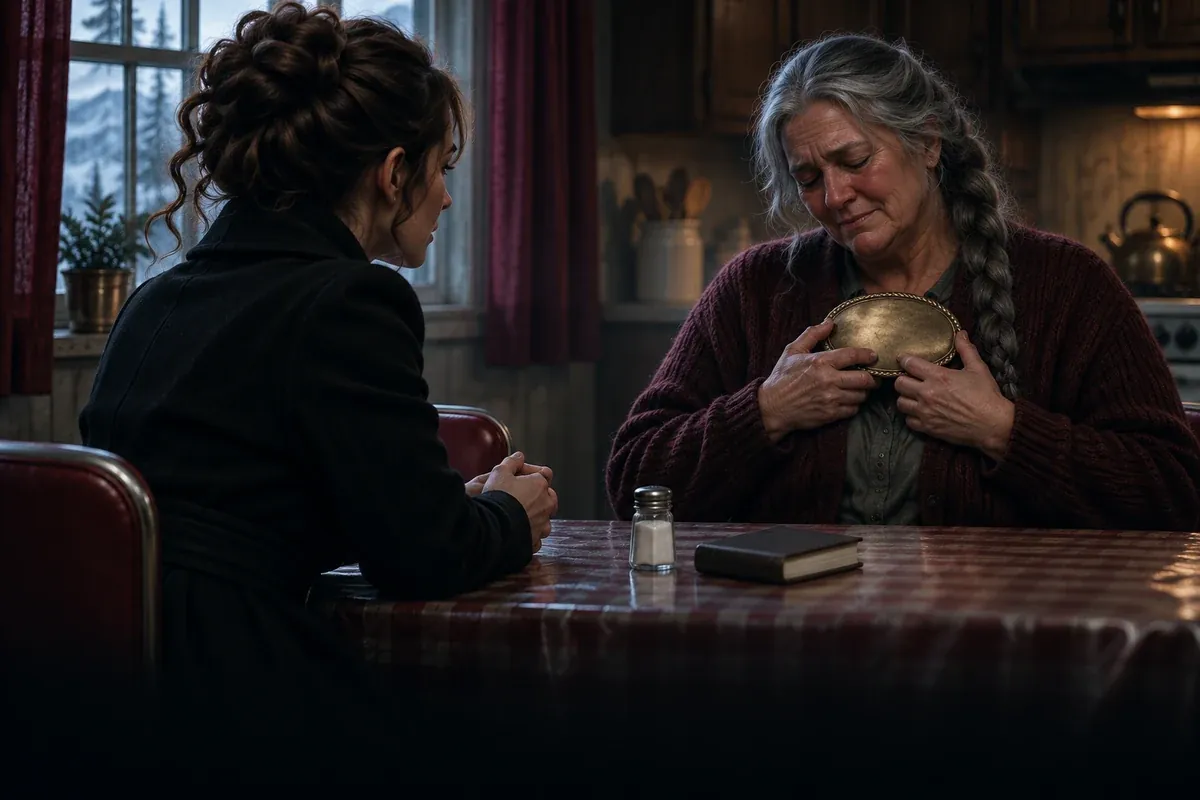
I tell Dee Pruitt that her husband died with his boots off, and that is the first lie of the day.
It is ten past ten in the morning. I am sitting at her kitchen table in a double-wide on Third Street, with a barrel painted like a cartoon cow standing in the front yard and a rodeo belt buckle the size of a saucer lying between us on the vinyl tablecloth. She has not touched it. She has touched everything else: the salt shaker, the edge of the table, the cuff of her own cardigan, as if she is counting the objects that stayed.
“He had the television on,” I say. “A cooking show. He was lying down, and he looked comfortable, and nobody was in a hurry.”
The truth is that Gil’s boots were by the door, and the television was off, and he was alone on a bed in two states with a tag through his ear. But I have been doing this since I was sixteen, and I have learned that the living do not want the facts. They want the temperature of the room. So I give her a warm room.
“Was he west?” she asks. She is a born wolf, sixty, gray in the braid and broad in the shoulders, and she asks it very carefully, like someone trying a door she suspects is painted shut. “When he went. Was he on the right side?”
“Mr. Pruitt was entirely in California,” I say. “He has his name. Mr. Kowalczyk signed it himself.”
That part is true by now, and I watch it land. Her shoulders come down from around her ears. She takes the belt buckle at last and holds it against her chest with both hands, and for a while the only sound in the kitchen is a refrigerator humming a note I have heard in a hundred kitchens.
“He’d been saying he felt thin,” Dee says. “Last week. Like a rented tux, he said. Like somebody else’s hands. I told him he was getting old. I said we’re all getting old, Gil.” She laughs, once, with no air in it. “Everybody’s hands feel like somebody else’s after fifty.”
I write down rented tux in the small notebook I keep for exactly this. I do not know yet why I do it. It is the kind of detail that falls out of a person like a coin, and my grandfather taught me to pick up coins.
“The viewing is Thursday,” I say. “Mr. Kowalczyk will drive him himself.”
“He’d like that. Gil liked your grandfather. Said he was the only man who ever got him to sit still.”
I leave a card on the table that says nothing but our name and our number, and I let myself out. In the yard the plywood cow smiles at me with its enormous hand-painted eyelashes. By the time I reach the hearse, my own hands have started to shake, so I sit on the running board and wait until they are mine again.
It is a quarter to twelve when I push open the door of Mae’s Two-State Diner.
Mae’s is the only restaurant in Dry Ladder with a state line through the middle of the counter. The strip comes in under the front door, runs between the third and fourth stools, and goes out through the kitchen, so that half the pie case is in California and half is in Nevada, and the pie, I have been told, can taste the difference.
There is a slot machine by the register. There is a paper placemat of a map with no borders on it. There is Mae herself, eighty-one, in a hairnet, behind the grill, who has not said a word to me in my life and who nods at me every day as if I had.
“Del.” Peg Lundgren slides a coffee in front of me before I have sat down. She is fifty-five and built like a mailbox, with a pencil behind each ear in case one gets lost. “You look like the middle of a funeral.”
“It’s not noon yet.”
“Then you look like you’ve already had the afternoon. What’ll it be?”
I look at the menu. I do not need to. I have eaten here since I was a child. I say, in the formal voice I use for banks and widows, “I’ll have the Eulogy Special.”
Peg does not write it down. Peg never writes anything down. She tilts her chin at the kitchen, and the cook, a long silent man named Odell, takes a pair of eggs off the flat-top and cooks them until they could be used to patch a road.
Two slices of rye go into the toaster and come out black. The coffee arrives with a small steel pitcher of cream, and Peg sets the pitcher on the east end of the counter, three inches past the brass, with the handle turned toward the back of the house.
Nevada cream. It is not a menu item. It is a door.
I eat what I can of the eggs. I leave the toast. Then I stand, and Peg takes my elbow, and the two of us walk through the kitchen past a stack of crates and a mop bucket and a calendar from a feed store, to a gray steel door with a handle the length of my arm.
The freezer is cold, but not as cold as it should be. Past a sheet of plastic curtain there is another door, and past that is the Pantry.
I have been in the Pantry perhaps a dozen times in my life. It is a long windowless room that was an ice house in the thirties and a bomb shelter in the fifties. Now it holds a scarred oak table, twelve folding chairs, a woodstove, a coffee urn the size of a toddler, and the pack of the Stateline Hotel, or as much of it as can be gathered at noon on a weekday.
Marguerite Hale sits at the head under the one lamp, with her silver collar up. Rudy sits at her right and clicks his pen. Odell has come in behind me from the kitchen and taken a chair. The housekeeper, Tina Ruelas, a small woman with forearms like rope, sits with her hands folded over her mop-bucket apron. There are nine others, wolves I have buried the grandparents of, each of them watching me with the polite stillness of people at a reading of a will.
At the far end of the table, on the floor with a box of crayons, a small boy is drawing on the back of a menu.
“Room One,” says Marguerite, to no one, “is not here yet.”
“Room One is an empty suite on the top floor,” Rudy murmurs. “Mom, we don’t have to...”
“Office, hush.” She looks at me. “Hearse. Sit.”
I sit. I put my coat on the back of the chair, and the embalmer’s scissors in the pocket knock softly against the wood.
“I need to ask a question of the Lease,” I say. “I’d like it answered on the record.”
“The Pantry has no record.”
“Then I’ll ask it anyway. This morning a tag was clipped into Mr. Pruitt’s ear before he was cold. It had a number that the state doesn’t have. I removed it. I’d like to know who in this hotel can make a tag.”
Nobody moves. Somewhere on the other side of the room, a woodstove ticks.
“Hearse.” Marguerite says it as though she were reading it off a bill. “Everyone in this room has a lease. Do you know what a lease is?”
“A contract to occupy.”
“A contract to be tolerated. We occupy a hotel built on a line that neither state believes in. We occupy it at the pleasure of two governments and a bank. Paragraph one, no tenant shall hold paper of the other state on his body. Paragraph two, no tenant shall file paper against another tenant.
Paragraph three, no tenant shall make paper at all, in either hand, for any purpose. Paragraph four, a death on the Line is settled by the Registrar and not by the family, and not by the Landlady. Paragraph five, the Landlady counts. Everything else is custom.” She tips her head one degree. “Nobody in this room prints tags. It would be a violation of three paragraphs and a courtesy.”
“Someone did.”
“Then someone has an extra reason.” Her eyes slide to Rudy, so quickly I almost miss it, and then they are back on me. “I will count heads. You will not accuse a tenant at my table. Is that clear, Hearse?”
“Perfectly,” I say, in the funeral-home voice, which is what comes out of me when I am afraid. “The remains were cooperative. No one was harmed.”
“The remains were Gil Pruitt,” says Odell, from the end. He has not spoken in my hearing before today. His voice is very soft and very low, and when he says it nobody looks at anyone else. “That’s what we’re trying to say, Del.”
“I know. I’m sorry.”
“Don’t be sorry. Be quick.”
Rudy’s pen clicks. “It might be Nevada. I’m just saying. The Predator Office prints a lot of paper, and this one’s got a district Specialist in our lobby twice a week with a roll of orange tags in his pocket, and nobody checks that roll. Seems to me if there’s a tag with a phantom number in a dead man’s ear, we ought to ask who carries phantom numbers.”
“Ask him yourself,” says a voice from the doorway.
The room turns.
Calder Finch stands in the freezer door with his hat in his gloved hand and frost from the walk-in on the shoulders of the olive jacket. He is looking at the table the way a man looks at a church he was raised in and then left. The cook has stopped. Peg is behind him with her order pad finally out, and an expression I can only call enjoyment.
“He said the order,” Peg says. “Eulogy Special. Eggs hard, toast burned, cream on the east end. He said it right, Landlady. He even said the thing about the toast.”
“What thing about the toast?” I ask.
“That it was a kindness,” says Calder.
Marguerite gives him a long look. “Specialist, how do you know the order?”
“My father ate it every Friday for thirty-one years.” He turns his hat over once in his hand. “Nobody ever told him not to. I’m told that under the old custom, a man who says the order is a guest for the length of a meal. If the custom’s changed, I’ll finish my coffee outside. I like the cold fine.”
A long silence. Marguerite looks at the cup in front of her and does not drink.
“Seat him,” she says. “Four stools down from the boy. He may eat. He may not speak to the tenants.”
“I’ll speak to the funeral director. She’s the only tenant I’m sure I can’t bribe.”
He takes the chair across from me and puts his hat on the table, crown down, like a bowl. Nobody offers him a plate, so Peg brings one, because Peg is Peg. He eats his eggs with a fork, politely, and I watch him do it, because it is the first time I have seen him eat a meal. He eats like someone whose mother taught him to, and then died.
“Mateo,” Marguerite says, “no staring.”
The boy at the end of the table has not looked at Calder at all. He has been looking at me. He puts down a green crayon and says, in the voice of a child who has been rehearsing a question for hours, “Miss Del. Was Mr. Pruitt the Nevada kind of dead or the California kind?”
The room freezes in a different way. Rudy’s pen stops mid-click.
“California,” I say. “He has a name, Mateo. He’s going to have a funeral on Thursday, with flowers and a minister. His wife gets to say goodbye.”
“That’s good.” He nods, very seriously. He picks up the green crayon again. “Which kind was my dad?”
I have never in my life heard a room go quiet like that. It is a sound as well as a silence, like a held door. Odell has looked down at his hands. Tina Ruelas has crossed herself with her thumb, quick as a tic. Marguerite sets her coffee down with the delicate click of a woman setting down a very full glass.
“Mateo,” she says. “Eat your toast.”
“I already did.”
“Eat it again.”
I look at Rudy. He is writing something on his legal pad with the ballpoint, very hard, and I can see that he is writing nothing. I look at Peg. Peg is looking at the ceiling. I look at Marguerite, and she is looking at my hands.
I realize that I have my left hand flat on the table, palm up, as if I had been about to take something. I did not mean to. I curl the fingers in, and Marguerite’s eyes follow them the way you follow a coat you have lent somebody, to see whether it comes back with the lining intact.
“The meeting is adjourned,” she says. “Hearse, a word.”
But Calder is faster. He slides his chair back, takes a small orange rectangle out of his jacket, and sets it in the middle of the oak table between the salt and the coffee urn, exactly where the light is brightest.
It is tag 0912, with its loop cut through and its little orange flag bent where my scissors went. It lies on the oak like a coin on a church floor.
Every wolf in the room flinches.
I have seen wolves flinch from a great many things. I have seen them flinch from slammed doors, from sirens, from the sound of a dentist’s drill. This is something else. Peg, who is made of mailbox, steps back three feet. Tina Ruelas puts a hand over her mouth.
Odell, the cook, who has probably killed no one in his life, shows the heel of one palm to the tag as though it were a gun. The nine at the far end of the table all draw back from it at once, a little wave of bodies. Rudy turns his face away entirely.
“That’s the only thing in this room the paragraphs agree on,” says Calder, quietly. “Paragraph one. No tenant shall hold paper of the other state on his body. They’re not being polite. It burns, doesn’t it? A tag. If you’re a wolf. You go to pick it up and your palm starts to blister before you’ve closed your hand.”
Nobody answers him.
“That’s what I thought.” He looks at me. “Del, would you hold it?”
“Why?”
“Because whoever’s printing these is counting on a certain kind of person never being willing to touch one. And I would like to know which kind you are.”
It is an insulting thing to ask. It is an insulting way to ask it, in front of the whole Lease. I find that I am angry in a clean, useful way, the way I get when someone tells me the dead are not my business. I reach across the oak and pick up the tag.
The plastic is cool, then slightly warm from my skin. It weighs almost nothing. I turn it over in my fingers. I wait, and I count, and I get to twelve, and then to twenty, and my palm does exactly what a palm does.
Nothing.
A soft sound goes around the table, like wind through a wire. It is not a gasp. It is closer to the noise a congregation makes when the organ finally stops.
I look at Marguerite. She has not moved. She is watching my palm with the flat, bright attention of a woman reading a meter. Her mouth does a thing I can only describe as arithmetic.
“Interesting,” says Calder, and he is looking at her, not at me. “That’s very interesting.”
“It means nothing,” says Marguerite.
“I’d say it means she’s human.” He says the word lightly, and nobody laughs. “Which I suppose we knew. But it’s something to see it.”
I do not know why that matters. I know only that it matters a great deal to the woman at the head of the table, who has not blinked in thirty seconds, and that Rudy has started clicking his pen again, rapidly, like a man trying to put out a fire by tapping on it.
“Give it back,” says Calder. “I want to show you something.”
I give it back. He takes the tag in his bare fingers, and he turns it face down on the oak, and he peels at the corner of the little paper label glued to its back with the edge of his thumbnail, the way you lift the corner of a stamp. The label comes up in one piece. He lays it flat under the lamp.
It is the size of a postage stamp, thick and cream-colored, and pressed into it, so lightly that you have to tilt your head to see, is a round seal about the width of a nickel. Around its rim, in small raised capitals, are the words I have seen every day of my life, on every certificate, on every wall of the funeral home, on the brass plate by the door and the card in my own wallet.
KOWALCZYK AND SON.
I had not known I could go this cold and still stand.
“That’s your family’s seal, Del,” Calder says. He says it gently, which is worse. “Somebody is using your grandfather’s pen.”