

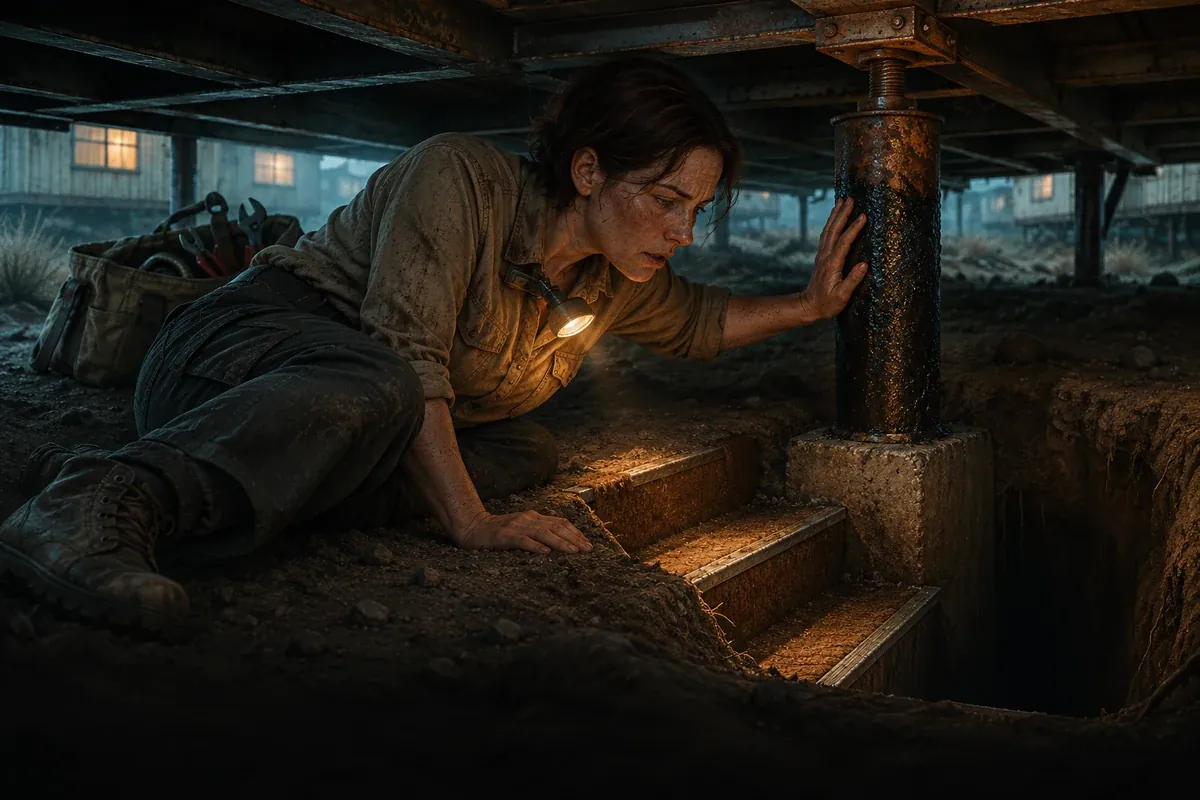
When Petra lifted the corner of number nineteen, a man underneath the trailer asked her to put it back.
There wasn’t room for a man. She had crawled the whole length of the chassis ten minutes earlier, dragging her canvas tool bag through rat droppings and powdered gypsum. She had counted six piers, three dead lizards, and one spoon. No man. Certainly not her brother, who had been missing sixteen years and still sounded nineteen.
“Pet,” he said. “That’s somebody’s ceiling.”
The hydraulic jack stayed under her hand. Above her, Mara Venn walked across the kitchen, and a cup chimed against another cup. Petra knew the noise of two cups touching. She could not have explained why that small domestic sound frightened her more than the voice.
She lowered the corner a fraction. The voice stopped.
Outside the skirting, her daughter called, “Mom? The steps moved.”
Petra slid out on her back. Dust pasted her wet shirt to her shoulder blades. The afternoon had turned the settlement white around the edges, as though Bellwether Flats were a photograph left on a dashboard. Nineteen trailers, the landlord’s low office, a water tank on crippled legs. Beyond them lay the flat stretch everybody called the old wash, although nobody under thirty remembered water there.
Tilda stood beside the cinder-block steps with her drawing pad tucked under an arm. Fourteen, all knees, wearing the sun hat Petra had bought too large three summers ago. A strip of faded fabric held the hat beneath her chin. The steps now pointed toward the wash instead of the kitchen door.
“Settlement,” Petra said.
“Steps don’t settle sideways.”
“The ground shifts.”
“The ground didn’t. I drew them.”
Tilda opened her pad. The page showed Mara’s trailer in diligent pencil, including the warped screen and the two propane bottles with their rain caps. The steps faced the door. In the drawing’s lower corner, Tilda had copied Petra’s spirit level. Its bubble floated outside the glass tube.
Petra took the pad. She rubbed the graphite with her thumb. A little came away.
“You being funny?”
“No.” Tilda looked at the level in Petra’s hand. “Why?”
It had belonged to Petra’s father. Three chipped yellow vials in an aluminum body, a dark spot where his finger always rested. In the long vial, the bubble pressed against its usual black line. Nothing floated where it shouldn’t.
Mara pushed open the screen. Her gray hair was braided so tightly it pulled the skin at her temples. She wore the canvas vest from her water route, every pocket bulging with hose washers and folded receipts.
“You heard him,” she said.
“Heard who?”
Mara regarded Petra with the tired patience of a person watching somebody step around a mess she’d made. “You can finish for today. I’ll pay for the call.”
It was not what Petra wanted to hear. Denner had contracted her to level every home before his lender’s inspection. The settlement job would cover the overdue insurance on her truck and buy new tires before school began. She and Tilda rented number four. That fact made refusing their landlord difficult and arguing about his foundations harder.
“I’ve only done one corner.”
“I know.”
“Your floor was out almost two inches.”
“It stays that way.”
Mara went inside. The screen latched. Through the kitchen window Petra saw two cups on the table, both placed on saucers. She had hauled drinking water for Mara three days earlier after the pump failed. Mara lived alone. Everyone knew that, in the lazy way people knew a fact without knowing the person attached to it.
Petra checked the front door. It shut square now. She checked the window above the sink. That shut square, too. The chassis hadn’t twisted. The concrete pads hadn’t cracked. Whatever had turned the steps hadn’t left so much as a scrape in the crusted dust.
Under the trailer again, she left the jack loose and pulled herself to the rear pier.
The steel stanchion stood on a square footing. Around its bottom somebody had poured a collar of concrete, rough and yellow with sand. It was poor work but ordinary work. A wide weld joined the top to the screw adjustment. Beneath the weld, half hidden by tar, was a stamped number.
Six.
Petra scraped it clean with a screwdriver. She knew the type. Her first summer working for Lyle Denner, she’d carried survey pipes exactly like this, numbered into soft metal with a punch. She had painted tar on the lower ends to slow corrosion. Survey markers weren’t foundation members. You didn’t build a home on leftover boundary stakes.
She put a palm against the pipe.
Cold went into her skin like water through a tear in a glove.
A stair appeared beside her knee.
It descended where the ground should have been. Brown carpet covered its narrow tread, worn silver at the edge. Beneath that lay another tread, and another, going down past the little electric lamp clipped to her collar. She smelled wet wool. Then boiled onions. Then the bitter ink smell of the cheap cigarettes her brother had rolled behind their mother’s shed.
Petra pulled her hand away.
Her knee hit dirt. There were no stairs.
She lay still, sucking air through her teeth. A yellowjacket moved along a joist, carrying a thread of wood pulp. From above came Mara’s chair scraping the kitchen floor. Somewhere down the row a child laughed, then shouted that it hadn’t been funny.
Petra called her brother’s name once.
Nothing answered. She hated herself for calling again.
Outside, Tilda sat on the steps, adding details to her drawing. She had drawn a second staircase underneath the first. Her pencil moved in quick, angry strokes.
“I can’t remember our number,” she said.
“Four.”
“I know that because you just said it. But where is it?”
Petra pointed. Their trailer stood across the service road, green shutters, one shutter missing its top screw. Laundry hung from the narrow porch. Tilda’s yellow sock had slipped from the line and lay on the gravel.
Tilda looked at it for so long that Petra wanted to take her by both shoulders.
“That’s ours,” Petra said.
“Then why do I remember living under here?”
Tilda’s finger pointed between the blocks. In the shade beneath Mara’s kitchen, the dirt had taken on a broad rectangular depression. Not deep. Perhaps an inch. It had corners, though, and beside one corner was a smaller rectangle, the shape and position of a room.
Petra made her daughter stand. She checked Tilda’s face for heat sickness, felt her pulse, asked what she’d eaten. Tilda answered with increasing disgust. Toast, half a peach, crackers in the truck. She was not sick. She remembered their number now. She wanted Petra to stop doing the thing where an answer arrived before the question was finished.
Across the road, Lyle Denner stepped out of his office carrying a rolled inspection chart. His shirt was pale blue, clean except for a crescent of sweat under each arm. He looked at the displaced steps and stopped.
“How far did you raise her?” he asked.
Petra held up the level. “What are those pipes?”
“Standard salvage. Been there fifteen years.”
“Sixteen.”
His eyes moved to Tilda. Petra watched him subtract a year. It was a small motion of the mouth, and she remembered seeing it before, long ago, when he had changed a number on a form without crossing it out.
“Leave the rear corner for tomorrow,” he said. “Start on eleven in the morning.”
Petra walked back to the trailer and lowered the jack until Mara’s door sat crooked in its frame again. The rectangle in the dirt disappeared. The steps faced the kitchen.
On Tilda’s page, the second staircase stayed.
Petra photographed it. Then she photographed the pipe, keeping her hand away from the cold tar. She told Tilda to wait by the truck while she went to Mara’s door.
This time she didn’t ask whether Mara had heard a voice.
“Who lived at six?” Petra said.
Mara set down the cup she’d been holding.
“My wife,” she said. “And your brother was trying to get her out.”