

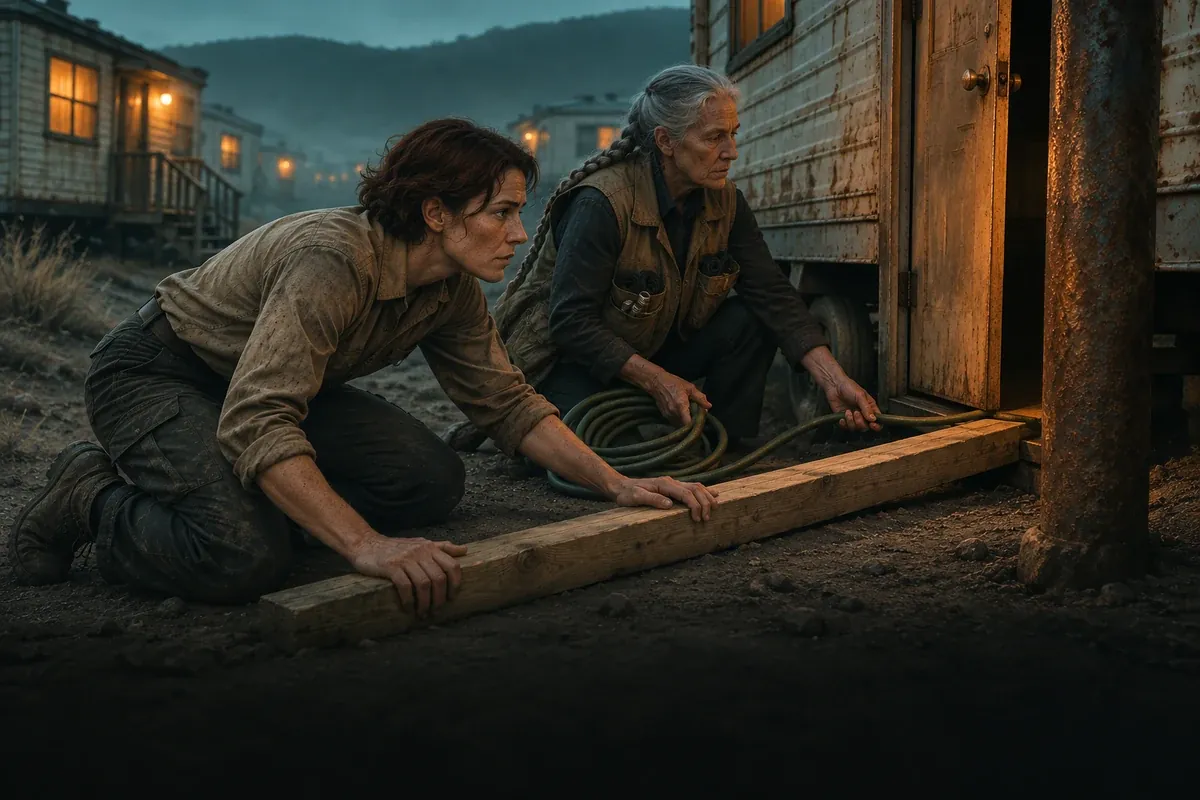
Eamon’s children were at their aunt’s. His wife was working a double shift. Eamon himself stood in the yard holding a rake and insisting he’d been about to go inside for a glass of water.
Petra kept him outside. She and Mara spent the remaining light carrying loose timber from the maintenance shed, laying it beneath the chassis without raising the trailer. Petra didn’t trust the piers, and she didn’t trust her own explanations. The pale square underneath the floor went dark. Eamon said a window must have reflected something. He asked whether he should be worried about his deposit.
That night Petra and Tilda slept in their truck by the water tank. Mara slept upright in a folding chair beside them. None of them called it keeping watch.
In the morning Petra went to her mother’s house.
Cora lived a mile above the Flats, on land too stony to have interested Denner. Her excavator sat behind the garage with a flat front tire on its transport trailer. She maintained the machine and neglected the trailer. This was consistent with most of Cora’s decisions: the thing that did the work mattered; the thing that carried it could wait.
She was sharpening a shovel when Petra arrived. Her hair, once red, had gone the color of dust on a white truck. A hearing aid whistled against the arm of her glasses. She switched it off instead of adjusting it.
“If that’s about your suspension noise, it’s the bushing,” she said.
Petra put the survey copy on the workbench.
Cora stopped moving the file.
“Did you know Ellis was down there?” Petra asked.
A fly rubbed its front legs on the bench. Cora watched it. Petra remembered every punishment she’d had in childhood and saw, with an unpleasant clarity, how often her mother had been buying time to find the easier answer.
“Not when I started,” Cora said.
“Started what?”
“The east fill.”
Tilda stood in the garage doorway. Petra had asked her to stay in the truck and changed her mind before the girl could refuse. No more deciding which part of the world her daughter was allowed to see.
“Tell me the order,” Petra said.
Cora put down the shovel. She went to a metal cabinet and came back with a stack of narrow notebooks, their covers curved from old damp. Maintenance records, fuel amounts, hours. She found one with a split green cover and turned pages with her thumbnail.
“Those are machine notes,” she said. “I kept them for taxes.”
Petra took the book. One page had three lines written harder than the rest. At nine fourteen, first load placed. At nine twenty-one, stopped east slope. At nine twenty-three, voices from occupied structures.
Below it, in smaller writing: 2, 4, 6, 7. Eleven counted. Young Bale with bell bicycle.
“You counted him.”
“I saw him go in. After the first slip, I saw him at the window of six. He was pushing something up against the frame.”
“A table?”
“I couldn’t tell.”
“What did you do?”
“I called for shoring. Denner said the slope would take the road if I dug into it. He said wait for the county crew.”
“Did they come?”
Cora’s face worked. No tears came, and Petra felt an ugly relief. She had been afraid her mother’s crying would force her to become a daughter before she had finished being a witness.
“They came after dark,” Cora said. “By then the windows were covered. The supervisor said he couldn’t authorize men under that bank. The next morning Denner brought statements. He said the houses had been empty when we started, so nobody had to lose a license over rumors.”
“You kept this in a drawer.”
“A cabinet.”
Petra stared at her.
“I know,” Cora said. “I know what I just did.”
Tilda pulled a clean rag from the workbench. She placed it under the notebook, which had been resting in a puddle of cutting oil. Her movements were careful and a little angry. Petra photographed every page before asking Cora for the original.
“I should have gone to somebody,” Cora said.
“You should have gone to eleven people’s families.”
“I was scared.”
“I know that, too.”
Outside, Tilda waited until Petra had opened the truck door. Then she asked, “Why did Grandma write down the bicycle?”
“Because it was his.”
“But you said he took a bus.”
Petra gripped the door edge. She wanted to explain that she had been young, that Denner had spoken with certainty, that the alternative had been a brother dead in mud while she’d stood somewhere safe. All those things were true. They were also furniture arranged in front of a locked door.
“I said what I wanted to believe.”
“That’s not the same as telling me you were wrong.”
“No. It isn’t.”
Tilda climbed in. She placed her sketchbook on her lap without opening it. Petra drove back to the Flats with her mother’s notebook between them.
Eamon had gone inside.
His rake lay on the service road. The front door of number eleven stood open a hand’s width. From within came a steady scraping, followed by a man’s frustrated breath.
Petra called his name. He answered from farther away than the trailer had room for.
“I’m in the hall. Door’s jammed.”
His trailer had no hall. A kitchen opened into a living room, with bedrooms at either end. Petra had crawled beneath it twice, once for a frozen drain, once to retrieve the older child’s escaped rabbit. There was no place to put a hallway.
Mara came out of nineteen carrying a coil of water hose. She stopped at the foot of Eamon’s steps.
“Don’t stand on his porch,” she said.
Petra felt the cold before she saw why. The front support beneath the porch was a tarred pipe. A pale ring had appeared where yesterday its number was invisible.
Four.
Inside, Eamon said something about the ceiling. His voice lost the final consonants, as though they had been cut off by a closing door.
Petra knelt in the dust and touched the end of a long timber they’d placed the night before. It was warm. She pushed it toward the threshold, keeping its weight on the ground beyond the porch. Mara understood and lowered the hose alongside it.
“Eamon,” Petra called. “Put one foot on the wood. Tell me when you’re touching it.”
“I don’t see any wood.”
Tilda turned a page in her pad. “Mom.”
Petra looked back. The girl had copied the original survey and drawn the current trailers over it. She had used the water tank and service road as fixed points. Number eleven sat beyond old parcel four, but its porch pipe fell directly on the line leading to old six. The homes were connected by something more deliberate than bad fill.
“You can’t go straight through his door,” Tilda said. “His door is in the wrong house.”
A thin crack ran down number eleven’s aluminum siding. Behind it Petra saw floral wallpaper and a brass coat hook. A man’s fingers emerged between two studs, searching for an edge.
Petra knew the wallpaper. Her mother had bought the same discounted roll for their kitchen sixteen years ago.
She laid her hand over the fingers.
Eamon asked, quite politely, why she was touching the wall.