

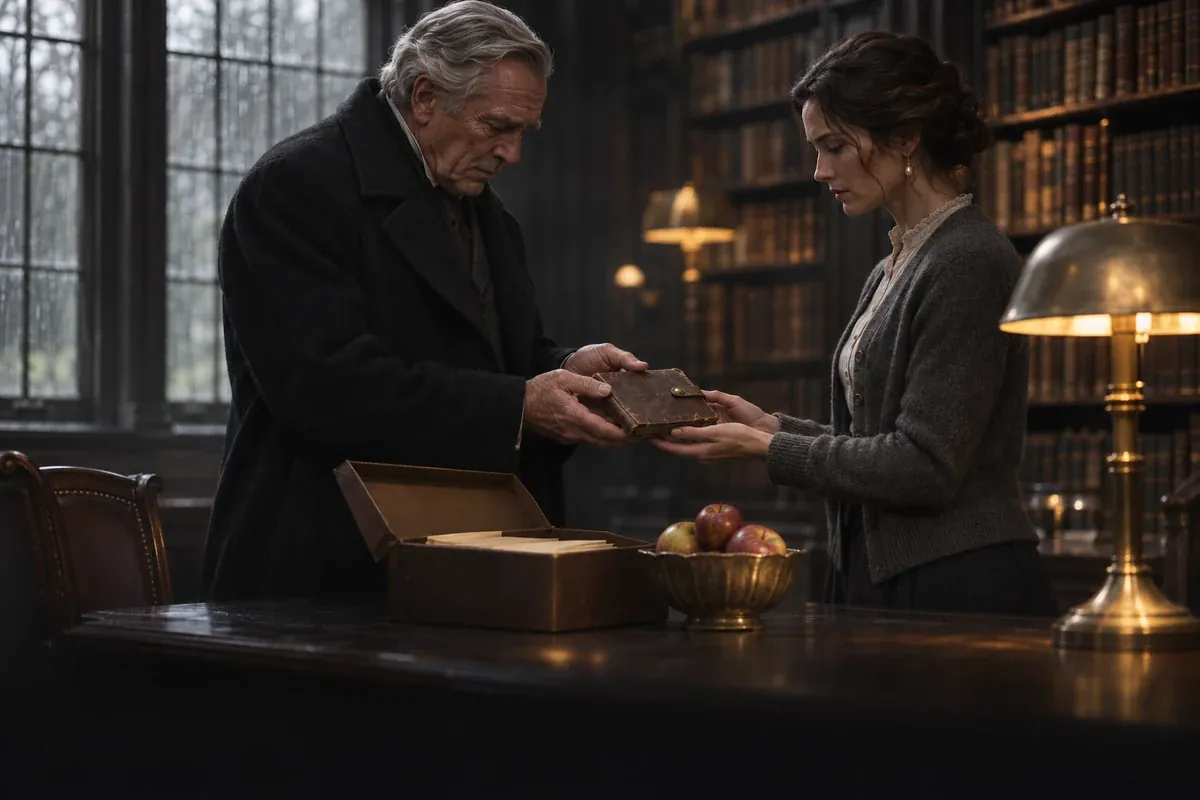
Grant Voss keeps an appointment the way other men keep a vow. At nine o’clock on Monday morning the black sedan is on the gravel, with the engine already off, and its owner is on the front step, in a dark overcoat, holding a document box against his chest as though it contained something that might spill.
Lena sees him from the long gallery window and goes to tell Calder, who is in the library with the telephone against his ear and three newspapers spread across the desk, every one of them with his own face on the front page. The headline in the Haverleigh Courier is the shortest: ALIVE. The one in the city paper has a question mark. He puts the receiver down, looks at her, and understands before she speaks.
“Grant.”
“He brought a box.”
“Of course he did.” He rises. The cane is in the corner. He doesn’t take it. “He’s never come to a conversation without a document.”
“Do you want me to stay?”
He considers her, the plain gray cardigan she borrowed from Odette, the kit on her shoulder, the tired intelligent face. “I don’t want to need you to,” he says. “But I do.”
“That’s the nicest thing you’ve said since the elevator.”
“I’m working up to a sentence with a verb in it.”
Grant is shown into the library at five past nine. He does not sit. He lays the document box on the center table beside a bowl of Mrs. Okonkwo’s winter apples and stands over it with both hands flat on the lid, a tall gray man in an overcoat that no longer fits him quite right, as if the last few days had been a long, silent diet.
“I told you I needed to speak about a telephone line,” he says.
“You did.”
“It’s my son’s.” He doesn’t look at either of them. “Extension 214. It’s been mine to pay for since the week he died, out of my own account, not the company’s. I never explained it to anyone. I assumed you’d think it was sentiment.”
“Isn’t it?” says Calder, gently.
“It was.” A dry exhale. “It was for seven years. And then it wasn’t.”
He takes the lid off the box. Inside are a stack of printed pages, a manila envelope, and a battered brown leather notebook with a brass clasp, small enough to fit in a coat pocket, worn at the corners by hands that have long since stopped. Lena’s eyes fall on the notebook and stay there.
The pages in the box turn out to be the telephone bill, printed in a hard black font on yellowing paper. Lena takes the top sheet and lays it under the library lamp, reading the way she reads a provenance file: dates first, then patterns, then the gaps. The line has received one hundred and two calls in eight years. Ninety-six are the same Lisbon number, a few seconds each, always on the first Tuesday of the month, always between nine and ten in the evening, Lisbon time.
“He’s careful,” she says. “A regular appointment. He never calls on the anniversary, because that would be sentimental, and he never skips a month, because that would be a mistake.”
“Six calls are different,” says Grant.
She finds them. Six calls from a mobile prefix she doesn’t recognize, scattered across the first years. Each lasts under a minute. The last, three weeks before the brake line was cut.
“That one’s a Haverleigh cell,” she says. “Not Lisbon.”
“Petrie,” says Grant, to the floor. “I checked it last night. He was told to ring the voicemail once or twice a year, I think, to be sure the line was alive. I believe he thought it was for me. A kindness.” His face is gray in the lamplight. “He’s worked for me for twenty-six years. I don’t think he’s ever been unkind to anyone. I think he’s been afraid since 2018 and has not known what of.”
Calder, who has been standing by the window with his arms crossed, says nothing at all. But his fingers have whitened on his own sleeves, and Lena marks it in her mental notebook with the word she has learned to use for the things that don’t need a second look: genuine.
“Let me tell it in order,” says Grant. “I’m an accountant. I can’t do it any other way.”
Eight years ago his son Julian was thirty-one. He was tall and untidy and sweet, with an analyst’s mind and a golden retriever’s heart, and he worked in the family office on the sixteenth floor, running models on the old bond portfolio. He adored his cousin Calder. He adored his godfather Royce Fenn, who had taught him to play chess, and cheat at it, and lose gracefully. He called Royce “the other uncle.”
“In January of that year he came to my office,” Grant says. “Ten at night. He was pale. He said, ‘Dad, I found something in the 1998 series, and I think it’s wrong.’ I said, ‘Wrong how?’ He said he’d run an authentication against the original print run and the numbers didn’t match. I said we’d look at it in the morning.” He swallows. “I was tired. I had a board meeting at seven. I said, ‘Go home, son. I’ll have Petrie pull the file.’”
Lena glances at Calder. His face has gone absolutely still.
“He didn’t go home. He called Royce. I know because Petrie, God help him, saw the call log the next day. ‘The other uncle,’ Julian said. He told him what he’d found. And Royce said — I have this from Julian’s own handwriting — Royce said to leave it with him, that he’d handle it quietly, that the family had enough to bear and that Edmund’s memory deserved some care.” Grant’s mouth twists. “It was a lovely thing to say. It sounded so protective.”
“And four days later,” says Calder, very quietly.
“And four days later my son went skiing in Zürs with a group of friends and was caught in an avalanche on a marked piste.” He says it in an even bare voice, a voice that has been sanded for years. “The Austrians called it a tragedy. The resort called it an act of God. They shipped him home in a sealed casket. I buried him. I didn’t ask a single question. I’m an accountant. I don’t ask questions about things I can’t audit.”
No one speaks. In the corner the library clock ticks, a slow brass sound.
“I kept his line,” Grant goes on, after a while. “The company wanted to reassign it. I said no. I paid for it myself. I told myself it was because his voicemail still held his voice, a thirty-second message, ‘Hi, this is Julian, leave a note and I’ll call you back, probably,’ and I would dial in once a year on his birthday to hear it.” He sets down the first page, squares it. “Three weeks ago my telephone bill came with a detail I’d never read. I read it. Someone has been dialing into that voicemail box. Every month. For eight years. Always from the same Lisbon number.”
Lena feels the blood leave her face.
“The PIN,” says Calder. “Who knew the PIN?”
“His birthday. I set it myself.” Grant meets his eyes at last. “I told it to two people. His mother, who is dead. And Royce, at the funeral, when he put his arm around me and asked if there was anything he could do. I said, ‘I don’t know how to turn off his phone.’ And Royce said, ‘Don’t. I’ll help you remember the code.’” His voice does not break. It simply goes out, like a lamp. “He has been listening to my son’s voice for eight years, Calder. A thirty-second message. Once a month. And I have been grateful to him all that time for being the only one who cared.”
Calder moves. Lena has not seen him move that fast since the carriage house, since the first night. He crosses the room in three strides and puts both hands on his uncle’s shoulders, and the old man, who has not been touched in a very long time by anyone he trusted, bows his head.
“I should have asked,” says Grant, to the floor. “I should have asked the Austrians for the file.”
“You couldn’t have known.”
“I’m an auditor. It was my job to know.” He lifts his head and, quite deliberately, steps back from his nephew’s hands, and straightens his coat. “I am sorry about the clerk. Petrie. I have been unforgivably credulous about people who agree with me. I will not do it again.”
“Uncle.”
“I am not finished.” He turns to Lena. “Mrs. Voss, I have been unspeakably rude to you. I threatened you with a courtroom. I will take that back in writing. And I will tell you something I haven’t told my own lawyer: the signature on that altered page. It was Petrie who brought it to me. He said it came from Marsh. I didn’t question it. I wanted so badly to believe that someone else was to blame for my nephew’s death.” He closes his eyes. “I wanted a villain I could hire a lawyer against.”
“You were grieving.”
“I was convenient.” Grant lifts the leather notebook from the box with both hands and holds it out to her across the table, as one holds out something alive. “This is Julian’s. It was in his effects, in the pocket of his ski jacket. They sent it with the body. I never opened it. I couldn’t.” His voice cracks, finally, on the last word. “You read documents. You know how to look at what’s not meant to be seen. I should like you to read it. I’d like to know what my son was thinking.”
Lena takes it. The leather is soft as a glove. The brass clasp has a tiny lock, the kind sold with diaries, easily defeated.
She doesn’t defeat it. She looks at Calder, who nods, and then she carries the notebook to the window and sets it on the sill in the dull November light, and takes from her kit a tool she uses perhaps twice a year on jewelry boxes and cigar cases: a fine hooked pick, the width of a pin.
The lock opens with a click so small that no one in the room hears it but her.
The first pages are the ordinary pages of a young man’s working life. Meetings, a dentist appointment, a list of wines he meant to try. She turns them carefully. There is a pencil sketch of a chess opening and a note to himself about his mother’s birthday. A column of figures. A cartoon of a dog in a necktie.
Then, in January, a page headed 1998 SERIES, underlined twice.
She reads it aloud, slowly, in a flat voice, because she does not trust any other one.
“Authentication: microprint font on border does not match archive specimen. Guilloche artifact at corner A. Paper weight 3% light. Conclusion: reproduction. Whole box? Whole vault? Ask Dad. Ask Calder? Ask Royce first. He’ll know the history. R. will be gentle.”
She turns the page.
“Jan 17. Called R. Told him everything. He said: leave it with me, J. Don’t tell your father yet; Grant’s heart. Don’t tell Cal; it’s his first year as chairman. He said he’d take care of it. He said he was proud of me for catching it. I felt tall.”
And on the next page, the last one with writing, a few lines in a different pencil, hurried, slanting down the paper as though written on a knee in a moving car.
“Jan 20. Strange. R. called back. Asked if I’d shown the notebook to anyone. I said no. He said good boy. Then: ‘Don’t mention Antwerp to Odette.’ I never mentioned Antwerp. How does he know about Antwerp? I never wrote that down anywhere except here.”
Lena stops reading.
The room is so silent she can hear Grant breathing through his nose, deep and slow, like a man deciding not to be sick.
“Antwerp,” says Odette, from the doorway.
Nobody had heard her come in. She stands there in the cardigan, in her stocking feet, with her hand on the frame, and she is looking at the notebook in Lena’s hands with the face of a woman watching a ghost walk across a lawn.
“I told Royce I’d had them printed in Antwerp,” she says. “Nine years ago. He came to the house after Father’s funeral to check on me, and I was so upset, and I couldn’t keep it in. I told him everything. He held my hand. He said I’d done a loving thing. And then he said—“ She stops. Puts a hand on her mouth.
“He said never to mention Antwerp to anyone,” says Calder softly.
“He said it was our secret.” Odette begins, silently, to cry. “He said Julian must never know.”
Grant sits down. Not gracefully. His knees simply fail, and the library chair receives him with a creak, and he sits with both hands on his thighs and his chin up, like a man waiting for a verdict he has already heard.
“Eight years,” he says, in a stranger’s voice. “He sat at my table. At Christmas. He carved the goose.”
Lena closes the notebook with a snap that rings like a gavel. She does not know yet what she is going to do. She knows only that the pencil lines on the last page have gone through her like a cold wire, and that somewhere in a Flemish city a printer named Verhoeven has been sitting on a second order for five years, and that the clock is no longer a metaphor.
On the inside back cover, in small neat capitals, there is one last note. A name, a telephone number with a Belgian prefix, and three words.
Call if scared.
Later that night, long after the household has gone to bed and Grant has been persuaded, with Mrs. Okonkwo’s help and a tray of hot soup, to take the guest room beside Odette’s, Lena finds Calder on the stairs.
He is sitting on the fourth step from the bottom, in the dark, with the cane across his knees and his chin in his hand, the spot where the stair turns and the whole house goes quiet around you. She sits down beside him, not touching, close enough to share the warmth of a body in a cold hall.
“I’m trying to remember a Christmas,” he says, after a while, without looking at her. “Any Christmas. The goose. Royce carved it. He always stood to carve, the way a man does in a painting. He told stories. Very good ones. About my father, in college. About the night they met a girl in Boston and both got the name wrong.” He turns the cane in his hands. “I can see every detail. The knife. The light on the table. The way he laughed. I can’t find one moment in which I didn’t love him.”
“That’s the point of it.”
“I know. That’s what I can’t forgive.” He breathes out. “He didn’t just steal from me. He made me an accomplice. Every card I sent to Lisbon, every Christmas call, every time I asked his advice. All of it was a kind of rent I paid on a house he was already robbing.”
“Calder.”
“I’m all right.”
“You’re not, and that’s all right too.” She doesn’t touch him. She lets her shoulder rest an inch from his, in the dark. “I spent three years thinking the Driscoll was the thing that broke me. It wasn’t. It was how easily I forgave myself for being quiet. You didn’t do any of this. You were a boy at a table. Someone took the one thing a child can’t defend and used it as a door.”
For a long time he doesn’t answer. A branch taps the window. Somewhere upstairs a clock strikes one, thin and brass.
“Thank you,” he says finally, very low, “for being accurate.”
“It’s my only gift.”
“It’s the one I’d have asked for.” And then, so quietly she almost doesn’t hear it, his head tilts and comes to rest, just barely, against the top of her shoulder, a weight no heavier than a thought, and stays there, and neither of them says a word about it, and she sits very still in the dark, the way you sit when a bird has landed on your hand.