

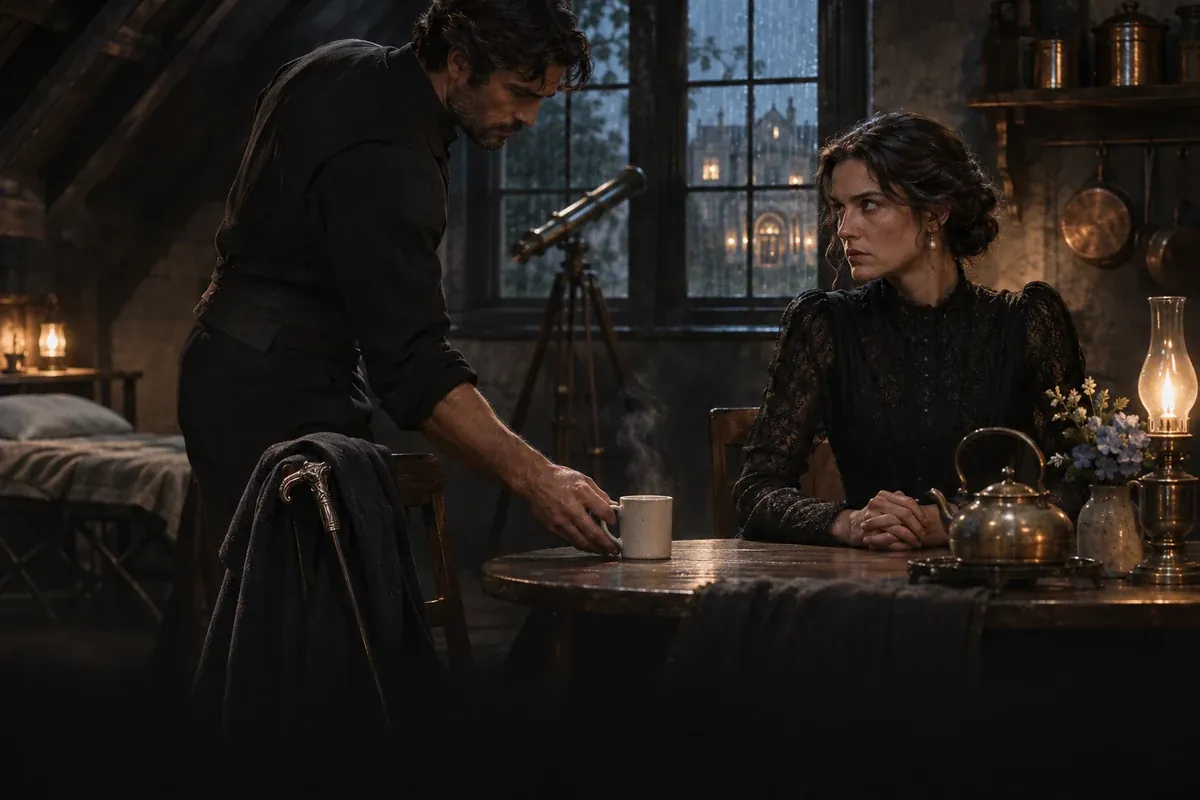
The carriage house at Greywater is on her inventory as storage, outbuilding, contents: garden equipment, two vintage vehicles (see Schedule F), assorted. Lena catalogued it on day one in forty minutes. She missed the door behind the pegboard, the staircase behind the door, and the entire second life of Calder Voss above his own garage, which is the kind of oversight that would normally keep her up at night, except that the oversight was engineered by a professional and the professional is currently making her tea.
“You counterweighted the pegboard,” she says, watching the kettle like it might also be a trick. “The tools are glued on.”
“Epoxied. The glue was Pruitt’s idea; he enjoys craft projects.” Calder moves through the small kitchen with the cane hooked over a chair back, no limp at all. Up here the gray is washed out of his hair and he looks like his photographs with the sound turned on: the same severity, but mobile, ironic, running on some fuel the portraits never caught. There’s a camp bed, a desk with three laptops, a wall of corkboard she is dying to read, and a window with a telescope trained not at the sky but down the lawn at the main house. “Milk? There’s no milk. There’s a tin of something Danish.”
“You’ve been living fifty yards from your own funeral.”
“Best address in town for it.” He sets the mug in front of her. “Ask. You’ve been composing the question since the fountain. Get it wrong, I’ll even help.”
“Friday night I stood over a casket and grieved at a pair of hands,” she says. “Whose were they?”
“Nobody’s.” He says it quickly, like a man who has been waiting to be asked by someone whose opinion of the answer matters. “There is no one in that casket, Mrs. Voss. There never was. What you saw Friday was eleven pounds of theatrical wax and a very good wig, invoiced to Lindqvist and Sons as ‘display services.’ It did one closed room for one hour and then the lid was sealed and the box was weighted to specification. The thing in my grave is ballast and carpentry.” A corner of his mouth moves. “You grieved at a candle, more or less. I’m told you were very convincing.”
The relief that goes through her is physical, and it annoys her, because it means some part of her has spent two days carrying the alternative. “The hands were smooth. Wax doesn’t break a ring finger twice falling off a sailboat.”
“No. The prop house worked from press photographs, and my press photographs are retouched, because Simone Adler does not permit imperfect hands on magazine covers.” He flexes the crooked finger, rueful. “My vanity, by proxy, is the flaw in my own forgery. You’re the only person who looked.”
“Your family buried an empty box.”
“My family buried a problem,” Calder says, and the irony goes out of him like a tide, fast and total, leaving something flat and cold that she recognizes, because she has seen it in her own mirror the year she lost the museum. He crosses to the corkboard and takes down a photograph: a silver coupe on a flatbed truck, front end crumpled like paper.
“Six weeks ago I drove down from the lake house at night. Old Quarry Road, nine percent grade, four switchbacks. At the second switchback my brake pedal went to the floor. I put the car into the runaway ramp at the bottom at approximately seventy miles an hour, which is why I now own a cane I don’t need for walking so much as for sitting down like a person my age shouldn’t have to.”
He pins the photograph back, precise, square. “My people retrieved the car before the county did. The brake lines were cut. Not frayed, not failed. Scored through, both circuits, by someone who knew that car has no electronic backup because I restored it myself and I am a romantic idiot. The cut was fresh. The car had been parked in exactly two places that week: this estate, and the lake house. Both private. Both family.”
The tea has gone cold in her hands. “So you died.”
“So I drowned.” He shrugs. “A staged swim, a capsized tender, a current everyone local respects. Missing, presumed. Pruitt assures me hourly that the paperwork is survivable - no certificate was forged, no person harmed, a man is allowed to disappear in his own lake. What he does not say is the part we both know: the only thing my death actually bought is time. Whoever cut those lines is still at my table. Still at my funeral. Grant gave him nine minutes, or Odette gave him thirty years, or Beau cried for him with his whole face. Someone in that cathedral killed me, Mrs. Voss, as far as they know. And every single one of them was word-perfect.”
“And the decanter?” She nods at the corkboard, where a lab report is pinned beside a photograph of the study’s crystal set; she can read the molecule name from here and doesn’t know it, but she knows a toxicology header when she inventories one.
“Colchicine. In the whisky, in my study, discovered after my death — I have my bottles assayed quarterly, which I’m aware is lunacy, and which has now saved my life once, so we’re done laughing at it. Think about what that means.” He taps the report. “The whisky was poisoned while I was already dead. A contingency. Planted in case the brakes hadn’t worked — or planted earlier, and never retrieved. Either way: patient. Methodical. Comfortable in my study. That is not a hired stranger. That’s family, or close enough to pour a drink.”
Lena puts down the mug and looks at the corkboard properly, and the shape of her own situation finally resolves, the way an attribution does — not gradually, all at once. “The will. ‘To my wife.’ You wrote that clause before you died.”
“Eight days before.”
“You needed the estate frozen. One unknown heir and everything stops - probate slows, the carve-up stalls, nobody can liquidate, and every one of them has to come out and contest it, on the record, showing exactly how much they need the money and how fast.” She hears her own voice speed up, the way it does over a good fake. “You didn’t hire a widow to hold assets. You hired a stress test.”
“I hired an appraiser,” Calder says. “The widow was packaging.”
“Why me?”
He is quiet long enough that she knows the answer will be true, and partial. “Three years ago, the Driscoll Museum circulated a four-page memorandum about a Rothko on loan from the Fenn-Voss Foundation. Stretcher bars twenty years too young. The memo was unsigned by the time it reached the board. I made it my business to learn who wrote it.” He meets her eyes across the little kitchen, and there is something underneath the dryness that she can’t price yet.
“You were right, by the way. It’s a fake. It’s hanging in a very good dining room as we speak, and the people who own it know, and the museum knew, and the only person in that entire food chain who said so out loud was an assistant registrar who got restructured for it, with cake.”
The room is very quiet. Fifty yards away, the house that is legally hers glows amber through the carriage-house window.
“You knew what the memo cost me,” Lena says, “and you watched me get hired to catalogue your things, and you let Pruitt dangle my brother’s debt to put me in a veil.”
“Yes.”
“That’s not an apology.”
“No. When I give you that one, it’ll be worth more.” He straightens, and the dry voice comes back on like track lighting. “Contract amendment, Mrs. Voss, verbal, effective tonight. You keep doing exactly what you told Pruitt you’d do — control the inventory, every room, no exceptions. But the inventory isn’t furniture anymore. It’s them. Grant’s committee, Odette’s foundation, Beau’s garage bills, Hale’s quiet little handshake deals, Simone’s records requests. You walk through my family with a clipboard and your terrifying eyes, and you bring me the thing you brought the Driscoll board.”
“A condition report.”
“A condition report,” he agrees. “On everyone.”
She should say no. The sane version of her life is one flight down and fifty yards northeast: take the standstill, do the furniture, let the rich bury their empty boxes. But the Corot is level and shameless on its hook, and Grant promised her a courtroom, and somewhere in this family is a person who scores brake lines and poisons decanters and weeps beautifully at funerals, and that person currently believes the only obstacle between them and nine figures is a hired widow with no one behind her.
They’re wrong about the no one, is the thing. That’s new information. She finds it changes the math.
“Show me the board first,” she says instead. “If I’m inventorying your family, I want to see your catalogue before I start mine.”
He hesitates — the first hesitation she’s seen from him — and then steps aside, and she gets the corkboard at reading distance. It’s organized the way she’d have organized it, which is unsettling. Four columns, one per heir, index cards in a fast slanted hand.
GRANT: the committee chairmanship clause. Access: estate books, family office, the study (keys to everything). Pressure: unknown. Note, underlined twice: Where did the audit budget go in March?
ODETTE: foundation endowment restructured eight months ago; two capital calls she didn’t bring to me. Access: the house, always. Pressure: Hale? Note: She asked me in June if I’d updated my will. Context sounded like love. Check that.
BEAU: debts — track club, the Carrera rebuild, something called Fairline Motorsport LLC. Access: garage, grounds. Pressure: obvious, constant, cheerful. Note: Lent him 60k in April. He paid back 60k in August. Where from?
HALE: a column that is mostly question marks. Introduced Grant to the Zurich storage people. Flew to Lisbon twice this spring — why Lisbon? Note: The handshake man. Everything by handshake. Nothing on paper in twenty years.
And pinned at the bottom, apart from the columns, one card with a single line: WHO KNEW ABOUT THE QUARTERLY ASSAYS? — with no names under it at all.
“That card,” Lena says, “is the whole case.”
“Four people knew I had the whisky tested. Pruitt. My doctor. The lab.” A pause. “And whoever read my household accounts carefully enough to wonder what Calloway Analytical bills me for four times a year. Which brings us back to everyone who can read a ledger, which in my family is everyone except possibly Beau.”
“Widow hours,” she says. “When do you want the reports?”
“Nine to midnight. The pegboard sticks; lift, then pull.” Calder picks up her cold tea and pours it out, already reaching for the kettle, domestic as anything, a dead man making a second pot. “And Mrs. Voss — tomorrow, when you move into the main house, hang the Corot in your bedroom.”
“It’s a forgery.”
“I know,” he says. “So is the widow. Let’s see who’s rude enough to say so.”
She crosses the dark lawn alone, and the house receives her with the particular silence of a place that has decided to wait and see. In the front hall, on the table where the week’s mail is laid out by staff she hasn’t met yet, two envelopes are addressed to Mrs. Voss. The first is from Pruitt’s office: the standstill agreement, executed, Harlan Credit Partners’ signature block filled in with a stamp and a scrawl, her brother’s catastrophe parked on a side street with the engine off. She reads it twice. It’s real. It’s the first thing in six days that is exactly what it claims to be.
The second envelope has no return address, no stamp, hand-delivered. Inside, a single sheet. Typed.
“We know what you are. The question is whether you know what they are. Price your loyalty before someone else does.”
No signature. The paper is heavy, laid finish, cream — and she stands under the hall lantern with it, heart going, doing the only thing she knows how to do with an unsigned work. Attribute it. Pruitt writes by hand on this exact stock; but Pruitt has no need to warn her, he owns her paperwork. Simone types; Simone would have signed it, messages unclaimed are wasted spend. Grant threatens in person, with witnesses, for the record. Which leaves the interesting possibilities: Hale, who puts nothing on paper in twenty years — except, perhaps, the things he wants mistaken for someone else’s. Or a person she hasn’t catalogued yet.
Somewhere on the grounds behind her, a dead man is rinsing two mugs.
Lena folds the note into her kit, between the calipers and the UV lamp, where the evidence lives. “Lot one,” she says to the empty hall, to the house, to whoever is listening, because by now she is certain someone is. “Anonymous correspondence, single leaf, undated. Attribution pending.”
Then the widow of Greywater climbs her dead husband’s stairs to choose which of the eleven bedrooms will hold the forged Corot, and does not look back at the carriage-house light going out across the lawn, and is almost entirely sure the fluttering under her sternum is professional.