

My job is to tell ranchers that whatever ate their cattle is an act of God and not covered. Forty-one head vanished from the Lindqvist north pasture overnight, and the grass where they stood is the color of dishwater. I have the denial letter in my glovebox, already stamped, and for the first time in six years I cannot make my hand reach for it.
I sit in the wagon at the Lindqvist cattle guard with the engine ticking and look at the letter through the glovebox’s cracked plastic door. It is a good letter. I wrote the template myself, in my second year, when Dub told me the old one sounded like a threat. Dear Policyholder, we regret to inform you. Exclusion 7b, acts of the Wood, including but not limited to. Page two has a paragraph about appeal rights that nobody has ever used.
Dub called me at eleven last night. He said it in his Friday-shirt voice, even though it was Saturday. “Lindqvist lost a bunch of head up north. Let’s not borrow trouble, Dell. Go out first thing, take your pictures, hand them the letter, and be kind about it.”
Be kind about it. Six years, and that has been the whole of the training.
The sun is not up yet, but the sky over the Sandhills has gone the color of a peach someone left in a truck. The hills roll away in every direction, grass-covered dunes that look like the sea if the sea had agreed to hold still. A windmill turns on the nearest ridge. It is the tallest thing in sight, apart from the north edge of the world.
The north edge of the world is the Sill. From here it is a dark line along the horizon, forty miles of it, oak trees where no oak has ever grown. I have driven past it ten thousand times. I do not look at it. Everyone in Garrow County has the same habit, the way you do not look at a neighbor’s yard sale.
I check my phone. No bars. I check the odometer, which I have done every morning for three years, as though it will stop. 212,000 and change. I check my hair in the mirror, which is a mistake.
For the file: I have been awake since the call. I have not slept in my bed since the call. I sat at my kitchen table with the Lindqvist policy open and read the livestock endorsement four times, the way you read a note that says someone has left.
Then I get out of the wagon, because my father taught me one thing before anything else. You do not deny a claim from the car.
The Lindqvist yard is a square of packed dirt with a white house on one side and a machine shed on the other. There is a cottonwood in the middle that someone planted for shade eighty years ago and has been apologizing to ever since.
Four vehicles are parked in a crooked row. A sheriff’s department truck is not among them, which tells me the deputy came and went. A deputy reads forty-one missing cattle and no tracks and drives home to his breakfast. Everyone around here knows the shape of that story.
Gunnar Lindqvist is on the porch with a mug. He is six foot four, sixty, and so tired that his shoulders have given up on being square. He lifts the mug a half inch. That is a greeting.
“Dell.”
“Gunnar. I’m sorry about all this.”
“Yep.”
“Is Carla up?”
“Carla has not gone down.” He tips his head toward the kitchen window, where a woman is standing at the sink with her back to us. She is not washing anything. “She sat at that table all night. Wouldn’t let me turn the light off.”
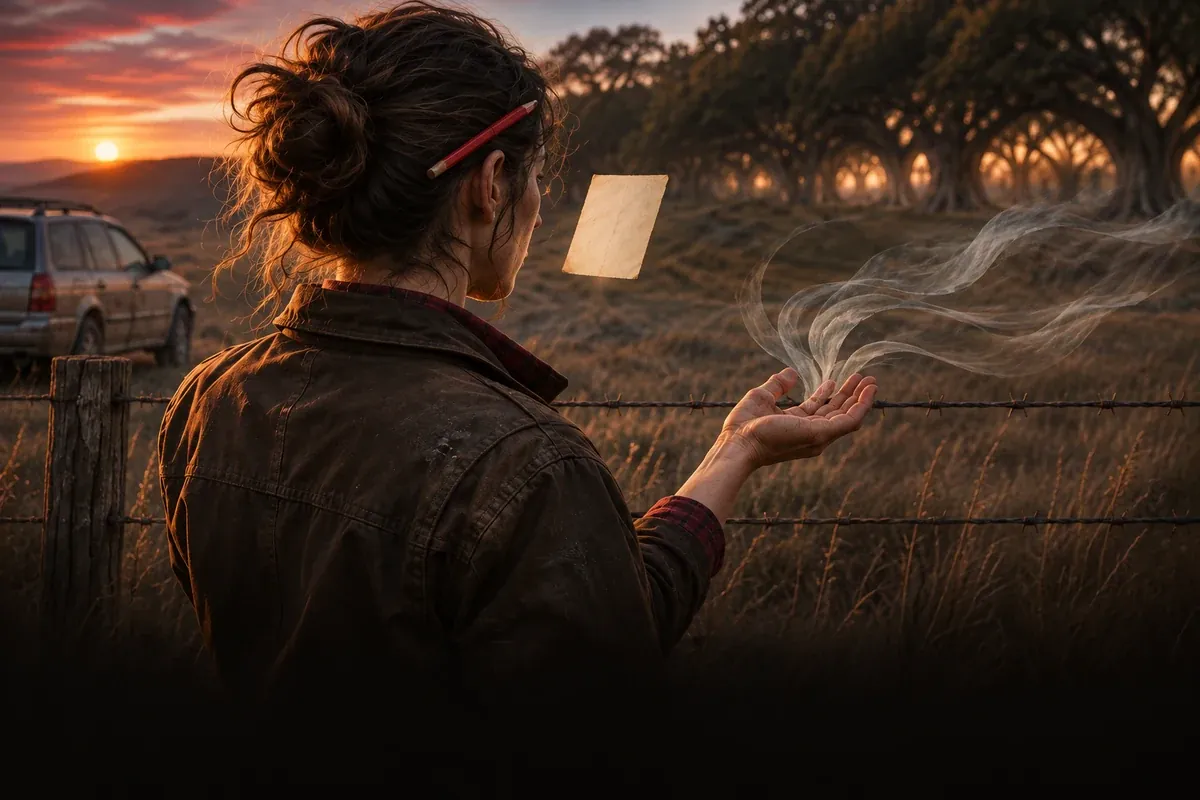
I nod. I have a clipboard, a tape measure, a moisture meter, a camera, and a cooler in the back seat with two gas-station sandwiches in it that I will not eat. Over my ear, where it has lived since my father’s funeral, is a flat red carpenter pencil with the end chewed square. I touch it without thinking. I do that when I am about to do something I do not want to do.
“I need to see the pasture,” I say. “Before anyone walks it any more than they already have.”
“Marit’s up there.”
“Of course she is.”
“She’s been up there since three,” Gunnar says. His voice does something small at the end of the sentence, and he drinks to cover it.
The north pasture is a mile and a half from the house by the ranch road, which is two ruts and a strip of grass that scrapes the wagon’s belly. I drive it with the windows down. The air smells like cut hay and diesel and the faint sweetness of cattle, and the smell gets weaker with every hundred yards, and by the time I stop at the gate it is nearly gone.
Somewhere around the middle of the pasture, the cattle smell stops. I check it twice, the way I would check a pulse. Forty-one head leaves a smell. This much silence is wrong.
I stand at the gate and do what I always do first, which is count. There are forty fence posts between the gate and the corner. There are three strands of barbed wire on each, the bottom one rusted brown, the middle one new, the top one new on the east end and old on the west. There are eleven steps from the gate to the first stain.
I have never told anyone about the stains.
They look like wet footprints on dry cement. Gray. A flat, drowned gray, the color of dishwater, the color of a coat someone forgot in the rain. Everywhere the cattle stood, the grass has gone dull and slack and lies down flat. They are not stains on the grass. They sit above it, a quarter inch or so, faintly, like a breath on a window.
Nobody else sees them. I figured that out when I was nine. I asked my father why the corner of the Brandvold place was gray, and he gave me a look I have been thinking about ever since, a look like a man doing arithmetic on something he did not want to add up. Then he said, “That’s the light, Delphine,” and bought me an ice cream.
Since then I have seen maybe three hundred. Under a collapsed hay barn. Around a drowned calf. On a kitchen floor in town, where a woman’s husband had stopped breathing at the table. Every stain sits where something was lost. Every stain comes with a taste in the back of my teeth, a thin metallic tick, like biting down on a bit of foil.
The tick starts as soon as I step through the gate. By the time I reach the first stain it is loud enough to hear.
I take out the tape measure and do my job, because the job is a rope you can hold. Forty-one stains. Each one is about the size of a cow lying down, which is wrong, because they were not lying down. Cattle at dusk stand, graze, shift. They do not leave beds in a perfect line.
But they did. Forty-one beds, in a single row, running straight north across the pasture to the fence, spaced the same distance apart. I measure the gap between the first two. Four feet, two inches. I measure the gap between the fifth and sixth. Four feet, two inches. I walk the whole row and stop measuring at the twentieth, because my hands are starting to shake.
No hoofprints leave the row. No tracks come in. The grass is dry; the dew has not lifted, and where the dew sits the grass is bent only where the cattle stood, as if they had been lifted up off the ground, one at a time, and set down somewhere else.
I look at the corner of the nearest stain. It has a corner. That is the part that makes the back of my neck go cold.
The edge of the gray is straight. It runs six feet, turns exactly ninety degrees, and runs another three. Nothing in nature has square corners except what somebody paid for.
For the file: I write that down. In block capitals, like my father did. STAIN HAS SQUARE EDGE. I look at it for a while and add, underneath, in smaller letters, WHY.
“You look at the ground like you owe it money.”
I do not jump. I have been an adjuster for six years, and I have learned to fake not jumping. Marit Lindqvist is sitting on the top rail of the fence thirty feet away, with her boots hooked on the middle strand and a cowboy hat pushed back off her forehead. She is seventeen. She has the best cutting-horse seat in the county and a stare that could take paint off a gate.
“Morning, Marit.”
“Obviously it’s morning.” She does not smile. “You’re going to deny it.”
“I haven’t decided.”
“You’ve decided. You always have it in the car.” She says this in the flat, quick way she says everything, as if she is reading it off a card. “My dad says Dub’s got a stamp that says it for you.”
“It’s not a stamp.”
“What is it?”
“It’s a stamp,” I say.
That gets the corner of her mouth, barely. Then she looks at the line of gray, and the corner goes back.
“Count it,” she says.
“Count what?”
“Forty-one cattle, one boy. That’s what Dad told the deputy. Forty-one head and one boy. But the deputy wrote down forty-one head.” She picks at a splinter on the rail. “You know how many people have asked me about Tobin? Zero. Everybody asks about the cows.”
I put the tape measure in my pocket. “Tell me about Tobin.”
“He’s eight. He’s my brother. He’s got a cowlick and a lisp on his s’s and he counts everything.” A very small hitch, there and gone. “Counts the stairs. Counts the eggs. Counts how many times Mom says no. He’s going to be an accountant or a serial killer.”
“And Saturday night?”
“He went out after the dog.”
“What dog?”
“Our dog. Biscuit.” The answer comes fast, a hair too fast. “He went out after Biscuit. Biscuit got out. He followed and he went through the fence, I guess, and the cows went through the fence, too, and obviously that’s what happened.”
“Cows don’t go through three strands of wire.”
“They do if they’re scared.”
“The wire’s not cut.”
Marit looks at me. It is a long look. I know this look, because I have given it to people across a kitchen table: the look of someone deciding how much of the story to hand over.
“Obviously,” she says.
I do not write that down. I do not need to. The job teaches you to hear when the third version of a story has started to differ from the first, and Marit is a very good liar, which is the only kind of liar who tells three versions. I let it sit. I walk to the fence.
Beyond the wire, the Sill starts at exactly the width of a fence post. That is how you tell. On this side, the grass runs to the edge of the ranch road, short and brown and rattling in the wind. On the other side there is ground the color of slate, hard and smooth and dark, with no grass on it at all. Footprints, if you made them, would not stay.
And then the trees.
I have never stood this close. They rise straight up out of the slate, one after another, and every one of them is an oak, wide as a barn door at the base, crowned with leaves so dark they look wet. There are no oaks in Garrow County. We have cottonwoods and soapweed and chokecherry in a draw if you are lucky.
Forty feet over the wire, a branch as thick as my waist stretches over the fence, and a few leaves lie on my side of the line, and when I look at them I see that each one has been cut at the stem, a clean angle, like a letter opener.
The fence posts on the other side of the wire are budding. I touch the nearest one on this side. It is just a cedar post, sun-bleached, split down the grain. On the Sill’s side, ten feet down, a post has put out a leaf.
I do not know how long I stand there. Long enough for the sun to clear the ridge behind me and throw my shadow across the wire and into the dark.
My shadow reaches the slate. The slate swallows it. It does not move.
Then I see the boots.
They are standing at the foot of the nearest post, on our side, side by side. They are small, brown, the kind you buy a size big and stuff with socks so a kid can grow into them. They are laced. The laces are tied in double bows, the way you tie something you want to find again. A pair of white tube socks has been balled up and tucked in, one in each boot, so neatly that it looks like someone folded them.
I crouch. I do not touch them. A beetle has walked across the toe of the left boot and is making its slow way up the tongue.
“Don’t,” Marit says.
She has come down off the rail. She is standing very close, with her hands in her back pockets and her hat low.
“I wasn’t going to.”
“Don’t pick them up. They’re not lost.” The deadpan has gone thin. “You leave something at the fence. Every kid does it. A button, or a shoe. So it knows you’re coming back.”
“So what knows?”
“The fence, obviously.” She looks over my shoulder at the trees. “I told him not to. I told him they’re just stories. You leave a shoe or a button and the Sill remembers it, and it lets you come home.”
“You told him.”
“I said I told him.”
“Marit.” I say it gently. “When did you tell him?”
She does not answer. Her eyes have gone wet, and she is furious about it, and she wipes them with the back of her wrist.
“Saturday,” she says. “Before supper. I said, you don’t have the guts to touch it. And he went white, and he said, I do, and I said, then go on.” The words have started to come faster, and she cannot seem to stop them. “I thought he’d touch it and run. He’s eight. I thought he’d run back and I’d say, see, nothing happens. That’s all. That’s the whole thing.”
“He touched the wire.”
“He took his boots off first.” A harsh little noise comes out of her. “Obviously he took his boots off first. He wanted to be sure.”
The tick in my teeth has become a steady ring. The gray stains lie in their square-cornered row behind me. In front of me is the fence, and the boots, and the oldest rule in the county, which I have been breaking for six years by denying it was ever a rule.
I put my hand on her shoulder. She lets me, which tells me how bad this is.
“All right,” I say. “Come on. Your mother needs to hear that.”
“No.”
“She needs to.”
“No she doesn’t. You’re going to deny it anyway.” Her chin comes up. “So what difference does it make what I say?”
I do not have an answer. That is the second time this morning I have not had an answer, and I have begun to find it rude.
Carla Lindqvist meets us at the cattle guard. I do not know how she got there. She must have walked the whole mile and a half. She has her good cardigan on over a nightgown, and her hair is flat on one side, and she is carrying a manila folder and a ballpoint pen.
She is a small, hard woman of fifty-five with forearms like a baker’s. I have eaten her pie at four different Methodist potlucks. At the first one she told me to stop apologizing for my last name.
“Dell.”
“Carla.”
“I want you to know I’m not angry with you.”
“I’d understand if you were.”
“I know you would.” She holds up the folder. “That’s why I’m not. I did the paperwork. Proof of ownership. Brand inspection, the tag numbers, the bills of sale for the last two bred groups.” Her mouth works. “I did it last night, because I can’t do anything else. It’s all in order. It’s all in order, and I know what you’re going to tell me.”
Gunnar has driven up behind her in the farm truck. He climbs out slowly and stands with one hand on the door.
I take the folder. It is heavier than it should be. I put it on the hood of the wagon, and then, because I have run out of ways to stall, I open the glovebox.
The denial letter is on top. Prairie Mutual and Fidelity, Garrow County Branch, a blue logo of a plow and a sheaf of wheat. A stamp in the corner, red, slightly crooked: EXCLUSION 7b APPLIES. Under it, my signature, already dried.
I have signed this letter two hundred and sixteen times. I counted once, on a bad night.
“I’ll tell you the truth,” I say, “since you did all that work. I came out here to give you this.”
“Yes,” Carla says.
“I can’t.” The words surprise me coming out. “I mean, I can. It’s printed. But the policy won’t pay on forty-one head that went missing under what the company calls an act of the Wood. It’s excluded. They don’t even send an investigator.”
“Yes,” Carla says again, so quietly that Gunnar looks at his boots.
“I’m sorry.”
“I know.”
“If you want to appeal—“
“Nobody’s ever won an appeal.” Carla says it kindly, the way you would tell a child the stove is hot. She is looking not at me but at the line of the fence, at the little brown boots waiting in the grass.
“You know what my mother used to say? About the Sill? She said, somebody has to carry it. That’s all. When the cattle died or the well went or the hail came. She’d say it in the kitchen to nobody. Somebody has to carry it. Because it doesn’t go away, she said. It has to go somewhere.”
Her voice breaks on the word somewhere.
“Somebody has to carry it,” Carla says to the morning, to the pasture, to nobody.
And I hear myself say, “I’ll carry it.”
I do not decide to say it. I have never decided to say it. It has been coming out of my mouth since I was nine, at birthday parties and funerals and in the checkout line at the grocery store, to strangers who dropped a bag of oranges. Debts bother me. A debt that has not been paid sits in my chest like a swallowed coin. My father used to say I would take on the national deficit if somebody handed me a pen.
Somebody is handing me a pen.
It is a cheap ballpoint, blue, with the name of a bank on the barrel. Carla’s hand is steady holding it. She has opened the folder to the last page, and on the last page, where she has already signed, is the Acknowledgment of Receipt: the form I carry in triplicate, the one that says the adjuster has received the insured’s proof of loss and will advise the company of the claim. I have signed ten thousand of them. They are meaningless. They are the paperwork equivalent of nodding.
Except, at the bottom of this one, below the dotted line, in print so small I have never read it, there is a line that says: The undersigned adjuster accepts responsibility for the adjustment of the above loss.
I have never read it, because it has never been said aloud with a pen in my hand and a stain on the ground. I know that the moment I take the pen.
I know that, and I take it anyway.
The pen is warm. I put that down to Carla’s hand, which has been holding it all night.
I sign. D. Okafor-Reyes, in the loop I have used since the fourth grade, with the long tail on the y. The ink goes on thick and black. It does not dry. It sinks into the paper like a drop of water into a sponge, and the whole signature goes dark and quiet, and the page curls up one corner as though pleased.
The tick in my teeth stops.
For one second there is no sound at all. No wind in the grass, no windmill, no truck engine ticking. Then something lifts off the ground behind me with a sound like a long breath drawn through paper, and I turn around.
The gray is rising. All forty-one stains, all the way down the line. Each rises off the grass in a thin, flat sheet, dull as dishwater, as though the pasture itself is being unrolled. They drift toward me over the stubble, quiet, in no hurry, and Gunnar and Carla and Marit stand looking at the empty air and do not see a thing.
I raise my hand. I do not tell my hand to. It simply opens.
The gray folds up into my palm.
It is cold. That is all. It is cold in the way a dime is cold, a small coin of cold the size of a dime, and it sinks into the skin between the thumb and the first finger and goes in without a mark.
The sheets keep coming. They fold and fold. There is far more of it than there is of me, and for a moment I think I will break, and then my hand closes around a loss the size of a county and holds it, easy, like a dropped glove.
Something unfolds in the corner of my left eye.
It is a rectangle of paper. It hangs in the air about an arm’s length away, cream-colored, the color of an old policy, with a clipped typewriter face and one ink-blot period that skips. It is not on the wind. It is not on a screen. When I move my head, it stays exactly at the edge of my sight, the way a thing does when it is your own.
It says:
Named Assumer: D. Okafor-Reyes
Limit: $2,000
Retention: to be advised
I read it three times. I count the letters in my name. Then I count the digits in the dollar figure, because counting is what I do when something is about to knock me over.
“Dell?” Gunnar says. “You went white.”
“I’m fine,” I say, and I am a terrible liar, but he is not looking for a liar. He is looking for a miracle, and I have left him with an adjuster.
“What did you sign?” Carla says.
I look at the page in the folder. The signature is the signature. The ink has dried. Nothing has changed. I say, because it is the only thing I can think of, “The acknowledgment. I’m opening the claim. Not denying it. I’m going to adjust it.”
“Is that different?” Gunnar says.
“I don’t know yet.”
I have never said anything truer, and nobody is going to believe me. Carla puts the pen back in her cardigan. Marit watches me with her chin up and her eyes narrowed, as if she has watched a cutting horse decide which way a calf will break.
“You saw it,” she says. Quietly, so only I can hear. “You saw something.”
I do not answer. I turn back to the fence, because I need to look at something that is not her face, and that is when I notice the nearest post.
It is the one with the boots at its foot. Last time I looked, it was bare. Now it has a piece of paper nailed to it, a heavy sheet, the color of old cream, held with a single brass tack. It was not there a minute ago. I would swear to that on my father’s grave, though I have recently begun to doubt whether he is in it.
Nobody has crossed the grass. The fence has not been touched. But on that sheet, in handwriting more perfect than any hand I have ever seen, copperplate, every loop a closed curve, black ink so fresh it still glistens, is a short paragraph.
Notice of Assumption received. Kindly advise your Retention.
F. Rue, Assessor.
Under the signature, in smaller letters, as though added by a clerk who could not help himself:
Welcome to the schedule, Miss Okafor-Reyes. Your name has been entered.
I did not tell the fence my name.