

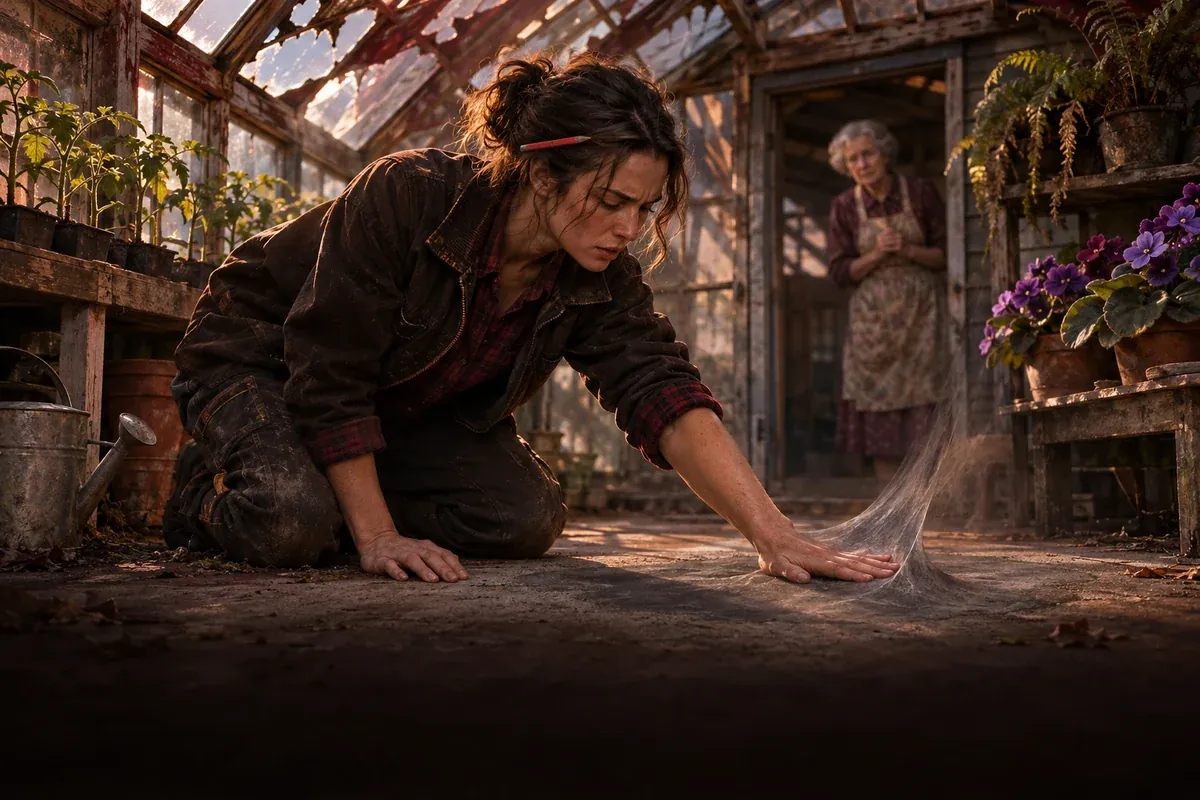
The first thing I learn about Retention is that it takes the hands first.
I learn it at ten past eight on Monday morning, kneeling in a broken greenhouse on Maple Street, with my palm flat on a rectangle of gray that nobody else can see and a very old fern watching me from a shelf. I have been awake for most of two days. I have the Declarations Page hanging in the corner of my eye like a smudge on my glasses, and I have a client who has just asked me, kindly, whether I am having a stroke.
“No, ma’am,” I say. “I’m adjusting.”
“You look like you’re lifting a piano.”
“It’s a small piano.”
Mrs. Hattie Abernathy folds her arms. She is eighty years old, five feet tall, and wearing a garden apron over a church dress, because the greenhouse claim was on my desk Friday and she has decided that anyone who comes to look at a ruined greenhouse deserves to be looked at in return. She has had a Prairie Mutual policy since 1971. She keeps the premium receipts in a cookie tin. She is the only person in Cutbank who has ever sent me a thank-you card for a denial.
I should back up.
I did not sleep Sunday night. I drove home from the Lindqvists’ with Rue’s note folded in my shirt pocket, though when I got to the kitchen the note was gone and the pocket was clean, and I sat in the dark with my hands on the table and said the word Retention out loud to see if anything answered.
Nothing did. At five in the morning I gave up and went to work, because the job is a rope, and because I had a pending claim on Maple Street that I was fairly sure was a ghost.
Hattie’s greenhouse is twelve feet by thirty. It runs along the south wall of her garage, glass panels over a pine frame, with a bench of tomato starts down one side and a row of African violets down the other. Or it did. On Thursday night the roof came in. Every pane on the top is broken, and half the side panels, and there is glass in the aisle like spilled sugar.
And I have stood in the middle of it for forty minutes, taking pictures and writing in block capitals, because there is something wrong with the hail.
For the file: hail is a lazy, ugly, scattershot thing. It falls in swaths and bands across the county in a long diagonal, hitting whatever it hits. It dents the north side of a truck and misses the south. It strips one shingle and leaves its neighbor alone. My father taught me to read a hail loss the way you read a fingerprint, and this one is wrong in six ways.
One. The broken glass sits entirely inside the frame. Not a pane outside the footprint is cracked. Hattie’s garage has a window a foot from the greenhouse wall. It is untouched.
Two. The hail damage stops at a line. I walk it with the tape measure, because I have to see it: the dents in the tin of the garden shed end at the exact edge of Hattie’s lot, along a boundary that exists only on a plat map in the courthouse, and the shed next door, six feet farther along, does not have a mark.
Three. Four. Five. I list them on the clipboard. The neighbor’s laundry on the line. The lilacs. A kid’s blue plastic pool, upright, full, with a skin of dust on the water.
Six is the hailstone.
Hattie has kept it. She stands behind me in the garage door holding a margarine tub, and when I turn she holds it out like a woman presenting a casserole. Inside, on a bed of paper towel, sits a single white sphere the size of a quarter.
“Put it in the freezer Friday,” she says. “I thought you’d want one. Your daddy always wanted one.”
“Mrs. Abernathy.”
“Hattie.”
“Hattie. Thank you.” I take the tub, and the chill of it goes into my wrist, and the tick in my back teeth starts up again.
I take a pocketknife out of my jacket and cut the stone in half.
A real hailstone has layers. Every one does, like an onion, because it rises and falls through the storm and picks up a skin of ice on every trip. You count the rings and you can tell how many times it went around. My father could do it with his thumbnail. He once told a wheat farmer in Kearney County that his hail had flown up eleven miles, and the farmer did not speak to him for a month, and then bought him a fifth of whiskey.
This stone has no rings. It is clear all the way through, hard as a marble, with a faint cloudy seam down the middle where my knife went. It does not look like water. It looks like something cast.
I hold half of it up to the window and look at the garage floor through it.
I do not know what I have just seen, but I know the price of it, and that is a bad feeling in an adjuster.
“What’s the number?” Hattie says. She says it the way a woman asks a doctor for a lump’s size. “Fourteen hundred?”
I look at her.
“I got a quote,” she says. “From the nephew of that Hanrahan boy. Fourteen hundred to put new glass in. That’s the figure I put on the form.”
“That’s the loss,” I say. It is. I have measured it. Fourteen hundred and some change, call it $1,400 even, and if I stop now I can leave it there.
I do not stop. That is my flaw, my father used to say, and he said it fondly, which is the most dangerous way to say it.
“Hattie,” I say. “Two years ago, in the spring. You put in a claim on the greenhouse door.”
Her face changes, a very little. “That was wind.”
“You said it was a straight-line wind. You said it took the door off its hinges and put it in the neighbor’s yard.”
“It did.”
“I denied it.”
“You did,” Hattie says. “You wrote me a lovely letter.”
I remember the letter. I remember writing it. I remember the number: $310, one aluminum storm door and a hinge. I remember Exclusion 7b in the second paragraph, and the stamp, and Dub saying, “Good, good, just like that,” like a man teaching a child to ride a bicycle.
And I remember what I did not think about at the time, because I was twenty-seven and I did not know I was allowed to.
I thought: the wind that took Hattie’s door was a very polite wind. It came from the north, from the Sill, in a column about six feet across. It went through her yard and nowhere else.
I put the clipboard down.
I turn to the corner of the greenhouse, where the tomato starts sit in their trays, and I let myself look at the thing I have been refusing to look at since I walked in.
It is there. Of course it is. A stain, lying across the floor and the bench and the broken glass: a rectangle of gray, twelve feet by thirty, with four right angles and a bite out of the northeast corner exactly the size of a storm door.
Three hundred and ten dollars has been growing for two years. It has been collecting interest. And now someone has come to collect.
I do the arithmetic on the clipboard, because I need to hear it. $310 to $1,400, over twenty-four months. That is a rate I have seen only on the sandwich boards outside check-cashing stores.
“Well, hell’s bells,” I say.
“Delphine?”
“Sorry. Sorry, Hattie.” I take a breath. “I’m going to try something. It might look strange. I need you not to call anyone.”
“At my age,” Hattie says, “I would be delighted to see something strange.”
I kneel on the glass-strewn floor with my knees in the sugar. I take off my work glove. I think about what the page said. Limit, $2,000. Retention, to be advised. I think about what my father taught me about the order of things: you investigate first. Cause. Extent. Only then do you say yes.
I have done the cause. The extent is $1,400, measured twice, photographed, written down.
I put my palm flat on the gray, and I say, “I’ll carry it.”
It goes in like a drink of cold water.
For one second I feel good. I feel clean and quiet and lit up, as though somebody has opened a window in a room I did not know was stuffy. Then the gray rises into my hand, thin and level, and the first thing that goes is my fingers.
They do not hurt. They simply stop. I feel the glass under my knees and the floor under my hand, and then I feel the place where my hand is, and then there is no hand. There is a pale thing on the end of my arm, a mitten of dead wood. I raise the other one and it is the same.
“Oh,” I say. “Okay.”
“You’ve gone gray,” Hattie says. “Dell. Dell, you’ve gone gray around the mouth.”
“I’m all right.”
“You are not.”
“It’s the Retention,” I say, and then I stop, because that is not a sentence I can explain.
The page unfolds in the corner of my eye. It has been waiting. The typewriter font is clipped and neat and in no hurry.
Limit: $3,400
Retention: both hands, one hour
Premium: to be collected
The greenhouse roof is whole. I only notice because the light has changed. The broken glass has gone out of the aisle, the panes are in their frames, and there is a faint, clean seam along each one where a pane has been set, as though a very careful person had been through with a putty knife. The stain is gone. Across the room, in the neat row of tomato starts, a green shoot has begun to lean toward the sun.
“Well,” Hattie says. She sets the margarine tub down on a potting bench with great dignity. “I suppose I’ll want a different form.”
It takes her twenty minutes to get me into a chair and ten more to stop me apologizing. She sits across from me in a lawn chair she has dragged in from the garage, holding a cup of tea to my mouth because I cannot hold it.
I drink it with her hand under the cup like a child. It is hot, sweet, and tastes of orange peel. I do not tell her it is the best thing I have ever had, because it is true, and I do not want to say true things on this much sleep.
“You know,” Hattie says, “your father did that.”
My head comes up so fast the tea slops.
“Did what?”
“Oh, I don’t know.” She is looking at the greenhouse and not at me. “Looked at the ground. Used to stand in a yard after a loss like he was waiting for it to say something. I used to think he had a bad back.”
“Hattie.”
“Drink your tea, Delphine.”
I drink the tea. For the file: I have never in my life wanted so much to ask a question, and I do not ask it, because her face has closed like a gate. I am an adjuster. I know when a witness has told me everything she is going to tell me for free.
My hands come back at nine-twelve, a little after the hour. They prickle first, then burn, then fill up like rubber gloves under a tap. I write her a closing letter on the company form that says, in block capitals, CLAIM CLOSED, NO PAYMENT, LOSS ADJUSTED AND RESOLVED BY OTHER MEANS. Dub will read that and sigh. I put it in her hand. She holds it to the light.
“That’s a lot of words for nothing,” she says.
“Yes, ma’am.”
“I’ll frame it.”
I walk back to the wagon on legs that feel borrowed. The sun is high already, the street is empty, a dog is barking two blocks off. I sit behind the wheel and I reach for the thing I reach for every morning, which is the pipe.
It lives in the center console, in a sandwich bag, where it has lived since the funeral. A briar pipe with a chewed stem, a little burned at the lip. My father smoked cherry-vanilla tobacco, which he bought by the pound from a man in Lincoln and kept in a coffee can.
For three years I have taken the pipe out of the bag every morning, lifted it to my face, and breathed in. It is not a habit I would defend to a stranger. It is a way to start the day with somebody in the car.
I lift it.
I breathe in.
It smells like a pipe. Old wood, a little char. The smell of any pipe that someone has put down.
There is nothing underneath.
I try again. I hold it closer. I put my whole face into the bag. I shut my eyes and think of the back porch, and the coffee can, and the way the whole house smelled in the evening, sweet and warm and slightly like a Christmas cookie that had been through a fire.
I can remember that I used to smell it. I can remember the words. I can even remember what I felt. But the smell has been taken out of the middle of the memory as neatly as a pane out of a frame, and what is left is a clean place with a faint seam around it.
The page is there in the corner of my eye.
Premium: the smell of cherry-vanilla pipe tobacco
Collected.
I sit in the wagon for a long time. A man walks past with a small, aggrieved terrier. He glances at me and looks away, because it is Cutbank, and a woman crying in a parked car is a private matter between her and the car.
I put the pipe back in the bag. I put the bag back in the console.
Then I take out my phone, because there is a number in it I have not been able to delete in three years, and I scroll down to the voicemail, and my thumb hovers.
I do not press it. Not today. I have not paid enough to listen.
Dr. Odessa Harkin’s clinic is a long steel barn on County Road 9, nine miles out of town, with a hand-lettered sign over the door that says LARGE ANIMALS BY APPOINTMENT AND ALSO BY SPITE. She retired six years ago. She still stitches cows. She does it for cash, or eggs, or on one occasion a rebuilt carburetor, and she does it with the hearing aids turned off, so that you must stand in front of her and speak slowly, like a tourist.
She is standing at a steel table now, seventy-one years old and six feet tall, with her gray braid down her back and forearms like fence posts. She has a cow tied head-up in a headgate and one big hand pressed flat against its ribs.
“Well,” she says, without looking round. “There she is. Sound as a three-year-old mare.”
“Hi, Dessa.”
“Don’t hi me. Come here and look at this.”
I put my clipboard on a hay bale and walk up the aisle. The barn smells of iodine and alfalfa and warm animal. The cow is a black baldy heifer, thin in the flank and calm as a church. She turns her head and looks at me with one large wet eye. There is a yellow ear tag in her left ear, number 1127, and something else, stapled in the right, that is not a tag.
It is a slip of heavy cream paper, folded in half, held by a brass staple. I tilt it toward the light. On the fold, in a hand so perfect that I feel my own handwriting shrink in my hand, it says: Security, Lindqvist. 1 of 41.
“Walked up the Lindqvist road at four this morning,” Dessa says. “By herself. Carla called me because Gunnar can’t stand to look at her. I said, bring her in, I’ll see what the damage is.”
“Is she hurt?”
“Not a scratch.” Dessa slaps the heifer’s flank, and the cow lets out a patient breath. “Count her ribs for me.”
I do not want to. I do it anyway. I put my hand on the left side, below the spine. I count. Twelve, thirteen. Fourteen.
Cattle have thirteen ribs.
“Dessa.”
“Mm.”
“She’s got fourteen.”
“She does.” The old woman’s voice is perfectly even. “And she doesn’t have a shadow, if you’d like to look at that, too.”
I look. The late-morning sun comes through the barn door in a slab. It lays itself across the straw, across the headgate, across my boots, and across the black cow’s legs. Every post throws a long bar of dark. The cow, standing in the middle of all of it, throws nothing at all. The straw under her is as bright as the straw beside her. It looks like someone cut her out with scissors and held her up.
I hear myself make a sound. It is not a word.
“She’s eating,” Dessa says. “She’s drinking. Her heart is slow, but it’s regular. If I’d found her in a field, I’d say she was a very fine cow.” She lifts her hand off the ribs and wipes it on her coverall. “A heifer that walks out of that fence is not a heifer that was lost. She’s a heifer that was sent.”
“Sent.”
“Returned. With a receipt.” Dessa taps the paper in the cow’s ear with one large finger. “You’ve seen the handwriting.”
“I’ve seen the handwriting.”
“Then you know who writes in it.”
I do not. That is the honest answer, and I think she can tell, because she looks at me properly for the first time since I came in: down, up, a vet’s look, the kind that finds the limp. Her gaze stops at my hands.
“You’ve been carrying.”
“I don’t know what you mean.”
“You’ve been carrying,” Dessa says, “and you’re a bad liar, and your father was worse.” She says it without malice. She turns away and begins to coil a length of suture. “How much?”
“Fourteen hundred. Hail.”
“And the Premium?”
I say nothing.
“Mm.” She nods slowly. “What did it take?”
“A smell.”
“Which?”
“Dessa.”
“All right.” She holds up one hand. “Keep it. I won’t ask again, today. Tell me this. Did you sign something yesterday? With a pen somebody handed you?”
“Carla’s pen.”
“Was it warm?”
I cannot feel my face. “How do you know about the pen?”
“I don’t know a thing,” Dessa says. “I’m an old woman who stitches cows.” She reaches up and, with great delicacy, turns off one of her hearing aids. “Come back tonight, if you like. I may remember something. Bring a flashlight.”
“You can just tell me.”
“I could.” She turns the second aid off. “I’ve been meaning to for twenty-two years, and I’ve never gotten the dose right. Go on, Dell. Your boss is looking for you.”
My phone has found a bar. It buzzes in my pocket, and when I take it out, I have six missed calls from the office and a text that says: Come in. Please. Don’t stop anywhere. D.
Dub never says please.
Prairie Mutual and Fidelity, Garrow County Branch, is one long room on the second floor above Hanrahan’s Feed and Seed. You can smell the feed on the stairs, cracked corn and molasses and the sour sweetness of fifty-pound bags. At the top there is a glass door with the company name in gold paint, a plow and a sheaf of wheat, chipped on the sheaf.
Wendell Prewitt is standing at the window with his back to me.
He is sixty-one and soft in the middle and wears a shirt the color of a tangerine, which is wrong, because it is Monday. Hawaiian shirts are Fridays. Everything in the world is scheduled in this office, down to the donuts, and a man in a Friday shirt on a Monday is a man whose clock has stopped.
On his desk is the butterscotch jar. It is a big glass apothecary jar with a metal lid, and he has been filling it with the same cheap candies for as long as I have known him. He gives them to widows. He gives them to ranchers who have just lost a barn. He gave me one at my father’s funeral, pressed into my palm like a coin, and said, “It’s not much, kiddo.” I kept it in my pocket for a month.
The jar is shaking.
I do not mean that Dub is touching it. His hands are in his pockets. The jar is sitting on a steady oak desk, and the candies inside are trembling, the way water does when a train goes by a mile off.
“Dub.”
“Dell.” He does not turn. “You didn’t mail the Lindqvist letter.”
“No.”
“I looked for it. I looked in the outgoing. I thought, she’ll have done it from the car. She never does it from the car, but she’ll have done it.”
“I didn’t deny it.”
“Okay.” His voice is very mild. “Okay. That’s all right. File it as pending. We can say it’s under review. Home office won’t mind. They’ll want to know why the Garrow County denial rate is sixty-one percent, and the state average is nine, but that’s a different problem. Pending is fine. Pending we can live with.” He swallows. “Let’s not borrow trouble, Dell.”
“You’ve got somebody in the room,” I say.
Dub turns around.
I have not noticed him until now. That is the only excuse I can offer. He has been sitting in the client chair by the file cabinet since before I came in, with his legs crossed and his hat on his knee, and the trouble with him is that he does not want to be noticed. Everything about him has been arranged to slide off the eye.
He is a lean man, tall and a little stooped, in a brown suit the color of a paper bag. There is a straw sun hat on his knee, an old-fashioned one, with a green band. A county lanyard hangs on his chest on a loop of white cord. Over the suit he wears a gardener’s apron, canvas, stiff with use, and in the front pocket, in neat order like a row of cigars, are nine fountain pens.
His face is the kind you forget. I mean that exactly. I look at it, and by the time I have read the eyes, I cannot say what the nose was.
“Miss Okafor-Reyes,” he says. His voice is dry and clean and exactly as perfect as his handwriting. “Fenwick Rue. Assessor. I was told you would be a few minutes. You are twenty-one minutes behind the schedule I was given, which I attribute to the Abernathy loss. It was nicely done.”
“You’ve been watching me.”
“As written, I have been informed.” He inclines his head. “I did not attend. It would have been an impertinence.”
I look at Dub. Dub is looking at the butterscotch jar as though he would like to climb into it.
“Fenwick,” he says faintly. “We’ve met.”
“Mr. Prewitt.” Rue rises. He is taller than I thought. “Thirty-one years. I would like to say that your shipments have always been received in good order.”
Dub makes a very small noise.
“Thank you,” Rue says gently, and then, to me: “May I sit you down?”
“I’d rather stand.”
“As you like.” He does not sit either. Instead he draws a fountain pen from the apron, uncaps it, and writes something on the corner of Dub’s blotter, a line of handwriting so perfect that it seems to arrive on the paper already dry. He turns the blotter so I can read it.
Lindqvist, Carla and Gunnar. Schedule of Unassumed Losses, current balance: $38,000.
“It is assessed in your currency,” he says. “I have taken the liberty of rounding.”
“Thirty-eight thousand,” I say. “For forty-one head? They’re worth seventy-three, easy.”
“As written, you are correct. The cattle were attached on Saturday night against the balance. The Wood is not permitted to retain more than it is owed. The surplus will be returned when the debt is satisfied.” A tiny pause. “I have returned one head already, as evidence of condition. I trust Dr. Harkin found her well.”
“She’s got fourteen ribs.”
“Yes.”
“She has no shadow.”
“As written,” says Rue, “she is held in good condition.”
I should have learned my lesson then. I did not, not for another three days. I stood there with my mouth open, a woman who has spent six years learning how to read a denial letter, and I did not hear that he had answered a question I had not asked.
“What about the boy?”
“Tobin Lindqvist,” Rue says. “Aged eight.”
“Where is he?”
“He is held as security.”
“Is he hurt?”
“He is not.”
“Is he scared?”
“He is held.”
“Fenwick,” Dub says. His voice has gone up a notch. “She’s twenty-nine. Don’t. Give her a straight—“
“I have given her a straight answer, Mr. Prewitt.” Rue’s tone is mild. “I cannot do otherwise. It is the one thing I am not able to do.” He turns the pen in his fingers, once, a clerk’s flick. “I will say what I may. He crossed on his own legs. He took off his boots, which was well considered. He was not attached. He was found at the first heap of the schedule, counting, and he declined to leave.”
“Declined.”
“Repeatedly.”
Something has gone out of my knees. I hold the corner of the desk.
“Is he fed?”
“He is fed.”
I have the sense that I have asked something that matters, and that the answer has been shaved. I do not know how I know it. I think of Rue’s apron, and the nine pens, and the neat way he stands, like a man standing on the last dry spot in a flood.
“What do you want?”
“Nothing is wanted.” He caps the pen. “A balance is owed. The Lindqvists did not assume it, and you, as of yesterday, have entered your name on the schedule. The Wood has a standing offer. The boy may be released to any licensed Assumer who carries the sum. The cattle go with him.”
“Thirty-eight thousand.”
“Thirty-eight thousand.”
“I’ve got three thousand four hundred.”
“You have a Limit of three thousand four hundred,” says Rue, with the faintest warmth, “which is, I must say, remarkable growth for a first day. I congratulate you. But it is not thirty-eight.”
Dub has sat down very slowly in his chair. He is looking at the window and breathing as though it hurts.
“When?”
“The Wood closes its quarter on Friday, at noon.” Rue looks at the pocket watch he has drawn from his apron and put away again before I could see its face. “After that, unassumed balances roll forward with interest, and security becomes property of the estate. I would not wish that for the boy. I would not, as it happens, wish it for anyone.”
“Property of the estate.”
“As written.”
He puts on his hat. He picks up his clipboard, which I had not noticed, thin and neat as a menu. At the door he stops, and for the first time in the conversation the dry voice softens, and the face I cannot remember turns very slightly toward me.
“Miss Okafor-Reyes. I advise you to ask better questions. I will be obliged to answer all of them.” The tiniest bow. “I should like to be asked.”
He goes out. The glass door closes behind him with a gentle, ordinary click. On the stairs there is no footfall at all.
Nobody says anything. In the jar the butterscotch has stopped shaking.
“He left you something,” Dub says, in a voice with no color in it.
I look down. On the corner of the blotter, below the line about the Lindqvists, in the same perfect hand, a second line has appeared that was not there a minute ago.
Closing: Friday, 12:00 noon.
I pick up the pencil from behind my ear. I do not know why. I stand holding it, a flat red carpenter pencil that my father chewed, and I do the math on the blotter, because I cannot do anything else. $38,000 less $3,400. Friday minus Monday. Four days, counting today, and the days are not even whole.
I take the stairs down to the wagon one at a time, counting them. Fourteen. A woman I do not know is buying seed corn in the store below and does not look up.
Friday. I do the math again on the drive back to town, the way I do everything: I have to become thirty-eight thousand dollars’ worth of person in four days.