

Hollis Kessler’s grain bin did not collapse, and I know because I am the first person in Garrow County to look at the bolts.
It is Tuesday, a quarter past seven, and the bin lies across his yard in curved sheets of galvanized steel like the shell of something enormous that has finished with the world. Thirty feet across. It stood next to his machine shed for forty years. Last night it let go of its wall and sat down in its own wheat, and now five hundred and fifty bushels lie in a long gold tongue across the gravel, going soft where the dew has found it.
Hollis stands at the edge of the wheat with his cap in both hands. He is fifty-eight, with a sunburned neck and the stooped, wary look of a man who has been kept waiting by a bank.
“It’s just old,” he says. “That’s what I think. Forty years. Steel gets tired.”
“Maybe,” I say.
“Dub called me last night. He said a collapse is a covered loss. Not a, you know.” He glances at the sky and does not say Sill. “Not one of those.”
“Dub said that.”
“He said, standard structural, you’ll be fine.” Hollis turns the cap. “That right?”
I put the clipboard under my arm. “Let me look.”
Here is what you do with a failed grain bin. You walk the ring. A bin is built of curved panels stacked in courses and bolted at the seams, and when it fails from age, it fails from the bottom, where the moisture sits and the rust eats the steel. You find orange. You find flaking, pitted metal that comes away in your hand like pastry. You find bolts that have rotted to stubs, and you write down AGE AND CORROSION, and the company pays what it must.
I walk the ring. I walk it twice.
The bolts are all along the seam on the north side, a vertical line from knee height to chest height, and they are not rusted. They are not even dirty. Every one has been cut. A bolt cut with a shear leaves a face like a coin, flat and bright, with a fine curl of bare steel at the edge.
Fourteen coins in a column, shining in the early light. A forty-year-old rust bolt does not do that. Time does not do that. A tool does that, and a person on a ladder, in the dark, with a very sore wrist.
I crouch. In the soft ground by the north wall there are two small dents, twenty-two inches apart, the feet of an aluminum ladder.
“Hollis,” I say. “Who’s been out here?”
“Just me. And Rory.”
I turn.
Rory Prewitt is on the far side of the wheat, shoveling it into a grain cart with a big scoop shovel. He is twenty-four, built like a doorframe, with Dub’s soft chin and a pair of ears that would be comical on a man with less to be afraid of. He works at the elevator in town. He has been out here since five, Hollis says, unasked, shoveling like someone paying off a debt.
I watch him not look at me.
His left hand holds the shovel’s neck. There is a Band-Aid across the web of the thumb, a big square one, and the skin around it has the red, tight look of a blister that has popped and been worked on. It is exactly the place where the handle of a long bolt cutter sits when you lean on it.
For the file: I am not proud of what I do next. I do it carefully.
“Hollis, can I have a minute with your hired man? I want to ask him about the grain.”
“Sure,” Hollis says, relieved. “Sure.”
Rory comes around the end of the machine shed with me like a man walking to a scaffold. We stop where the tin blocks the wind. He keeps his shovel in his hands, though there is nothing left to shovel. I wait. I have learned that the thing to do is wait.
It takes nine seconds.
“I labeled them,” he says.
“What?”
“The cutters. When I put them back. At the elevator shop. I’ve got a pegboard with outlines. I put them on the hook with the label.” His chin shakes. “It says BOLT CUTTERS, 36 INCH. I made the label. I’ve been awake all night thinking, I put them away right. It’s the one thing I did right.”
I look at him. He looks at the shovel.
And I laugh.
I do not mean to. It comes up out of the dead middle of three nights without sleep, a short bright startled bark of a laugh, the kind my father said sounded like a seal getting good news. It is a ridiculous thing to laugh at. It is also the last time I do it for a while.
“Sorry,” I say. “Sorry. Go on.”
“Uncle Dub said.” He is crying now, very quietly. “At Sunday dinner. He said bin collapses get paid, it’s not like, you know, a Wood thing. Mr. Kessler’s behind on the loan. He’s got that wheat sitting there for the price. I thought. I thought if it fell down. I only did fourteen. I only did the ones that wouldn’t kill anyone.” He wipes his nose on his wrist. “I didn’t think it’d go like that. I thought it’d lean.”
“It was always going to go like that.”
“I know that now.”
I think about Hollis, behind the shed, holding his cap. I think about Dub, with his butterscotch jar and his Friday shirts and his gentle, useless advice about borrowing trouble. I think about what the company does to a man who files a claim on a bin that someone cut: a fraud referral, a sheriff, a lawyer. Two years for Rory if he is lucky. The loan called in for Hollis, the farm gone by Christmas.
And I think about the other thing.
The stain is lying in the gravel behind us. It is a ragged gray shape, the color of dishwater, with a square corner, and it is waiting for me the way the gray in Hattie’s greenhouse waited. This one sits very close to the surface and is a different kind of gray. It is darker. It has an edge to it, like a bruise on an apple.
I look at it, and the Declarations Page unfolds in the corner of my eye, and for the first time it has a line I have not seen.
Exclusion: intentional act. Party shielded, not named.
Retention and Premium doubled.
I read it twice. I am an adjuster. I know a moral hazard when it is typed on cream paper and held in front of my face.
“Rory,” I say. “Listen to me. I’m going to ask you three things. Don’t answer fast.”
He nods.
“Did you tell anyone else?”
“No.”
“Will you do it again?”
“God, no.”
“Do you know what I’m going to do now?”
“Turn me in?”
“I’m going to carry it,” I say. “And you’re going to spend every Saturday this fall running Hollis Kessler’s combine. For free. And if I ever find out you thought a loss was a thing you could cause on purpose and have somebody else pay for, I will personally put you in front of a judge and hold the shovel.”
He stares at me. I do not think he has understood a word of it, but he has understood the shovel.
I walk to the gravel. I kneel. I do not take off my glove this time. I say it the way you say it when you know exactly what it costs.
“I’ll carry it.”
It is not like the greenhouse. It is not like drinking cold water. It is like pulling a hook out of a fish with my bare hand. The gray rises with a tearing noise that I feel in my ribs, and then it is in me, all of it, and I am on my hands and knees in a pile of wet wheat.
My hands go. They go at once. Then my knees. I fall onto my side and stare at the sky, and the sky is a very pale blue and has a single jet trail in it, thin as a pencil line.
The page comes up in the corner of my eye like a card being dealt.
Limit: $6,700
Retention: both hands, both knees, two hours
Premium: my laugh. Moral hazard surcharge, applied.
Credit: first loss under surcharge, fifty percent.
I lie there with Rory’s face coming down over me, enormous, terrified.
“Don’t,” I say, and my mouth does not feel like mine. “Don’t touch me. Get Hollis. Tell him it’s fine. Tell him it’s adjusted.”
Behind me there is a long metallic sigh. I do not look. I know what I would see. Fourteen new bolts will be shining in the north seam of a grain bin that stands whole and plumb in the dawn, with a faint seam round every panel where the putty knife has been.
I know that Hollis Kessler will take off his hat and not say anything. I know that he will not ask. I have lived in this county long enough to know that this is how it is done: you do not ask.
Rory is crying and talking and I cannot hear him. I lie with my cheek on the wheat. And then, because I am a fool, because I am the kind of fool who tests the stove, I try to laugh.
Nothing.
I try again. The breath goes in. It is a perfectly good breath. It holds, and holds, and goes out of me in a thin dry sound like air from a tire, with no music in it, nothing, a woman exhaling.
I have not lost the laugh. I have lost the second half. The in-breath, the lift, the little spasm in the ribs, all of it is there, sitting in my chest like a bird in a box. The sound that should go with it never arrives.
It is a half. That is what the credit was for. Half a laugh is a thing a body can live with. I lie in the wheat and think: fifty percent. It is the first discount I have ever been given in my life, and I am grateful, God help me, and I hate that I am.
By the time my hands come back, Rory has told Hollis it is all fine. Hollis is standing at the bin with his hand flat against the wall, saying nothing at all, with his cap pressed to his chest. I write CLAIM CLOSED, NO PAYMENT, LOSS RESOLVED BY OTHER MEANS on a form with a hand that does not feel like mine. Hollis signs it without reading. He says, “Thank you, Dell,” in a voice like gravel, and he does not meet my eye, and that is the entire conversation.
Wednesday I do a stock tank.
It is a short one, because I need it to be. The Highway 20 Plaza, forty miles north of Cutbank, sells diesel, coffee, and showers to men who drive for a living. It is owned by Ruthanne Pasek, who is sixty-three, wears a visor in all weathers, and has the fiercest handshake in three counties.
On Tuesday night the galvanized stock tank behind her showers overflowed, and a foot of water came across the lot and through the door of the shower building and took out the floor, the water heater, and two chest freezers full of ice cream.
“Pump’s been dead since 2019,” Ruthanne says. She is standing at the edge of the tank with her arms folded, a twelve-foot oval of galvanized steel, full to the brim and as still as a coin. “Motor burned out. I never replaced it. There isn’t any line to it. There isn’t any water in it, you follow? I used to fill it with a hose for the horses. I haven’t had horses since the nineties.”
“Float valve?”
“Disconnected.”
“Is it your well?”
“It is not my well.”
I put a hand in the water. It is very cold, colder than any water should be on a July morning at ninety degrees. When I take my hand out, it smells of iron and wet stone. The silt on the lot has dried in fan-shaped ridges across the asphalt, a fine slate-colored crust that does not break up under my boot, and I look back at where I walked and there are no footprints in it. I take another step. Nothing. The silt closes behind me like water.
“That’s funny,” Ruthanne says. “The truckers have been tracking it all morning. And not one print.”
I look at the stain. It lies across the lot in a rectangle two hundred feet long, and it points straight north, at a line of low hills a quarter mile away. I do not need Proof of Loss to know what is on the other side of them. I only need the highway map, which has a thin dotted line on it where the Sill touches the road.
I do the cause. I do the extent. I write the number down, $4,300, and I do not round it. Ruthanne watches me, and when I put my hand on the water, she says, in a voice nobody should have to use, “I’ll go see to the coffee,” and leaves.
Retention takes my balance. For ninety minutes I cannot tell which way is down, and I sit on the curb with my head between my knees and the asphalt rotating slowly beneath me like a record. When it stops, the page comes up.
Limit: $11,000
Retention: my balance, ninety minutes
Premium: the color of my bedroom wall
Rider: Proof of Loss
I sit very still. I try to see my bedroom in the house on Elm Street where I was a child, the one with the slanted ceiling and the shelf of horse figurines. I can see the shelf. I can see the horses. I cannot see the wall behind them, only the idea of a wall. It might be blue. It might not.
It is a very small thing. I know that. I decide to be grateful that it was not the horses.
Below the Declarations Page, in fainter type, a new paragraph has begun to write itself line by line, the way a typewriter does when somebody is working it from the next room: Proof of Loss. The Assumer may read a stain and rebuild the event that caused it. Scope: one scene.
Limit eleven thousand. Premium after Premium. I am at the back of the stairs of a very long building, and the building is made of numbers, and somebody has told me that if I walk to the top I will be able to afford a boy.
I need to know what I am buying.
The Prairie Mutual office is dark by ten Wednesday night. I let myself in with the key I have worn on my belt for six years, past the glass door with its chipped gold sheaf, past the empty desks and the dead water cooler, to the door at the back that says RECORDS and leads down.
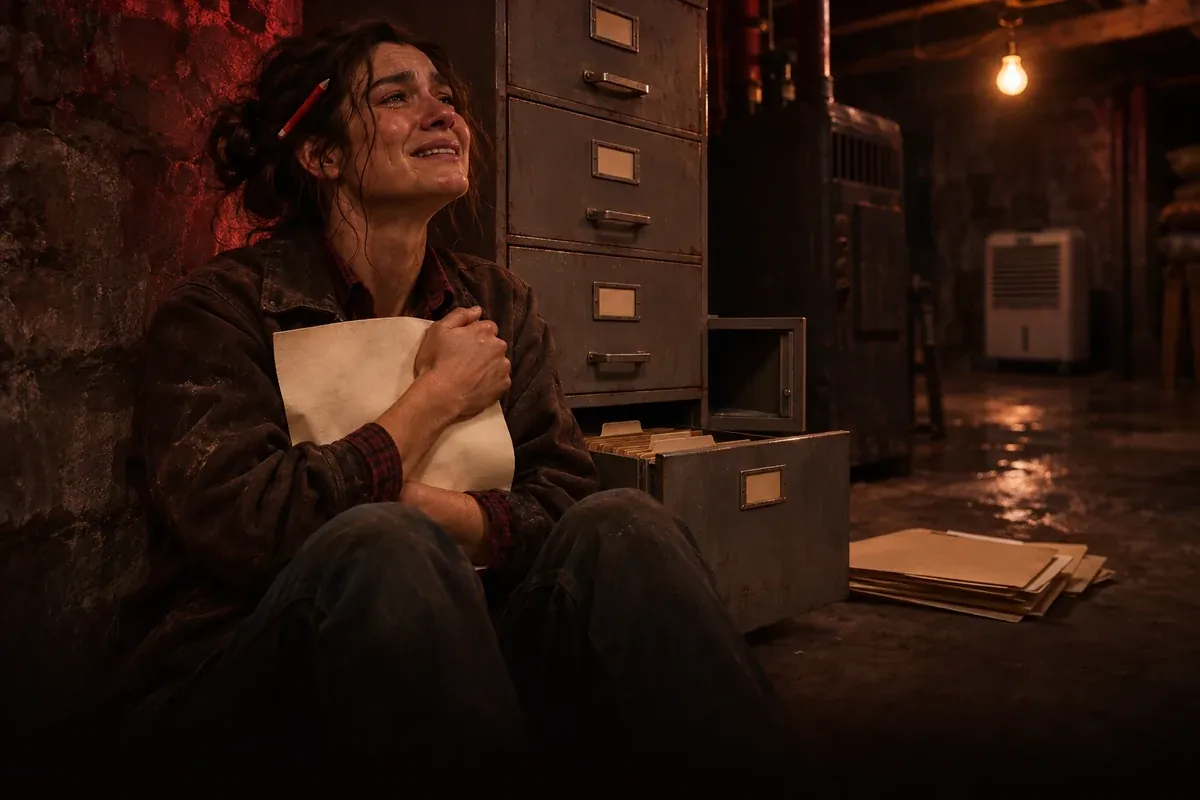
The basement of Hanrahan’s Feed and Seed is damp and low and smells of cardboard. A dehumidifier runs in the corner with a sound like an old man snoring. There is a long bank of gray steel filing cabinets down the middle of the room, labeled by year, and at the very end, tucked behind the furnace where nobody has a reason to go, there is one that is not.
It is a four-drawer cabinet the color of a battleship. On the top, in strips of masking tape, someone has labeled it in block capitals.
A.O.R.
I have not been down here since my father died. I could not tell you why I came now, except that I have been thinking about precedent. An adjuster looks for the last time. If there was ever a Garrow County claim where somebody carried a loss and lived, there will be a file, and my father, who kept a copy of everything, will have kept it.
I pull the first drawer.
It is full of denials.
I mean full. They stand in the drawer in manila folders thick as a Bible, thirty years of them, tabbed by year, and every one is a copy of a Prairie Mutual letter I could have written myself. Dear Policyholder. We regret. Exclusion 7b. They are signed by various adjusters, mostly my father, and at the bottom of every page, stamped in red, are two words.
CEDED TO REINSURER.
And next to the stamp, in blue ballpoint, in a neat, rounded, friendly hand that I have seen on every birthday card of my life: W.P.
Wendell Prewitt. Dub.
I pull the second drawer. The third. I stand there with files heaped in my arms and a transmittal slip fluttering from one hand, and I read it, because I cannot stop. Forwarded to: Reinsurance Department, P.O. Box 4408, Omaha, Nebraska. Date mailed. Initials. A thousand slips, two thousand, every one a loss that was not mine to carry and was not his, and every one marked off in a good soft hand: sent.
For the file: I counted. I always count. Four thousand, one hundred and twelve.
There is a pattern, and I see it only because I am tired and my hands have stopped shaking. The dates are not evenly spread. In the first years there are a few a month. Then a few a week. Then, after the year my father died, a drift that becomes a flood. Hail. Wells. A church roof. A man in a tractor. The numbers are climbing like a fever.
I open the bottom drawer.
It is not a drawer. That is what I learn. The bottom of it is two inches too shallow, and when I put my hand in and press the false back, there is a click, and a panel gives, and behind the panel is a space just big enough for a shoebox and a single folded sheet.
It is cream-colored.
It is the exact cream of the Declarations Page, heavy paper, soft at the creases from being opened and closed, typed in the same clipped typewriter face that has hung in my left eye since Sunday morning. There is a stamp across the top. It is not a Prairie Mutual stamp. It shows a scale, and under the scale, in tiny capitals, GREAT PLAINS SURETY AND INDEMNITY.
I unfold it. I am holding the paper by the edges, as I would hold a bird.
DECLARATIONS
Named Insured: D. Okafor-Reyes, a minor, age seven.
Collateral for: [REDACTED]
Effective: twenty-two years ago this August.
Limit of Assumption: to be determined on maturity.
At the bottom is a signature, in block capitals I know better than my own face. AMBROSE OKAFOR-REYES. Under it a second line, smeared, with only two initials legible, O. H., and a date that has been scratched out hard with a pen.
I read the page a third time.
I cannot feel my hands, and it is not Retention.
At the foot of the page, in the margin, in carpenter pencil, in the same capitals, so small and faint that I almost miss them, someone has added a note. My father wrote it on a Tuesday, I would guess, in some quiet moment, to nobody. I read it in the light of a single bulb.
SHE LAUGHED AT THE NURSE’S JOKE TODAY. WORTH IT.
I sit down on the cold floor. I am holding the page against my chest. The dehumidifier snores. In the corner of my eye the Declarations Page hangs, cream and patient, with its four neat lines.
I try to laugh. I try to make a sound like a person. What comes out is a breath, and then another, and then a thing I do not have a word for.
I had been a policy for twenty-two years. I had only just become a person who could read it.