

File note: Weekend. No inspections. Reviewing correspondence only, which is what people say right before they find something.
There is exactly one place in Pell Pass where a phone can find a signal. It is the roof of the lift barn, and on Saturday morning I climbed a ladder to get there.
“You’re sure about this?” Mick called from below, holding the ladder with one hand and a paper bag of doughnuts in the other.
“I’m a professional,” I said, and almost fell off.
One bar. I dialed my office friend Dina Penrose before it could change its mind. Dina handled underwriting intake. She had a husband, a dog named Ledger, and a deep, structural fear of saying anything incriminating on a recorded line.
“I’m going to ask you a question,” I said, “and I want you to answer with a number. When was my authority memo on the Pell Pass file signed?”
A pause. A keyboard.
“I’m not saying look at the dates,” said Dina, very carefully. “I’m saying dates are public.”
“Dina.”
“The thirteenth. Monday. 4:52 p.m.” More keys. “And the first notice of loss for the freezer claim came into the system Tuesday at 6:03 in the morning.”
I held onto the edge of the tin. The wind pulled at my hair.
“The memo lists eleven claims,” I said.
“It does.”
“On Monday, there were ten.”
“Jo.” Her voice dropped. “I did not tell you that. I am a person who is saying nothing at all and going to lunch.”
She hung up. I stayed on the roof a minute longer with the dead phone against my chest, watching the mountains come out of the clouds.
An eleventh claim, counted before it had been filed. My vice president had signed the denial of a loss that, on paper, had not happened yet.
Connie Vogt did not forget details. She had made vice president by remembering every one. Which meant that either she had been very sloppy, or she had known that on Monday night a freezer door was going to come apart in a ski town two hundred miles away.
And there were only two groups of people who knew when the Three were due. One of them was sitting in the Grange hall folding chairs. I did not know who the other one was.
I climbed down the ladder, and I did not talk to Mick about doughnuts.
On Sunday afternoon my father called.
I knew it was him before I looked. He called every Sunday, from a house in Tucson with a lemon tree he had never learned to prune. I let it ring, as I had every Sunday for nine years. I was standing in the motor court lot with my back against the cabin door when the voicemail light came on.
“Jo,” said Walt Lindmark’s voice, thin and apologetic. “It’s Dad. I’m not calling to fix anything. I’m calling because it’s Sunday.”
I did not delete it. I stood there with my thumb over the trash icon, trying to remember why I never listened.
I did not need to try hard. Pell Pass had been reminding me all week.
At two o’clock Mick drove me up a gravel road to a cabin with a rain barrel and a sign that said BEWARE OF AGENT.
“He wrote the original policy,” Mick said. “Gus Trevanion. Local agent, forty years, retired. He’s a little…” He wobbled one hand. “But if there’s anything left of how this mountain got insured, he’s it.”
The man in the recliner was seventy-nine and very thin. A clear tube ran from his nose to a green tank on wheels. He had a pair of horn-rimmed glasses and a cardigan with one button left, and he looked up at me as if I had just arrived on a scheduled train.
“Lindmark,” he said. “Oh, you have his chin.”
“Mr. Trevanion, I’m here to ask about the policy.”
“Everyone is.” He gestured at a kitchen chair. “Sit. Don’t mind the oxygen. It’s good for me, which is why I resent it.”
I sat. “I’d like to understand what was written in 1987.”
“You’d like to understand,” said Gus, delighted, “what the carrier didn’t read.”
Mick coughed. “Gus.”
“Don’t Gus me, Michael, I was writing exclusions before your mother had her braces off.” He leaned toward me with a rattle of tubing. “Child, you have read the warranty. Of course you have. Page nine. You found it like a cat finds a warm vent.”
I said nothing.
“And you skipped the endorsements. Everyone skips the endorsements.” He wheezed a laugh. “Fourteen of them. Boilerplate. It isn’t boilerplate, though, not when someone has written it with love. Words don’t cost me anything, honey. They cost the people who read them. Ask your carrier what Endorsement Fourteen cost.”
“What does it say?”
“It says what I meant.” He closed his eyes. “Your father used to say that about every contract he ever wrote. Did you know that? The only honest man Harborline ever sent up this road. That’s why they broke him.”
I sat very still. Behind me, Mick had gone quiet, studying the rain barrel through the window.
“I’m tired now,” said Gus, and was, as suddenly as a light switching off. “Go and read your paper.”
I read my paper that night, at the motor court, on a bedspread patterned with pheasants.
The policy’s declaration page lists the endorsements in a small block on the last line. I had always skimmed that block, the way you skim a hotel fire map. Number fourteen read, in its entirety: ANIMAL LOSS (SPECIAL). See attached.
There was nothing attached. A single index page, with a footnote in a typeface older than I was. It had never been copied into the electronic file. Somebody, years ago, had scanned the declarations but not the pages behind them.
I turned off the light. I lay in the dark with the sound of pine trees against the window and decided what to tell Teo.
I told him on Monday morning, at the fire hall, before Brice Quillan could.
“The memo is dated the thirteenth,” I said. “It lists eleven claims. The eleventh didn’t exist yet. My boss knew your freezer would break.”
Teo had been oiling a hose coupling. He stopped.
“That’s not possible,” he said slowly. “Nobody outside the Mutual knows the dates.”
“I know.”
“Then someone told her.”
“Yes.”
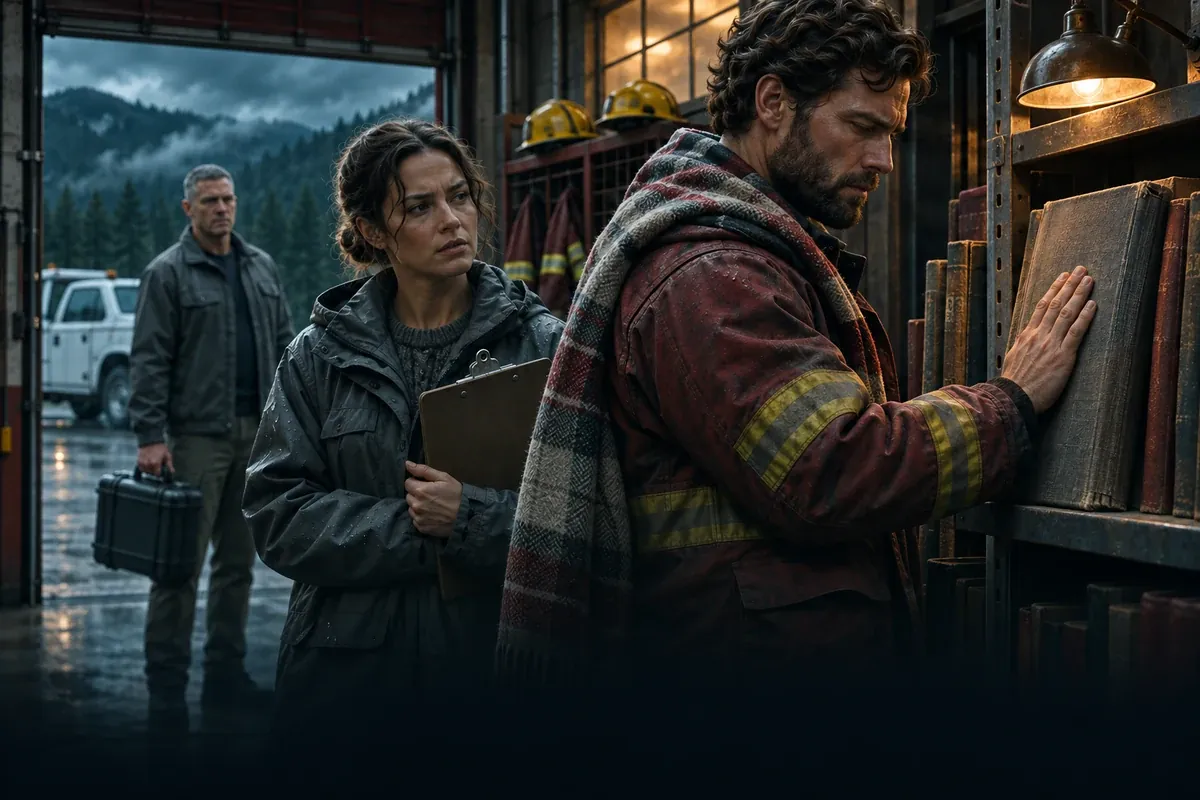
For a while he did nothing at all. Then he set the coupling down, wiped his hands on a rag, and went to the shelf where the Book had been put away. He did not take it down. He put his hand flat against it, the way you touch a sleeping animal.
Outside, a white truck pulled up to the fire hall. It had a roof rack full of equipment, and a man climbed out of it as if he had been assembled in a factory: six foot three, gray crew cut, gray jacket, and a black case slung from his shoulder like a rifle.
He walked into the doorway and held up a badge.
“Brice Quillan,” he said. “Special investigations. I’m told everyone here has been very cooperative.” He looked at Teo, and then at the shelf, and then at me. “I’ll be the judge.”