

File note: Reservation of rights letter issued Tuesday, 9:40 a.m. Carrier retains all defenses. Insured retains all hope. Only one of these is a legal term.
A reservation of rights is the most polite weapon in my industry. It says: we are not denying you, we are not paying you, we are still looking. It buys thirty days. It also, by law, has to state the reasons we might say no.
I wrote mine on the pheasant bedspread with Brice Quillan’s trail cameras already humming on the lodge roof. He had spent Monday afternoon putting them up, in pairs, covering the kitchen, the lot, the barn, and the road. He did it with a drill and an ironclad lack of curiosity.
“I don’t care what bit it,” he had told me, tightening a bracket. “I care who paid for the glass.”
“That’s an interesting philosophy.”
“It’s a living.”
In the letter I named the Protective Safeguards Warranty. I had to. If I left it out, I could not use it later, and if I could not use it later, the file would belong to whoever opened it next. So I typed six cold lines about unmaintained structures, and my hands did not shake, and I sent the letter on Tuesday morning from the roof of the barn, with Mick holding the ladder and eating a doughnut.
Connie Vogt called back in four minutes.
“A reservation,” she said. “Jo, I signed a denial.”
“You signed a memo authorizing me to recommend one. I’m recommending a thirty-day investigation.”
“I don’t need you to be right,” Connie said. Her voice was very pleasant, like a doctor’s. “I need you to be done. Quillan arrives Monday. I want the final report on my desk by the time he leaves.”
“Quillan arrived Monday.”
“Then I want it by Wednesday.”
“It’s Tuesday,” I said, and she hung up on me, and Mick held up a doughnut with an expression of deep, sympathetic horror.
Copies of the letter had to go to the insured. That meant a copy to Dot Okonjo and one hand-delivered, by me, to the Clerk of Losses, because it was the polite thing to do and because I wanted to see his face.
Teo read it standing in the lodge parking lot with his hands steady and his jaw working.
“Protective safeguards,” he said.
“It’s a clause.”
“It’s our barn.” He did not raise his voice. He never did. “It’s the avalanche, and the bank, and nine hundred hours of people hammering. It’s every stall that held. You took a hundred and forty thousand dollars we don’t have and put it in a paragraph.”
“I put it in a paragraph so I could keep the file open.” I heard how it sounded. “A reservation isn’t a denial.”
“It is if it’s the only thing in the file.”
That one landed. I had taught myself not to flinch at insureds, and I flinched.
“Then give me something else to put in it,” I said. “I need grounds to say yes, Captain. I keep looking for them, and every one I find is a reason I can’t.”
For a moment he looked at me with that tired, pale-brown gaze, and I saw him decide not to say something. It was a gentleness I did not know what to do with.
“I know,” he said. “I’m sorry. I know it’s not you.” He folded the letter once, neatly, and put it in his pocket. “I just don’t know how to read a thing like this without feeling like it’s a verdict.”
“It’s a calendar,” I said. “It says you’ve got thirty days.”
“Is that long enough?”
“No,” I said, and he nodded, as though he had expected me to lie and was grateful I hadn’t.
That evening a black SUV rolled into the motor court and a man got out of it in a camel coat. He had silver hair, a politician’s warm, tired smile, and a gift basket in both hands.
“Ms. Lindmark. Hale Strand, Strand Summit Partners.” His handshake was dry and brief. “I own a few parcels up the valley. I thought a neighbor ought to say welcome.”
The basket held smoked trout, a jar of honey, and a card, embossed, with a phone number and nothing else. It looked like a wedding present from a stranger.
“I can’t accept gifts from interested parties, Mr. Strand.”
“I’m not interested,” he said pleasantly. “I’m concerned. Pell Pass is a fine community, and a hard one to insure. I’d hate for a reputable carrier to be caught holding the bag.” He glanced up the valley, where the lodge lights were coming on. “If you ever tire of claims, Ms. Lindmark, I have use for someone who can read a policy. Risk director. It pays better than Harborline.”
“Is that a job offer?”
“It’s an exit strategy,” said Hale Strand. “Everyone should keep one.” He tapped the basket. “Do try the trout. And do enjoy the valley before the tenth. It’s a pretty place when the moon comes up over the ridge.”
I thanked him. He drove away without hurrying.
It was nearly ten minutes before I understood what bothered me. I had said nothing about a moon to anyone in his world. And the tenth was the middle night of the November Three, which no one outside Pell Pass was supposed to know.
On Thursday morning, Mick called Teo, and Teo called me, and by nine o’clock the three of us were hiking the service road to the ski patrol hut at the top of the lift line, with Brice Quillan’s white truck grinding behind us.
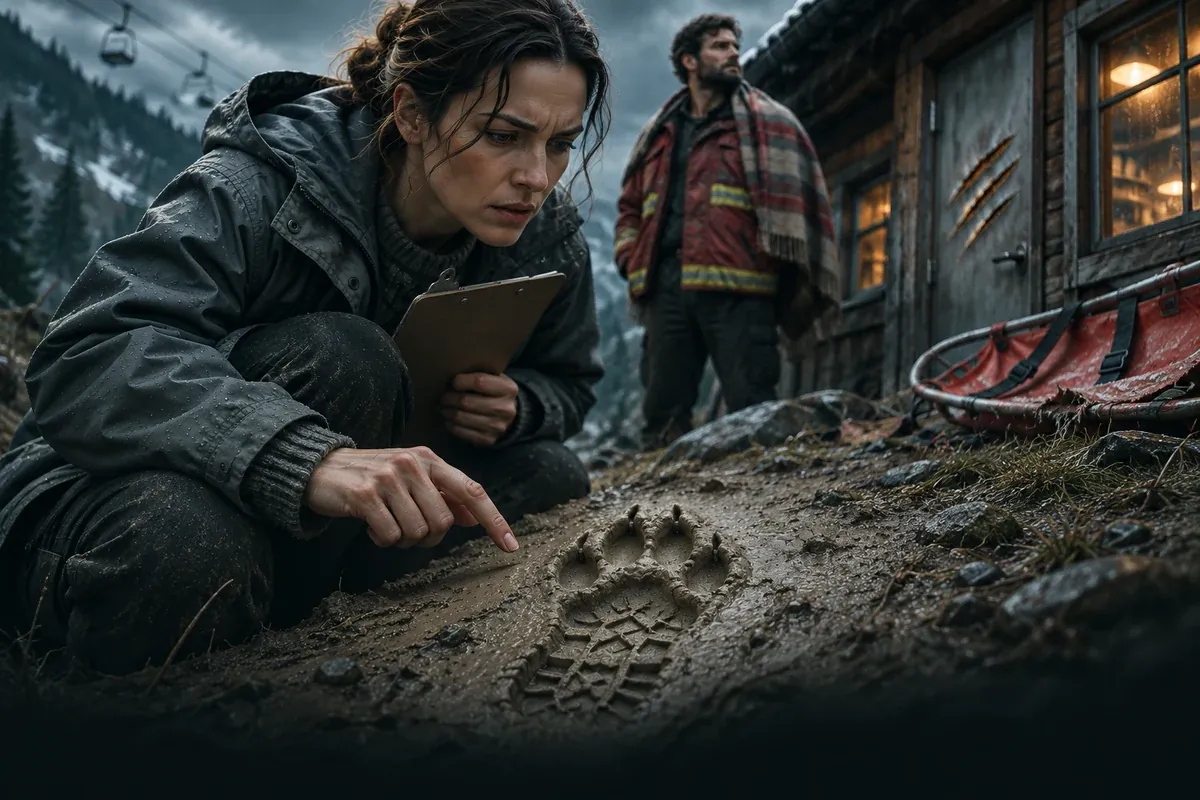
The hut had been torn open. A window frame hung off its hinges. Someone had gutted the rescue sleds and scattered splints across the mud, and gouged a long, ragged claw mark down the doorframe, three fingers wide.
“Bear,” said Mick, with no conviction.
“It’s the twenty-third,” said Teo, flatly. “The Three isn’t for seventeen nights.”
Brice Quillan walked the length of the hut with his hands behind his back, a man reading a menu in a language he spoke very well.
“Daylight,” he said. “Dry weather, no carcass, nothing taken. A bear that wrecks a rescue sled and leaves the sandwiches isn’t hungry. It’s making a point.”
“It might be a different bear,” said Mick.
“It might be a different species,” said Brice. “Of man.”
Teo said nothing. I noticed he had not looked at the doorframe once. He was looking down the valley, toward the place where the road went out of town, with a stillness I had seen before only in hunted things.
I did not follow his gaze. I was crouched at the edge of the mud, where the rain had left a crust of pale clay, and in the clay, big as a dinner plate, was a perfect paw print.
It was too clean. The pads were round and symmetrical. Even the claws had been pressed into the clay at the same depth, like a stamp.
I leaned in close, until my nose nearly touched the mud. Under the paw, half erased, was a shape I knew too well: the long ridge of a work boot heel, and the diamond lugs of its sole.
Someone had walked here, and then pressed a wolf’s foot on top of his own.