

File note: Photograph 7 of 31, ski patrol hut. Paw print overlies a boot print. Order of events: boot first. Someone walked here before the animal did, which is unusual for an animal.
I took thirty-one photographs of the print before Brice Quillan came back from his truck, and I showed him none of them.
I am not proud of that. A good adjuster shares evidence with the carrier’s investigator, and I knew it. But Brice had a gray face and a gray jacket and the habit of nodding at everything, and I had stopped trusting my own colleagues sometime between a doughnut and a dated memo.
I put my phone in my pocket. I said, “Dry weather. It’s impossible to date.”
“It always is,” said Brice, and wrote that down.
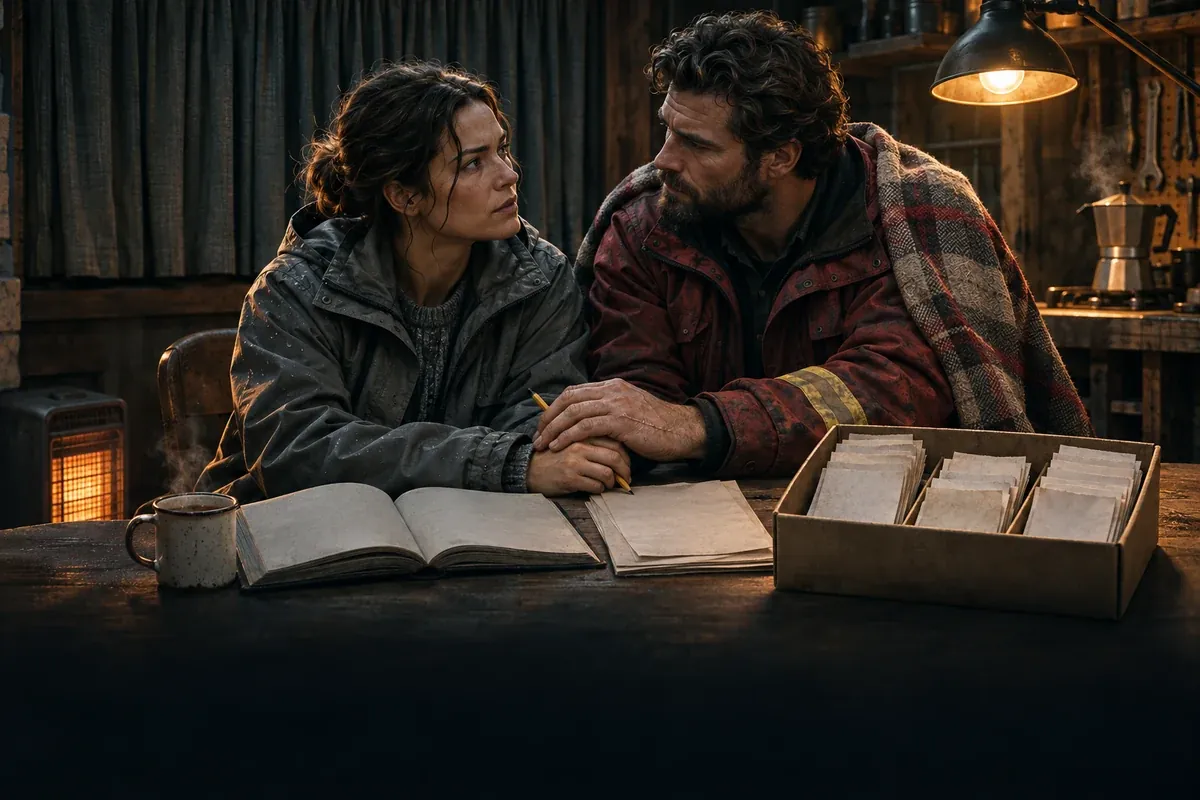
That night I sat on a stool in Teo Aasland’s workshop, with a space heater at my ankles and a pot of terrible coffee between us, and laid the evidence out on a workbench stained by thirty years of other people’s projects.
On the left, my photographs. In the middle, the eleven claim files. On the right, the Book.
“I need to check something,” I said. “May I?”
“It’s your job.”
“It’s not what I’m paid for.” I opened the gray ledger to October of last year and ran my finger down the Book’s column of pencil. “Look at this. In October, your people recorded who was held where, and what broke. Dot, held. Mick, held, minor damage, a chair. Now look at my file.”
I flipped the claim to the page. “Harborline paid ninety-one hundred dollars for a collapsed fence along the creek. A bear, the claim says. Where is the fence in your Book?”
Teo bent over the ledger. He read it for a long time.
“It isn’t,” he said.
“Because nobody broke it.”
I did the same for the other nine. It took an hour. We did it silently, the way two people do taxes, and at the end of it I put down the pencil and counted on the fingers of one hand. Three claims showed damage no one on the mountain had caused. A fence, a garage door, a section of the lodge’s snowmaking line.
“Three of eleven,” I said. “Staged. Somebody knew the dates, and wrecked something on the right nights, and then you were left holding the loss.”
For a while he said nothing. The heater ticked.
“I knew,” said Teo.
I waited.
“Not all of it.” He crossed to a metal cabinet, unlocked it, and took out a cardboard shoebox, the old kind with a rubber band around it. He set it in front of me. Inside were receipts. Dozens of them. Lumber, concrete, a snowmaking valve, a roofing crew from the next county.
“The Mutual’s fund covers the real losses,” he said. “It always has. When the Book and the damage didn’t match, I couldn’t say why, and I couldn’t ask the town, because they would have asked how I knew. So I paid it out of my own pocket. I told myself it was a small thing.” He looked at the shoebox. “Thirty-eight thousand dollars. Two years.”
“Teo,” I said, and it was the first time I had used his name.
“I wasn’t going to lie to you,” he said. “I was going to be unhelpful in a friendly way.”
“Who do you think is doing it?”
He did not answer at once. He took off his work gloves, then put them on again. The silence stretched like a rope.
“I had a brother,” he said. “Kasper. Two years younger. Four winters ago, when the barn came down, he was out on the ridge with a snow crew. We dug for nine days. They found the crew. They didn’t find him.” His voice was very even. “Nobody ever said he was dead. Nobody ever said he wasn’t.”
“And he’d know the dates.”
“He’d know everything. He helped me start the Book.” Teo put his hands flat on the bench. “I don’t know that it’s him. I want it very much not to be him. But the fake damage started after he disappeared, and now there’s a boot print—”
“Is a size twelve, according to the lugs,” I said. “What was your brother’s size?”
“Twelve,” said Teo, and rubbed his face with both hands.
I did not know what to say, so I said the true thing, which is the only reliable choice in a quiet room.
“I asked for this file,” I said.
He looked up.
“Three weeks ago. I volunteered. I told my boss it looked interesting, because of the loss ratio.” I turned the pencil over. “It wasn’t that. Nine years ago I helped him pack his garage for the move to Tucson, and I found a box. He had kept exactly one Harborline file from his whole career. A mill fire, 1999, in a town called Pell Pass. I never opened it. I carried that box through three apartments, and last month when Pell Pass came up on my queue, I asked for it.”
“Why?”
“I wanted to know what my father had done,” I said. “And then I wanted to know why he’d kept it. I haven’t worked out what it would mean if the answer were the same.”
Teo studied me for a long moment. Then he did something I did not expect. He reached across the bench and, very carefully, as though I might shy, put his scarred hand over mine on the pencil.
“Thank you for telling me,” he said.
It was the whole sentence. It was all he said. It was enough that I had to look at the heater.
At midnight, on the way back to the motor court, Teo’s truck rolled quietly up the lodge road with the lights off. He had asked me to ride along. “I want to look at the barn,” he said. “Humor me.”
There was a thin new moon. The pines stood black against the valley. We parked a quarter-mile below the barn and walked up the last stretch, not speaking.
Above us, in the trees on the ridge, a light was moving.
It was a small yellow beam, the kind a flashlight makes, bobbing between trunks. It went up the slope, steady and unhurried, toward the lift line.
Teo put out a hand and stopped me, and I understood how very still a large man can be.
“That’s not one of us,” he whispered.
“Could it be Brice?”
“Brice is asleep at the motor court. I walked by his window.” His jaw tightened. “We don’t carry lights.”
The beam stopped on the ridge above the barn. For a second, nothing moved. Then the light went out.
And in the dark, from somewhere up the slope, a single voice lifted. Long, rough, and very near, it began as a note and became a howl.
Teo’s hand tightened on my sleeve.
“It’s seventeen nights from the Three,” I whispered. “Can anyone in the Pass change off schedule?”
“No,” said Teo. He was white to the lips. “That’s the one rule. Nobody can.”
The howl came again, from the same spot, and this time I thought I heard something in it that sounded almost like a name.