

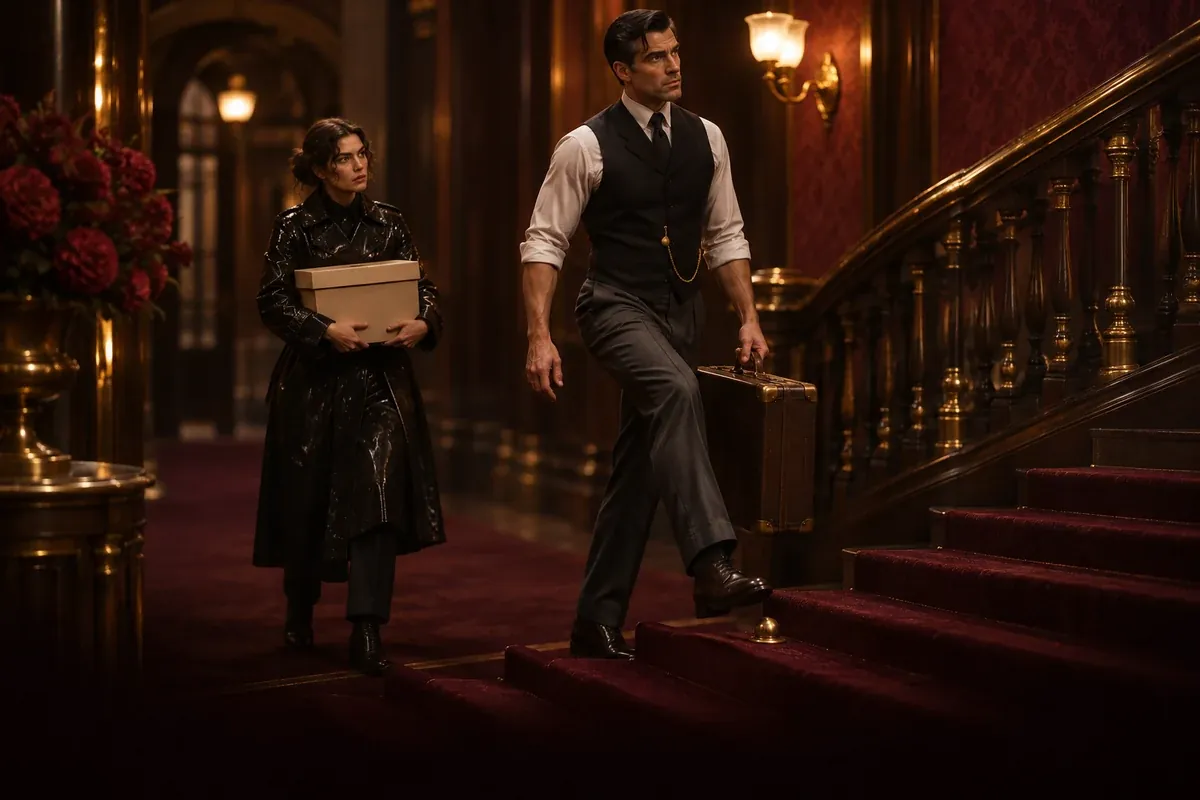
The sole heir of the Vesper Hotel has been dead for six years, and he is carrying my suitcase up the main staircase. He steps over the brass stud set into the ninth stair without looking down, the way you step over a dog you have known since it was a puppy. I know his name because I sent his mother flowers.
Let me back up forty minutes, because a lawyer who starts in the middle of a story gets the facts wrong.
Forty minutes ago I am standing under the porte-cochere of a five-story brick hotel on a mountain in the rain, holding a banker’s box against my chest like a shield. The hotel is called the Vesper.
It was built in 1924 as a spa for people with lungs and money, and the cracked tile fountain in the drive still has a mermaid in it, minus her face. The wipers on my car are still ticking behind me because I forgot to turn off the engine. That is how I know I am nervous. I am never nervous. I bill in six-minute increments.
The box holds the Estate of August Tallis, Deceased. Nine weeks dead, pancreatic cancer, no known family, one will. The will names me as executor. It does not name my firm. It names me, Sabine Pascoe, thirty-two, probate associate at Lisle & Strunk in Roanoke, Virginia, and it was delivered to our office in a cream envelope by a woman who would not give her name and who left a pot of beeswax polish on the reception desk as a tip.
Prosper Lisle handed me the file himself. He is the senior partner, and for ten years he has called me his dear counselor in the voice other men use for a good dog. “Read it, bill it, come home,” he said. “A hotel on a state line. Heaven help the surveyor.”
I said I would take it. I said it fast. I did not tell him why.
Here is why. In my wallet, behind my bar card, there is a laundry ticket the color of weak tea. It says VESPER in blue letters and under that, in pencil, one gray cardigan, paid. It was in the glove box of my sister’s car when the state police pulled the car out of the Tallow River six years ago, door open, headlights still on under the water. It is the only thing of hers I kept that was not filed.
I have not told anyone I have it. I have not told anyone a lot of things. Let the record show that I am excellent at not telling.
The lobby is warmer than the night and smells of lemon oil, wet wool and old plaster. The floor is black and white tile, and a line of brass studs the size of quarters runs across it on a diagonal, from the revolving door on my left to the foot of the grand staircase on my right.
The studs are worn smooth in the middle, where a hundred years of people have crossed them without noticing. I notice. It is a survey line. I am standing on one side of a state border, and in four steps I will be standing on the other.
The front desk is a slab of black walnut with a brass bell, a rotary phone and a guest register as big as a Bible. Behind it, folding a stack of white napkins into triangles, is a woman of about seventy-five with a face like a clean pillowcase and forearms like a stevedore.
“Miss Pascoe,” she says. She does not ask. “You’re early. Mr. Tallis said the executor would be late, on account of the weather, and wouldn’t hear a word against her.”
“I’m not late and I haven’t heard a word against me yet.” I put the box on the desk. “I’m here to read a will.”
“Mrs. Utley,” she says, as if it were an answer. “Bernice. I do the beds.” She turns the register around to face me and lays a pen on it. “Virginia side or Tennessee side?”
“Excuse me?”
“For the register. Folks like to choose.” She taps the page. It has two columns, ruled in red ink, one headed VA and one headed TN. “Some say the Tennessee side has the better water pressure. Some say the Virginia side has the better ghosts.”
“I would like to be on whichever side is not on fire.”
“Then you’ll want 41,” says Mrs. Utley, and for the first time I see her mouth do something that is nearly a smile. “It sleeps in both.”
I sign in the Virginia column. It is a reflex. I am a Virginia lawyer, and I have never been able to sleep in a bed I am not licensed to practice in.
“Mr. Tallis left instructions,” Mrs. Utley says. She turns three napkins into three triangles while she talks, and she does not look at her hands. “The will is to be read aloud, in Room 41, at ten o’clock tonight. The heir will attend.”
I have been practicing law for seven years. I have heard a great many strange things said across a great many desks, and I have a face for it. The face holds.
“The heir,” I say, “is deceased.”
“Mm.” Mrs. Utley picks up another napkin. “That’s a stain that wants cold water, and I wouldn’t rub it before supper.”
“Mrs. Utley. I read the file. Wystan Anselm Kincaid. Former Virginia state trooper. Drowned in the Tallow River six years ago, presumed dead on the petition of his mother, certified by the county medical examiner. I have a copy of the order in this box. There is no heir to attend.”
“Then it’ll be a short evening,” says Mrs. Utley, “and you can go home.” She rings the bell on the desk, one clean note. “Wystan. Bag.”
I have been standing on the Virginia side of the brass studs for three minutes, and I have not once looked down at them again. I look down at them now, because a man has just come through the swinging door behind the desk, and I do not want my face to be the first thing he sees.
His shoes are old, resoled, polished until the leather has gone soft. Gray trousers, creased so sharply I could file a motion with them. A waistcoat, charcoal, buttoned to the throat over a white shirt with the sleeves turned back twice. A brass name tag, the old kind with a pin.
W. KINCAID.
“Ma’am,” he says.
He is tall, thirty-five or thirty-six, with the squint of a man who has spent years looking at something in the distance and trying to work out how it got there. There is gray at his temples that was not in the photograph in the memorial program. He has a farmhand’s shoulders under the good waistcoat, and he picks up my suitcase from beside the revolving door as if he has been told its weight in advance.
I think: it is a common name. I think: the mountains of southwest Virginia are full of Kincaids. I think of a church basement six years ago, folding chairs and a coffee urn, and a small woman in a navy dress holding both my hands and saying that her boy had wanted to be a trooper since he was nine years old.
I had a casket spray sent to her house the next week. Lilies, white ribbon, a card that said With sympathy, Sabine Pascoe. I paid forty dollars extra for same-day delivery. I did not know what else to do with my hands.
“Room 41,” says Mrs. Utley. “Show her the long way.”
The long way is up the grand staircase, which is wide enough for a bride and her whole family to come down at once. The carpet runner is the color of old claret. The brass studs cross it every nine steps, and I realize, climbing, that the staircase has been built so that every flight starts in one state and ends in the other.
He does not talk. He goes up the stairs ahead of me with my suitcase in his left hand and his right hand free, and on the ninth stair he steps over the stud.
So here we are, back where we started.
On the landing I stop, because I am a lawyer, and when I am afraid I ask questions.
“Mr. Kincaid. Have you worked here long?”
“Six years, ma’am.”
He says it to the staircase wall. A man answering a question truthfully does not look at the wall.
“Before that?”
“Roads.”
“Roads,” I say.
“State roads, mostly.” He turns. His eyes are the gray-green of a creek over slate, and they are the steadiest thing I have seen all week. “Third floor’s the one with the good light. Fourth’s the one with the line.”
“Do you have family in Marlin Ford?”
It is a small town, forty miles from here, with a Methodist church and a drugstore and a trooper’s mother. It is the sort of question that would sound idle in the mouth of a tired woman at the end of a long drive. I ask it idly.
“No, ma’am,” says the man in the waistcoat. “Nobody left there at all.”
He carries my bag up the last flight, and I follow, and I do not say another word, because I have just found out something about myself. I do not want to be right. For six years I have organized my life around the principle that a thing is real once it has been filed and not before, and I have never been so frightened of an unfiled thing as I am of the back of this man’s neck.
The fourth floor is long and narrow and smells of lavender and brass polish, with a carpet that has been walked down to a shine along the middle. The brass studs run along it like the dots of a very straight sentence. At the far end there is a double door with a transom, painted dark green, and on the door there is a number, 41, in numerals that have been rubbed bright by thumbs.
He sets my suitcase down outside it. He does not try the knob.
“It stays locked until you’re ready,” he says. “Mrs. Utley has the other key. I have this one.” He holds up a brass key on a loop of green cord. “Nine o’clock, if you’d like to look it over. The reading’s at ten. Hotel’s got a rule about that.”
“What happens at ten?”
“The door shuts.” He puts the key in his pocket, and I see his left hand turn in the light, and across the back of it, from the knuckles to the wrist, there is a patch of skin the color of candle wax, puckered and shiny. A burn, years old. The kind that comes from putting your hand somewhere you were told not to.
I have seen that hand before. I have seen it in a photograph a trooper’s mother pressed into my fingers at a funeral, a boy of eighteen in a uniform too big for him, hand raised in a salute. I have no way of knowing it is the same hand, because the boy in the photograph does not have the scar.
I would like to make a note of that, for the record. The boy in the photograph does not have the scar.
“Thank you, Mr. Kincaid,” I say.
“Ma’am.”
He goes down the corridor, silent on the carpet, and I stand outside Room 41 with a banker’s box and a feeling I cannot file. At the corner he turns his head, only a little, as if he is deciding whether to say something. He does not. He goes down the stairs. Somewhere below, a door swings and Mrs. Utley’s voice says, “Supper’s soup.”
I eat the soup. I eat it alone at a table in the Virginia half of the dining room, under a chandelier with four of its twelve bulbs burned out, and Mrs. Utley stands at my shoulder and refills my water glass without being asked. The soup is white bean with ham, and it is the best thing I have eaten in a month, and I cannot taste it.
I do my job. I open the box and look at the will again, the actual paper this time, and not the scan. It is six pages typed on an old manual machine, the letters slightly crooked, and the signature at the end is in green ink, in block capitals, AUGUST TALLIS, as if he were signing a hotel register.
Two witnesses whose names I do not recognize. A notary in Beale County, Tennessee, whose stamp has been pressed so hard that it has gone through the paper.
At the top of the first page there is a handwritten note, in the same green ink, a single line.
READ IT ALOUD OR IT DOESN’T COUNT.
I put the page down. I pick it up. I look at the line for a long time.
At nine o’clock I climb back to the fourth floor and find the door of Room 41 standing open and the lights on. He is not there. The key is in the lock on the outside, on its green cord, turning slowly, as though someone has just let go of it.
I step across the threshold, and the room is not what I expected.
It is large, and it is old, and it is lovely in the way of rooms that have been looked after by a person and not a committee. Oak floor, wide boards, dark as tea. A high ceiling with a plaster rose.
Tall windows on the front wall, with the rain still going down them in long threads, and beyond them the lights of Lantern Gap, nine hundred souls in a bowl of hills. A wardrobe. A writing desk with a green-shaded lamp. A wing chair beside the door, slightly worn on one arm.
And across the middle of the floor, running from the wall on my left to the wall on my right, a line of brass inlaid into the oak, as straight as a ruler and as wide as a finger.
On one side of the line, the near side, my side, stands an iron bed with a white coverlet and brass feet. On the other side of the line, through an arch in the wall, there is a bathroom with black and white tile and a clawfoot tub, and the tub’s four iron claws grip the floor in a different state.
I walk to the line. I look at it for a while, the way you look at a thing you will have to defend in court.
I put one foot on each side.
It is a ridiculous thing to do. It is exactly what I would have told any client not to do. I stand in two states at once, in sensible shoes, with the rain against the glass, and what I feel is not wonder. It is the same thing I feel when I read a clause that has been drafted by someone smarter than I am.
Admiration, and then dread, and then the worst thing, a flicker of envy.
I step back into Virginia and sit on the end of the bed, which is firm and smells of cedar. I take the will out of its folder. I find the clause I need, the one about the reading, and I read it twice, because I am a careful woman.
Clause 3. The executor shall read this will in full, aloud, in Room 41 of the Vesper Hotel, standing upon the Line with her back to the door, at ten o’clock in the evening of the day she first arrives, in the hearing of the heir, wherever he may be.
Wherever he may be. I notice the grammar of that. I have drafted ten thousand clauses, and I have never put in a wherever he may be, because it is a clause that admits it is talking to the air.
At five minutes to ten, I put my phone on the desk. It has had no signal since the second hairpin turn on the mountain road. I could not call my office if I wanted to.
At two minutes to ten, I stand up and take off my coat and hang it on the back of the wing chair. I put the will on the lid of the writing desk, under the green lamp, where I can see it, and I take my pen out of my breast pocket.
It is a fountain pen with a black barrel and a worn gold nib. My father gave it to me on the afternoon I passed the bar and said, “Sign nothing you haven’t read twice.” He died the next spring. I have signed everything I have ever signed with it.
At ten o’clock exactly, behind me, I hear the door of Room 41 shut.
Not slam. Shut. A heavy, patient sound, the sound of a thing that has been shutting at this hour for a hundred years. And then, from the other side, the quiet scrape of a key going round in a lock. Once. Twice.
I am alone in a sealed room on the fourth floor of a hotel that nobody told me was a mile from help, and I am standing in two states reading a will to a dead man.
Fine. I have done worse for less. I turn my back on the door, as the clause requires. I plant one foot on each side of the brass line. I take a breath and lift the pages.
“The Last Will and Testament of August Tallis,” I read. My voice comes out dry and level, and I am grateful for it. “I, August Tallis, of the Vesper Hotel, in Lantern Gap, being of sound mind and unsound pancreas, do declare this to be my last will. I revoke all earlier wills, and any codicils, and any promises made to anyone in a bar.”
Nothing answers me but the rain.
“Clause one. My debts shall be paid, my funeral kept short, and no man in a black suit shall be allowed to call me a pillar of the community. Clause two. I direct that my executor serve without bond, because I am told she is the only honest lawyer in Virginia, and I would hate to insult her with a bond.”
I stop. I look at the page. Honest. Somebody who has never met me wrote that sentence, and it lands on me like a hand on the back of the neck.
I go on.
“Clause three, the reading, which you are doing now. If you have skipped it, go back to the beginning, because I will know. Clause four.”
Here the typed lines change, and the type is a little darker, as if the machine had been struck harder.
“Clause four. I give, devise and bequeath everything I own, the Vesper Hotel and the ground it stands on, and every card in it, to my friend and my hands, Wystan Anselm Kincaid.”
The room is perfectly still.
I have read the name aloud in a sealed room, to nobody, in my own flat voice, and I feel something I did not expect. It is not fear. It is the specific loneliness of saying a dead man’s name into a room that has been waiting for it.
“Wystan Anselm Kincaid,” I say again, because the clause says wherever he may be, and I have never in my life left a job half done.
Behind me, with no knock and no warning, the lock turns.
I hear the bolt draw. I hear the brass handle dip. I hear the door open on its patient hinges, and a draft comes in off the corridor, smelling of lavender and rain and, faintly, of hot iron, the smell of a waistcoat that has just been pressed.
I do not turn around. A woman who turns around in a story like this one is a woman who has never read the end of a contract.
“Here,” says a low voice behind me, and it is not a ghost’s voice, because a ghost would not sound so tired.
The door closes. The key goes round in the lock, once, twice, on the inside this time.
“Here,” says the dead man, and locks the door behind me.