

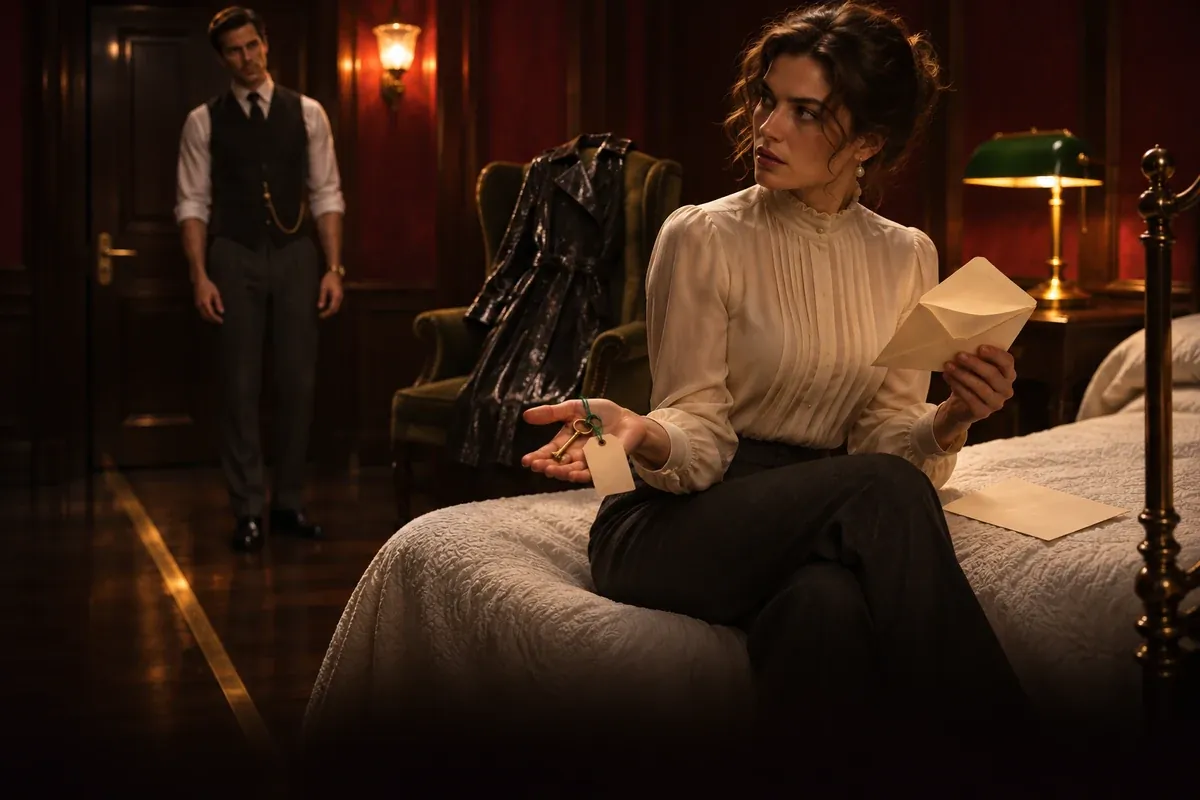
“Keep reading,” says the man behind me.
I would like to report that I screamed, or hit him with the lamp, or did any of the things a woman does in the second act of a different kind of story. What I do is look down at the page in my hands and find my place. Clause five. My eyes need three tries to land on it.
“Clause five,” I read. “I name as my executor Sabine Marie Pascoe, of Roanoke, Virginia, to serve without bond, for a fee of one dollar and the right to complain.”
My voice has gone thin. I can hear the rain between the words. Behind me there is a sound of a man shifting his weight from one foot to the other, the small creak of an old floor taking a load, and then nothing. He is standing at the door. He has not come any closer. I know he has not, because I am listening to the floor the way I listen to a witness who is about to change his story.
“Clause six. My executor may enter every room of the Vesper, open every drawer, read every card and ask every question. She will be told the truth by everyone who works here, except where I have forbidden it in writing.”
“Clause six is where you start to like him,” the man says, very quietly. “Most people do.”
“Please don’t talk during the reading.”
“All right.”
“Clause seven.” I stop. I have drafted lapse clauses, and I have litigated them, and I can read this one upside down in my sleep. But I have never read one aloud to the person it was written about. “If my heir is dead at the time this will is read, then all that I have given to him shall pass to my executor, absolutely and without condition, as if he had died before me.”
The last word hangs in the room like a coat on a hook.
I look at the brass line under my shoes. I do the arithmetic that I have been trying not to do since the staircase. A dead man cannot inherit. If the heir is dead when the will is read, the gift fails, and under clause seven the entire Vesper Hotel, the land, the building, and every card in it, lands in my lap. Everything I own and everything I have ever seen on a closing statement would fit inside the lobby fountain.
And the man at the door is either dead, which makes me rich, or he is not.
“Clause eight,” I say, and I do not know how my voice is still working. “The house owes nothing it cannot pay in kind. Clause nine.”
I take a breath. It does nothing.
“Clause nine. The executor shall be sealed in Room 41 from ten at night until six in the morning for nine nights together, beginning with the night she first arrives. On each night she shall open one envelope, read it aloud, and do as it says if she has the stomach. If on any of the nine nights she fails to sleep in the room, the condition fails, and my estate shall fall into ordinary probate, and may God help the lawyers.”
“It’s ‘sleep’ in the document,” the man says. “Not ‘stay.’ He was particular about that.”
“He was particular about all of it.” I have not turned around. “Clause ten.”
“The keeper of the room.” He says it along with me, and I realize he has the thing by heart. “Holds the key. Answers the executor’s questions truthfully, on any subject, unless the answer lies in an envelope she has not yet opened.”
“Clause eleven. This will shall be proved and probated in the court of the state in which I die. It is my intention to die in the bed, and I have measured.” I look up at the iron bed. It stands entirely on my side of the line, brass feet planted in Virginia. The headboard is nearly touching the brass. “Clause twelve.”
There is a single line under the last clause, in green ink, and I read it in a voice I barely recognize.
“Do not thank me.”
I lower the pages. The reading is finished. By the terms of clause three it counts, and I have done what the clause asked, and I am a person who has fulfilled a condition, and I am going to turn around now.
I turn around.
He is standing with his back against the door, one hand behind him on the key, the other hanging at his side. The green-shaded lamp throws his shadow up the wall and across the plaster rose. Tall, narrow in the hip, the waistcoat buttoned to the throat.
In the lamplight the gray at his temples looks like frost. He does not look dangerous. That is the first thing that frightens me. He looks like a man who has been standing very still for six years and has just been told he may move.
“Miss Pascoe,” says Wystan Kincaid. “I’d like to start by saying I’m sorry about the door.”
“Take your hand off the key.”
He takes it off. He puts both hands where I can see them, and I watch the left one, the scar bright as candle wax under the lamp. It is the steadiest hand I have ever seen on a living man.
“Thank you. Now take it out of the lock and put it on the desk.”
He considers this. “No.”
“Is there a reason?”
“Clause ten says I keep it.” He says it without apology, like a clerk citing a rule. “It also says I answer any question you ask, so ask. I’m not going to lie to you. I’m going to tell you when I can’t answer, and why.”
“That’s a courtesy a deponent usually gets from his lawyer.”
“I haven’t got one.”
“No,” I say. “You’re dead.”
Nothing moves in his face. Then, so slightly that I might have imagined it, the corner of his mouth does something very dry.
“Yes, ma’am,” he says. “That’s the working theory.”
I go to the writing desk. I need something to do with my hands, and the desk has a drawer with hotel stationery in it, cream paper with the Vesper’s name in raised letters across the top, and I take out three sheets and uncap my pen. The act of writing steadies me. When I was twelve my father taught me that when you do not know what is happening, you make a list.
“Name,” I say.
“Wystan Anselm Kincaid.”
“Date of birth.”
He tells me. It is the date in the memorial program. I do not need to look it up.
“Occupation.”
“Night manager of the Vesper Hotel. Before that, six years a Virginia state trooper, the last two in accident reconstruction.” A pause. “Before that, a boy who liked roads.”
“Do you have identification?”
“No.”
“You do not have a driver’s license.”
“A dead man doesn’t renew.” He reaches slowly into the inside pocket of the waistcoat, two fingers, a movement I realize he has made a thousand times at the side of a highway, to show a driver that he is not going to draw a weapon. He takes out a square of paper, folded and refolded until the creases have gone soft as cloth. “I do have this.”
I take it. It is warm from his body.
It is a certified copy of a Certificate of Death, Commonwealth of Virginia, with a raised seal in the corner and a pale green security pattern across the back. Dray County. Decedent, WYSTAN ANSELEM KINCAID. Date of death, March twenty-first, six years ago. Place of death, Tallow River, at the Carter’s Mill bridge. Cause of death, drowning. Manner, accident. Disposition, body not recovered, presumed dead on order of the Circuit Court. Certifier, Inez Garland, M.D., Medical Examiner. Informant, Ruth Kincaid, mother.
I read it twice. A careful woman reads twice.
“It’s misspelled,” I say.
“Yes, ma’am.”
“Anselem. With an e. Your middle name is Anselm.”
“My mother spelled it right on the birth certificate. Somebody at the state office didn’t. I’ve carried it six years. It’s the only thing on that page that’s wrong in a way I’d call a favor.”
“Why do you carry it?”
“A man ought to know what he’s dead of.”
I put the paper down on the desk, and I make myself look at it as a document and not as a face. Here is what I know about documents. Anyone can have a death certificate printed. A forger in Knoxville will do you a very nice one for four hundred dollars.
But a seal like this one, a security stock like this one, a medical examiner’s real signature in real blue ink, is something you do not buy. You call it in. You call it in from somebody who sits in an office in Dray County and has a pen.
“This is genuine,” I say.
“It is.”
“Which means the Commonwealth of Virginia believes you are dead.”
“It does.” He lets the pause open, and it is not a cruel one. “The Commonwealth is very sure.”
“Mr. Kincaid. You are standing in front of me.”
“Yes.”
“If I take what I can see and set it against what I can read, then the thing I can read is false.”
“Yes.”
“Then I am looking at a fraud on the Commonwealth.”
“Yes.”
“Committed by whom?”
He says nothing. It is not a refusal. His eyes are on me, steady, gray-green, and he is simply waiting, the way he must have waited at the edge of a hundred roads while someone decided whether to tell the truth.
“That’s an envelope,” I say. “Isn’t it. Clause ten. You can’t answer because the answer is in an envelope I haven’t opened.”
“I’d tell you if I could.”
“You would not.”
“I’d tell you if I could,” he says again, evenly, and I believe him, which makes me want to hit him.
I write it all down. Name, date, certificate, seal. Dray County, Carter’s Mill bridge. I write Kincaid is alive, and I look at the sentence and my hand stops over the paper, because I have just committed a thing to ink that I cannot take back.
Let the record show that a record is the problem.
Here is the trouble. I am an officer of the court. When I petition for probate on this estate, I will file a document with the Clerk of the Circuit Court of Dray County, and I will swear to it.
I will swear that I have made diligent inquiry and that I know of no living person who takes under this will except as stated in the petition. I will name the heir. And the name I write on that line will be the name of the man standing in front of me.
If I list him as dead, I lie to the court. If I list him as alive, I confess that I am a witness to a fraud that reaches the medical examiner, the clerk, and God knows who else, and I have the evidence in my own handwriting. And if I say nothing at all, every day I do not say it is a day I am deciding not to.
“What are you thinking?” he says.
“I’m calculating how many years the Commonwealth gives you for a false certificate.”
“I didn’t write it.”
“You carried it.”
“I did.” He folds his arms. It is the first defensive gesture he has made. “I’ll tell you something you can use. If I’m alive, I’m the heir. But the Virginia slayer rule says that a person who helps to cause the death of a testator cannot take under the testator’s will. So I can’t take. If I’m dead, you take. If I’m alive, I can’t. That’s the whole machine, Miss Pascoe. Either way the hotel doesn’t come to me.”
“You know the slayer rule.”
“I know a lot of rules.” The dry mouth again, nearly a smile. “I was a trooper. You can’t write a ticket without a section number.”
“Whom did you help to cause the death of?”
“That one’s in an envelope.”
I put down my pen. I walk to the door. I do it slowly, on the Virginia side of the line, and I stop an arm’s length from him. He is taller than I thought. He smells of starch and cedar and the hot, clean smell of an iron.
“Open the door.”
“I can’t.”
“You can. You have the key in your hand.”
“I can. I won’t.” His voice does not rise. “Clause nine says that you sleep in this room, Miss Pascoe. It doesn’t say what happens if the room has no door. But it says I keep the key, and I keep it until six.”
“You have just confined an officer of the court in a room against her will.”
“Yes.”
“That is a crime.”
“Yes. There’s a lot of that going around.”
“I want to call my office.”
“There’s a phone on the desk. It’s a house line. It rings at the front desk. Mrs. Utley sleeps in a room behind the kitchen after ten, and she has the other key. If you call her, she will come up, and she will tell you the same thing I’m telling you, and then she will make you tea. I think you should let her make you tea. It’s very good tea. But she can’t open the door, either.”
“Because of the will.”
“Because of the will.” He holds my gaze. “And because somebody on this mountain wants you not to sleep here. I can’t tell you who. I don’t know yet. I know it’s somebody who knew about the executor before the executor did. The lock isn’t only Tallis’s clause, Miss Pascoe. It’s also the only door in this building that nobody can open from the outside while I’m standing next to it.”
The sentence sits in the room.
“So the lock is for my protection.”
“Yes.”
“And it keeps me inside.”
“Yes.”
I let that settle. I let it go cold and clear in my mouth, and then I say it, because I am a lawyer, and the name for a thing is half of what you do about it.
“That is custody.”
I see it land. For one second the careful, patient face goes blank, as if somebody had put out a hand and wiped it clean.
“Yes,” he says. “It is. I’d like to tell you it isn’t. I’d like to say I’m keeping you safe. I am. I’d also like to say I’d let you walk out if you asked me, and I wouldn’t. I’d stand in front of the door.” He pulls his shoulders back, very slightly, a man taking his sentence standing up. “You can call it whatever you like, ma’am. Call it what it is. I won’t argue.”
I had expected excuses. I had a speech ready for excuses. I am left standing with an empty hand, and I realize that I have just been handed the rarest thing a lawyer ever gets in a negotiation: an admission against interest, freely given.
I do not know what to do with it. I do what I always do. I go back to the paper.
“There’s supposed to be an envelope,” I say. “Tonight’s. Where is it?”
“Under the pillow.”
“Under the pillow.”
“Mrs. Utley puts them there. It’s an old hotel custom. A mint on the pillow, only this one doesn’t melt.”
I cross the room to the iron bed. There is a single cream envelope lying on the white pillow, square and thick, no larger than a greeting card, with the number ONE written on the front in block capitals of green ink. The ink is dry and slightly raised. Under it, in smaller letters, the same hand has written, FOR THE EXECUTOR, AFTER THE READING, AND NOT BEFORE.
I sit on the Virginia side of the bed and slide a thumbnail under the flap. Something small and hard falls into my palm before the paper does. A brass key, no longer than my finger, with a tag of cardboard tied on in green thread. The tag says CATALOG.
The letter is a single sheet. The same block capitals, the same green ink, the pen pressed so hard in places that the paper has torn.
I read it aloud, because the will says so.
“Miss Pascoe. If you are reading this, you have stood on my line and said my heir’s name into an empty room, and he has answered it. Good. That means two things. It means you are as stubborn as I was told, and it means he has kept his word, which is a thing he does when it costs him.
“Here are the rules, as you are a woman who likes them. One. You sleep in the bed, on the Virginia side, every night. Two. Wystan keeps the key and tells you the truth, except where my envelopes forbid it. Three. The enclosed key opens a catalog in the old linen elevator. You will be shown it tomorrow, by a woman who folds. Four. Do not leave the room before six, and do not try to make the room leave you.
“The Vesper does not sell rooms. It sells endings. You will want to know what I mean by that, and I will tell you one thing tonight and the rest in nine nights, in the order I have chosen. The house has been a hotel for a hundred years. For forty-eight of them it has been a place where a person can stop.
“Do not thank me. August Tallis.”
I read it twice, silently, after the first time aloud. Then I put the page down on the coverlet, and it is the stillest I have ever been.
An ending. A place where a person can stop.
I look up. He has not moved from the door. His hands are open at his sides. And I understand that I have been looking at the thing in front of me for forty minutes and calling it a lie.
“Your death certificate,” I say. “It isn’t a fraud.”
“It’s a fraud.”
“It isn’t a mistake. It’s a product.”
He does not answer, and he does not need to. Silence is a clause like any other.
“The medical examiner signed it. The county clerk filed it. A circuit judge entered an order. Your mother wore black.” My voice has gone very quiet. “There is a catalog in the linen elevator, with a key to it in my hand, and the hotel sells endings. Not funerals. Endings. The kind that come with seals.”
“Yes.”
“How many?”
“That’s tomorrow.”
“How many, Mr. Kincaid?”
“More than I want you to be afraid of,” he says. “Fewer than you think. Every one of them is on a card.”
I look at the iron bed, and the brass line, and the old dry certificate on the writing desk, and the tall night windows with the rain going down them. I look at a man who has been an accident reconstructionist, a trooper, a dead person, and a night manager, and who is now standing between me and the only door.
He is the hotel’s hands. The will says so. My friend and my hands. He is the one who does the work Tallis could not, the one who makes the endings, and by the plain words of clause seven, the only person on earth who profits if he stays dead is the woman holding the pen.
I think of the thirty-day window to qualify. I think of the oath. I think of a Clerk in Dray County who has seen his name on a certificate and has not once said that it is wrong.
I am a probate attorney, and I have just worked out that I am the beneficiary of a man I am locked in a room with.