

Car 86 was a protection racket with throw pillows, and its proprietor, Odile Brandt, greeted us from a nest of six seats she had arranged into a kind of throne, every one of them billing by the hour, none of them billing her.
I know that because I read her ledger from the doorway, which is rude, and which I will keep doing to people for the rest of this story.
“The famous Inspector,” she said. She was sixty-odd, upholstered in cardigans, with the voice of a woman who has run a homeowners’ association through three civil wars. “You cost me a great deal of money this morning, dear. Half this car paid me for seats near the coffee smell.”
“The coffee smell was a surcharge.”
“It was an amenity,” Odile said, “and I was its distributor.” She waved a hand at her nest, at the car behind her, where I counted eleven passengers seated in defiance of arithmetic and all of them, per their ledgers, paying their hourly seat rent not to the Tariff but through it, with a private markup, to BRANDT, O. — the System, I realized with real admiration and real nausea, would broker anything. It didn’t care who skimmed, so long as the base fare cleared. “Sit down, Inspector. First hour’s free.”
“Nothing here is free.”
“No,” she agreed, comfortably. “But the bookkeeping is.”
She was skimming a third. I read it off her like a billboard: BRANDT, O. BROKERAGE ON SEAT SUBLEASE, 34%. Thirty-four percent on the right to sit down, which she didn’t own, which she’d only had the sense to invent. Four hours earlier, on a good day, I’d have cited her by name and slept like a baby. Now I stood in her carpeted nest with a level-2 clause burning in my wrist and Veen’s variance review ticking in the back of my skull, and thought: she’s a symptom, and the disease is eating better than she is.
“You’re thinking of disputing me,” Odile said.
“I’m thinking about how I’d do it.”
“Of course you are. It’s the lovely thing about you people. You’d rather be right than fed.” She smiled with all of her cardigans. “I’ll tell you what I tell everyone, Inspector. Breaking me doesn’t free a single seat. It only changes who skims.”
Yun, behind me, made a noise that was half agreement and half I hate that she’s right.
I had come in angry, and Odile Brandt was a problem, but she was a Tuesday problem, a zoning-dispute problem, and I’d walked in carrying a dead woman’s ticket from 1974. So I did something that four years on the aisles had taught me never to do: I showed a civilian the evidence.
She looked at the punched ticket for a long time. The cardigans settled, like birds. When she spoke again the HOA voice had gone out of her.
“Hollis,” she said. “There was a Hollis in 79 when I boarded. An old man. He used to say his mother was still aboard somewhere, and everyone let him say it, the way you let people say things.” She handed the ticket back with two fingers, as if its condition were contagious. “You want the Quiet Car, Inspector. If you’re going to keep pulling threads, you’ll want where threads get kept. 84. Pearl can walk you in — they won’t bill her.”
“Why won’t they bill her?”
“Nobody knows,” Odile said, HOA voice back, bright as a bell. “Isn’t that interesting? Door’s that way. Mind the silence.”
She called after us as we reached the door, not unkindly: “And if you ever push toward the Dining Car, dear, there’s a gate at 79 that asks one true thing. Decide yours in advance. Nobody lies to it twice.”
Car 85 was the cold car. Heat on the Meridian Line is included, in the way that being alive is included: at a level calibrated to keep the customer a customer. Past that level, “thermal comfort optimization” ran one Fare a night, and the passengers of 85 had arranged themselves into the oldest solution there is. They huddled in rotas. Eight people to a bench, three-hour shifts, the middle seats rotating outward so everyone took a turn at the window side, which was where the frost was. A woman with a clipboard ran the rota with the fierceness of a ward nurse, and none of them looked at us as we passed, because looking costs warmth and warmth costs Fare.
“Three weeks ago somebody tried to sell body heat,” Yun murmured. “Per minute. Brandt shut it down. Not out of kindness. It was cutting into her seats.”
I wrote a note in my head, because the notebook was in my hand and I’d stopped being able to write in front of those faces: the Tariff doesn’t have to be cruel. It only has to be thorough, and then people do the cruelty for it, in rotas.
The Quiet Car has a tariff plate on its door and the tariff plate says everything you need to know about the Meridian Line’s sense of humor:
CAR 84 — QUIET CAR. SILENCE IS COMPLIMENTARY. SOUND IS BILLED.
RATE: 1.00 PER DECIBEL-SECOND ABOVE AMBIENT.
MERIDIAN LINE THANKS YOU FOR TRAVELING QUIETLY.
Per decibel-second. A sneeze in there was a mortgage payment. Yun walked me through the protocol in the vestibule beforehand, whispering, though the vestibule was free: breathe through your nose, step on the beat of the rails, and if you have to communicate, do it like this — he held up his hands and made a shape — because hand signs are free, the way standing is free, the way everything is free that the house hasn’t figured out how to need yet.
“Why cross it at all?”
“Because it’s eighty meters of car between us and 83,” he said, “and because the detour is the roof.” He watched my face do what faces do. “The roof is free too, if that helps.”
“We’ll take the silence.”
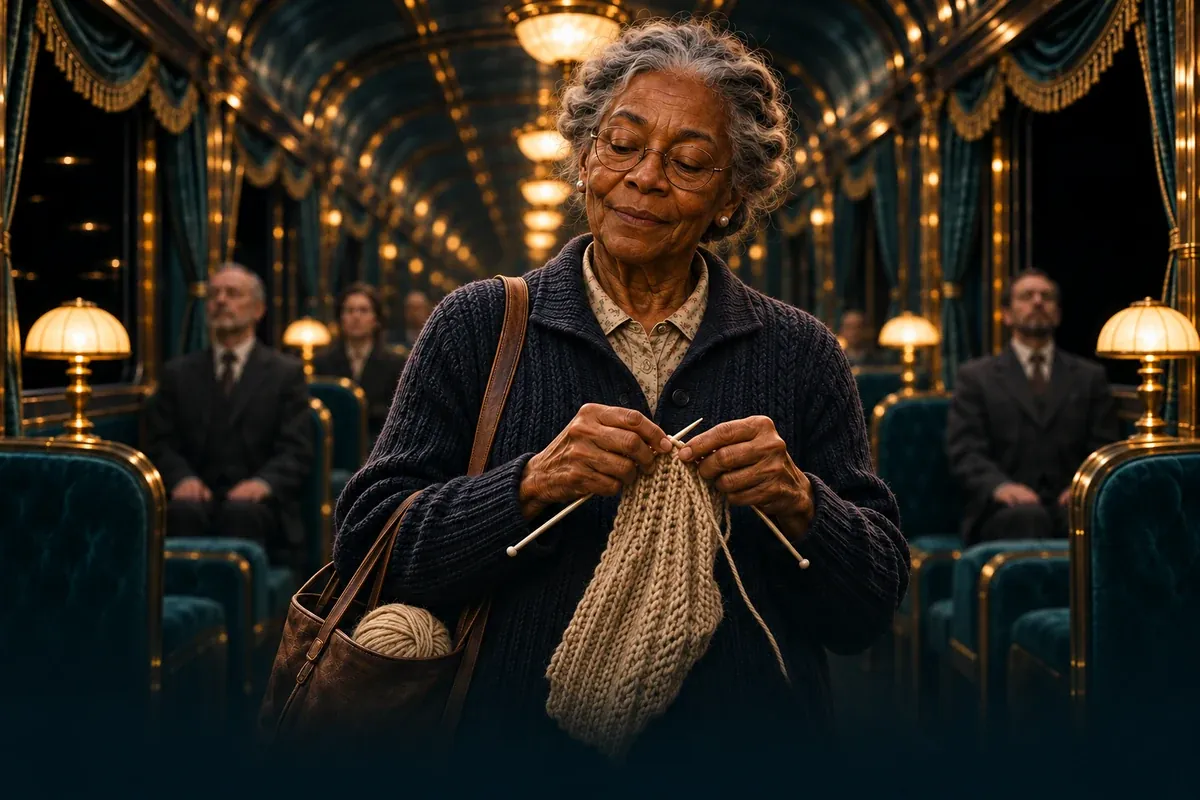
Pearl met us at the door. I hadn’t asked her to; she was simply there, knitting bag over one shoulder, as if the morning had been posted somewhere and she’d read the schedule. Up close in the doorway light she looked exactly like what she said she was, a retired bus driver, and also like something I didn’t have a word for yet — the way a tool looks when it’s been kept oiled long after the factory shut.
“Stay on my left,” she said. “Both of you. And whatever you hear in the middle rows — and you’ll hear it — you keep walking, because it’s already paid for.”
The Quiet Car was full. That was the first wrongness. Every seat taken, every passenger bolt upright, hands flat on knees, eyes forward, and not one ledger visible over any of them. My wrist read the whole car as a single entry:
CAR 84 — BULK SILENCE CONTRACT — PREPAID. TERM: [SEALED.]
Someone had rented the quiet. All of it. For all of them. The passengers’ faces were calm the way lobby fountains are calm, and as we walked — Pearl’s rubber soles, Yun’s sneakers, my regulation shoes learning humility — I saw that a thin green thread of text hung over each sleeper after all, almost too faint to read, one line each, like a name tag:
SOUND RIGHTS ASSIGNED.
They’d sold their noise. Their footsteps, their coughs, their words, their — I stopped walking, for one beat, over a woman whose faint line differed from the others by a single clause, and Pearl’s hand closed on my elbow like a bus rail and moved me on. SOUND RIGHTS ASSIGNED, the woman’s tag read, INCL. DREAMS.
The sound in the middle rows started at row eleven.
It was quiet — of course it was quiet, it was the only sound in the world that had paid its own way in that car — and it came from everywhere between rows eleven and fifteen, a low, continuous, muttering drone, like a radio two rooms away arguing in its sleep. Words almost resolved and declined to. It rose and fell on the rhythm of the rails. Beneath it, beneath the floor plates, something enormous breathed in time.
A Stowaway, Yun hand-signed. Big. Sleeping.
Under the car? I signed back.
Is the car now, Pearl signed, which is not a thing I wanted to see said in any language, and we walked on, on the beat, through the muttering, past rows of calm faces who had sold the rights to scream, and I kept my eyes forward and my mouth shut and my balance read 46.50 and the silence read my heart rate the whole way down, deciding, I am sure of it, whether it was billable.
It was Yun who nearly killed us, and he did it with a cold.
Row fourteen, two-thirds of the way through the muttering, I heard it before he did: the tiny involuntary hitch of a face making a decision. His eyes went wide. His hand flew to his nose. In the corner of my vision a bar began to assemble, a sound meter, a thin green line rising from AMBIENT.
Don’t, I signed. He signed back something I won’t write down.
The sneeze didn’t come out. It built. You could watch it build in the shoulders, in the watering eyes, a boy trying to hold a hurricane behind his teeth. The meter climbed. Fourteen decibel-seconds above ambient, fourteen Fare. Twenty. He’d have paid forty to let it go. He was seventeen, he owed nine thousand, and he was going to die of a sneeze.
Pearl didn’t turn around. She simply took her needles out of her bag, with no change of expression, and began to knit.
Click.
Click.
It was no louder than a clock. But on the meter, where the line had been climbing like a thermometer in a fever dream, the green stopped. It didn’t fall. It stopped, as if the Tariff had looked up from its ledger, found Pearl’s needles in its field of view, and pointedly declined to assess them.
Yun sneezed.
It was a monster, a once-a-decade sneeze with its own postal code. It rattled the luggage racks, and the ranks of silent faces didn’t so much as blink, having sold the right to blink at it, and under all of it, the whole time, Pearl’s needles clicked in a steady, unbothered rhythm that wrapped Yun’s disaster up like a coat. The meter lay flat across zero.
NO CHARGE.
Beneath us, something enormous breathed in. Then, slowly, breathed out, and went on sleeping.
Pearl did not look up from her knitting. “Bless you,” she said, at the volume of a thought, and I did the arithmetic. Either the Tariff could not bill what Pearl made, or it would not, and I did not know which of those two was worse.
The far vestibule took us like a held breath released. Yun folded in half, hands on knees, and said several words that would have cost him a semester’s tuition eighty meters earlier.
Yun straightened, wiped his eyes with a sleeve, and said, with enormous dignity, “That didn’t happen.”
“No,” I said. “You’ve never sneezed in your life.”
“Thank you.” He looked at Pearl’s back, at the needles, then at me, and some calculation I could actually watch went across his face. “You owe me one, Inspector.”
“I owe you nine thousand one hundred and fourteen. I’m working on it.”
It was the first time I said it out loud, and he didn’t flinch, which is how I knew he’d already put me in the column marked people who might. I’ve been trusted by better-connected men. I’ve never been trusted at a lower price.
Pearl checked the door seal behind us, unhurried.
“You wanted the Quiet Car kept in your head next to the ticket in your pocket,” she said. “That’s why Odile sent you, and for once she wasn’t wrong. Whatever’s running this line doesn’t just collect money, Inspector. It converts. Sound to Fare. Sleep to Fare. People to upholstery to salvage to citation revenue — “ she nodded at my wrist, and I felt the 110 commission in it like a stone “ — and it has been converting for longer than your tariff admits. You’ve read the front matter. Go on. Say the old name.”
“Meridian & Western.”
“Mm.” Her needles were out, I hadn’t seen her take them out, and they moved while she watched me, click, click, like a meter running backward. “I boarded in ‘95, by my own count. Thirty-one years. You’ve been polite about not asking, and I’m about to make being polite very hard.”
She set down her knitting, took out a flat tin that said lozenges and didn’t rattle like lozenges, and from under a layer of waxed paper she drew her ticket and held it out to me, face up, steady, the way you’d show a warrant.
Old card stock, soft at the corners. MERIDIAN & WESTERN. Punched with a validation pattern I didn’t know — seven holes, arranged like a constellation, nothing like the single centered shot that had killed Margaret Hollis. Date of issue: 1995. And where every ticket I’d seen on this train, living or salvaged, printed PASSENGER, Pearl Odum’s ticket said, in type pressed deep enough to read with a thumbnail:
CLASS: CREW (RETIRED).
“Now then,” Pearl said, picking the needles back up, click, click, while the Quiet Car muttered behind the glass and Yun looked from the ticket to her face and back like a man watching a card trick ruin his life. “You’ve got about sixty hours left on that wrist. Ask me the right question, Inspector, and I’ll decide how much of the answer you can afford.”