

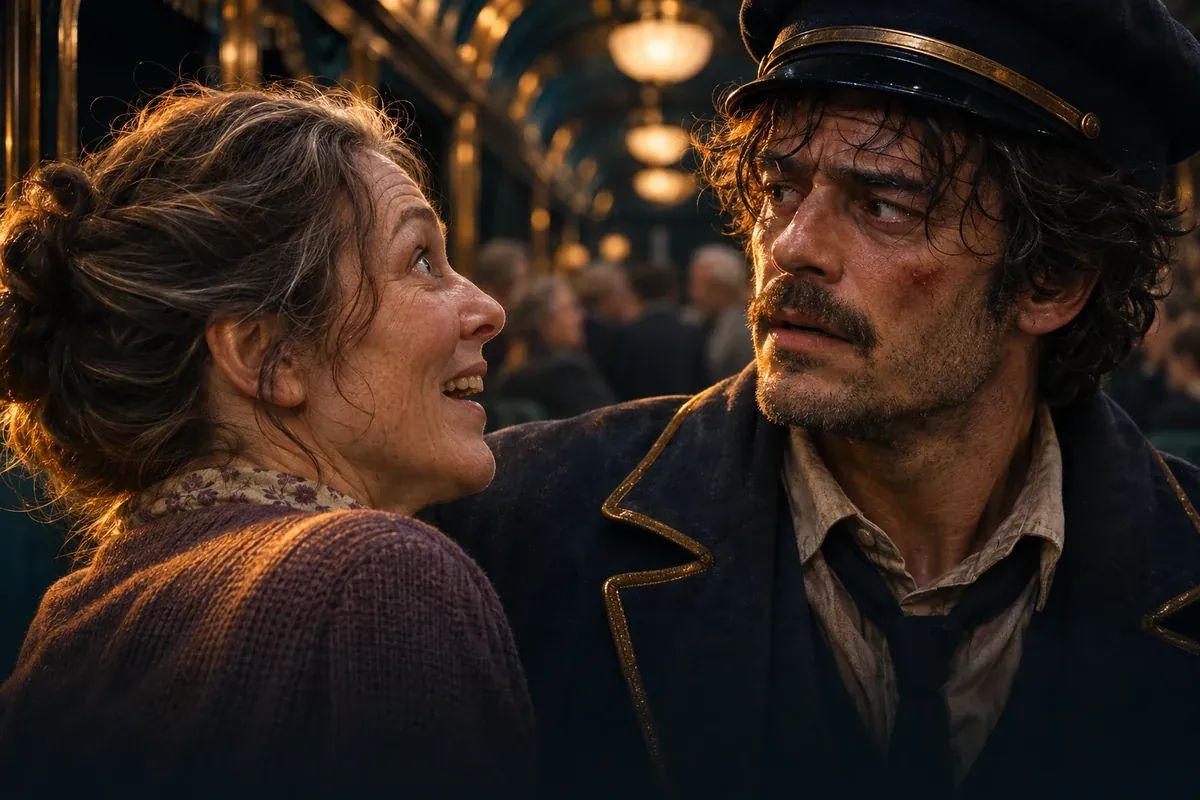
“Who’s paying for my grace period?” I asked, because it was the right question, and Pearl Odum smiled at it the way you smile at a good dog that has fetched the wrong stick.
“That’s not the question I told you to ask.”
“It’s the only one I’ve got.”
“Mm. Then I’ll answer the one underneath it.” Her needles didn’t stop. “Crew aren’t billed, Inspector. That’s the whole of my pension, that I’m not billed. I did thirty-one years on the old line, and when it merged into this one, somebody decided retired staff were an asset to be carried, not collected. So I sit, I knit, and the meter pretends I’m furniture.” Click, click. “The Porters wear punch-card faces because the Tariff needed hands. Hands have to come from somewhere. I’ll leave you to do that arithmetic. You’re good at it.”
“Pearl — “
“That’s what you can afford,” she said gently. “For now.”
That was the moment the train stopped.
I want to describe it correctly, because I’ve heard other people tell it since and they get it wrong: there was no scream of brakes. A train that has been running for fifteen hours at the speed of a held breath doesn’t brake. It simply ceases. The floor stopped being the floor of a moving thing and became the floor of a place, and every loose object on every rack in car 88 slid forward an inch in perfect unison and settled. A thermos rolled down the aisle. Nobody picked it up.
Then the lights went amber.
THE MERIDIAN LINE IS EXPERIENCING A DELAY, said the air, in the Authority’s crisp service-alert font, in fifty identical sentences hung over fifty heads. PASSENGERS ARE REMINDED THAT DELAYS ARE A NORMAL FEATURE OF THROUGH SERVICE.
“There aren’t any stations,” Yun whispered. “There’s no reason to stop.”
The windows answered for him.
They’d been black for fifteen hours, a clean unbothered black, the black of a thing that has nothing to say. Now there were shapes in it. They pressed up against the glass from outside the way fingertips press on a fogged window, pale and then paler, a dozen on each pane, then fifty, then more than I’m willing to put on the record. Not faces. Not quite hands. Smudges of light that remembered being hands, laying themselves against the glass in rows as if to feel the warmth coming off the car, and each one, as it touched, left a faint line of frost.
Someone started to scream, and then someone else started to count, which I’ve always found is the more frightening sound, because the person counting is trying to find the edge of the problem.
My wrist chimed. It was a tone I’d learned to dread in the way you learn to dread a text from a number you don’t recognize.
EMERGENCY AMENITIES ACTIVATED — CAR 88.
CABIN LIGHTING (EMERGENCY): 2.00/HR.
STRUCTURAL REASSURANCE: 1.00/HR.
HANDRAILS (SUPPLEMENTARY): 0.50/HR.
CALM ENVIRONMENT (AROMATIC, LAVENDER): 0.75/HR.
PASSENGERS MAY DECLINE ANY AMENITY BY WRITTEN NOTICE TO THE PORTER OF RECORD.
I read it, and I read the footnote again, and I understood the trap in the same instant that the car did. Of course they could decline. Decline the lights, in a car with shapes at the windows. Decline the handrails, in a car that had just stopped. They’d built the opt-out so the charge would hold up in court, and they’d priced it so nobody would use it. Panic pricing. It was the oldest play in transit, and I’d just never seen it executed by a building.
The balances started to bleed. On the hour, someone shrieked at the sight of their own number; by the half hour, Odile Brandt had wandered back through the connecting door in her cardigans with a gleam in her eye, selling reassurance seats: “Sit by me, dear, I’m already paying for the lights.” I watched a woman hand over twelve Fare for a spot on a bench. I watched Dev Raman, nineteen, feed the Schedule’s slot one Fare, then another, then another, asking when the train would move, and be told each time, “The Meridian Line is experiencing a delay.”
I opened the Tariff with my hands shaking, and I did the thing four years of fare enforcement had trained me for, which is to ignore the room, because the room is not the problem. The problem is on page two of a document nobody reads.
Section 3. Service Conditions. Clause 44.
WHERE A THROUGH SERVICE IS DELAYED BEYOND TWENTY (20) MINUTES IN THE AGGREGATE, EACH AFFECTED PASSENGER SHALL BE ENTITLED TO COMPENSATION AT THE RATE OF TEN PERCENT (10%) OF FARE PAID, PER TWENTY (20) MINUTES OF DELAY. CLAIMS SHALL BE FILED BY THE PASSENGER OR THE PASSENGER’S DESIGNATED REPRESENTATIVE.
Designated representative.
I had to read the line three times, and then I read it aloud, because it was the first time that morning anything in the Meridian Line had sounded like a door.
“Everybody,” I said, and the car didn’t hear me. I climbed up on the arm of a seat I wasn’t renting. “Everybody. EVERYBODY. Clause 44. You’re owed money.”
It took a moment. People do not, in my experience, believe good news when the windows are full of hands. But Pearl had stopped knitting, and Yun had gone to stand beside the seat, arms out, forming the kind of line a bouncer makes, and the car, one by one, turned toward the only man in it who’d been right twice that day, and lost once.
“I need a designation,” I said. “Each of you, hold your palm to my wrist. That names me your representative for the claim. It doesn’t cost anything. I checked.” I checked again; I read the line to the whole car until the whole car knew it. “And if I’m wrong, I’ll pay double. That’s the penalty for a failed dispute, and I’m the one filing.”
That got the first hand. It was Carol’s, the woman who’d been going to her niece’s recital. She pressed her palm to my wrist like a person taking a pulse, and my ledger printed: DESIGNATED REPRESENTATIVE — CAROL ANN WHITLOCK — CAR 88. Then Dev, then the man in the good coat, then the old man by the window, then an entire line of them down the aisle, thirty, forty, fifty hands laid on my wrist one after another, each leaving a small bright seal of consent, like a signature on a petition, until my left arm felt like it had been shaken by an entire congregation.
I filed.
I didn’t dress it up. I wrote the claim on the notebook page, pencil, in block letters, the way I’d file for a stranger at the fare gate: DELAY BEYOND TWENTY MINUTES IN THE AGGREGATE. FIFTY-TWO PASSENGERS, CAR 88, DESIGNATED. FILED UNDER CLAUSE 44. And because I’d learned that morning that the Tariff is a thing that reads what you say and not what you mean, I added the line that mattered most: DELAY MEASURED FROM THE STOPPAGE OF THE TRAIN AT 14:51 TO THE TIME OF THIS CLAIM.
I held my breath. The shapes at the windows leaned, as if listening.
[DELAY COMPENSATION — CLAUSE 44] CLAIM RECEIVED.
DELAY: 52 MINUTES. COMPENSATION: 10% OF FARE PAID PER 20 MINUTES, 2 PERIODS. ASSESSED: 20% OF FARE PAID.
ROUNDING APPLIED: TO THE NEAREST QUARTER-FARE, DOWNWARD.
CLAIM ALLOWED. REPRESENTATIVE CLASS: INSPECTOR, COACH SECTION. COMPENSATION CREDITED: 2,314 ACCOUNTS.
I don’t know what I expected. A klaxon. A gavel. What happened was a sound I knew from the far end of every transit hub in the country: the polite descending chime of a refund hitting a card.
It went down the car like a wave, and then it kept going. I felt it through the floor plates, car after car after car, a long chain of chimes receding toward the back of the train. I had filed for fifty-two people. The Tariff had read designated representative the way it reads everything, literally and with an appetite: my class, as of that morning, was Inspector of Coach, and it had paid out the whole section. Balances ticked up in the green type over every head, a little at a time, and people looked at them as if they’d forgotten what a number going the right way looked like.
And the windows cleared.
The pale hands lifted from the glass in a sort of slow exhale, fingertip by fingertip, and drew back into the black as if the delay had been a thing that needed to be paid for and had just been. The frost on the panes beaded and ran. The amber lights came up warm, and the Schedule said, in its stitched-together voice, THE MERIDIAN LINE THANKS YOU FOR YOUR PATIENCE, and under my feet the floor remembered how to move.
The hug was Carol’s, and it was a lot of hug. She had her whole arms around my neck, weeping, saying, “Nine Fare and eighty cents! I got nine eighty!” and the man in the good coat was laughing, and Dev Raman was dancing with a stranger, and Yun was standing straight with his hands in his pockets, trying to look like he hadn’t been about to cry, and from somewhere in the crowd someone started to clap — a slow, tired, genuine sound — and the car took it up.
It was at that exact moment, with a stranger’s face in my collar and fifty-two people shouting my name, that the Tariff decided to print my receipt.
[DELAY COMPENSATION] PRECEDENT ESTABLISHED: FIRST SUCCESSFUL SECTION-WIDE CLAIM.
STANDING: +70.
STANDING: 107. THRESHOLD 100 REACHED.
CLASS ADVANCEMENT: INSPECTOR — LEVEL 3.
CLAUSE UNLOCKED: [DELAY COMPENSATION — 44] (RETAINED).
It hit like a pressure drop in a closed car: every joint, a moment of weightlessness, the light of the thing flaring up my arm and out through Carol’s shoulder so that she shrieked, “Oh!”, and let go, and the whole car watched me glow in a cardigan-scented amber. Some people cheered louder, which I take as proof that humans will cheer anything with a glow.
I mention the timing because it is the Tariff’s single gift to the comic form. Nothing has ever leveled up quietly on that train. Every receipt prints while you have your arms full.
The thermos had rolled to my feet. I picked it up, unscrewed the cap, and it filled itself with the cheapest beverage currently on any menu, which was a hot dishwater the Galley called Americano. We founded the committee over it.
I don’t think anyone proposed it. I think it just happened, the way a line forms at a fountain. There was Yun, who knew the Tariff by feel. There was Pearl, with a tin of lozenges that were definitely not lozenges and an open offer of tea bags she’d been hoarding since ‘09. There was Carol, who wanted to know what we’d file next, and Dev, who wanted to know who’d tell him if the egg sandwich was ever going to be reasonable. And there was me, the unauthorized inspector with a stranger’s custody paperwork in his head, handing out paper cups of cheap water to people who’d just seen what a section’s worth of consent could do.
“We should have a name,” Carol said.
“The Standing Committee,” said Yun, with great dignity, and everybody turned to look at him. “Standing’s the stat. And nobody sits.”
“It’s a joke about the seats,” Dev said.
“It’s also a joke about the seats,” said Yun.
I laughed with them. I want to put that on the record, because of what came next: for about twenty minutes, in car 88, in the middle of the Dark, in a place where the air was billable, a handful of strangers drank bad coffee and felt, in the specific warm-and-stupid way you feel after any victory, that the rules had been bent.
Felix found me at the end of it.
I didn’t see him coming. The Porter slid along the wall of the vestibule like a page sliding into a file, face-card turned slightly away, and the holes in it had arranged themselves into a pattern I’d never seen him use: a downward curve, something like an apology, something like a man who had hoped to be wrong.
He held out a slip of card stock. No stamp. It had a header I knew from my old life, from the other side of the glass: PAYOUT SOURCE REPORT.
“I’m not supposed to give this to passengers,” Felix said, in his choir-of-one voice, very low. “It’s an internal document. I’m misfiling it. You’ll find, if anyone asks, that it was misfiled.”
“Felix, what is it?”
“Your claim was allowed, Inspector. It was credited. I would like you to understand that I am glad of it.” The holes shifted. “But I am obliged by the Tariff to tell you what a refund is made of. Nothing on this train is made of nothing.”
I read it standing up, in a vestibule, with a cup of dishwater going cold in my hand.
PAYOUT SOURCE: ADVANCE AGAINST FUTURE ACCOUNT BALANCES.
DISBURSEMENT: 2,314 ACCOUNTS, COACH SECTION (CARS 100-51).
TERMS: RECOVERABLE AT NEXT COLLECTIONS REVIEW, WITH INTEREST AT THE PREVAILING RATE (1.40x).
TOTAL ADVANCED: 22,774.00 FARE. TOTAL RECOVERABLE: 31,883.60 FARE.
NEXT COLLECTIONS REVIEW: TIMETABLE HEARING, FORTY-EIGHT (48) HOURS, ANNEX CAR 90.
I read it again. I read it as if reading it would let me edit it, which, I’d learned that morning, was the only way I’d ever fixed anything.
The refund wasn’t a refund. It was a loan. The Tariff had paid them back with money it intended to collect back, from the same ledgers, in two days, at forty percent interest. And I’d done it for them. Fifty-two hands had signed my wrist. Fifty-two designations, each one freely given, each one a perfectly valid consent to a debt I hadn’t read the footnote on, and the Tariff had stretched all of it across two thousand more people who’d never met me. I’d mortgaged the whole of Coach Section, with a smile, and a pencil, and the best intentions on the train.
“You didn’t know,” Felix said, quietly, to the floor. “That’s why I wanted to tell you. It’s the only part of this I’m permitted to choose.”
On the other side of the vestibule glass, fifty-two people were laughing and counting their money, and somewhere down the train, two thousand more were doing the same.
I folded the report, small, and put it in the pocket where the badge used to be.