

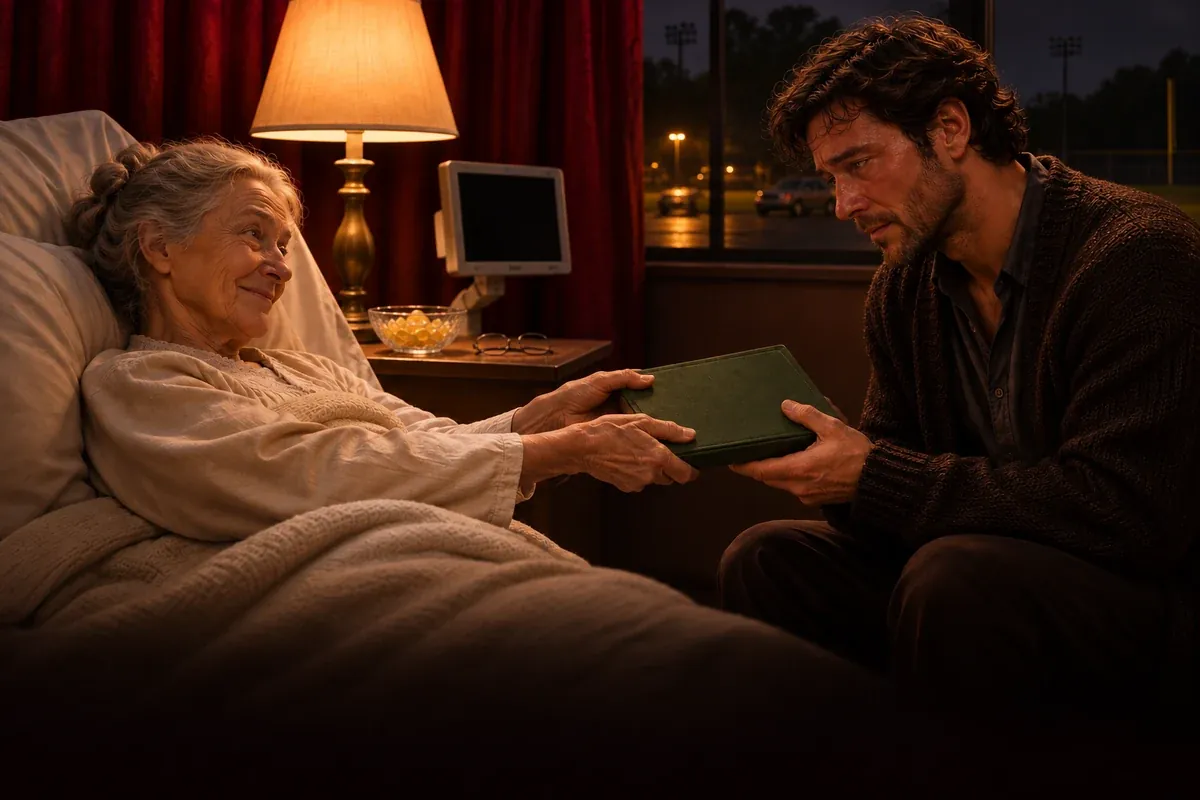
In nine years at St. Odile’s I have sat with 1,106 dying people, and every one of them handed me something to carry and never once asked where I put it. Tonight the thing is a green cloth scorebook, and the hand pressing it flat against my chest belongs to Sister Ruth Kowalczyk, who is seventy-four and about half an hour from dead and has never in her life let go of anything I wanted her to.
“Hold this,” she says.
“Sister, I came in here to tell you something.”
“Mm. You came in here to resign.”
I have a letter in the pocket of my cardigan. It is one paragraph long and I wrote it on a legal pad in the parking lot, in the car, with the dome light on. I haven’t shown it to anyone. I haven’t said the word out loud.
“Sorry,” I say. “That’s just true.”
“You apologize for facts, Reverend. It’s the most Methodist thing about you.” She coughs, and the cough goes on longer than she meant it to, and I reach for the cup with the bent straw. She waves it off. “Later. Hold the book first.”
It is 2:40 in the morning. Room Nine is at the east end of the second floor, the last door before the stairwell, and it has the best window in the building. I know this because the patients in the east rooms argue about it. From Room Nine you can see, over the parking lot and the chain-link and a strip of dead grass that belongs to nobody, the right-field foul pole of Cinder Field.
It is a yellow pole, forty feet tall, and at night with the park lights off it is just a line the dark is drawn along. During the season the whole east wing hears the crowd through the glass. People who are dying at St. Odile’s in July get a roar for their last night, free of charge. The town is proud of that. The town says nobody dies hard at St. Odile’s, and the town is right, and I have never once asked myself why.
The book is heavier than it looks. It is a Lamplighters scorebook, the old kind, cloth over board, and in gold letters on the cover, rubbed nearly to nothing, it says LAMPLIGHTERS 1971. The corners are soft. Ruth’s thumbs have worn two pale half-moons into the cloth where she held it. I take it from her, because she is not going to stop pushing until I do, and I set it on my knees.
“Don’t open it yet,” she says.
“I wasn’t going to.”
“You were. You’ve been looking at it for three weeks.”
This is true, too. It was on the nightstand for three weeks, under her rosary and her reading glasses and a bowl of cough drops she refused to let the aides move. I looked at it the way you look at a closed door in a house where somebody has died. I never touched it. Ruth watched me not touch it, and I watched her watch me, and neither of us said anything, which is the kind of conversation we have specialized in.
She was the chaplain of this hospice for forty-one years. I was hired nine years ago to be her second pair of hands, and then her knees gave out and her second pair of hands became the only pair, and then the board gave her the title of Chaplain Emerita and a room. Room Nine. She picked it herself.
She insisted that the door be kept locked when it wasn’t hers, and Dr. Lindqvist-Amadi, who has never lost an argument with a state inspector, lost this one with an eighty-one-pound nun. Nobody else has died in Room Nine in the nine years I’ve worked here. I noticed that in the way you notice a stain on a ceiling. You see it, and you choose not to see it.
“Ansel,” Ruth says.
She has never called me Ansel. It sounds like a stranger wearing my coat.
“I’m here,” I say.
“I know you are. That’s the one thing I never had to teach you.” She breathes, and I count it, because counting is a habit. Four seconds in, a gap, six out. The gap is getting longer. “Do you know what you do for a living?”
“I’m a chaplain.”
“You are a man who stands in a hallway and lets people hand him their coats.” Her eyes are the pale blue of an old dish. They are very much awake. “Eleven hundred coats. And you hang every one of them on a hook where nobody will ever look. Mm. That is not listening. I thought for a while it was. I let myself believe that.”
“I’ve held a lot of hands.”
“You’ve held a lot of hands and you’ve never once said anything to the people attached to them.” She says it gently. That is the worst part. She says it the way she would tell a man his scan was clear. “For the record, Reverend, I am not scolding you.
“I am telling you what I did to you. I gave you a job where you could be near the biggest things in the world and never have to say one of them. I was a coward in that way, and I thought it was kindness.”
“For the record” is mine. I use it before I say anything brave, which is not often. I have never heard her use it, and I have never told her I do.
“You had the same job for forty-one years,” I say.
“Yes.”
“Then it’s not a coat-hanging job.”
She looks at me for a long moment, and something on her face moves that I can’t read at all. “No,” she says. “It is not.”
The monitor on the wall is off. She asked for that in July, and for once Dr. Lindqvist-Amadi agreed without a fight. So there is nothing in Room Nine to tell me how much time she has except her breathing and the color in her fingernails. They are the color of cold wax. I have seen that color on a lot of fingers.
I look at the sill because I can’t look at her hands. Someone from the parish ladies brought lilies on Tuesday, a white bunch in a pickle jar, and the room smells the way a room smells when somebody has been kind in it and the kindness has started to turn.
Lilies, floor wax, the peppermint of her cough drops, my own coffee going cold on the tray, and under all of it the thin sweet chemical note that every hospice has and every hospice swears it doesn’t. I smell it all and I’ve smelled it for nine years. If you asked me to name the one sense I could not do the job without, I would not have said sight.
I would have said this one.
“Ansel,” she says. “Listen. There are some things you will not believe, and I haven’t time to prove them, so I’m going to say them in the order of how much they’ll hurt.”
“Sister.”
“The book is not a diary. It is not mine. It was given to me in 1983 by a man who is dead, and he got it from a woman who is dead, and so on back to a Lamplighters game in 1971 that I wasn’t at. It is full.” A breath. “It is not quite full. There is one line left. I am going to leave you the line.”
“I don’t understand.”
“No. You will.” Her mouth does a thing that would be a smile on someone with more air. “There are four hundred and twelve of them. Four hundred and eleven are other people’s. The last one is mine, and I’m going to spend it tonight, and I have been telling myself for three weeks that I would do it properly. A proper handoff. A speech. Mm. I wrote a speech. It’s in the drawer, and you will not read it, because it is bad.”
She laughs, and it costs her. The laugh turns into a long wet struggle in her chest, and I have the cup in my hand and the straw at her mouth before I know I’ve moved. This time she lets me. She drinks like a bird, one sip, and lies back against the pillow with her eyes shut.
“Eleven hundred and six,” she says.
I go still. “What?”
“That’s the number, isn’t it? I’ve been keeping my own count. You’ve told me that number twice, at two in the morning in the break room, when you thought I was asleep in the chair.” She opens one eye. “I was not asleep. I don’t sleep. It’s an old habit.
“And I never told you that I could do the same arithmetic. Forty-one years. I have sat with a few more than you. Mm. I lost the exact figure around the time I stopped being able to afford to remember it.”
“Why are you telling me this?”
“Because tonight I am your eleven hundred and seventh, and you should know you were not the only one counting.” Another breath, with a rattle in it now, and I look at the clock on the wall. 2:58. “I want you to understand something before I go. Every one of those eleven hundred people said something to you.
“Most of them said it with the last of their strength, and you wrote it nowhere. You heard it and you put it in the hallway. That was not a failure. That was a skill. It’s the only reason I could hand you this.”
“I don’t know what ‘this’ is.”
“No. I’m sorry.” For the first time in nine years I hear her apologize. “I’m sorry to do it like this. I wanted to have the time to tell you properly. I had a plan. But the people I wanted to avoid were quicker than I thought, and I had to be sure of tonight.”
“Which people?”
“Hold the book,” she says again.
I put both hands on it. The cloth is warm. I had not noticed. It is warm the way a cat is warm after it has left the sunny part of the floor, a stored warmth, and under my palms I feel something that is not the book. It is a slow weight, like a sleeper’s breathing, in the board of the cover.
“Good,” says Ruth. “Now do not drop it. And whatever happens, whatever it feels like, do not let go, Reverend. Hold what I give you. Mm. You are very, very good at that.”
I want to say something to her. I have said the right thing to a thousand people in this chair. I say nothing now.
I look at an old woman with her rosary in her hand and the lights of the parking lot laid in stripes across her blanket, and I have all of it ready, the words, the soft voice, the spare practiced hand on her wrist, and none of it will come.
I think, with great clarity, that she is right about me. I think it is a hell of a time to find out.
“Ruth,” I say.
“Mm.”
“Is there someone I should call? Family. Anyone. You’ve never—”
“Ansel.” She turns her head on the pillow and looks right at me, and the pale eyes are gentle and amused and entirely unafraid. “I have one brother. I haven’t spoken to him in thirty years. He is not a man who answers the telephone. Do not call him. If he comes, he’ll come on his own, and he will be sorry, and you will let him in.”
“Sister—”
“There. That’s all of it.” She closes her eyes. “I am so tired. Isn’t that something? After all this. I thought it would feel like a door. It feels like a Sunday afternoon.”
She breathes in. I count, and I count the gap, and the gap is nine seconds. I put my hand on her wrist. The pulse is a thread somebody is pulling very slowly out of a hem.
“Hold it,” she says, so quietly I almost lose it. “Hold it, and don’t eat it.”
“Don’t what?”
She breathes out.
It is a long breath, and I think it is only a breath, the last long one I have heard a hundred times, the soft dropping of a body that has decided. But this one does not end where the others end. It goes on past her lips and I see it.
I can’t make myself believe I do, but I see it, in the dim light from the parking lot: a thread of something warm and pale, the color of a streetlight through a window, running out of her mouth the way smoke runs out of a candle someone has just pinched. It doesn’t rise. It comes toward me.
It moves along the blanket across the back of my hand and finds the book under my fingers and goes into the green cloth the way water goes into a sponge.
The book gets heavier.
I don’t have a better way to say it. It was heavy like a book and now it is heavy like a baby, the specific dead weight of something that was light a moment ago and has been given a life. My arms tremble. I almost let go, and I hear her say hold it, and I don’t.
Her chest does not rise. I wait through the count, the gap, nine seconds, twelve, twenty. I take my fingers off her wrist and I put two of them under her jaw and there is nothing there either. 3:07 in the morning. I say the time aloud because that is what you do, to the room and the wall and the foul pole outside, so the death is on the record. “Sister Ruth Kowalczyk. Three-oh-seven.”
Nothing answers. Nothing ever does.
The book lies on my knees, humming faintly against my thighs, and I look down at it. The cover has come open on its own, a few inches, like a mouth. I don’t touch it. I look at the blanket and the hand that was holding it and the rosary, and I do what I always do. I sit there for a minute with her, saying nothing, because you give the dead a minute. You give them the first minute no matter what.
Then I realize what is wrong with the room.
I’ve been sitting here for a full minute and I haven’t smelled it. I breathe in through my nose, hard, the way you do when you think you’ve got a cold. Nothing. I lean over the sill and put my face right down against the pickle jar, the white petals brushing my cheek, and breathe again. It is like breathing in the picture of a flower.
I can tell that the lilies are there by the shape of the cold air coming off them, and the wetness of the cut stems, and nothing else. No sweetness. No floor wax. No peppermint. The cold coffee on the tray might as well be a cup of dark paint. I pick up the cough drop wrapper on her nightstand and put it under my nose, and it is cellophane and nothing.
I stand up very carefully, with the book in both arms, and I understand that I am standing in the middle of the one room in this building where I have sat with the most dying people and I cannot smell a single thing in it.
The door opens, and the night nurse comes in, Lonnie Mapes, a big gentle man who has worked this wing since before I did. He is carrying the form on the clipboard and he stops when he sees my face. “Oh, Reverend. When?”
“Three-oh-seven.”
“Aw, Sister.” He sets the clipboard down and puts one hand over his mouth. He takes the death hard every time. It’s the only reason I trust him. Then he sniffs, and makes a face. “Somebody’s been smoking in here.”
“No.”
“You smell that? Like something burning.”
I breathe in. I give it everything I have. There is nothing at all. “No,” I say. “I don’t smell anything.”
Lonnie looks at me, and at the green book in my arms, and something goes across his face and is gone. He is not a stupid man. He is a man who has worked at St. Odile’s for twenty years, where nobody dies hard. “That’s a nice old book,” he says, in a very careful voice. “Sister’s?”
“She wanted me to have it.”
“Then you ought to keep it.” He lifts the clipboard again. His hands are not quite steady. “I’ll call Dr. Lindqvist-Amadi. You go sit down, Reverend. You look like you’ve seen a ghost.”
“I’d say I haven’t,” I say. “But I’m starting to doubt it.”
He laughs, one short note, and goes out to the hall, and I hear him murmuring into the desk phone. I go to the window. The parking lot is empty and orange under the sodium lights. Beyond it the field is dark and, on the far side, so is the yellow foul pole. I stand there for a while with the weight on my arms and the new silence in the front of my face.
There is a chair by the bed, the one I sat in a hundred nights while Ruth slept or didn’t, and I sit in it. The door is shut. The book is open a hand’s width on my knees, and the heat of it has gone up my forearms into my elbows.
I should not open it. She told me not to, and then she told me to hold it, and I am a man who does what the dying tell him because it is the only authority I have ever believed in.
I open it.
The first page is ruled in faint green lines, like all the scorebooks my father used to keep, a grid of small squares for innings and a column down the left side for the players. Only here the squares are not full of pitches and putouts.
Every line has a name, written in a dark upright hand I have seen on a thousand prayer cards. After each name comes a room number and a date, then a pair of initials, then a row of small symbols: K, F8, 6-4-3, E5, PPD. Scorekeeping shorthand. Every baseball kid learned it once. I have not read it since I was nine.
I run my finger down the page, and my finger leaves a trail of faint gold, like a snail on a window.
The lines are numbered down the margin in the same small hand. 2, 3, 4. I turn the page and the numbers go on. 61. 112. I don’t read the names. I can’t make myself read them. I turn pages the way you turn them on a bad test, looking for the end, and I find it.
Line 412, three-quarters of the way down a page in the back, written in ink that is still wet. It is only a name and a place, and the name is hers: Kowalczyk, R., Room Nine, 3:07, and the initials H.P., and a row of notation I can’t read. The ink shines. It is drying while I look at it. She was a woman who kept excellent records.
Below it there is a line with a number and nothing else. 413. The square beside it is empty.
I go back to the start because I can’t help it. I put my thumb on line one.
I know the name before I have read it. I would know it if it were written in a language I had never seen. It sits at the top of the first page, in a handwriting that is not Ruth’s, a slanting hurried hand, the writing of someone filling in a form in a hurry with a bad pen. After it comes Room Nine. After that, a date: the ninth of September, 2000. Then two initials, A.B., that I do not let myself read yet.
Raymond Boyd.
My father died on the tenth of October, 1999. He drove a rented box truck off the Route 2 bridge in the rain, and he was alone in it, and the casket at the funeral was closed. I was nine. Cal was fourteen.
I stood in the first pew in a clip-on tie, and my brother stood next to me with his jaw working like he was chewing nails, and when the funeral lunch was over and the church ladies had gone into the kitchen, Cal came and stood over me and asked if Dad had said anything. Anything at all. At the end.
On the phone, at breakfast, anything.
What Dad said at breakfast, the morning he died, was that there was no more milk and I should eat the dry cereal and not complain. That was the last thing he said to me.
“He said to tell you that you were right,” I told my brother. I was nine years old and I looked him in the eye. “He said, tell Cal he was right.”
I have never told that to anyone. I haven’t said it since. Cal went outside to the church parking lot and I watched him through the window, standing there, with his head down, for a very long time. He has been, in some invisible way, a man who believed it for twenty-seven years. And I have been the man who knew.
I read the date again, September 2000, eleven months after the funeral. I read the room number, Nine. My father’s handwriting, if it is his, has put his own name in a book in the room where I am sitting, on a night eleven months after I buried him.
The book hums against my knees. Out in the hall, I hear a door, and Dr. Lindqvist-Amadi’s clogs on the linoleum, and her voice saying, in the tone she uses for the worst nights, “Friend, I’ve got it. Let me see her.”
I close the cover and put both arms around the book. Under my palms it hums once, low and steady, the way a thing hums when it has heard its name.