

By half past six in the morning I have burned a piece of toast to charcoal and not known it.
I find out because the smoke detector over my refrigerator starts to scream, and I stand in my own kitchen with a butter knife in one hand and the green scorebook under my other arm, looking at a toaster that is pouring a thin gray rope toward the ceiling. The kitchen is a rectangle above a laundromat on Perch Street.
In nine years I have never burned anything in it. I wave a dish towel at the alarm until it quits, and then I open the window, and then I stand there feeling stupid, because I can see the smoke and I cannot smell it. It is like watching a fire on television with the sound off.
“Huh,” I say. It is my brother’s word. I have no idea where I got it.
The toast is a black square with a pale edge. I scrape it into the sink. Then, because I am a man who needs to do the next ordinary thing, I turn the knob on the stove to put the kettle on, and the burner clicks, and clicks again, and doesn’t catch.
I stand there for a while, listening to it click.
Somebody is knocking on the apartment door, hard, with the flat of a fist. I open it on the chain. It’s Mr. Okafor from the second floor, in an undershirt and slippers, his face the color of dishwater. “Boyd,” he says, “do you not smell that? The whole stairwell’s gas.”
“Sorry,” I say. “I—”
He pushes past me and slams the knob off with one flat motion, and shoves the window up another six inches, and turns on me with a face I have only seen on a husband in a waiting room. “You could have blown the building,” he says. “Are you sick? Are you drunk?”
“A little of both,” I say, “I think.” And then, because the man is seventy and shaking: “Sorry. That’s just true. I had a long night.”
He looks at my face. He looks at the book. He is not a man who asks, and he puts the stove knob in his pocket and goes downstairs, and I hear him tell somebody in the laundromat that Boyd upstairs has finally cracked. I think that is a fair assessment.
I do not go back to bed.
Here is what I have worked out since 3:07. I did not imagine the thread of light. I did not imagine the weight.
The book has not stopped being warm, and when I open it at the first page and hold my finger over a name, a little of that gold comes up under the skin of my finger like a bruise in reverse. I have been awake for twenty-six hours. I do not feel tired.
I feel the way you feel when you have been given a very large animal and nobody has told you what it eats.
The other thing I have worked out is that the smell is gone and it is not coming back on its own. I tried the coffee. I tried a lemon from the bottom drawer, cut open and held to my face.
I tried the bottle of bleach under the sink, which I know in my body is a smell that makes your eyes water, and my eyes did not water. What I got was a faint pressure behind my forehead, the way you can feel a sneeze that will not come.
Dr. Lindqvist-Amadi found me in the hallway outside Room Nine at five.
She had put her coat on over her scrubs, and her gray braid had come half out of its clip, and she had the look she gets at the end of a very bad night, calm and furious and entirely functional, like a woman who has decided to be a wall.
She did not ask what I was carrying. She looked at the green cloth and she looked at my face, and I watched her decide not to know.
“Funeral home’s coming at seven,” she said. “Friend, go home. Don’t sign anything. Don’t come in today. Ruth left you in charge of nothing, and I mean that kindly.”
“Neva, I wrote a letter.”
“I’m sure you did.” She put one hand flat on my sleeve. “Don’t give it to me today. I’d have to read it.” She looked at the door of Room Nine, and I saw her take out her key, and lock it, and put the key in her breast pocket and button the pocket over. “She asked me for that,” she said, without looking at me. “Forty-one years of locking a door. I never asked what for.”
I said nothing. I have spent my life learning to say nothing, and it has never once felt like an accomplishment.
So now it is a quarter to seven on a Saturday, and I am in my kitchen, and I do not feel like a man who is going to do the sensible thing. I put the book in a canvas grocery bag from the hardware store and go out.
I intend to walk to the river. I end up at the ballpark.
I don’t decide to. Port Ardent is a town of nineteen thousand, a gray lake port that has been very slowly getting smaller since before I was born, and every road in it eventually runs into either the water or the Lamplighters. My feet take Perch to Fifth and Fifth to Ballast, and then there is the chain-link, and past it the long cinder-colored back wall of Cinder Field with its faded mural of a man holding a lantern, and St. Odile’s behind it.
From the street you can see the flat brick roof of the hospice just over the right-field fence, so close that the center-fielder, in a tight game, can look up and see the east wing windows. I have walked past it every day for nine years. This morning, for the first time, I notice that it is not a coincidence.
The gate on the service lane is open. A white pickup is parked on the grass beyond it, its bed full of rakes and a drag mat. I walk through, and nobody stops me, and I come out at the end of the visitors’ tunnel into the low early light of the field.
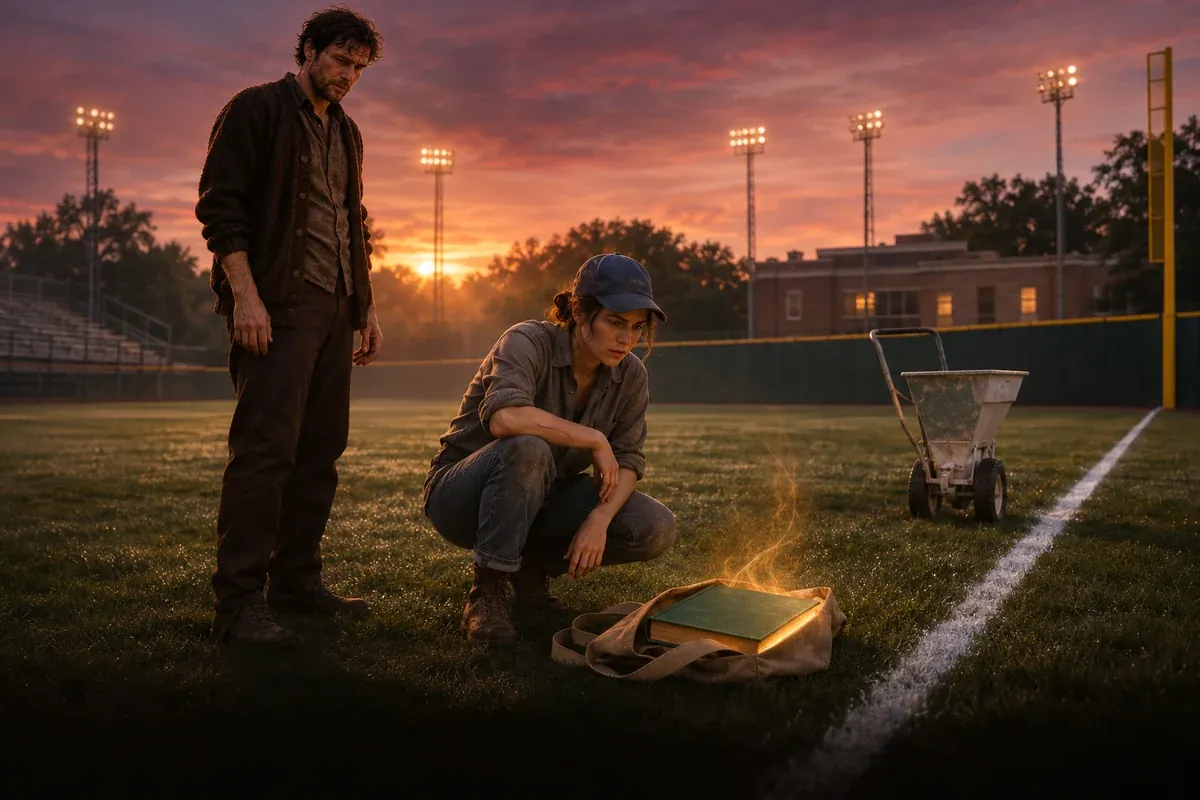
The park lights are on.
I stop. It is a clear morning, the first pale orange of the sun just reaching the top of the left-field wall, and all six light towers are lit. In the daylight you wouldn’t notice. The big white lamps look dim and thin, like candles at a noon wedding.
But they are on, and I know the Lamplighters’ grounds crew is careful about the power bill, and I know that when I looked out of Room Nine at three this morning all six towers were dark.
“They don’t switch on for you,” says a woman’s voice. “They switch on for the book.”
She is standing about thirty feet down the right-field line with her back to me, pushing a chalk machine, one of those small wheeled carts with a hopper and a thin white stripe coming out behind it.
Her hair is shoved under a blue cap and she wears a gray Lamplighters work shirt, jeans that have gone white at the knee, and boots coated to the ankle in infield clay. She has not turned around.
She finishes the line to the foul pole, a clean straight stripe forty yards long, and only then does she let go of the handle, and straighten, and look at me over her shoulder.
“You can come down,” she says. “You’re making the pitcher’s mound nervous.”
I go down. The grass is wet with dew and my shoes darken. When I am close enough to see her face, I see a woman about my age with a flat tired mouth and dark, quick eyes, and a long white scar along one forearm that she has made no effort to hide. She looks at me, and then at the canvas bag, and her eyes stay on the bag a half second longer than a person’s would.
“Mari Tkach,” she says. “I run the night chalk. You’re the chaplain from the hospice. Boyd. Ruth’s guy.”
“How do you know that?”
“I’ve been chalking this line for eleven years and you’ve walked past the fence every day of them with your head down. Small town.” She wipes her hand on her jeans and does not offer it. “She’s dead, isn’t she. It’s all over you.”
“Three-oh-seven this morning.”
“I’m sorry.” She says it quickly, and then, in a lower voice, she says it again, and I hear that the second one is the real one. She looks away at the foul pole. “She used to bring us coffee after the last out of night games. Never stayed for the game, just the coffee. Every single home stand, forty-one years. I thought she’d outlast the stadium.” A pause. “Is that it? In the bag?”
“Is what it?”
“Mr. Boyd.” She says it patiently, like she is talking to a toddler holding a live wire. “That is the glow of a League book coming out of a hardware store bag in broad daylight. Set it down before you start a rumor.”
I do. I put it on the grass, and the cloth is giving off a faint amber shimmer, a heat haze, and I realize that I have been seeing it all morning and that I assumed it was my own tired eyes. Mari crouches and doesn’t touch it.
She looks at the cover for a long moment, and her mouth moves very slightly. I hear her breathe three words, under it, in a flat sing-song. “One, two, three,” she says. “Four.” She stops. She looks up at me with a perfectly normal face. “Sorry. Habit.”
“You count.”
“When I’m thinking.”
“Mari. What is this?”
She is quiet. She stands, wipes her hands, and looks out across the empty field at the six pale towers. Her face goes through something. I’ve watched people decide whether to tell a family the truth about a prognosis, and I know the look. Then she turns to me with a bland, bright expression that looks very practiced, and says, “Okay. You get six lines. Not seven. I don’t do seven.”
“Six lines of what?”
“The lecture. You’re going to want to sit down, but you can’t, because the dew’s heavy, so stand.” She holds up one finger. “One. Every minor-league park in this country sits on a seam, a place where the world is thin. This is one. There are thirty-two in the League, and we are the smallest.”
A second finger. “Two. The people in the bleachers, the Crowd, a few thousand strangers all hoping for the same thing at the same time, they put out a kind of power. Weak but clean. Some of us can draw it in with the chalk. That’s what I do. That’s the whole job.”
“Mari—”
“Three. We’re called players. The ranks are innings. One to nine, and after nine, extra innings, which is a rumor. Nothing before the Fifth counts. Below that you’re a hobbyist.”
She holds up four fingers. “Four. People who are dying have something that doesn’t leave with them. All the things they didn’t say. We call it the Remainder. It’s heavy and it’s fresh and it’s, uh. Edible.”
“Edible.”
“Five. Scouts eat them. A Scout sits in the stands on a game night and uses the roar like a fishing net, and he pulls Remainders out of anyone dying within a mile of the park. Hospitals, nursing homes. A hospice. The dead go very quiet afterward. Peaceful. Empty.” She looks at me, and then at the brick roof beyond the fence. “You’ve noticed how peaceful it is.”
I have a very long, cold moment in which I notice a number of things at once. I notice the hospice reputation, the roar through the glass, the nine years of faces smoothing out at the end like a sheet being pulled flat. I notice that I have written the word peaceful on a thousand forms.
“Six,” says Mari, and her voice has gone a little tight. “Ruth did something else. She held them instead. She wasn’t supposed to be able to. It’s called Closing, and I don’t know the technique, nobody under a Seventh does, but that book is what she held. She sealed every one of them as a line, so they couldn’t be eaten. Four hundred and some.”
“Four hundred and twelve.”
“Then she finished. Good for her.” Mari blows out a breath. “That’s six. That’s all I give out before coffee.”
“That’s not a lecture. That’s a hostage situation.”
“Yeah,” she says, and almost smiles. “I get that a lot.”
I look at the book on the grass, and I try to put the six lines in any kind of order that would let me stand up under them. I can’t. “My sense of smell is gone,” I say. It is the only part of the conversation I am sure about. “It went when she died. At 3:07. I don’t get it.”
“You’ve got an open seal.”
“A what?”
“She opened her own.” Mari’s voice has turned careful again, flat, like she is reading the information off a card. “Line 412. Hers. That’s the one that’s open. It’s the one you’re carrying.”
“It cost me my nose.”
“It costs you whatever the dead person lived by,” she says. “I don’t know what Ruth lived by. I wasn’t close enough.”
I do. I know it in the way you know the answer to a riddle that has been sitting in front of you for nine years. Ruth could walk into a room and know who was lying. She did it by sniffing the air.
She said it was incense, or old habit, or the way she was trained in the convent, but she would stand in the doorway of a patient’s room with her head cocked and her eyes half closed, and then she would turn to me and say, in that dry voice, mm, the son isn’t coming. And the son did not come. Every time.
A nun who read lies off incense and cold rooms and the sweat on a daughter’s collar. She lived by her nose.
“Smell,” I say.
“Okay. Then that.”
“Does it come back?”
“You’d have to read the book.” Mari takes a step back. She pushes the chalk cart half an inch to one side, a nervous little gesture. “I’m not supposed to touch one. I’ve never seen one, actually.”
“You said you’d never seen one.”
“I said I’d never touched one.”
“No, you said you’d never seen—”
“Mr. Boyd.” Her face is entirely pleasant. “It’s barely seven in the morning, and I’ve been up since nine last night, and you’ve been up since I don’t know when. Go read the book.”
I look at her for a second longer than I should. I’m the wrong person to do it. I have no instrument, no nose, and a lifetime of training in not noticing what people leave out of their sentences. She smiles at me, a wide easy smile, and I notice only that it comes slightly too fast.
I pick up the bag. I thank her. I don’t know yet what for.
“There’s a thing,” she says. I stop. She isn’t looking at me. She is looking at the flat blue sky over the upper deck, and her voice has gone casual in a way that is not casual at all. “Tonight’s a home game. Six-oh-five first pitch. There’s a Scout who works the stands. He works Section 112, mostly, because it’s close to the hospice wall, and the wind carries the roar that way. You can’t miss him. Usher’s vest. Hums.”
“Hums?”
“The first six notes of the song. You know the song.” She sings them, flat. Take me out to the ball game. “Off key. He does it before he does anything he’s going to regret.”
“What’s his name?”
“Gideon,” she says. “Everybody loves him.”
She puts her hand on the cart and pushes. The chalk line starts to unroll again behind her, a clean white stripe on the green. She does not look back, and I stand watching her go down the line until she is a gray shirt and a blue cap against the light, and I can’t hear her counting from here. I can see her lips move.
I walk to a seat in the first row behind the visitors’ dugout, because my legs have gone out, and I sit. The whole field is laid out in front of me in the early sun. The six pale towers. The dewy infield. The chalk stripe running to the foul pole, and past the pole the brown brick of the hospice with its east windows catching the first light, and in the second window from the end, a square of curtain that is Room Nine.
I open the scorebook on my knees. Under the sun the gold on the lines is almost invisible, a faint oily sheen like a thumbprint on glass. I turn to the very front, past the first ruled page, to the inside of the cover that I did not look at last night, and I find the endpaper.
There is handwriting there. It is small and upright and I know it better than my own, from forty prayer cards a month, from the pad on her nightstand, from the note she stuck to my locker on my first day that said Welcome. Remember to eat. It is in blue ink, and it looks fresh.
Reverend,
You will have asked by now what it costs. I wanted to put this in a drawer for you and give you three weeks to work up to it, and the Commissioner decided otherwise. So, short.
A seal is a promise someone died holding. When you open one, you pay for it with the sense that person lived by. A cook pays in taste. A musician pays in her ears. This is not a punishment. It is the only way a living body can carry what a dead one meant.
When you deliver the words, to the person they were for, in the dead person’s own voice, which you will not be able to stop, the sense comes back. Changed, but it comes back. Mostly.
Do not open another seal until you have been taught how. Do not open a seal for the sake of the book. Do not trust anyone who counts out loud.
I am sorry to leave you so little, and I am not sorry at all.
R.
I read it twice. Then I read the word Mostly in the sentence above, which she has underlined. And while I am looking at it, the ink under the line goes a shade darker, the way it does when someone presses down, and a second line appears under the first, a little shakier, as if a hand that was no longer there had thought better of it and gone over the word again.
Mostly. Underlined twice.
Down at the end of the right-field line the chalk machine has stopped. Mari is standing at the foul pole, one hand on the yellow steel, looking up at the east wing of the hospice. She is counting again; I can see it in her shoulders.
I look at the schedule posted on the dugout wall, faded and curling, next to a flyer for Dollar Dog Night. I read it twice. Saturday, August 29. Port Ardent Lamplighters. First pitch 6:05 p.m. And below it, in the small italic type that every Single-A park prints for the sake of old people and fans of tradition: Seventh-inning stretch approximately 8:41.
I sit there in the cold bright morning with the book open on my knees. I do not hear the crowd that is not yet there. I try, and fail, to smell the grass.