

The first rule I make for myself is that I will open exactly one seal, and I will make it the one I have a reason for.
I make the rule at four in the afternoon on my kitchen floor, with the stove knob gone and the window open and the green scorebook across my knees like a tray. I have slept for ninety minutes and woken with the book on my chest, warm as a sleeping dog.
I have decided, on no evidence, that Ruth’s rule against opening seals was a rule about opening them stupidly. I have also decided that I would rather be a man who tests a theory than a man who sits in a kitchen going slowly mad. The theory is in the endpaper in blue ink. Deliver the words, and the sense comes back. Mostly.
I need to know what mostly means before I decide what to do about my nose.
So I turn pages. I don’t look for the old ones, the lines in other handwriting, the names that go back to the seventies. I turn from the back, from 412 toward the front, reading only what the gold lets me read, until a name stops my finger.
Line 388. Farrow, L. Room Four. August 7. T.F.
I know Lucille Farrow.
She was eighty-four, a small gray bird of a woman with a voice like gravel in a coffee can, and for twenty-two years she cooked at the Anchor Diner on Ballast Street. She came to us in July with a pancreas that had given up, and she was in Room Four for nineteen days, and she cursed the hospice cooking from the first to the last. I sat with her on the night of August 7.
It was one of the long nights, a Thursday, with the east wing windows open and a day game’s worth of crowd noise still hanging around from the afternoon. I remember her hand, which was dry and hot and quick. I remember she said, “Reverend, you tell my son,” and I said, “Tell him what, Lucille?” and she said, “You tell him,” and the morphine took her under in the middle of the sentence.
She died on the eighth, at four in the afternoon, while I was at a funeral across town. I never told her son anything. It was one of the eleven hundred coats. I hung it up in the hall.
I told myself a woman on morphine in the small hours says a lot of things, and her son would call if he wanted to know. He didn’t call. I never called him.
For three weeks I have walked past her empty bed, in my head, whenever I thought about it, and I thought about it more than I would say.
Below the name and date there is a row of notation. I read it the way I read it when I was nine, with my father’s hand on my shoulder on a bleacher, learning the shorthand. F9: a fly ball to right field, caught. Then 6-3: ground ball, shortstop to first. Then a symbol like a small box with a line through it that I do not remember at all.
I think about right field, which is where the hospice sits. I think about first base, which is where a runner would be if you wanted a runner to be safe. And I think about the thing my father told me when I was nine, that a score sheet is a story with all the adjectives taken out.
Under the notation, in Ruth’s hand, two words: Section 112.
I close the book.
“Okay,” I say, aloud, to a kitchen with nobody in it. “One.”
Cinder Field at six-thirty on a Saturday night in the last week of August is the closest thing this town has to a religion, and I have never been a member. I walk through the main gate with a ticket Mari had left for me at will-call.
She did it without a word, a plain white envelope with my name on it in block capitals, and I don’t think about it until I’m in the concourse and the line of people on either side of me is eating something fried. The park smells like popcorn and cut grass and wet concrete, I assume. I get none of it.
I get the sight of a thousand people queuing, and the sound, and an odd flat feeling, like walking through a painting of a ballpark.
Section 112 is down the third-base line, a short walk from the hospice fence. The concession window at the top of the aisle has a hand-lettered sign over it, and it says FARROW’S CHILI WINDOW, and under it, in smaller paint, SINCE 1996.
The man behind the counter is fifty-two, with a heavy brow and a hairnet that does not suit him and forearms like a man who carries trays for a living. He is ladling beans into a paper boat with a motion so practiced it looks bored. He looks up. His eyes pass over me and then come back.
“You’re the chaplain,” says Teddy Farrow.
“Ansel Boyd. I was with your mother.”
“I know who you are.” He puts the ladle down. “I’m sorry. I didn’t mean to sound like that. Everybody up there was good to her. I never said thanks. I couldn’t.”
He wipes his hand on his apron and holds it out over the counter, and I take it, and it is dry and hot and very quick, and I know that hand. It held mine on the night of August 7. “You want a chili dog?
“On the house. Mom’d haunt me.”
“I’ll take one.”
I don’t know why I say it. I think I want one more ordinary thing before I do something that isn’t. He builds it with the same slow bored motion, bun, dog, a long ladle of dark beans, a handful of raw onions, a stripe of mustard. He puts it in my hand and I take a bite.
It is the last thing I will taste for a while. I know it in the way you know you are looking at a face for the last time. The chili is thick and hot, the onion bites back, there is something sweet underneath, molasses, a little cinnamon, an oddly old-fashioned note I can’t name. It’s extremely good. It tastes like a kitchen with the radio on.
“That’s the recipe,” says Teddy. He is watching me. “Her recipe. Fifty years. I make it every day. I haven’t changed a thing.”
“It’s good.”
“It’s not right.” He says it flatly. “I measure it exactly. She never wrote it down. I watched her for twenty years. Every day for thirty years I get it wrong, and I don’t know what it is. She said I’d figure it out. She said it was in me.” He catches himself and laughs, a short unhappy bark, and picks up a rag. “Listen to me. You want a drink? You got a seat?”
“Mr. Farrow,” I say, “do you have a minute?”
“It’s the second inning. I’ve got a line to the corner.”
“Then at the stretch.”
He looks at me. I have a very bad moment in which I see that this man, who has the same hands as his mother, is not a fool, and he is looking at a hospice chaplain who has come to his work window with a canvas bag. “She said something to you,” he says slowly. “The last night. Didn’t she.”
“She started to.”
“And you didn’t tell me.”
“Sorry,” I say. “That’s just true.”
For a long moment Teddy Farrow looks at me with no expression whatever. Then he says, “Eight-forty. I’ll have Raelynn cover the window. Back stairs. Don’t eat that in front of the other customers; it’ll make them jealous.”
I take the dog back to my seat and eat what is left of it, in the third-base stands, row twelve. I watch the Lamplighters give up two runs to a team in blue from the next town down the lake. I put the bag between my feet. It hums against my ankle. I watch the usher in the aisle, a pleasant man in a red vest with a lanyard and a face you would trust with a house key.
He is talking to a grandmother with a stroller, and he is kneeling down to say something to the baby, and the baby laughs. He knows the ticket-taker’s name. He knows the name of the little boy at the end of the row, and tells him what the score was at this time last year. When he straightens up, he catches me looking, and smiles, and raises two fingers from his lanyard in the smallest possible salute.
Gideon.
I look away.
At 8:38 I go up the back stairs to the service corridor behind the concession stands. It is a concrete tunnel with a floor drain and pipes overhead and the smell of old fryer oil, I imagine. Teddy is waiting at the end with his arms crossed. He has taken off the hairnet. Under it his hair is gray and thin and sweat-matted, and without the hat he looks like his mother.
“All right,” he says. “Say it.”
“It’s not exactly mine to say.”
“What does that mean?”
“Mr. Farrow, I need you to listen to me for about ninety seconds without leaving. I know how this is going to sound. I want you to know that I’ve never done it before and I don’t know what it’s going to do.” I open the canvas bag. “If you want to walk away, this is the time. I won’t blame you.”
He looks at the green book, and the faint gold on its cover. He looks at me. And Teddy Farrow, who has been getting his mother’s chili wrong every day for thirty years, says, quite calmly, “Is she in there?”
“A piece of her.”
“Then say it.”
I open the book. It falls open to 388 without my help, the way a prayer book falls open at a favorite psalm. The line shines like wet ink. I put my thumb over the small box with a line through it and I think, with my whole body, for the first time in my life, I would like very much to be a different man. And then I think, no. And press.
The seal gives like a blister. I feel something go out of my mouth, quick and total, the way the air goes out of a room when somebody opens the door.
The taste of onion on my own tongue is the first to go and then the sweetness of the molasses and then everything else, mustard, the dry paper of the bun, my own saliva, until my mouth is an empty drawer. I put my hand to my lips.
It is just a mouth. It is not a very good one.
And then my tongue moves, and I did not move it.
“Theodore Michael Farrow.”
It is her voice. It is exactly her voice. It comes out of my chest and my throat and my teeth in the register of an eighty-four-year-old woman who smoked for forty years, gravel in a coffee can, and I hear it in my own head with the clarity of a thing happening in somebody else’s mouth. I try to stop it. I try to close my jaw. It will not close.
“Theodore, you stop that right now,” says the voice. “I have been dead three weeks, and I can taste your beans from here, and they are bland.”
Teddy Farrow makes a sound that is not a word.
“Don’t you look at the chaplain like that. He’s a good boy. He’s late, but he’s good.” A breath. A rattle. “Listen. I haven’t got long, and I’ve been practicing this since June. I want you to stop paying it back.”
“Mom,” says Teddy.
“Twenty-two years at the Anchor, and the owner says, Lucille, the drawer’s short, twenty-eight hundred dollars, who took it? And I said, I did, Walt. I did.” The voice goes up and down like a woman going down a flight of stairs in the dark.
“And I knew it was you, Teddy. I knew it that night. You were thirty-four, and you owed those men money, and you came in at the end of my shift with your hands shaking. I counted the drawer myself. I knew.”
He is crying now. He does it the way big men do it, with his whole face, silently, with no attempt to cover it.
“I said it was me because I could stand losing the Anchor,” says the voice. “I could not stand watching you be a thief. You’d have been one. You’d have gone to the county, and your Julie would have gone back to her mother’s, and Maya was two years old. I did the sum. I was sixty-six and I figured I’d done enough good in that kitchen already.” A pause. “And then for eighteen years you’ve been bringing me envelopes.
“Fifty dollars a week in a coffee can on my back step like I’m the landlord. Do you think I didn’t see? I have the cans. They’re in the cellar, Theodore. All of them. Nine hundred and thirty-six. I didn’t spend a dime. You paid me back twice over by 2010, and I never touched it. Stop. Go and buy your Maya something, and put the rest in the lake.”
“I couldn’t,” says Teddy. “I thought—”
“I know what you thought.” The voice has gone soft, softer than I would have believed an old woman’s voice could go. “I want to say the other thing, because I never could say it in my life. You think it’s the sauce.
“You’ve been trying to get the sauce right for thirty years, and you stand there and you measure and you taste, and you think there’s a thing you missed. There isn’t. I left out nothing. The recipe on the card is the recipe.” A breath. “It’s your hands. Your hands are the secret. You hold the ladle like your father. You cut the onion like him.
“It’s never going to taste like mine because it’s going to taste like yours.”
I cannot tell you what it is like to be a mouth.
I stand in a concrete corridor in the foundation of a baseball stadium with my jaw moving and my throat doing things I would not know how to do, and I hear an old woman say the thing she could not say to her son in eighty-four years.
And I can feel her. That is the part I will never be able to explain. I can feel where her tongue would go. I can feel how much she meant it.
“That’s all,” says the voice. “That’s all of it. I’m tired and my pancreas is out. Put some salt in the beans. I love you, baby. I never said it right. I never said it at all.”
The jaw stops. It is mine again.
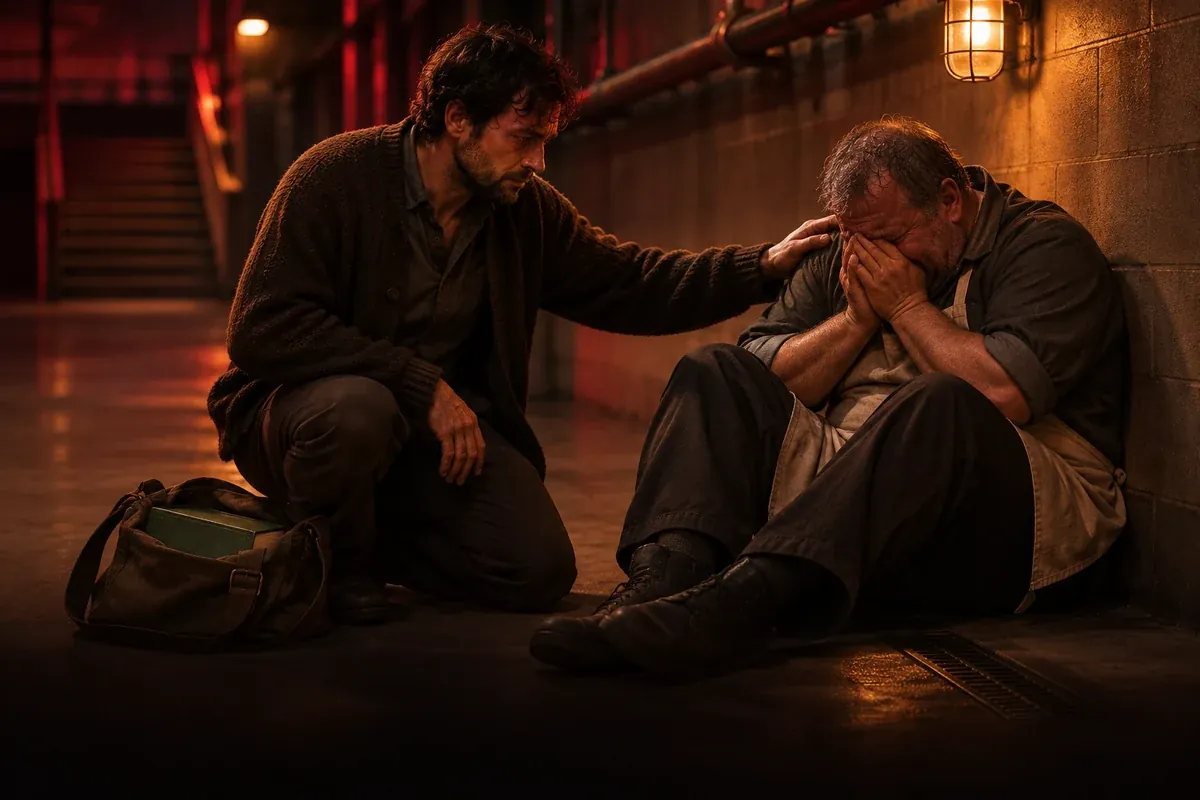
I put my hand to my chin. My legs are shaking. I can’t feel my tongue or anything on it, and for a moment I think the whole thing has simply failed, the way an old pipe fails, and left me standing in a hallway with a stranger. Teddy has slid down the concrete wall to sit on the floor with his hands over his face. He is making a low noise.
I am afraid to touch him. Then I remember that I’ve done this for nine years, that touching is the one thing I do know how to do, and I kneel down in front of him in my good cardigan on the oily concrete and I put my hand on his shoulder, and I leave it there.
“Nine hundred and thirty-six,” says Teddy, into his palms. “She counted them.”
“I think she was proud of you.”
“She was never,” he says, and laughs, and wipes his face with the apron. “She told me that. She was never proud of anything. She said pride was for people who didn’t cook.” He looks up at me. His eyes are red and very clear. “Thank you, Reverend. I don’t know what that was, and I’m not going to ask. Thank you.”
“It wasn’t mine.”
“No,” he says. “It was hers.”
And then the thing happens that Ruth meant by mostly.
It starts at the back of my tongue. A warmth, then a pressure, then a kind of bright startled pain, like a foot waking up. Taste comes back. It does not come back the way it left. It comes back all at once and it is much too large. I taste the concrete corridor.
I taste the fryer oil in the pipes, burnt, and the soap on Teddy’s apron, and the cold iron of the drain. I taste salt. I taste Teddy’s tears on the air the way you taste a coming rain. And under all of it, beyond it, below it, I taste something that has no name in any language I know, a flat, plain, slightly bitter flavor with a rind of lemon on it.
It is a sentence. I realize it a half-second after I have tasted it. It is a sentence that Teddy Farrow has swallowed. It is sitting in him like a stone in a peach, and it tastes of lemon rind and old pennies, and the sentence is, I wish I had asked her to forgive me.
I get to my feet very carefully. I say, “Mr. Farrow, you should call Maya.”
He looks at me with an expression I have seen on very few faces. “How did you know?”
“Lucky guess,” I say, and walk back up the corridor toward the lights.
By the time I reach the stairs, the organ has started.
It is the old-fashioned kind, a real pipe organ somebody bolted into the press box in 1962, and it is wheezing through its pre-stretch fanfare in the slow, sweet, slightly flat way that makes every Lamplighters fan of a certain age tear up.
I come out of the stairwell into the grandstand noise and light, and the taste goes through me like a bell. I can taste the whole stadium. I can taste hot dogs and sweat and spilled beer and the metal rails and the thin sweet burn of cheap sunscreen.
And beyond that, underneath, in a thousand small wet pockets of flavor all through the crowd, I taste the other thing. A man in row nine, who has not said a word to his wife in three days: pennies and ash. A girl with a face full of braces: unripe plum. A grandmother in a wheelchair at the end of row fourteen: a taste like a church. They are all swallowing something.
“Easy, friend,” says a warm voice at my elbow. “Take a breath. It’s a lot the first time.”
Gideon Wray has taken the seat next to mine in row twelve. I do not know how long he has been sitting there. He has his clipboard on his knee and his lanyard tucked into his vest, and his smile is entirely, perfectly kind.
He is a man of forty with the soft pink face of a youth pastor and the eyes of a man who has learned to look as if he is listening. He is humming. Take me out to the ball game. Just six notes, flat, over and over, like a man trying to remember the rest of a song.
“I’m so sorry about Sister Ruth,” he says. “She gave my mother a rosary once. I’ve never forgotten it.” He pats my arm. “You must be exhausted. I’d be happy to find you something cold.”
“No, thank you.”
“It’s the stretch in a minute. Everybody’s going to stand.” He says it as if he is telling me something gently about the weather. He looks past me at the bag on the floor, and I feel his gaze go over it like a hand over a pocket. “Do you mind if I ask what you’ve got there?”
“A scorebook,” I say. “It was Ruth’s.”
“Of course it was.” He nods. “She kept a lovely one. Do you know, I’ve never been able to keep score myself. I always lose track of the innings.” And he laughs, and I taste it.
I taste the laugh. It is the new thing in my mouth, and I cannot stop it. I taste his laugh, and his kind words, and the soft little squeeze of his hand on my sleeve, and it tastes of nothing at all. Not a lie. A lie has a taste. A lie is sharp, like a thumbtack.
This is a plate that has been wiped clean, a bowl with no soup in it, not even a rind, a flat white absence in the middle of the stadium, and for the first time since I picked up a green book at 3:07 this morning I am afraid.
Gideon Wray starts to hum again. The organ swells. All around us in the grandstand, four thousand people get to their feet.
“That’s the stretch,” he says, pleased. “Isn’t it wonderful?”
The seventh-inning stretch at Cinder Field is a ritual so old nobody can say who began it. The organ plays the old song a half-beat slow, the crowd stands, the crowd sings, and somewhere under the singing a few thousand strangers hope for the same thing at the same time. I stand with them. I do not mean to.
I rise because every body in the stadium is rising, and because the roar has a pull like a tide, and I find myself on my feet with my arms at my sides, tasting four thousand swallowed sentences, in the yellow light of the towers, while a man in an usher’s vest hums six flat notes into my ear.
Something moves in the crowd noise. It is the only way I can say it. It is as if every voice in the stadium has been combed in one direction, like grass in a wind. The roar leans. It leans past the first-base line and over the right-field fence and toward a flat brick building with a single lit window on its east side.
I see Gideon’s lips go still. His eyes go distant and mild. And I understand that he is casting something out over four thousand heads and across a parking lot and up two flights of stairs to a bed on the east wing where someone is in the last hour of his life.
I put my hand flat on the bag. It is hot as a stove.
The book moves against my leg. I look down. It has opened itself in the canvas, the cover swung back, and the pages are turning on their own with a dry papery whisper, turning through hundreds of names, a rustle like a flock of birds taking off. It stops near the back.
A new line is forming under 412, in Ruth’s upright hand, but the pen is not in anyone’s fingers. Letter by letter, the ink comes up out of the paper the way a bruise comes up out of skin.
Line 413. Ansel Boyd. Section 112.
The crowd sings. The organ plays slow. I read it with my mouth full of nothing.
8:52 p.m. tonight.