

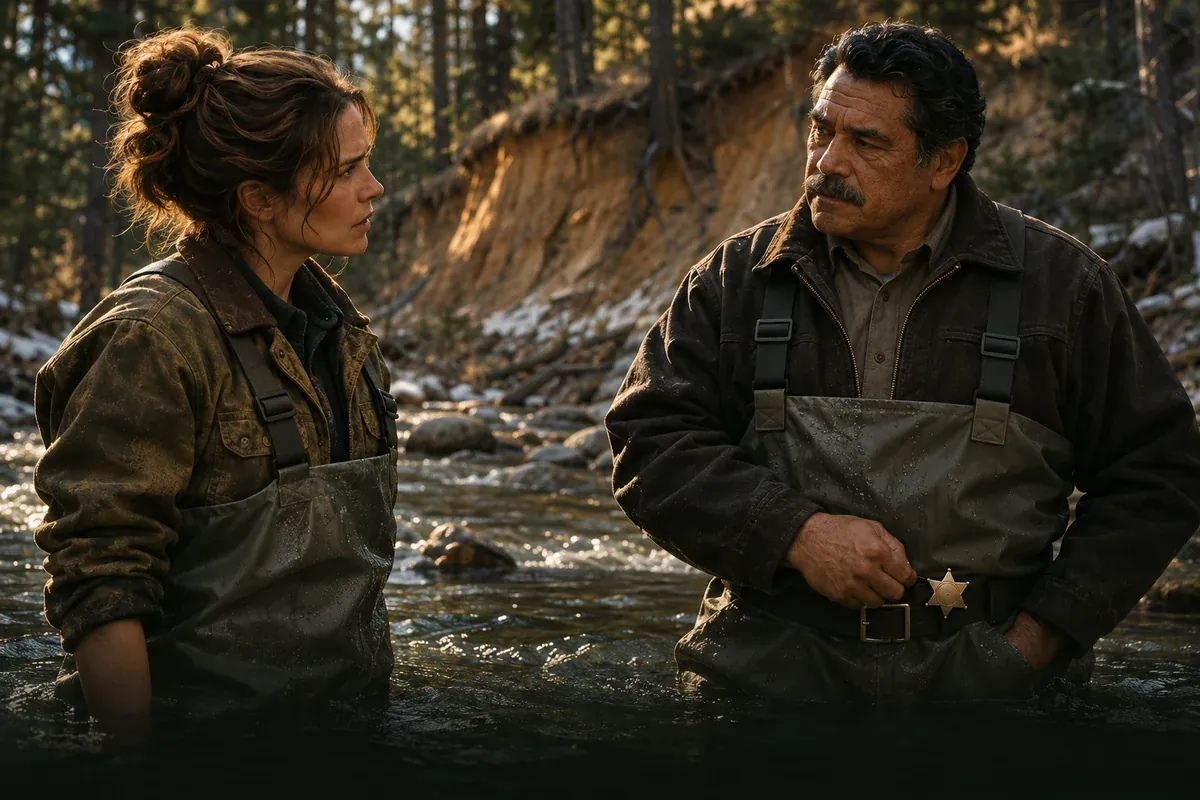
There is a legal phrase that every sheriff in the country knows by heart, and I’d never heard it said aloud until the moment Teddy Ibarra took his badge out of his pocket, looked at it, and clipped it back on his belt.
“Exigent circumstances,” he said. “Doctor, I need you to answer a question for me, and I need you to answer it as a licensed veterinarian. Not as my friend. Not as somebody’s partner. Do you have reason to believe an animal inside that building is in distress?”
The sound had stopped. The bluff stood sunlit and silent above us, with the fence and the cameras and the sealed white door. A single hawk turned in the thin blue sky.
I thought of my oath, and the board, and the complaint on its cream stationery. I thought about what I was about to do to my license by saying one more thing in public. Then I thought about a sound that had cracked at the top and broken, and I said, “Yes. That was a young canid in acute distress. In my professional opinion it requires immediate evaluation.”
“Thank you.” Teddy turned to the bluff. He raised his voice, mild and even and carrying. “Mr. Voss. Based on a licensed veterinarian’s statement of an animal in distress, I am entering that structure under the state’s animal cruelty statute and the doctrine of exigent circumstances. You can open the door, or I can call for a locksmith and a judge. I’d prefer the first.”
“Sheriff.” Voss’s easy manner had gone smooth and hard. “This is private property. You have no warrant.”
“I’ve got a vet and an ear.”
“You’re making a serious mistake. My counsel will have you before the commission by Friday.”
“I expect so.” Teddy waded toward the bank, his boots spreading the current in slow, heavy arcs. “Deputy Ruiz, call dispatch. I want a second unit and a judge’s phone number. Then come up behind me and don’t take your hand off the radio.”
“Yes, sir.”
“Doc. You’re with me. Mr. Hollis, you’re staying in the creek.”
“No,” said Dane.
His voice came out so low and so strange that Teddy stopped. The sheriff turned and looked at him, and I watched the whole of Teddy Ibarra’s twenty-two years of choosing not to see rise to the surface of his face and settle there, quiet and enormous.
He looked at Dane’s eyes. He looked for a count of three. Then he said, in precisely the same level tone, “Mr. Hollis, I’d consider it a personal favor if you’d take a minute and cool off. That’s a lot of upset for a man standing in a creek.”
“Teddy,” Dane said.
“I’ll bring her out,” said the sheriff. “Whatever’s in there. I give you my word as a sworn officer of this county.” He paused. “Take your sister and sit on that rock. Breathe. That’s not an order. That’s a request from somebody who’s known your father a long time.”
For three long seconds nothing moved. Then Dane’s shoulders dropped, an inch, two inches. The gold went out of his eyes in a slow retreat, like a tide going out. He closed them. When he opened them again they were brown and wet and terribly tired. He let go of my arm.
“I’ll hold,” he said.
“I know you will,” said Teddy.
We climbed the bluff on a deer trail, Teddy first, then me, then Deputy Ruiz with her radio crackling, up through the clay and the roots to the edge of the fence. There was a gate there that I hadn’t seen from below, a man-wide gap in the razor wire, and Voss stood at it with his two silent attendants.
He didn’t step aside. He studied Teddy’s face for a long moment, and I saw him run a calculation, quick and cold. A sheriff and a vet and a deputy, three witnesses and a camera. A refusal would look like exactly what it was.
“Of course,” said Garrett Voss. His smile came back, small and pleasant. “We’ve nothing to hide. Please, Sheriff. See for yourself.”
He made a small gesture to one of the men. A keypad chirped, and the white steel door of Field Unit 4 swung open on a breath of cold, clean air.
I’d expected a stable, or a kennel, or a barn. What I walked into was the most immaculate room I’d ever seen. White walls, white floor, a drain in the center, and a long steel counter that ran the length of the room. Along it stood a row of glass-fronted refrigerators, each one humming, each one labeled in clean sans-serif: COHORT A.
COHORT B. COHORT C: CARROW CREEK. Beyond them, at the back, a pair of stainless tanks the size of oil drums, their sides beaded with condensation and their gauges glowing, and a tangle of tubing running from them into the wall. On a monitor above the counter, a graph ticked slowly across a dark screen: pH, temperature, flow. Everything had a little green light.
And along the far wall, under a bank of cold white lights, stood six steel cages in a row. Five were empty and clean. In the sixth, on a thin pad, lay a wolf.
She was small, a pup of perhaps ten or eleven months, all legs and ears, with a coat the color of old ashes and a white blaze on her chest. She lay on her side. Her ribs rose and fell, rapid and shallow.
A line ran from her foreleg to an IV bag on a stand, and a collar of soft gray nylon lay loosely around her neck with a plastic tag attached. As I came closer I saw her eyes, half-open and glassy, and the gums at the corner of her mouth, the color of a winter sky.
“Oh, God,” I said.
“Beagle,” said Teddy, in a voice I would not wish on anyone. He had not raised it. He did not need to. “Garrett. That is a gray wolf.”
“A rescue.” Voss had followed us in and stood a little behind us, hands clasped. “Found injured. We were nursing her back to health under a research permit. It’s all on file.”
“Show me the permit.”
“Our counsel—“
“Show me the permit, Garrett, or I’m going to assume you’ve got a wild gray wolf in a cage in a building with no state wildlife license.” Teddy took one slow step toward the cage. “Doc.”
I was already moving. I knelt at the cage door, and my hands went into the routine I couldn’t have stopped for anything: gloves from my pocket, the latch, the soft murmur I use on all of them. “Hey, sweetheart. Hey, little one. I’m here. I’ve got you.” The door was not locked, which tells you something about what Lysark thought of her chances. I slid my arm in and laid my palm flat against her side.
She was burning up. Her heartbeat was thready and fast, a hundred and ninety, a tiny frantic engine. Her gums were bleached, her tongue was pale, her capillary refill, when I pressed my thumb to the pink, took five full seconds to return. On the inside of her forelimb, under the IV, there was a bruise the size of my hand. And on the cage’s metal card holder, in the same clean sans-serif, was a typed label: SUBJECT 7 (GARNET FALLS). COHORT C. DOSE 3 OF 4. NEXT: 11/04.
I read it twice. Behind me, Deputy Ruiz’s camera was clicking steadily along the counter, and I heard her say under her breath, “Cohort A, Cohort B, Cohort C,” working her way down the refrigerator doors like a woman reading names off a wall. Cohort A’s label carried a state abbreviation I didn’t recognize and a date in March. Cohort B was dated May, and the abbreviation was a different one, in a different part of the country. Cohort C, ours, had been started in July.
Three cohorts. Three places. Somebody had been running this experiment on more than one valley, and had been doing it for most of a year.
Then I read the line above the dosing note, and my hands stopped.
NO TREATMENT. OBSERVE ONLY.
“They’re dosing her,” I said. My voice didn’t sound like mine. “This isn’t a rescue. This is a subject. She’s on the same schedule, and she’s farther along than any of ours.” I looked up at Teddy. His face was gray. “Teddy, she’s dying. She has days. I need to move her now.”
“Doc, I can’t—“
“I’m not asking you to do anything illegal. I’m asking you to seize an animal in acute distress as evidence of a wildlife violation and hand it to a licensed veterinarian for emergency care.” My voice had gone ragged. “That’s your job. Please. Do your job.”
He looked at the label. He looked at the cage. He looked, for a long beat, at Garrett Voss, and Voss did not smile at him.
“Deputy Ruiz,” said Teddy Ibarra. “Photograph everything in this room. Every cabinet, every label, every tank. Start with the refrigerator doors. Mr. Voss, you will remain here with my deputy and not touch a thing.” He turned. “Doctor Mercer, I’m seizing that animal under section 87-6-201 as evidence of the unlawful possession of a protected species. You’ll take custody and treat her at your clinic. I’ll write the chain of custody myself.”
“Sheriff!” Voss’s voice finally rose, sharp and cold and no longer pleasant at all. “You’re in violation of federal research protocols. I’ll have your badge.”
“You can try,” said Teddy, mildly. “Get me a blanket, Doc.”
I wrapped her in my jacket. She weighed less than a good-sized beagle and more than a miracle. Her head lolled against my arm and her ears twitched once, weakly, and I felt a thin, fast breath go in and out against my wrist.
We came out of the building into a bright cold noon. At the gate, Von and Dane stood waiting. They hadn’t sat on any rock. They’d climbed the bluff behind us, silent, and stood at the fence with their hands hanging at their sides, looking at the small gray bundle in my arms.
Von put a hand over her mouth. Dane did not move at all.
“She was in a cage,” I said. “Hooked to an IV. Her label says Garnet Falls.”
“Garnet Falls,” said Dane. It was barely a sound. “That’s Tobias Garrick’s pack. His daughter’s been missing since August.”
Nobody spoke. The wind moved in the lodgepole. I looked down at the pup in my arms, at the ash-gray fur and the blaze of white and the thin, fast, stubborn breath, and in the silence I heard Teddy Ibarra, a few feet away, say very quietly to himself, “All right. All right.”
I looked at him. He was looking at nothing, at the trees. And I understood that Sheriff Teddy Ibarra, who had spent twenty-two years choosing carefully what to see, had just stopped choosing.
Teddy drove. It was his own truck, a dusty gray pickup with a cracked dash and a mule hair or two still clinging to the seat, and he had put the second deputy on the road behind us as an escort and the fire marshal’s cousin on the phone as a witness to every turn.
I sat in the passenger seat with the pup across my lap in my jacket, one hand on her ribs, counting breaths. Jo had gone ahead to open the clinic. Behind us, along the old logging road, came the black shape of Dane’s truck with Von beside him, keeping its distance exactly one hundred yards back.
“I’m going to say something,” said Teddy, after the second switchback, “and I don’t want you to answer it.”
“All right.”
“A while ago, up at the creek, I saw a man’s eyes catch the light.” He kept his own on the road. “It’s a thing I’ve seen a hundred times at night on Route 11. Deer. Coyotes. The occasional bear. You get a flash, gold or green, and it’s gone. It happens with people sometimes when the sun hits right.” He paused. “I decided that’s what it was. I’d like it written down that that’s what I decided.”
I took a long breath. “I’ll put it in the notebook.”
“Good. In pencil.”
“I’ll use ink,” I said. “I don’t want it to wipe off.”
He made a small sound, half a snort. For a quarter mile we rode in silence, with the pup’s breath whispering against my wrist and the sun flickering through the trees. Then he said, quietly, “Whoever she belongs to, they’re going to want her. Tobias Garrick has been calling every sheriff in three counties since the end of August. Says his daughter wandered off on a hike. I didn’t buy it then. I’m not sure I buy it now.”
“It wasn’t a hike.”
“No. I don’t suppose it was.” He glanced at the small gray shape in my lap. “She going to live?”
“I don’t know.” I was honest. It was the only thing I had to give her. “She’s the sickest patient I’ve ever held. Her gums are white. Her blood doesn’t clot. Her heart is hammering and she’s burning up. If I don’t strip that protein out of her plasma in the next day, I’m going to lose her. And I don’t know how.”
“You’ll figure it out.”
“Teddy, I don’t have a dialysis machine. I don’t have a plasma separator. I have a feed store, a microscope and a very good tech.”
“You also,” said Teddy, “have a friend with a mass spectrometer and a mouth like a truck horn. I’d call her.”
I almost laughed. I pulled my phone out with my free hand, thumbed to PRIYA, and put it to my ear, and she picked up on the first ring.
“Tell me you’re alive.”
“I’m alive. I need a protein chemist. Right now.”
“I’ve been one for sixteen years. Go.”
“The tag,” I said. My voice was going, and I steadied it. “The six histidines. The handle you said they forgot to cut. If there’s a handle, can you grab it? In a patient. Out of her blood. While she’s alive.”
There was a pause. Not a long one. I heard, on the other end, something like a chair scraping back.
“Nickel,” said Priya. “Immobilized metal affinity. You run the plasma across a column loaded with nickel and the tag sticks like a key in a lock.” Her voice had gone fast and strange and bright. “It’s how we purify it in the first place. Rowan. If you could get her plasma out of her body, pass it over the resin and put it back in, you’d pull the protein right off her cells.”
“That’s an extracorporeal circuit.”
“It’s plasmapheresis with a nickel filter. It’s insane. It’s never been done.” A beat. “It might work.”
“How soon can you get me resin?”
“I can have a case on a courier by dawn. Eight hundred dollars, maybe. I’ll bill the state and tell them it’s a very expensive hamster.” She was breathing hard. “You’ll need a pump, a centrifuge or a membrane, tubing, anticoagulant, an operating room. Rowan, you’d be building a kidney from a feed store.”
“I’ve built worse,” I said, looking down at the ash-gray ears and the white blaze and the thin, fast, stubborn heart. “I once built a splint from a hockey stick.”
“God help us,” said Priya. “Send me a picture of what you’ve got.”