

Montana has a law that I had never loved until that Thursday. The stream access statute says that anyone may walk the bed of a river or creek below the high-water mark, no matter who owns the banks. A landowner can post No Trespassing signs on both sides and string wire across the current, and the law will still let you wade through, so long as you keep your boots wet and your feet off the grass.
Ranchers hate it. Fly fishermen quote it like scripture. And on that morning, at a quarter to seven, with frost still silvering the willows, it was the only thing standing between Lysark Bio and a very long look at what they were doing to the water.
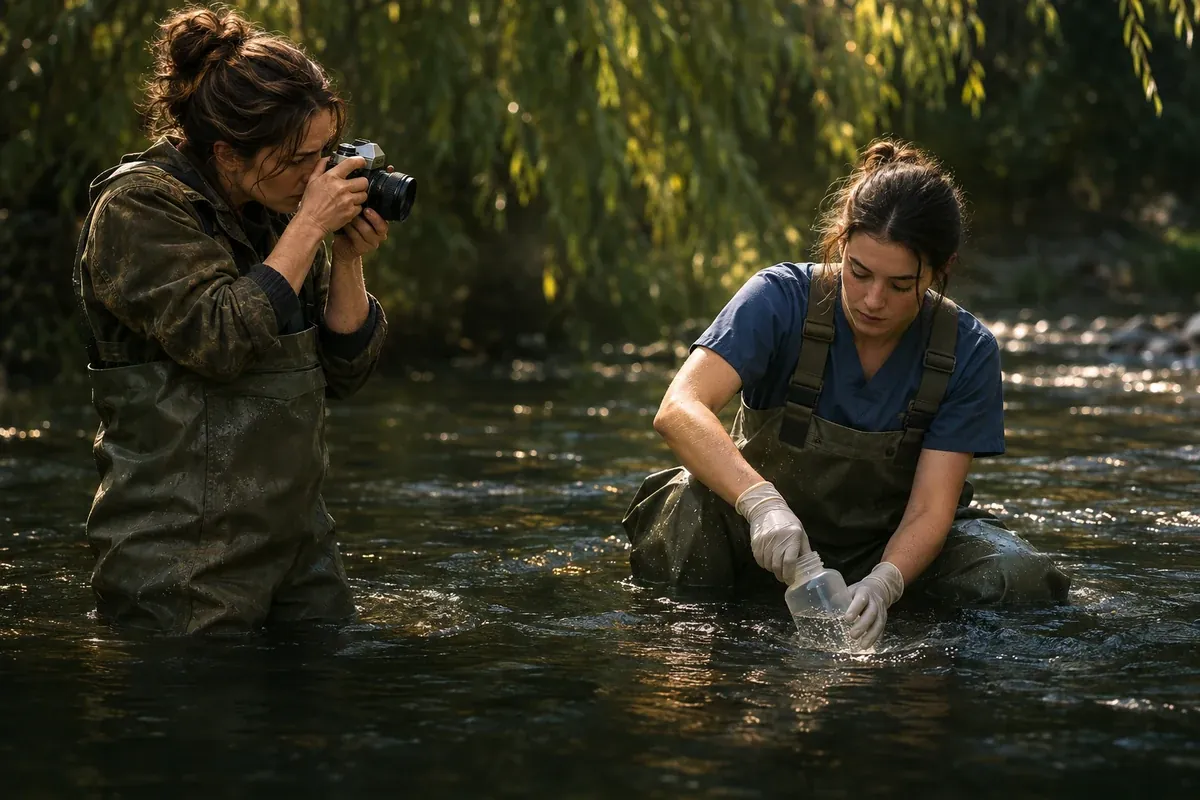
We met at the lower bridge. Five of us, in chest waders and rubber boots, with two coolers, a case of sample bottles, a handheld GPS, and a camera Jo had bought at a pawn shop in Garnet Falls for forty dollars on the theory that nobody could say it had been tampered with.
Teddy Ibarra had come in uniform and then, thinking better of it, had taken off the badge and put it in his pocket, in the way of a man who wants the law with him and not in front of him. He brought a young deputy named Marisol Ruiz, with a clipboard and the unhurried gaze of a woman who has delivered a lot of bad news in this county and taken most of it herself.
Von had come because she would have come if I’d asked her not to. Dane had come because he’d put it in writing. TWO. NEITHER PARTY DECIDES FOR THE OTHER.
“Rules,” I said. I stood on the gravel bar with my notebook in one hand and a bottle in the other.
“We stay in the water. Every step is below the line where the willows start. Teddy, if anyone asks, we’re a licensed veterinarian conducting a water survey in a public stream, escorted by the sheriff’s office. We sample every two hundred yards. We label, we photograph, we log the time and the GPS point. Nobody collects anything from the bank. Nobody touches a fence or a pipe. We look. We write down. We take pictures. If we find what I think we’re going to find, we do not go up to it.”
“Why not?” Von asked.
“Because the minute we step out of the creek, it’s trespass. And the minute it’s trespass, everything we’ve got is fruit of a bad tree.”
“Doc has been reading about the law,” Teddy murmured.
“Doc has been reading about everything for eleven days,” I said. “Doc is going to need a very long nap.”
We went up in single file. The first half mile was easy: gravel and cobble and clear green pools, the water cold enough to make my shins ache through the waders. Dane walked ahead of me, pushing steadily against the current, and every so often he stopped and lifted his head, nostrils flared, listening to something I would never hear.
The first time, I almost asked. Then I remembered the clause and shut my mouth. He caught me looking, and he gave a half-smile, and he said, without turning around, “Nothing yet. I’ll tell you the second I know.”
We took the first sample at the bridge, the second at a long riffle where the creek braided around a boulder, the third in a pool below the mill intake that smelled faintly of cedar. Jo logged each one in her square capitals and photographed each bottle in the water’s edge with its label facing the lens.
Priya had insisted on that, over the phone, with the voice of a woman who had once watched a case collapse on a missing timestamp. “You are not collecting water,” she’d said. “You are collecting a story that has to survive a man in a suit saying you made it up.”
By nine the sun was on the water. The creek had narrowed. The banks steepened into cut walls of crumbling glacial till, and the willows gave way to old lodgepole leaning out over the current like people eavesdropping. We passed the place where the road crossed at the second ford, and the place where the mill’s old intake box squatted in its concrete, and we kept going. Von sang something under her breath, tuneless and soft. Teddy’s deputy hummed along, and then stopped, embarrassed, and Von grinned at her over her shoulder and kept singing.
“What do you smell?” I asked Dane at the next stop, quietly, while Jo capped a bottle. I hadn’t meant to ask. I’d meant to wait for him to offer. But the question had been walking around in my mouth for a mile, and I said it as an offer. “If you want to tell me.”
He stood a long moment, with the water piling against his waders. “I don’t know how to describe it,” he said at last. “It’s not a smell the way you smell coffee. It’s more like a sound in the back of the nose. It’s wrong, the way a note is wrong. Clean. Too clean. Metal and cold, and something underneath that’s almost sweet.” He looked at me. “It’s the same thing Micah said on the ridge. I didn’t understand. I do now.”
“Is it getting stronger?”
“It’s been getting stronger for the last half hour.”
I wrote it down. Time, GPS, observation by D. Hollis, nose. Then, because I’d learned something about how he worked, I added a second line: Do not discount. Jo, reading over my shoulder, nodded gravely.
We stopped at noon on a gravel bar for sandwiches, because Jo had made eight of them and would not be argued out of it. The deputy sat on a log with her boots drying and ate in silence. Von lay flat on her back on the stones, hat over her face, asleep or pretending. Dane had waded off to a quiet pool upstream and was standing in the water with his head tipped back, listening to something.
Teddy lowered himself onto a boulder beside me, grunting. He unwrapped his sandwich and looked at it for a while.
“I’ve been sheriff twenty-two years,” he said. “Elected five times. Did you know that? Unopposed twice.”
“I did not.”
“There are some things in this county I decided a long time ago not to see.” He said it to the sandwich. “A man with a still in a root cellar. A woman whose husband fell off a roof, twice. A family up the Carrow Creek road who go out at night and come back with mud on their boots and no explanations. I figured those weren’t my business. I figured every county has its share of private weather.”
I didn’t say anything. I’d learned from animals that the way to hear a thing is to hold perfectly still.
“I want you to know,” said Teddy, “that I’m not blind. I’m choosing. That’s different. I’m choosing to not see something with my eyes wide open, because I think what I’d find isn’t a crime, it’s a people. And I’m sheriff of all the people.” He took a bite and chewed. “But if that woman in the field jacket is putting something in the water that’s killing them, and it’s illegal, then that’s my business, too. That’s the whole job.”
“Teddy.”
“I’m not asking. I’ll never ask. I’m telling you that when the time comes, I’ll be standing on the right side of the line, and I’d like you to put it in your notebook.” He looked at me then, finally, over the sandwich. His face was brown and creased and very kind. “In pencil, if you like.”
I wrote it down in ink.
The old logging landing came up at one-fifteen.
You come on it from below, at a place where the creek swings hard against the east bank and cuts a deep pool under a bluff. The bank on the left rises thirty feet in a wall of raw clay, and at the top of it, set back from the edge, is a flat shelf of ground the size of a football field where loggers once stacked their timber. We had seen it from the road above on the night of the cage. We had never seen it from below.
There was a fence at the top of the bluff. It was new, galvanized steel, eight feet tall, with a coil of razor wire along the rim. It ran along the whole edge and out of sight in both directions. Every thirty yards there was a small gray post with a camera lens on it, aimed down at the creek.
“Don’t,” said Teddy softly. “Don’t look up. Don’t wave.”
“They know we’re here.”
“They’ve known since the bridge.” He kept walking. “The cameras are cellular. Somebody in a trailer in Garnet Falls is watching us on a monitor and eating a sandwich.” I could hear him smiling, bleakly, behind his mustache. “Take your time. Every minute they watch, they look like they’ve got something to hide.”
I did take my time. I set the notebook on a flat rock, and I did a very careful, very slow sweep of the bank with the pawn-shop camera at full zoom, and what I saw made my stomach turn over.
Below the fence, set into the clay of the bank just above the high-water line, was a stainless steel outfall. It was about the diameter of a coffee can, flanged and bolted to a concrete collar, with a little green status light blinking on its housing. A pipe ran back from it into the hillside and disappeared. At the lip of the outfall, a faint, almost invisible sheen lay on the water. It spread out and thinned and was swept downstream, a pale oily shimmer, so delicate that you would have thought it was sky.
The clean metal smell hit me then. Dane had told me what to expect and still I wasn’t ready. It was nothing I could name. It was a sharp, thin, sterile sweetness, like a hospital hallway in a dream. It came up the back of my throat and sat there.
“There,” Dane said, softly, very softly. His voice had gone odd. His whole body had gone still in a way I’d only seen when something was very wrong. “That’s it. That’s where it comes out.”
“Is it running now?” Von breathed.
“Not now. Not yet.” He lifted his head. “It’s between pulses. We’ve got weeks. The next one’s due, what, the fourth of November?” He looked at me. “It’s eight weeks from the ninth of September.”
“Yes.”
“There’s another sound,” he said. “Under the outfall. Something humming. A pump, or a motor.” His jaw worked. “I can smell something else too. Another animal. Fear. Old fear, and not mine.”
I turned slowly. At the top of the bluff, where the fence turned a corner, a gap had been left in the razor wire, and in the gap stood a long, low, cinder-block building I’d never noticed from the road. It was windowless. It had a white steel door and a keypad and a sign. The sign was too far away to read.
I raised the camera. I zoomed. And I read it aloud, in a voice that did not sound like mine.
“LYSARK BIO. FIELD UNIT 4. AUTHORIZED PERSONNEL ONLY. BIOLOGICAL MATERIALS.”
“Photograph it,” said Teddy. His voice had gone flat. “All of it. The fence, the cameras, the outfall, the building. Time-stamp every frame. Nobody climbs. Nobody talks to anyone who comes down.”
“Nobody’s coming,” said Von.
“Somebody’s always coming,” said Teddy.
The click of the shutter was very loud in the hush. I took forty frames. Jo knelt in the shallows with the sample bottle and a plastic ruler, labeling, filling, capping, a girl at a funeral. Deputy Ruiz stood beside her with her hand resting on her belt, not on the holster, just beside it, very calm. I saw the camera lenses along the top of the fence turn, one after another, with a little whir like cicadas, to follow us.
“Rowan,” Dane said. He had moved closer to me without my noticing, so close that I could feel the heat coming off him through two layers of rubber. He was looking not at the building but at the hillside above it, where the trees began. “We’ve got company.”
I looked.
Two men had come out of the lodgepole at the edge of the shelf. They wore dark green jackets with no logo and carried nothing in their hands. They stood very still on the lip of the bluff, looking down at us, in the manner of men who have been told to watch and have been told, very precisely, not to do anything else.
And behind them, coming along the fence line at a leisurely walk, hands in the pockets of his clean indoor jacket and his sunglasses pushed up into his hair, came Garrett Voss.
He raised one hand in a friendly, easy wave. He called down, in a voice that carried perfectly across the water.
“Morning, Doc! Beautiful day for a swim.”
“Garrett,” said Teddy, mildly, and stepped up beside me with his hands loose at his sides. “Didn’t expect to see you out this far.”
“I’m everywhere, Sheriff. It’s the job.” Voss came to the lip of the bluff and stood there, easy and relaxed, ten feet above our heads. His two companions fanned out behind him, not close, not threatening, just present. “I saw you on the cameras. I thought, well, that’s neighborly. Let me go say hello. Private property, you understand, but I’m sure it’s an honest mistake.”
“We’re in the creek,” I said. “Below the high-water line. Montana code, section 23-2-301.”
“Of course you are. I’m not suggesting otherwise.” His smile didn’t move. “Though I’d note that my cameras recorded you zooming in on a secured facility with a long lens for several minutes. There’s a privacy statute for that. I’d hate for it to become a conversation. Why don’t we all just agree to be friends?”
“Friends don’t fence the creek,” said Von, from the gravel, not loudly. She’d sat up and pushed her hat back, and her face had no jokes in it at all.
“Ms. Hollis. Good to see you recovered.” Voss turned the sunglasses in his fingers. “I heard you’d been unwell. Nosebleeds, wasn’t it? Dry air does that. So many things this time of year.” He looked at Dane. It was a very quick look, flat and measuring, and I felt the hair stand up on my arms. “Mr. Hollis. You’ve been very quiet.”
Dane said nothing. He stood in the current with the water piling up against his thighs and his big hands open at his sides, and I became aware of an odd stillness coming off him, like the air before lightning. He was breathing through his nose. A muscle jumped in his jaw. Under the heavy rubber of the waders his shoulders seemed to have settled lower, wider, and I thought, very clearly: he’s holding it. He is holding something back with everything he has.
“Dane,” I said, very softly. “Partner. Say it.”
“I’m holding,” he said, through his teeth.
“Good. Keep holding.”
“Is something wrong?” Voss asked pleasantly.
“The outfall,” said Teddy, as if nobody had spoken. “On the bank, below your fence. Stainless pipe, status light, about so wide.” He held up his hands. “Garrett, I’m going to need the discharge permit for that.”
“It’s a research monitoring station, Sheriff. Exempt under the federal pilot program.”
“Is it?” said Teddy. “I’ll need the paperwork on that too. And I’ll need to know what it monitors. And I’d like the state water people to come take a look. They’ll be here Monday.”
“By all means.” Voss spread his hands with a perfect, generous ease. “Our counsel will be delighted to supply every document. We’ve nothing to hide. It’s a very boring facility.”
From inside the cinder-block building, thirty yards behind him, came a sound.
It was high and thin and cracked. It rose and wavered and broke, a small ragged wail that carried down the bluff and out across the water like a nail drawn along glass. It lasted perhaps two seconds. Then it stopped, abruptly, as if a hand had closed over it.
Nobody spoke. The creek ran. Deputy Ruiz had turned her head, very slowly, toward the building. Jo, kneeling in the shallows, had gone entirely still, a sample bottle in each hand.
For the first time since I’d met him, Garrett Voss’s smile came undone. It was a very small thing, a stutter at one corner of the mouth, there and gone in a quarter-second. But I saw it. And Teddy, beside me, saw it too.
“Garrett,” said the sheriff, in the most gentle voice I had ever heard him use. “What’s in the building?”
“Lab animals,” said Voss. “Beagles. Regulated. Quite humanely kept.”
“Beagles don’t sound like that.”
“Sheriff, I really must object—“
“Rowan.” It was Dane. His voice was strange, thick and low, hardly a voice at all, a sound pushed through a closed throat. His fingers had closed around my arm above the elbow, hard enough to bruise, and I could feel them trembling. I turned and looked up into his face, and what I saw there made me forget to be afraid of anything else.
His eyes had gone to amber. Not all the way. Only a ring of it, a hot, bright gold around the pupils, like a coin held up to a lamp.
“That’s not a beagle,” Dane said. “That’s a wolf. And it’s a child.”